Kirjojen hintavertailu. Mukana 11 244 527 kirjaa ja 12 kauppaa.

Kirjahaku

Etsi kirjoja tekijän nimen, kirjan nimen tai ISBN:n perusteella.

1000 tulosta hakusanalla Thomas Atkinson

The Collected Letters of Thomas Hardy: Volume 7: 1926-1927
The opening section of this seventh and final volume of the definitive edition of Thomas Hardy's letters covers the period from January 1926 to December 1927: his last letter, to Edmund Gosse, was written on Christmas Day 1927 and he died seventeen days later, on 11 January 1928. Although few of his long-standing personal correspondences were actively kept up during these last two years of his life, Hardy maintained (especially when writing to Sir Frederick Macmillan) a lively and practical interest in all aspects of his work and career; he also responded, usually with a courteous refusal, to the many requests and enquiries that his fame inevitably attracted. The second section is devoted to letters which became available too late for publication in their correct chronological sequence in earlier volumes of the edition; those now added date mostly from the nineteenth century, and include a series of letters to officials of the Duchy of Cornwall about the purchase of land on which Max Gate was built, as well as numerous individual letters of considerable interest and importance. This volume contains more than 350 letters, the great majority of them previously unpublished, which are supplemented, as before, by scrupulous annotation and extensive cross-referencing; by a chronology covering the whole of Hardy's career; and by an index of recipients of the letters included. As the concluding volume, however, it also incorporates an extensive General Index covering the texts and annotations of the entire edition.
The Letters of Thomas Love Peacock: Volume 1

The Letters of Thomas Love Peacock: Volume 1

Thomas Love Peacock

Clarendon Press
2001
sidottu
Thomas Love Peacock (1785-1866) was a lifelong and assiduous letter-writer at a time when the familiar letter was often virtually an art-form in itself. He had a wide circle of correspondents, and was a close friend of Shelley, whom he assisted over both personal and business affairs after Shelley's abandonment of his wife Harriet and departure to Italy. Friend also of many Radicals of the early nineteenth century, his letters often display the satiric wit of his published prose works such as Headlong Hall and Crotchet Castle. In the later part of his life he rose to high position in the East India Company's service, succeeding James Mill, under whom he had worked, as Examiner. This is the first time his extensive correspondence has been gathered together and given scholarly annotation: the two-volume edition will be invaluable both to students of Romantic literature and to historians of the period.
The Complete Poetical Works of Thomas Hardy: Volume IV: The Dynasts, Parts First and Second
Volumes IV and V of the Complete Poetical Works of Thomas Hardy, which complete the edition, contain all of his dramatic writing in verse. Hardy was interested in dramatic verse all his adult life; before he wrote his first novel he considered writing plays in blank verse, and during the thirty years of his novel-writing career he entered in his notebooks many schemes for a vast poetic drama of England's wars with Napoleon. But is was not until after he had turned from fiction to poetry, in the 1890s, that he actually began to work on a poetic drama. The Dynasts was written between 1902 and 1907; The Famous Tragedy of the Queen of Cornwall was begun in 1916 and completed in 1923. In addition to the two major dramas this volume includes Hardy's versions of two folk-pieces: the Mummers' Play of 'Saint George' and the rustic operetta O'Jan, O'Jan, O'Jan' (here published for the first time). Textual annotations, together with a full account of the rough draft of Part third of The Dynasts, make it possible for the reader to follow the history of the composition of Hardy's epic drama in unusual detail. Explanatory notes to each of the dramatic works describe its composition and publication, and provide supporting material from Hardy's letters and notebooks. Appendices add further information on the production and performance of these works.
The Complete Poetical Works of Thomas Hardy: Volume V: The Dynasts, Part Third; The Famous Tragedy of the Queen of Cornwall; The Play of 'Saint George'; 'O Jan, O Jan, O Jan'
Volumes IV and V of the Complete Poetical Works of Thomas Hardy, which complete the edition, contain all of his dramatic writing in verse. Hardy was Hardy was interested in dramatic verse all his adult life; before he wrote his first novel he considered writing plays in blank verse, and during the thirty years of his novel-writing career he entered in his notebooks many schemes for a vast poetic drama of England's wars with Napoleon. But it was not until after he had turned from fiction to poetry, in the 1890s, that he actually began to work on a poetic drama. The Dynasts was written between 1902 and 1907; the Famous Tragedy of the Queen of Cornwall was began in 1916 and completed in 1923. In addition to the two major dramas this volume includes Hardy's versions of two folk-pieces: the Mummers'Play of 'Saint George'and the rustic operetta O'Jan. O'Jan, O'Jan'(here published for the first time). Textual annotations, together with a full account of the rough draft of Part Third of The Dynasts, make it possible for the reader to follow the history of the composition of Hardy's epic drama in unusual detail. Explantory notes to each of the dramatic works describe its composition and publication, and provide supporting material from Hardy's letters and notebooks. Appendices add further information on the production and performance of these works.
The Works of Thomas Southerne: Volume II

The Works of Thomas Southerne: Volume II

Thomas Southerne

Clarendon Press
1988
sidottu
Southerne is one of the most important dramatists of the Restoration theatre, but until now there has been no modern edition of his works. The text is based on an exhaustive study of the earliest editions, and the introduction contains the first biography of Southerne to be based on the surviving documentary records.
Thomas Nashe in Context

Thomas Nashe in Context

Lorna Hutson

Clarendon Press
1989
sidottu
Challenging the tendency to disparage Nashe's writing as the product of an eccentric sensibility and to explain his texts in journalistic terms more appropriate to modern commercial publishing, this work provides an entirely new interpretation of the economic context of sixteenth-century literature. Lorna Hutson reveals hitherto overlooked links between humanist approaches to the literary text and the transformation of the English economy through humanist-inspired policies of ethical and social reform; from this context, Nashe's textual prodigality emerges as an assault upon the contemporary impoverishment of literary activity caused by the political over-valuing of the printed word. Generic precedents turn out to be festive; each of Nashe's apparently unstructured pamphlets derives shaping energy from traditions of popular-festive mockery. The pamphlets bring an older conception of seasonal prosperity into subversive dialogue with the newer discourse of provident individualism. For Nashe, stylistic experiment is shown to mean more than a choice of style; it is, rather, the expression of an intricate, socially engaged imagination.
Thomas Mann

Thomas Mann

T. J. Reed

Clarendon Press
1996
nidottu
T.J. Reed's study has long established itself as the standard work in English on Thomas mann, and offers as comprehensive a view of Mann's fiction and thought as is available in any language. It is based on a coherent close reading of Mann's oeuvre, literary and political, and also on manuscripts and sources, and was part of the first phase of literary scholarship that opened up the resources of the Zurich Thomas Mann Archive. Further documents that have appeared since then - Mann's diaries, notebooks, and other correspondences - have not fundamentally altered the individual interpretations or the overall picture the study offers, and in some respects have emphatically confirmed them. A further chapter added to this edition covers the new documentation, gives a vigorous account of the main curents in Mann scholarship and criticism over the last two decades suggesting how we should now see the writer, the man, and the political figure, and above all the complex relationship between the three.
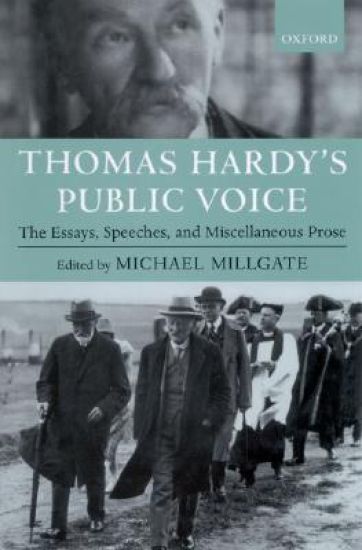
Thomas Hardy's Public Voice

Thomas Hardy's Public Voice

Thomas Hardy

Clarendon Press
2001
sidottu
Thomas Hardy has generally been viewed as an intensely private figure, shy of publicity and even of people, self-isolated in his Dorsetshire home, and much more cautious and conservative in his personal outlook than might be expected of the author of Tess of the D'Ubervilles and Jude the Obscure. What the present volume reveals is that Hardy's public utterances, addressed to a wide range of literary, social, and political issues, were far more numerous and various than has previously been imagined. His essays, speeches, and other acknowledged pieces, both formal and informal, are here fully described, edited, and annotated, together with the letters he wrote to newspapers and the many unsigned items, from obituaries to clandestine contributions to literary gossip-columns, that have now been securely or tentatively identified. Also described, although not necessarily reproduced, are his designs for tombstones and memorials, and some of the more striking instances of his lending his (immensely famous) name to causes and organizations of which he approved and to public letters initiated by others. The edition as a whole is thus a major work of textual scholarship and a rich source of fresh and often surprising information about a little understood aspect of Hardy's life and work.
The Letters of Thomas Love Peacock: Volume 2

The Letters of Thomas Love Peacock: Volume 2

Thomas Love Peacock

Clarendon Press
2001
sidottu
Thomas Love Peacock (1785-1866) was a lifelong and assiduous letter-writer at a time when the familiar letter was often virtually an art-form in itself. He had a wide circle of correspondents, and was a close friend of Shelley, whom he assisted over both personal and business affairs after Shelley's abandonment of his wife Harriet and departure to Italy. Friend also of many Radicals of the early nineteenth century, his letters often display the satiric wit of his published prose works such as Headlong Hall and Crotchet Castle. In the later part of his life he rose to high position in the East India Company's service, succeeding James Mill, under whom he had worked, as Examiner. This is the first time his extensive correspondence has been gathered together and given scholarly annotation: the two-volume edition will be invaluable both to students of Romantic literature and to historians of the period.
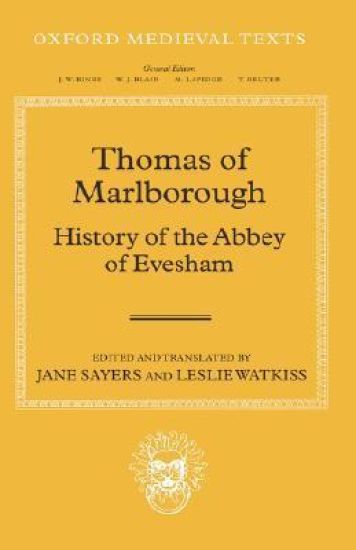
Thomas of Marlborough: History of the Abbey of Evesham
The Evesham History is one of the last important thirteenth-century texts to be translated. This is also the first completely new edition of the Latin since that of 1863. The author, Thomas of Marlborough, was an educated and much travelled man and his work was written not so much in terms of a chronicle but as a history of the lawsuit between the monastery at Evesham and the Bishop of Worcester over the Bishop's right to visit or inspect the community. The case began in England, but was finally taken to Rome and battled out with much legal argument before Pope Innocent III's curia. Much of the History is an eye-witness account. It shows the development of canon law at this period and illustrates aspects of England's relationship with the papacy during King John's reign, including the period of the Interdict. It is valuable too for the light it sheds into the mind of its author, a Benedictine monk, who had pursued a career at Oxford before entering the community. It tells us much about institutional pride and of the use of earlier archives to help the case. In telling the story of the community of Evesham from its foundation by St Ecgwine in the eighth century, Thomas incorporated the work of earlier Evesham historians including the twelfth-century Prior Dominic who was responsible for the Life and Miracles of St Ecgwine. Marlborough also produced a most vivid and personal account of the tyranny of the scandalous Abbot Norreis and of the sufferings of the convent. He went on to recount the return of law and order to the community at Evesham, and the election of a new abbot with whom he attended the Fourth Lateran Council. The edition concludes with the death of Thomas as abbot in 1236. The History provides a very pertinent example of the importance of the past in the interpretation of the present. Building on the past, Thomas exploited the evidence at his disposal in order to maintain and improve the rights that were won in the lawsuit. Few other chronicles or histories provide such an intense, inside view of a community, and are so frank.