Reprint of the fifth edition, the final authorial edition of Cooley's most important work. It went through six editions by 1890 and was cited more often that any other legal text in the late nineteenth century. This classic legal commentary on the Constitution examines the construction of state constitutions and the enactment of laws and "ranks with Story among the foremost commentators on the Constitution." Walker, Oxford Companion to Law 288. Originally published: Boston: Little, Brown and Co., 1883.
A true story of challenge and perseverance, this book details a family's journey through a traumatic life changing event and the inspirational resilience of a young woman fighting for her life. Our hope is that this story provides inspiration for anyone facing challenges in life, to keep fighting and to realize that although the journey may be long and arduous, the treasures that are waiting for you at the end, can be more amazing than you can ever imagine. Christine Wonica was unexpectedly diagnosed with leukemia in 2002, just seven short months after her daughter was born. The 27 year old's diagnosis kicked off an inspirational journey of survival through medical treatments, relapse, a bone marrow transplant, and the long road to recovery. The book is more than just a timeline of a patient's recovery. It's a story of never giving up and finding the strength to "stay the course" even when the odds are stacked against you. It's the story of how the selfless act of a total stranger can be lifesaving. Life does not always go as planned, but sometimes, the obstacles that seem impossible to overcome can be conquered on the wings of hope and heroes. Over the last 10 years, Christine's story has been provided to a number of blood cancer patients and their families as a guide to what may be experienced during a bone marrow transplant and post-transplant recovery. Our hope is that Christine's story may continue to offer patients, families, friends, and caregivers inspiration as they begin their own unexpected life journeys. A portion of all proceeds will go towards supporting the Leukemia and Lymphoma Society's continued fight against leukemia, lymphoma, and other blood cancers.
The Energetic Materials Encyclopedia is a compendium of pure energetic materials (i.e., not formulations) which summarizes the most important parameters of these compounds. The impact, friction and electrostatic discharge (ESD) sensitivity parameters are reported. Thermal parameters such as the melting points and decomposition temperatures are also given together with the thermodynamic enthalpies of formation. The density values that govern the detonation performance are given for the theoretical maximum density (TMD) and, where appropriate, also for lower densities. The most important performance parameters such as the detonation pressure, the detonation velocity as well as the temperature of explosion and the heat of explosion are also stated. Wherever possible experimental values are given together with calculated parameters. If multiple values for one property were available from the literature, these are also stated, e.g. 20 different detonation velocities for RDX. For all literature values, the original references have been included. This revised and updated edition of the Energetic Materials Encyclopedia will be of interest to professionals, advanced students and educators in chemistry, materials science, engineering and military technology. All data have been updated and additional compounds not listed in the first edition have been included.
This well-illustrated book, by two established historians of school mathematics, documents Thomas Jefferson’s quest, after 1775, to introduce a form of decimal currency to the fledgling United States of America. The book describes a remarkable study showing how the United States’ decision to adopt a fully decimalized, carefully conceived national currency ultimately had a profound effect on U.S. school mathematics curricula.The book shows, by analyzing a large set of arithmetic textbooks and an even larger set of handwritten cyphering books, that although most eighteenth- and nineteenth-century authors of arithmetic textbooks included sections on vulgar and decimal fractions, most school students who prepared cyphering books did not study either vulgar or decimal fractions. In other words, author-intended school arithmetic curricula were not matched by teacher-implemented school arithmetic curricula. Amazingly, that state of affairs continued even after the U.S. Mint began minting dollars, cents and dimes in the 1790s. In U.S. schools between 1775 and 1810 it was often the case that Federal money was studied but decimal fractions were not. That gradually changed during the first century of the formal existence of the United States of America. By contrast, Chapter 6 reports a comparative analysis of data showing that in Great Britain only a minority of eighteenth- and nineteenth-century school students studied decimal fractions. Clements and Ellerton argue that Jefferson’s success in establishing a system of decimalized Federal money had educationally significant effects on implemented school arithmetic curricula in the United States of America.The lens through which Clements and Ellerton have analyzed their large data sets has been the lag-time theoretical position which they have developed. That theory posits that the time between when an important mathematical “discovery” is made (or a concept is“created”) and when that discovery (or concept) becomes an important part of school mathematics is dependent on mathematical, social, political and economic factors. Thus, lag time varies from region to region, and from nation to nation.Clements and Ellerton are the first to identify the years after 1775 as the dawn of a new day in U.S. school mathematics—traditionally, historians have argued that nothing in U.S. school mathematics was worthy of serious study until the 1820s. This book emphasizes the importance of the acceptance of decimal currency so far as school mathematics is concerned. It also draws attention to the consequences for school mathematics of the conscious decision of the U.S. Congress not to proceed with Thomas Jefferson’s grand scheme for a system of decimalized weights and measures.
This well-illustrated book, by two established historians of school mathematics, documents Thomas Jefferson’s quest, after 1775, to introduce a form of decimal currency to the fledgling United States of America. The book describes a remarkable study showing how the United States’ decision to adopt a fully decimalized, carefully conceived national currency ultimately had a profound effect on U.S. school mathematics curricula.The book shows, by analyzing a large set of arithmetic textbooks and an even larger set of handwritten cyphering books, that although most eighteenth- and nineteenth-century authors of arithmetic textbooks included sections on vulgar and decimal fractions, most school students who prepared cyphering books did not study either vulgar or decimal fractions. In other words, author-intended school arithmetic curricula were not matched by teacher-implemented school arithmetic curricula. Amazingly, that state of affairs continued even after the U.S. Mint began minting dollars, cents and dimes in the 1790s. In U.S. schools between 1775 and 1810 it was often the case that Federal money was studied but decimal fractions were not. That gradually changed during the first century of the formal existence of the United States of America. By contrast, Chapter 6 reports a comparative analysis of data showing that in Great Britain only a minority of eighteenth- and nineteenth-century school students studied decimal fractions. Clements and Ellerton argue that Jefferson’s success in establishing a system of decimalized Federal money had educationally significant effects on implemented school arithmetic curricula in the United States of America.The lens through which Clements and Ellerton have analyzed their large data sets has been the lag-time theoretical position which they have developed. That theory posits that the time between when an important mathematical “discovery” is made (or a concept is“created”) and when that discovery (or concept) becomes an important part of school mathematics is dependent on mathematical, social, political and economic factors. Thus, lag time varies from region to region, and from nation to nation.Clements and Ellerton are the first to identify the years after 1775 as the dawn of a new day in U.S. school mathematics—traditionally, historians have argued that nothing in U.S. school mathematics was worthy of serious study until the 1820s. This book emphasizes the importance of the acceptance of decimal currency so far as school mathematics is concerned. It also draws attention to the consequences for school mathematics of the conscious decision of the U.S. Congress not to proceed with Thomas Jefferson’s grand scheme for a system of decimalized weights and measures.
Reprint of the original, first published in 1872. The publishing house Anatiposi publishes historical books as reprints. Due to their age, these books may have missing pages or inferior quality. Our aim is to preserve these books and make them available to the public so that they do not get lost.
Reprint of the original, first published in 1872. The publishing house Anatiposi publishes historical books as reprints. Due to their age, these books may have missing pages or inferior quality. Our aim is to preserve these books and make them available to the public so that they do not get lost.
This book has been considered by academicians and scholars of great significance and value to literature. This forms a part of the knowledge base for future generations. So that the book is never forgotten we have represented this book in a print format as the same form as it was originally first published. Hence any marks or annotations seen are left intentionally to preserve its true nature.
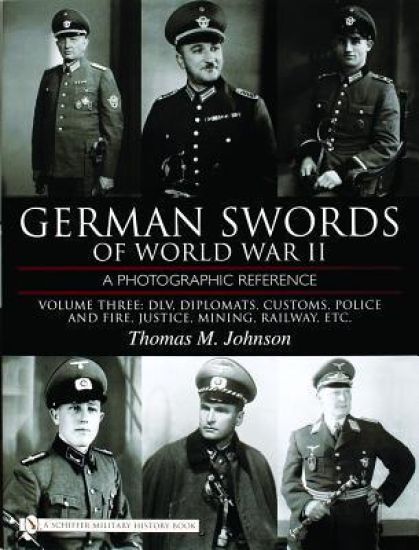
This three volume set on World War II German swords by LTC (Ret.) Thomas M. Johnson, a leading collector and authoritative researcher, is a follow-up to his successful and highly acclaimed four volume series on World War II German daggers by Schiffer Publishing (1995). Johnson is the author of some twenty-six reference books on the subject of German edged weaponry. This sword series has been designed to aid not only the beginning collector, but also the seasoned advanced collector and specialist. These volumes are the result of many years of arduous research conducted on both sides of the Atlantic, and are a scholarly study that is more than a perfunctory annotation and illustration of the known basis patterns. Also, the series is a study of a culture and the crafts that actually produced the blades, as well as being a manual in the art of collecting them. The embracing scope is both educational and recreational, and adds a whole new dimension to this popular collecting subject as a whole. Within these books one finds the historical background, the manufacturing techniques, constructional information, the actual basic patterns, variations and rarities, and a whole host of salient facts of absorbing interest.
This autobiographical book relates how God revealed Himself to the author when he was a small boy living in Windsor, Ontario, Canada.Through a series of family challenges, including a world war, a debilitating disease, a tornado, an automobile accident and a lapse in family loyalty, the author came to know who God is and what He wanted to do in this boy's life.This book is rich in description of life growing up in 1940's Canada and America. An easy read that will broaden the reader's understanding of a different time and place, but the questions and the heart that stays the same no matter the time or place.
An exploration of the cutting-edge technology that will enable us to confront the realities of climate change. For decades scientists and environmentalists have sounded the alarm about the effects of global warming. We are now past the tipping point. As floods, storms, and extreme temperatures become our daily reality, "Reduce, Reuse, Recycle" efforts aren't enough anymore. In Hacking Planet Earth, New York Times bestselling author Thomas Kostigen takes readers to the frontlines of geoengineering projects that scientists, entrepreneurs, engineers, and other visionaries around the world are developing to solve the problems associated with climate change. From giant parasols hovering above the Earth to shield us from an unforgiving sun, to lasers shooting up into clouds to coax out much-needed water, Kostigen introduces readers to this inspiring work and the people who are spearheading it. These futurist, far- thinking, world-changing ideas will save us, and Hacking Planet Earth offers readers their new vision for the future.