Kirjojen hintavertailu. Mukana 11 342 296 kirjaa ja 12 kauppaa.

Kirjahaku

Etsi kirjoja tekijän nimen, kirjan nimen tai ISBN:n perusteella.

1000 tulosta hakusanalla Vector Hasting

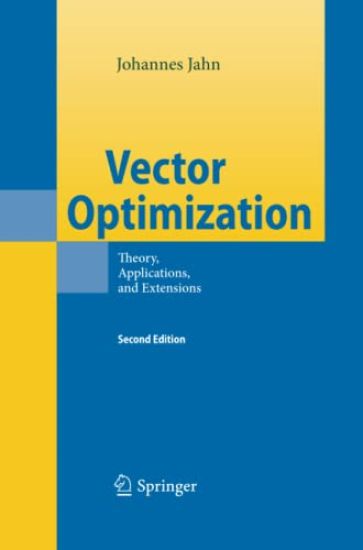
Vector Optimization

Vector Optimization

Johannes Jahn

Springer-Verlag Berlin and Heidelberg GmbH Co. K
2014
nidottu
Fundamentals and important results of vector optimization in a general setting are presented in this book. The theory developed includes scalarization, existence theorems, a generalized Lagrange multiplier rule and duality results. Applications to vector approximation, cooperative game theory and multiobjective optimization are described. The theory is extended to set optimization with particular emphasis on contingent epiderivatives, subgradients and optimality conditions. Background material of convex analysis being necessary is concisely summarized at the beginning.This second edition contains new parts on the adaptive Eichfelder-Polak method, a concrete application to magnetic resonance systems in medical engineering and additional remarks on the contribution of F.Y. Edgeworth and V. Pareto. The bibliography is updated and includes more recent important publications.
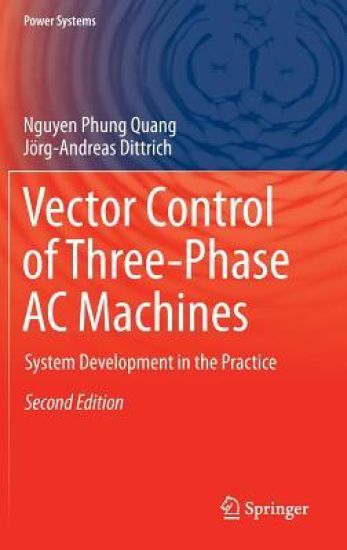
Vector Control of Three-Phase AC Machines

Vector Control of Three-Phase AC Machines

Nguyen Phung Quang; Jörg-Andreas Dittrich

Springer-Verlag Berlin and Heidelberg GmbH Co. K
2015
sidottu
This book addresses the vector control of three-phase AC machines, in particular induction motors with squirrel-cage rotors (IM), permanent magnet synchronous motors (PMSM) and doubly-fed induction machines (DFIM), from a practical design and development perspective. The main focus is on the application of IM and PMSM in electrical drive systems, where field-orientated control has been successfully established in practice. It also discusses the use of grid-voltage oriented control of DFIMs in wind power plants. This second, enlarged edition includes new insights into flatness-based nonlinear control of IM, PMSM and DFIM. The book is useful for practitioners as well as development engineers and designers in the area of electrical drives and wind-power technology. It is a valuable resource for researchers and students.
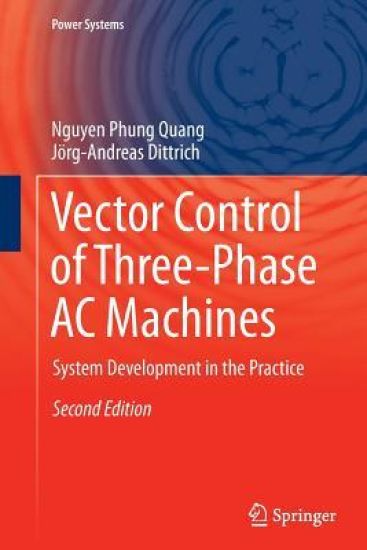
Vector Control of Three-Phase AC Machines

Vector Control of Three-Phase AC Machines

Nguyen Phung Quang; Jörg-Andreas Dittrich

Springer-Verlag Berlin and Heidelberg GmbH Co. K
2016
nidottu
This book addresses the vector control of three-phase AC machines, in particular induction motors with squirrel-cage rotors (IM), permanent magnet synchronous motors (PMSM) and doubly-fed induction machines (DFIM), from a practical design and development perspective. The main focus is on the application of IM and PMSM in electrical drive systems, where field-orientated control has been successfully established in practice. It also discusses the use of grid-voltage oriented control of DFIMs in wind power plants. This second, enlarged edition includes new insights into flatness-based nonlinear control of IM, PMSM and DFIM. The book is useful for practitioners as well as development engineers and designers in the area of electrical drives and wind-power technology. It is a valuable resource for researchers and students.
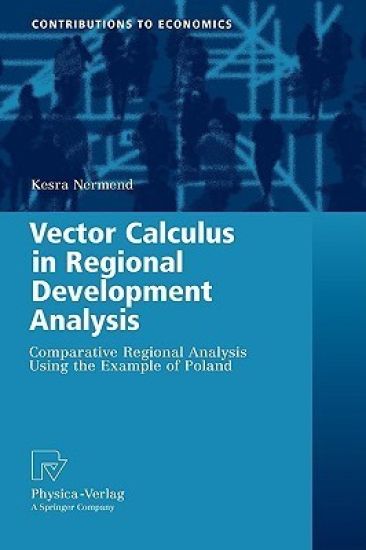
Vector Calculus in Regional Development Analysis

Vector Calculus in Regional Development Analysis

Kesra Nermend

Physica-Verlag GmbH Co
2009
sidottu
Methods used for regional development analysis are employed mainly to make forecasts and comparisons. Forecasting models of various types (e.g. econometric models) are usually used for forecasting. Recently, vector-autoregressive models (VAR) have become popular. These models were proposed by Sims in 1980. On the contrary, taxonomic methods (that are in the center of attention as far as the present publication is concerned) are most often employed to make comparisons. Linear ordering methods, including standard methods, are the most popular among ta- nomic methods. They are based on different distance and similarity measures, which leads to the fact that they do not always provide reliable information. When, for example, one construes the standard for a base year and then compares it with data for other years, it may turn out that the measure determined will have worse values than the standard for a real object (region, micro region) although this object is better from the standard. Hence, one must look for new methods employed in regional development analysis or improve hitherto existing ones in such a way so that information obtained re?ects the reality to a larger extent. The main aim of the present publication is to work out methodological basis for regional development analysis based on vector calculus together with assumptions about computer system supporting the implementation of the method suggested.
Vector Calculus in Regional Development Analysis

Vector Calculus in Regional Development Analysis

Kesra Nermend

Physica-Verlag GmbH Co
2010
nidottu
Methods used for regional development analysis are employed mainly to make forecasts and comparisons. Forecasting models of various types (e.g. econometric models) are usually used for forecasting. Recently, vector-autoregressive models (VAR) have become popular. These models were proposed by Sims in 1980. On the contrary, taxonomic methods (that are in the center of attention as far as the present publication is concerned) are most often employed to make comparisons. Linear ordering methods, including standard methods, are the most popular among ta- nomic methods. They are based on different distance and similarity measures, which leads to the fact that they do not always provide reliable information. When, for example, one construes the standard for a base year and then compares it with data for other years, it may turn out that the measure determined will have worse values than the standard for a real object (region, micro region) although this object is better from the standard. Hence, one must look for new methods employed in regional development analysis or improve hitherto existing ones in such a way so that information obtained re?ects the reality to a larger extent. The main aim of the present publication is to work out methodological basis for regional development analysis based on vector calculus together with assumptions about computer system supporting the implementation of the method suggested.
Vector Measures, Integration and Integral Representation Theory

Vector Measures, Integration and Integral Representation Theory

Lakhdar Meziani; Liaqat Ali Khan

Noor Publishing
2018
pokkari
The aim of this work is intended to present a unified, mostly self-contained, survey of the theory of integral representation of bounded operators in topological spaces. It is written for the graduate students who are familiar with abstract measure and integration, and also with the main topics of Banach spaces and topological vector spaces. A lot of work has been done on various extensions of this theorem and it is still the object of many investigations. The objective of this work is a presentation of some prominent generalizations of Riesz Theorem, frequently used in the literature. Each representation theorem considered here has its own integration process which goes through duality of function spaces. We will essentially be concerned by the following settings: In the first part, we consider Banach spaces X, Y, and form the Banach space C(S, X) of all continuous functions from the compact space S into X, equipped with the uniform norm. In the second part, the objective is to go beyond the Banach space setting, to X a topological vector space context