Sixteen-year-old Idward Wallace is a troubled boy. Always getting into fights at school, avoiding his over protective mother and trying to get a grasp on his problem with painkillers. With nothing but a bag of clothes and an old worn guitar, Idward heads to a peculiar house in Millianowere, Alabama. Here his mother hopes he will straighten out his life. After an old woman opens the door to the Blunder Halfway House and Idward meets his housemates, he falls through a portal in his room into an odd world known as Blunderland. As he delves into his new existence, his path leads him to meet a strange red-haired girl, an evil king, a captain, a madman, an overgrown bird, and a large array of other unique characters. Now as Idward attempts to help overthrow the evil king, he has no idea that he is about to uncover a truth that will change everything. In this young adult novel, a troubled teenager embarks on an enlightening journey of self-discovery after he tumbles through a portal into an odd world.
Wallace Stegner is an iconic western writer. His works of fiction, including the Pulitzer Prize–winning Angle of Repose and Big Rock Candy Mountain, as well as his nonfiction books and essays introduced the beauty and character of the American West to thousands of readers. Wallace Stegner’s Unsettled Country assesses his life, work, and legacy in light of contemporary issues and crises. Along with Stegner’s achievements, the contributors show how his failures offer equally crucial ways to assess the past, present, and future of the region. Drawing from history, literature, philosophy, law, geography, and park management, the contributors consider Stegner’s racial liberalism and regional vision, his gendered view of the world, his understandings of conservation and the environment, his personal experience of economic collapse and poverty, his yearning for community, and his abiding attachment to the West. Wallace Stegner’s Unsettled Country is an even-handed reclamation of Stegner’s enduring relevance to anyone concerned about the American West’s uncertain future.
Mary Shapiro explores the use of regional and ethnic dialects in the works of David Foster Wallace, not just as a device used to add realism to dialogue, but as a vehicle for important social commentary about the role language plays in our daily lives, how we express personal identity, and how we navigate social relationships. Wallace’s Dialects straddles the fields of linguistic criticism and folk linguistics, considering which linguistic variables of Jewish-American English, African-American English, Midwestern, Southern, and Boston regional dialects were salient enough for Wallace to represent, and how he showed the intersectionality of these with gender and social class. Wallace’s own use of language is examined with respect to how it encodes his identity as a white, male, economically privileged Midwesterner, while also foregrounding characteristic and distinctive idiolect features that allowed him to connect to readers across implied social boundaries.
Mary Shapiro explores the use of regional and ethnic dialects in the works of David Foster Wallace, not just as a device used to add realism to dialogue, but as a vehicle for important social commentary about the role language plays in our daily lives, how we express personal identity, and how we navigate social relationships. Wallace’s Dialects straddles the fields of linguistic criticism and folk linguistics, considering which linguistic variables of Jewish-American English, African-American English, Midwestern, Southern, and Boston regional dialects were salient enough for Wallace to represent, and how he showed the intersectionality of these with gender and social class. Wallace’s own use of language is examined with respect to how it encodes his identity as a white, male, economically privileged Midwesterner, while also foregrounding characteristic and distinctive idiolect features that allowed him to connect to readers across implied social boundaries.
This book by Wallace Wattles is a Metaphysical Bombshell. When Wattles abruptly passed away, this little book was published soon thereafter in 1914. It is like having a "Part Two" of The Science of Getting Rich. Nine rare chapters by Wattles are contained along with expanded summaries, commentary, teachings. This manuscript "Brings It All Together". If you want to develop a holistic view of Wattles Teachings, then read this digest carefully. Go to this book when catch your confidence ebbing so you can make a full shift of consciousness to the world of prosperity and richness of life which includes health, love, relationships, wealth, greatness, and more. Further, this book has knockout BONUS sections on the mental science of Thomas Troward & Genevieve Behrend, and on Ernest Holmes' classic book "Creative Mind and Success". This is the "Grand Slam of Prosperity Teachings". If you want to rapidly expand your consciousness, find this book and develop a comprehension of its teachings and power
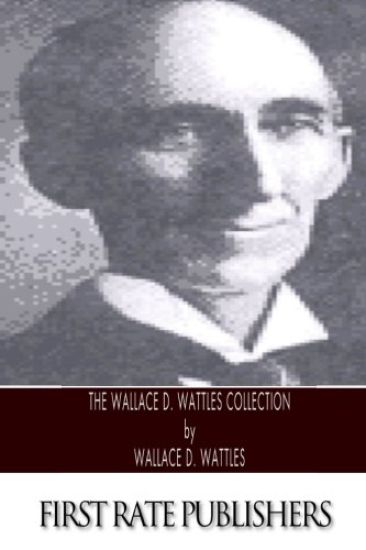
The Wallace Wattles Trilogy Includes three of Wallace Wattles best selling spiritual classics. It also includes access to the full audio-books Wallace Delois Wattles (1860-1911) was an American author. A New Thought writer, he remains personally somewhat obscure, but his writing has been widely quoted and remains in print in the New Thought and self-help movements. Wattles' best known work is a 1903 book called The Science of Getting Rich in which he explains how to become wealthy. Life and career Wattles' daughter, Florence A. Wattles, described her father's life in a "Letter" that was published shortly after his death in the New Thought magazine Nautilus, edited by Elizabeth Towne. The Nautilus had previously carried articles by Wattles in almost every issue, and Towne was also his book publisher. Florence Wattles wrote that her father was born in the U.S. in 1860, received little formal education, and found himself excluded from the world of commerce and wealth. According to the 1880 US Federal Census, Wallace lived with his parents on a farm in Nunda Township, McHenry County, Illinois, and worked as a farm laborer. His father is listed as a gardener and his mother as "keeping house". Wallace is listed as being born in Illinois while his parents are listed as born in New York. No other siblings are recorded as living with the family. According to the 1910 census, Wattles had changed the spelling of his last name from Walters to Wattles. He was married to Abbie Walters, 47, at the time. They had three children: Florence Walters, 22, Russell H. Walters, 27, and Agnes Walters, 16. It also shows that at the time Wallace's mother Mary A. Walters was living with the family at the age of 79. Florence wrote that "he made lots of money, and had good health, except for his extreme frailty" in the last three years before his death. Wattles died on February 7, 1911 in Ruskin, Tennessee, and his body was transported home for burial to Elwood, Indiana. As a sign of respect businesses closed throughout the town for two hours on the afternoon of his funeral. His death at age 51 was regarded as "untimely" by his daughter; in the previous year he had not only published two books (The Science of Being Well and The Science of Getting Rich), but he had also run for public office.