Kirjojen hintavertailu. Mukana 11 699 587 kirjaa ja 12 kauppaa.

Kirjahaku

Etsi kirjoja tekijän nimen, kirjan nimen tai ISBN:n perusteella.

1000 tulosta hakusanalla William McCarthy

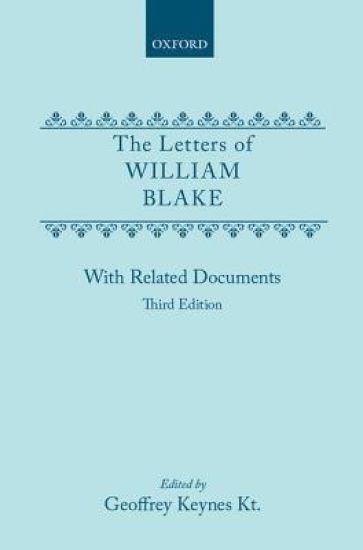
William Blake's Writings

William Blake's Writings

William Blake

Oxford University Press
1978
sidottu
Volume 1 and 2 of a two-volume scholarly edition of the writings of William Blake. The edition presents an authoritative text, together with an introduction, commentary notes, and scholarly apparatus.
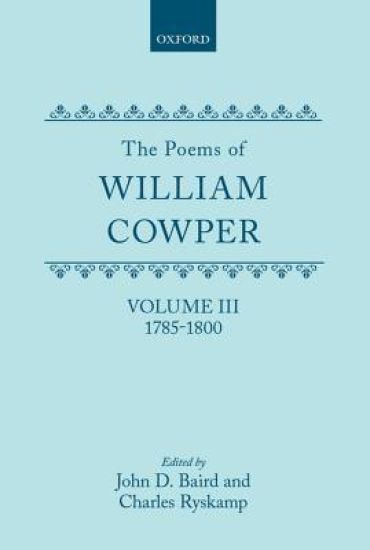
The Poems of William Cowper: Volume II: 1782-1785
This volume includes some of Cowper's finest works, among them such well-known short poems as `The Poplar-Field', `Epitaph on a Hare', `On the Loss of the Royal George' (here restored to the form in which Cowper wrote it, and accompanied by the music for which it was written), and `The Diverting History of John Gilpin' which, two years after its first anonymous publication in a newspaper, suddenly achieved huge popularity in a series of public readings. It also contains Cowper's masterpiece, The Task - one of the most approachable of the great English poems. Cowper's blank verse is a supple instrument, capable of every effect, from the parody-georgic on the growing of cucumbers to the visionary conclusion of Book VI. At the centre of the poem stands the poet himself, presented with wry humour and deep poignancy. The texts are based on manuscripts as well as early editions of the poetry, and are supplied with textual annotation and commentary. In the case of The Task, this is the first fully annotated edition for over a hundred years; its commentary relates the poem to the period in which it was written more fully than any previous edition.
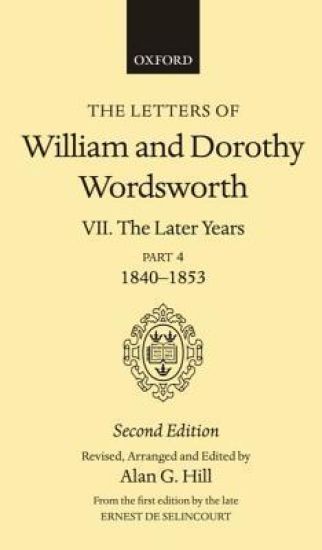
The Letters of William and Dorothy Wordsworth: Volume VII. The Later Years, Part IV, 1840-1853
This new edition of The Later Years contains over six hundred letters of William and Dorothy Wordsworth that have never been published before, and many more that have appeared only in fragmentary or incorrect form. It follows Wordsworth through the troubled years of early Victorian England, provides indispensable material for understanding the later phases of his career, while also offering innumerable insights into the great poems of his prime. Many hitherto unpublished letters reveal his pervasive influence as the poet of Man, Nature, and Society, who was acclaimed in his later years as the first of the great Victorian sages. Others illustrate his life in the Lake District and London, his last literary projects (including the publication of Guilt and Sorrow and The Borderers), and his contacts with a new generation of writers, artists, churchmen, and men of affairs, from both Britain and America. Above all, his correspondence bears witness to his lifelong commitment to poetry. For Dorothy Wordsworth, however, these were years of physical decline and near-silence, and the poet's letters provide a moving record of his struggles to come to terms with the problems and cares that afflicted his immediate family circle.
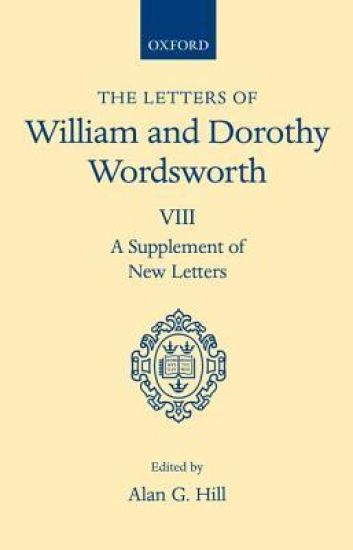
The Letters of William and Dorothy Wordsworth: Volume VIII. A Supplement of New Letters
This volume prints more than 150 letters, most of them previously unpublished, which appeared too late for inclusion in the second edition of The Letters of William and Dorothy Wordsworth (1967-88): they are indispensable for understanding the poet and the inner dynamics of the Wordsworth circle. Of outstanding interest are the unexpectedly tender and fervent letters which Wordsworth wrote to his wife Mary during brief periods of separation in 1810 and 1812: others provide fresh evidence about his contacts with Annette Vallon and his `French' daughter Caroline long after his withdrawal from revolutionary politics in France, and indeed up to the end of his life. Further letters illustrate the poet's literary and personal relations with Coleridge, Hazlitt, De Quincey, and Charles Lamb; his changing political and social views; his life in the Lake District and London; and, above all, his lifelong commitment to poetry and the principles that guided his imaginative life. These letters, varied in tone and subject-matter, will do much to dispel the ideal that he was invariably a reluctant or reserved correspondent. Dorothy Wordsworth, by contrast, fills out all the details of domestic life which her brother thought it unnecessary to dwell on, and her letters add their own characteristic touches to the picture of the Wordsworth circle - until the final breakdown of her health.
William of Malmesbury: Historia Novella

William of Malmesbury: Historia Novella

William of Malmesbury

Clarendon Press
1998
sidottu
The Historia Novella is a key source for the succession dispute between King Stephen and the Empress Matilda which brought England to civil war in the twelfth century. William of Malmesbury was the doyen of the historians of his day. His account of the main events of the years 1126 to 1142, to some of which he was an eyewitness, is sympathetic to the empress's cause, but not uncritical of her. Edmund King offers a complete revision of K. R. Potter's edition of 1955, retaining only the translation, which has been amended in places. Not only is this a new edition but it offers a new text, arguing that what have earlier been seen as William of Malmesbury's final revisions are not from his hand. Rather they seem to come from somewhere in the circle of Robert of Gloucester, the empress's half-brother, to whom the work is dedicated. In this way the work raises important questions concerning the transmission of medieval texts.
The Gesta Guillelmi of William of Poitiers

The Gesta Guillelmi of William of Poitiers

William of Poitiers

Clarendon Press
1998
sidottu
William of Poitiers began his career as a knight before studying in the schools of Poitiers and entering the Church. He became a chaplain in the household of William the Conqueror, and was able to give a first-hand account of the events of 1066-7. The Gesta Guillelmi, his unfinished biography of the king, is particularly important for its detailed description of William's campaigns in Normandy, the careful preparations he made for the invasion of England, the battle of Hastings and the establishment of Norman power after the Conquest. It is a mine of information of military tactics and the conduct of war in the eleventh century. Though written from the point of view of the Norman court, it gives what is probably the most authentic account of these momentous events. This edition, by the late R. H. C. Davis and Marjorie Chibnall, with facing-page English translation of the Latin text, provides the first complete English translation, as well as a full historical introduction and detailed notes.
William of Malmesbury: Gesta Regum Anglorum, The History of the English Kings: Volume I

William of Malmesbury: Gesta Regum Anglorum, The History of the English Kings: Volume I

R. A. B. Mynors; R. M. Thomson; M. Winterbottom
Clarendon Press
1998
sidottu
William of Malmesbury's Regesta Regum Anglorum (Deeds of the English Kings) is one of the great histories of England, and one of the most important historical works of the European Middle Ages. Although its focus is national, its scope encompasses most of Western Europe and beyond, providing a full-scale account of the First Crusade. Apart from its formidable learning, it is characterized by narrative skill and entertainment value - with topics including unpowered flight and Henry I's zoo. This edition in the Oxford Medieval Texts series is the first modern translation and edition. A full historical introduction is supplied in Volume II.
William of Malmesbury: Gesta Regum Anglorum: Volume II: General Introduction and Commentary
William of Malmesbury's Regesta Regum Anglorum (Deeds of the English Kings) is one of the great histories of England, and one of the most important historical works of the European Middle Ages. Volume II of the Oxford Medieval Texts edition provides a full historical introduction, a detailed textual commentary, and an extensive bibliography. It forms the essential complement to the text and translation which appeared in Volume I.
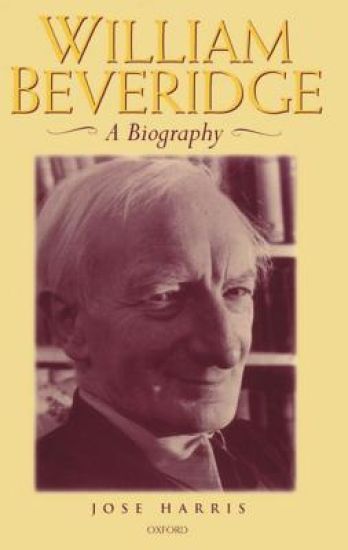
William Beveridge

William Beveridge

Jose Harris

Clarendon Press
1997
nidottu
This new and revised edition of William Beveridge remains the only documented biography of the most influential social reformer of the twentieth century. In Britain and Europe the Beveridge Plan of 1942 is still widely regarded as the seminal document of the modern `welfare state'. Yet if Beveridge was the `father of the welfare state' he was also, as this study shows, one of its earliest and most severe critics. Jose Harris explores Beveridge's life - the young social worker at Toynbee Hall; the `New Liberal' reformer in Edwardian Whitehall; the stormy director of the London School of Economics; and the `People's William' of the reconstruction movement after the Second World War. She combines biography with social and intellectual history, revealing many of the underlying principles and contradictions of social policy at different periods of the twentieth century. This new edition draws upon extensive new archive material to expand Harris's account of the origins and the aftermath of the Beveridge Plan. It also explores much more fully than was possible in the first edition the tortuous history of Beveridge's personal and emotional life, and its role in shaping his ideas and public career.
William of Malmesbury: Saints' Lives
This volume presents the hagiographical writings of the Benedictine monk, historian, and scholar, William of Malmesbury (c.1095-c.1143): his Lives of Wulfstan and Dunstan, which survive complete, and those of Patrick, Benignus, and Indract, which exist now only as fragments. Only the Life of Wulfstan has been translated before; the fragments are edited here for the first time, and for the first time an assessment is offered of William as hagiographer, and of the relationship between his historical and hagiographical output. For Wulfstan II, bishop of Worcester 1062-95, William's Life is the main primary source. The other Lives, written for the monks of Glastonbury, shed important light on William's use of his sources, and on the local cult of these saints.
William of Malmesbury: Gesta Pontificum Anglorum, The History of the English Bishops
Gesta Pontificum Anglorum (The History of the English Bishops) is a modern edition of one of the most important medieval texts written c. 1125 by one of England's key historians of the period, William, Monk of Malmesbury. It is a is a vivid narrative on the English Church, its bishoprics and monasteries, from c. 600 to William's contemporary era, and the edition features the original Latin text of the manuscript with the English translation alongside. Conceived as a companion piece to his Gesta Regum Anglorum, this historical work was a unique enterprise, and the result is a substantial book, elegantly written, full of original information, and characterized by intelligent interpretation and judgement. The first four books of the text, treat each diocese in turn, and the fifth book is devoted to the history of William's own monastery. A second volume by R. M. Thomson will contain an introduction and detailed commentary on the work.
William Whewell

William Whewell

Clarendon Press
1991
sidottu
William Whewell was a giant of Victorian intellectual culture. His influence, whether recognized or forgotten, is palpable in areas as diverse as moral philosophy, mineralogy, architecture, the politics of education, physics, engineering, and theology. Recent studies of the place of the sciences in nineteenth-century Britain have repeatedly indicated the significance of Whewell's sweeping and critical proposals for a reformed account of scientific knowledge and moral values. However, until now there has been no detailed study of the context and impact of his project. This collection of essays by recognized authorities in the fields of history, history of science, and philosophy thus represents the first attempt to do justice to a magisterial nineteenth-century intellectual. More generally, it makes an important contribution to our understanding of Victorian intellectual life and its aftermath.