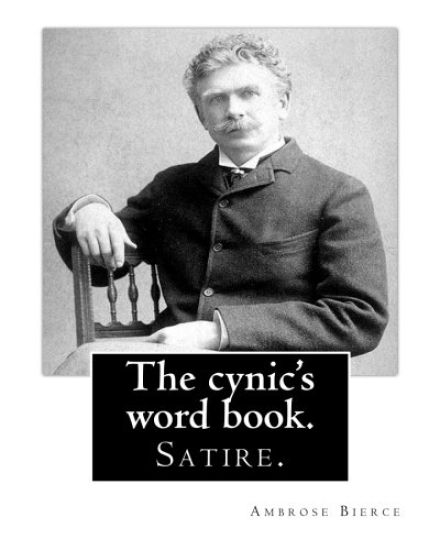
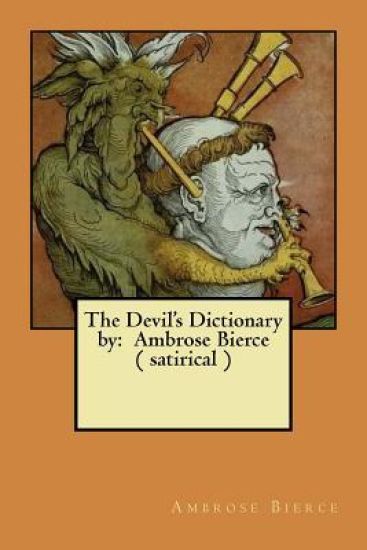
The Devil's Dictionary is a satirical dictionary written by American journalist and author Ambrose Bierce. Originally published in 1906 as The Cynic's Word Book, it features Bierce's witty and often ironic spin on many common English words. Retitled in 1911, it has been followed by numerous "unabridged" versions compiled after Bierce's death, which include definitions absent from earlier editions. The Devil's Dictionary began as a serialized column during Bierce's time as a columnist for the San Francisco News Letter, a small weekly financial magazine founded by Frederick Marriott in the late 1850s. Although a serious magazine aimed at businessmen, the News Letter contained a page of informal satirical content titled "The Town Crier". Bierce, hired as the "Crier"'s editor in December 1868, wrote satire with such irreverence and lack of inhibition he was nicknamed "the laughing devil of San Francisco". Bierce resigned from "The Town Crier" when?] and spent three years in London. Returning to San Francisco in 1875, he made two submissions to the News Letter in hopes of regaining his old position. Both were written under aliases. One, entitled "The Demon's Dictionary", contained Bierce's definitions for 48 words. Later forgotten in his compiling of The Devil's Dictionary, they were added almost a century later to an Enlarged Devil's Dictionary published in 1967. Though Bierce's preface to The Devil's Dictionary dates the earliest work to 1881, its origins can be traced to August 1869. Short of material and recently possessed of a Webster's Unabridged Dictionary, he suggested writing a "comic dictionary" for the "Town Crier". To a quote from Webster's entry for "Vicegerents", "Kings are sometimes called God's vicegerents", he added the italicized rejoinder, "It is to be wished they would always deserve the appellation," then suggested Webster might have used his talent to comic effect. Comic definitions were not a regular feature of Bierce's next column ("Prattle", in the magazine The Argonaut, of which he became an editor in March 1877). Nevertheless, he included comic definitions in his columns dated November 17, 1877 and September 14, 1878. It was in early 1881 that Bierce first used the title, The Devil's Dictionary, while editor-in-chief of another weekly San Francisco magazine, The Wasp. The "dictionary" proved popular, and during his time in this post (1881-86) Bierce included 88 installments, each comprising 15-20 new definitions.n 1887, Bierce became an editor of The San Francisco Examiner and introduced "The Cynic's Dictionary". This was to be the last of his "dictionary" columns until 1904, and it continued irregularly until July 1906. A number of the definitions are accompanied by satiric verses, many of which are signed with comic pseudonyms such as "Salder Bupp", "Orm Pludge", and "Father Gassalasca Jape, S.J.
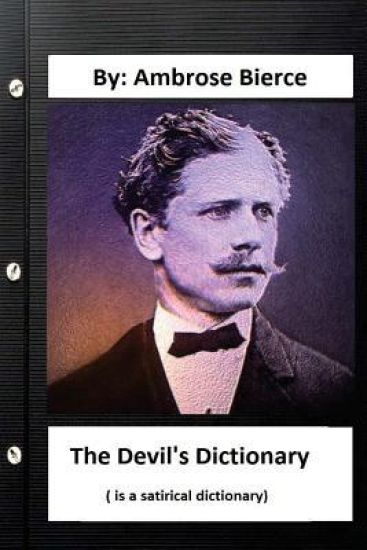
The Devil's Dictionary is a satirical dictionary written by American journalist and author Ambrose Bierce. Originally published in 1906 as The Cynic's Word Book, it features Bierce's witty and often ironic spin on many common English words. Retitled in 1911, it has been followed by numerous "unabridged" versions compiled after Bierce's death, which include definitions absent from earlier editions. The Devil's Dictionary began as a serialized column during Bierce's time as a columnist for the San Francisco News Letter, a small weekly financial magazine founded by Frederick Marriott in the late 1850s. Although a serious magazine aimed at businessmen, the News Letter contained a page of informal satirical content titled "The Town Crier". Bierce, hired as the "Crier"'s editor in December 1868, wrote satire with such irreverence and lack of inhibition he was nicknamed "the laughing devil of San Francisco". Bierce resigned from "The Town Crier" when?] and spent three years in London. Returning to San Francisco in 1875, he made two submissions to the News Letter in hopes of regaining his old position. Both were written under aliases. One, entitled "The Demon's Dictionary", contained Bierce's definitions for 48 words. Later forgotten in his compiling of The Devil's Dictionary, they were added almost a century later to an Enlarged Devil's Dictionary published in 1967. Though Bierce's preface to The Devil's Dictionary dates the earliest work to 1881, its origins can be traced to August 1869. Short of material and recently possessed of a Webster's Unabridged Dictionary, he suggested writing a "comic dictionary" for the "Town Crier". To a quote from Webster's entry for "Vicegerents", "Kings are sometimes called God's vicegerents", he added the italicized rejoinder, "It is to be wished they would always deserve the appellation," then suggested Webster might have used his talent to comic effect. Comic definitions were not a regular feature of Bierce's next column ("Prattle", in the magazine The Argonaut, of which he became an editor in March 1877). Nevertheless, he included comic definitions in his columns dated November 17, 1877 and September 14, 1878. It was in early 1881 that Bierce first used the title, The Devil's Dictionary, while editor-in-chief of another weekly San Francisco magazine, The Wasp. The "dictionary" proved popular, and during his time in this post (1881-86) Bierce included 88 installments, each comprising 15-20 new definitions.n 1887, Bierce became an editor of The San Francisco Examiner and introduced "The Cynic's Dictionary". This was to be the last of his "dictionary" columns until 1904, and it continued irregularly until July 1906. A number of the definitions are accompanied by satiric verses, many of which are signed with comic pseudonyms such as "Salder Bupp", "Orm Pludge", and "Father Gassalasca Jape, S.J.
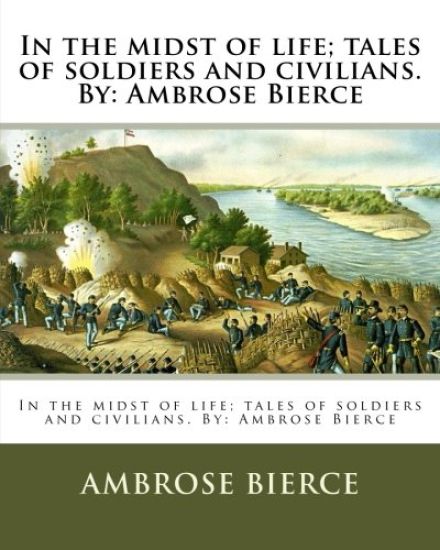
Tales of Soldiers and Civilians is a collection of short stories written by Ambrose Bierce. Published in 1891, the 26 stories detail the lives of soldiers and civilians during the American Civil War. His famous story "An Occurrence at Owl Creek Bridge" is included in this collection.In the preface to the first edition, Bierce maintained that the book had been "denied existence by the chief publishing houses of the country." He credited the eventual publication of the book to his friend, Mr. E. L. G. Steele, a merchant from San Francisco, who was listed with the 1891 copyright. 3] In 1898, Tales was republished along with other stories by G.P. Putnam's Sons under the title In the Midst of Life.George Sterling, in the introduction to a later (1927) edition, noted that as a result of "obtuse critics and a benighted public", the book failed to become the sensation Bierce had expected. The original publication contained nineteen stories, while those in later publications increased in number; 1898 to 22, and 1909 to 26.The original nineteen stories were retained in the 1898 publication, but were not entirely collectively retained in the 1909 edition.Four of these were transferred by Bierce into his collection Collected Works, Can Such Things Be?In a similar fashion, Bierce moved eight stories into the 1909 version of In the Midst of Life from the 1893 edition of Can Such Things Be?Sixteen of the original stories were initially published in the San Francisco Examiner... Ambrose Gwinnett Bierce (June 24, 1842 - circa 1914) was an American editorialist, journalist, short story writer, fabulist, and satirist. He wrote the short story "An Occurrence at Owl Creek Bridge" and compiled a satirical lexicon, The Devil's Dictionary. His vehemence as a critic, his motto "Nothing matters", and the sardonic view of human nature that informed his work, all earned him the nickname "Bitter Bierce". Despite his reputation as a searing critic, Bierce was known to encourage younger writers, including the poets George Sterling and Herman George Scheffauer and the fiction writer W. C. Morrow. Bierce employed a distinctive style of writing, especially in his stories. His style often embraces an abrupt beginning, dark imagery, vague references to time, limited descriptions, impossible events, and the theme of war. In 1913, Bierce traveled to Mexico to gain first-hand experience of the Mexican Revolution. He was rumored to be traveling with rebel troops, and was not seen again.
Ambrose Gwinnett Bierce (June 24, 1842 - circa 1914) was an American editorialist, journalist, short story writer, fabulist, and satirist. He wrote the short story "An Occurrence at Owl Creek Bridge" and compiled a satirical lexicon, The Devil's Dictionary. His vehemence as a critic, his motto "Nothing matters", and the sardonic view of human nature that informed his work, all earned him the nickname "Bitter Bierce". Despite his reputation as a searing critic, Bierce was known to encourage younger writers, including the poets George Sterling and Herman George Scheffauer and the fiction writer W. C. Morrow. Bierce employed a distinctive style of writing, especially in his stories. His style often embraces an abrupt beginning, dark imagery, vague references to time, limited descriptions, impossible events, and the theme of war. In 1913, Bierce traveled to Mexico to gain first-hand experience of the Mexican Revolution. He was rumored to be traveling with rebel troops, and was not seen again. Bierce was born in a log cabin at Horse Cave Creek in Meigs County, Ohio, on June 24, 1842, to Marcus Aurelius Bierce (1799-1876) and Laura Sherwood Bierce.His mother was a descendant of William Bradford. He was the tenth of thirteen children whose father gave all names beginning with the letter "A": in order of birth, the Bierce siblings were Abigail, Amelia, Ann, Addison, Aurelius, Augustus, Almeda, Andrew, Albert, and Ambrose. His parents were a poor but literary couple who instilled in him a deep love for books and writing.Bierce grew up in Kosciusko County, Indiana, attending high school at the county seat, Warsaw.He left home at 15 to become a "printer's devil" at a small Ohio newspaper.
Ambrose Gwinnett Bierce (June 24, 1842 - circa 1914) was an American editorialist, journalist, short story writer, fabulist, and satirist. He wrote the short story "An Occurrence at Owl Creek Bridge" and compiled a satirical lexicon, The Devil's Dictionary. His vehemence as a critic, his motto "Nothing matters", and the sardonic view of human nature that informed his work, all earned him the nickname "Bitter Bierce". Despite his reputation as a searing critic, Bierce was known to encourage younger writers, including the poets George Sterling and Herman George Scheffauer and the fiction writer W. C. Morrow. Bierce employed a distinctive style of writing, especially in his stories. His style often embraces an abrupt beginning, dark imagery, vague references to time, limited descriptions, impossible events, and the theme of war. In 1913, Bierce traveled to Mexico to gain first-hand experience of the Mexican Revolution. He was rumored to be traveling with rebel troops, and was not seen again. Bierce was born in a log cabin at Horse Cave Creek in Meigs County, Ohio, on June 24, 1842, to Marcus Aurelius Bierce (1799-1876) and Laura Sherwood Bierce.His mother was a descendant of William Bradford. He was the tenth of thirteen children whose father gave all names beginning with the letter "A": in order of birth, the Bierce siblings were Abigail, Amelia, Ann, Addison, Aurelius, Augustus, Almeda, Andrew, Albert, and Ambrose. His parents were a poor but literary couple who instilled in him a deep love for books and writing.Bierce grew up in Kosciusko County, Indiana, attending high school at the county seat, Warsaw.He left home at 15 to become a "printer's devil" at a small Ohio newspaper.
By the light of a tallow candle, which had been placed on one end of a rough table, a man was reading something written in a book. It was an old account book, greatly worn; and the writing was not, apparently, very legible, for the man sometimes held the page close to the flame of the candle to get a stronger light upon it. The shadow of the book would then throw into obscurity a half of the room, darkening a number of faces and figures; for besides the reader, eight other men were present. Seven of them sat against the rough log walls, silent and motionless, and, the room being small, not very far from the table. By extending an arm any one of them could have touched the eighth man, who lay on the table, face upward, partly covered by a sheet, his arms at his sides. He was dead.
Ambrose Gwinnett Bierce (June 24, 1842- circa 1914 was an American Civil War soldier, wit, and writer. Bierce's book The Devil's Dictionary was named as one of "The 100 Greatest Masterpieces of American Literature" by the American Revolution Bicentennial Administration;. His story An Occurrence at Owl Creek Bridge has been described as "one of the most famous and frequently anthologized stories in American literature"; and his book Tales of Soldiers and Civilians (also published as In the Midst of Life) was named by the Grolier Club as one of the 100 most influential American books printed before 1900. A prolific and versatile writer, Bierce was regarded as one of the most influential journalists in the United States. For his horror writing, Michael Dirda ranked him alongside Edgar Allan Poe and H.P. Lovecraft." as a pioneering writer of realist fiction, . His war stories influenced Stephen Crane, Ernest Hemingway, and others, and he was considered an influential and feared literary critic. In recent decades Bierce has gained wider respect as a fabulist and for his poetry. In December 1913, Bierce traveled to Chihuahua, Mexico to gain first-hand experience of the Mexican Revolution. He disappeared while rumored to be traveling with rebel troops, and was never seen again.Bierce was born in a log cabin at Horse Cave Creek in Meigs County, Ohio, on June 24, 1842, to Marcus Aurelius Bierce (1799-1876) and Laura Sherwood Bierce. His mother was a descendant of William Bradford. He was the tenth of thirteen children, whose father gave all names beginning with the letter "A" in order of birth, the Bierce siblings were Abigail, Amelia, Ann, Addison, Aurelius, Augustus, Almeda, Andrew, Albert, and Ambrose. His parents were a poor but literary couple who instilled in him a deep love for books and writing. Bierce grew up in Kosciusko County, Indiana, attending high school at the county seat, Warsaw. He left home at 15 to become a printer's devil at a small Ohio newspape
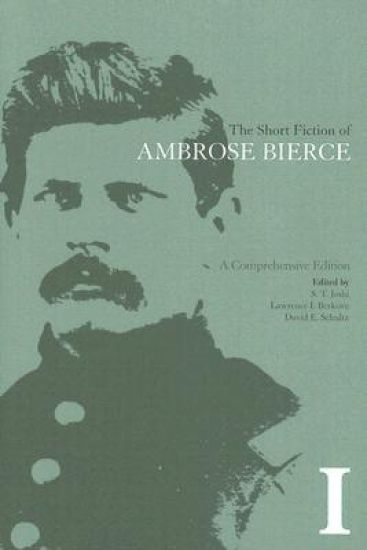
Ambrose Bierce (1842–1914?) has been a widely read, often controversial, author for more than a hundred years, but until now there has been no exhaustive collection of his short fiction. This new edition, both comprehensive and chronological, reveals the broad range of fiction that Bierce mastered. Readers who expect to find only a writer of grim and shocking stories of war and other horrors will discover that he excelled at other types of tales—humorous, mystical, Gothic, satirical, sentimental, mystery, science fiction, and even love stories. This collection gives readers the opportunity to observe the growth of characteristic themes and techniques in Bierce’s short fiction. A number of the early sketches evidence both the thoughtful moral focus and the technical brilliance of his best work, and here they also can be seen as training exercises for the young writer on his way to the better-known stories of his artistic peak.Although several previous books purport to provide accurate collections of Bierce’s work, none does more than uncritically re-assemble the tales in the heretofore standard Collected Works (1909-1912). This edition will be the new standard. It is the first to include all his known and rediscovered short fiction. Of the 249 items collected in this edition, 1 story (“Alasper”) is unpublished, 58 have not been previously reprinted from the newspapers and magazines in which they originally appeared, and 74 have not been reprinted since their appearance in Bierce’s early volumes. It is also the only edition to be based upon consultation of manuscripts and early printed sources. As a result, textual corrections have been made to some of Bierce’s stories, including two of his best known.Volume I covers the years 1868 to 1886 and includes nearly 150 stories from Bierce’s early period, among them “Pernicketty's Fright,” “The Grateful Bear,” and “Why I Am Not Editing ‘The Stinger.’”A model of careful scholarship, this edition includes selected textual variants, a bibliography of all appearances of the story in Bierce’s lifetime, introductory comments and extensive annotations that provide biographical and other background information, and citations to important works of criticism.
Ambrose Bierce (1842–1914?) has been a widely read, often controversial, author for more than a hundred years, but until now there has been no exhaustive collection of his short fiction. This new edition, both comprehensive and chronological, reveals the broad range of fiction that Bierce mastered. Readers who expect to find only a writer of grim and shocking stories of war and other horrors will discover that he excelled at other types of tales—humorous, mystical, Gothic, satirical, sentimental, mystery, science fiction, and even love stories. This collection gives readers the opportunity to observe the growth of characteristic themes and techniques in Bierce’s short fiction. A number of the early sketches evidence both the thoughtful moral focus and the technical brilliance of his best work, and here they also can be seen as training exercises for the young writer on his way to the better-known stories of his artistic peak.Although several previous books purport to provide accurate collections of Bierce’s work, none does more than uncritically re-assemble the tales in the heretofore standard Collected Works (1909-1912). This edition will be the new standard. It is the first to include all his known and rediscovered short fiction. Of the 249 items collected in this edition, 1 story (“Alasper”) is unpublished, 58 have not been previously reprinted from the newspapers and magazines in which they originally appeared, and 74 have not been reprinted since their appearance in Bierce’s early volumes. It is also the only edition to be based upon consultation of manuscripts and early printed sources. As a result, textual corrections have been made to some of Bierce’s stories, including two of his best known.Volume II covers the years 1887 to 1893 and collects nearly 60 pieces, including “A Horseman in the Sky,” “Chickamauga,” “A Son of the Gods,” and “An Occurrence at Owl Creek Bridge.”A model of careful scholarship, this edition includes selected textual variants, a bibliography of all appearances of the story in Bierce’s lifetime, introductory comments and extensive annotations that provide biographical and other background information, and citations to important works of criticism.
Ambrose Bierce (1842–1914?) has been a widely read, often controversial, author for more than a hundred years, but until now there has been no exhaustive collection of his short fiction. This new edition, both comprehensive and chronological, reveals the broad range of fiction that Bierce mastered. Readers who expect to find only a writer of grim and shocking stories of war and other horrors will discover that he excelled at other types of tales—humorous, mystical, Gothic, satirical, sentimental, mystery, science fiction, and even love stories. This collection gives readers the opportunity to observe the growth of characteristic themes and techniques in Bierce’s short fiction. A number of the early sketches evidence both the thoughtful moral focus and the technical brilliance of his best work, and here they also can be seen as training exercises for the young writer on his way to the better-known stories of his artistic peak.Although several previous books purport to provide accurate collections of Bierce’s work, none does more than uncritically re-assemble the tales in the heretofore standard Collected Works (1909-1912). This edition will be the new standard. It is the first to include all his known and rediscovered short fiction. Of the 249 items collected in this edition, 1 story (“Alasper”) is unpublished, 58 have not been previously reprinted from the newspapers and magazines in which they originally appeared, and 74 have not been reprinted since their appearance in Bierce’s early volumes. It is also the only edition to be based upon consultation of manuscripts and early printed sources. As a result, textual corrections have been made to some of Bierce’s stories, including two of his best known.Volume III covers the years 1895 to 1910 and includes more than 70 pieces, with “Moxon’s Master,” “Beyond the Wall,” and “The Eyes of a Panther.”A model of careful scholarship, this edition includes selected textual variants, a bibliography of all appearances of the story in Bierce’s lifetime, introductory comments and extensive annotations that provide biographical and other background information, and citations to important works of criticism.
Ambrose Bierce and the Dance of Death uses psychoanalytic theory in combination with historical, cultural, and literary contexts to examine the complex motif of death in a full range of Bierce's writings. Scholarly interest in Bierce, whose work has long been undervalued, has grown significantly in recent years. This new book contributes to the ongoing reassessment by providing new contexts for joining the texts in his canon in meaningful ways.Previous attempts to consider Bierce from a psychological perspective have been superficial, often reductive Freudian readings of individual stories such as An Occurrence at Owl Creek Bridge and The Death of Halpin Frayser. This new volume not only updates these interpretations with insights from post-Freudian theorists but uses contemporary death theory as a framework to analyze the sources and expressions of Bierce's attitudes about death and dying. This approach makes it possible to discern links among texts that resolve some of the still puzzling ambiguities that have- until now- precluded a fuller understanding of both the man and his writings.Lively and engaging, Ambrose Bierce and the Dance of Death adds valuable new insights not only to the study of Bierce but to that of nineteenth-century American literature in general.
A veteran of some of the bloodiest battles of the Civil War, Ambrose Bierce went on to become one of the darkest and most death haunted of American writers, the blackest of black humorists. This volume gathers the most celebrated and significant of Bierce's writings. In the Midst of Life (Tales of Soldiers and Civilians), his collection of short fiction about the Civil War, which includes the masterpieces An Occurrence at Owl Creek Bridge and Chickamauga, is suffused with a fiercely ironic sense of the horror and randomness of war. Can Such Things Be? brings together The Death of Halpin Frayser, The Damned Thing, The Moonlit Road, and other tales of terror that make Bierce the genre's most significant American practitioner between Poe and Lovecraft. The Devil's Dictionary, the brilliant lexicon of subversively cynical definitions on which Bierce worked for decades, displays to the full his corrosive wit. In Bits of Autobiography, the series of memoirs that includes the memorable What I Saw of Shiloh, he recreates his experiences in the war and its aftermath. The volume is rounded out with a selection of his best uncollected stories. Acclaimed Bierce scholar S. T. Joshi provides detailed notes and a newly researched chronology of Bierce's life and mysterious disappearance. LIBRARY OF AMERICA is an independent nonprofit cultural organization founded in 1979 to preserve our nation's literary heritage by publishing, and keeping permanently in print, America's best and most significant writing. The Library of America series includes more than 300 volumes to date, authoritative editions that average 1,000 pages in length, feature cloth covers, sewn bindings, and ribbon markers, and are printed on premium acid-free paper that will last for centuries.