Kirjojen hintavertailu. Mukana 11 244 527 kirjaa ja 12 kauppaa.

Kirjahaku

Etsi kirjoja tekijän nimen, kirjan nimen tai ISBN:n perusteella.

1000 tulosta hakusanalla Content Team Audiolearn

Content and Object

Content and Object

J. Cavallin

Springer
1997
sidottu
This study is a revised version ofa book, published in February 1990 under the same title, as my Ph.D. thesis at the University of Stockholm. Revision of an earlier work poses specific problems, some of which deserve mentioning. After the appearance of the first version of this book new literature on related subjects and a new version of the principal HusserI text involved in the discussion have appeared. The newer literature contains both accounts of Twardowski's thought and its relations to HusserI's philosophy, though without referring to my study from 1990, largely because the texts concerned were con­ ceived parallell to it, though published later, or independently of it. It would seem anachronistic, in this situation, to enter into new and ex­ tensive discussions with the authors of this literature. The choice made here has been to update the original study, adding references to texts published after my study, and to take account of points of views expressed. I have retained the major part of the basic information giv­ en in the 1990 version, although some of it might now be more famil­ iar to interested students than it was in 1990.
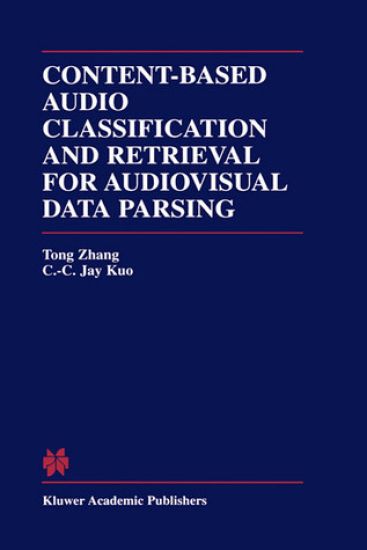
Content-Based Audio Classification and Retrieval for Audiovisual Data Parsing
Content-Based Audio Classification and Retrieval for Audiovisual Data Parsing is an up-to-date overview of audio and video content analysis. Included is extensive treatment of audiovisual data segmentation, indexing and retrieval based on multimodal media content analysis, and content-based management of audio data. In addition to the commonly studied audio types such as speech and music, the authors have included hybrid types of sounds that contain more than one kind of audio component such as speech or environmental sound with music in the background. Emphasis is also placed on semantic-level identification and classification of environmental sounds. The authors introduce a new generic audio retrieval system on top of the audio archiving schemes. Both theoretical analysis and implementation issues are presented. The developing MPEG-7 standards are explored. Content-Based Audio Classification and Retrieval for Audiovisual Data Parsing will be especially useful to researchers and graduate level students designing and developing fully functional audiovisual systems for audio/video content parsing of multimedia streams.
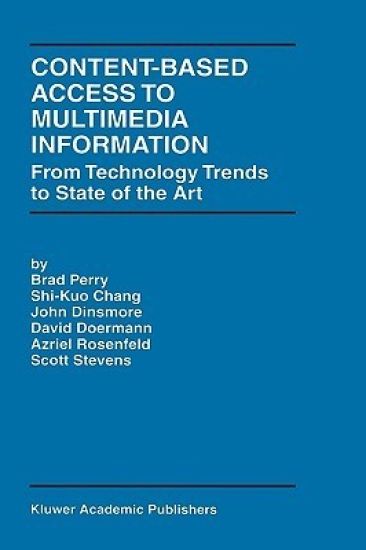
Content-Based Access to Multimedia Information

Content-Based Access to Multimedia Information

Brad Perry; J. Dinsmore; David Doermann; Azriel Rosenfeld; Scott Stevens

Springer
1999
sidottu
In the past five years, the field of electrostatic discharge (ESD) control has under­ gone some notable changes. Industry standards have multiplied, though not all of these, in our view, are realistic and meaningful. Increasing importance has been ascribed to the Charged Device Model (CDM) versus the Human Body Model (HBM) as a cause of device damage and, presumably, premature (latent) failure. Packaging materials have significantly evolved. Air ionization techniques have improved, and usage has grown. Finally, and importantly, the government has ceased imposing MIL-STD-1686 on all new contracts, leaving companies on their own to formulate an ESD-control policy and write implementing documents. All these changes are dealt with in five new chapters and ten new reprinted papers added to this revised edition of ESD from A to Z. Also, the original chapters have been augmented with new material such as more troubleshooting examples in Chapter 8 and a 20-question multiple-choice test for certifying operators in Chapter 9. More than ever, the book seeks to provide advice, guidance, and practical ex­ amples, not just a jumble of facts and generalizations. For instance, the added tailored versions of the model specifications for ESD-safe handling and packaging are actually in use at medium-sized corporations and could serve as patterns for many readers.
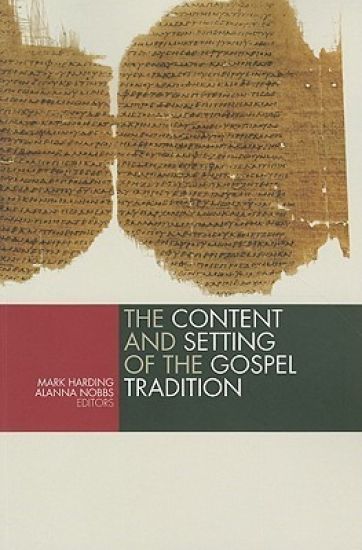
Content and the Setting of the Gospel Tradition

Content and the Setting of the Gospel Tradition

William B Eerdmans Publishing Co
2010
nidottu
Bringing together the internationally recognized excellence of Macquarie University faculty -- renowned for their knowledge of the New Testament's Greco-Roman background -- and the theological expertise of scholars affiliated with the Australian College of Theology, this book provides a major, integrated, and distinctively Australian contribution to the study of the content and setting of the New Testament Gospels. Seventeen scholars here delve into the archaeology, the manuscripts, and the political, social, and religious context of the Gospels, as well as their place and use in the early churches. Even more, however, they offer in-depth, in-context examinations of Jesus' life and ministry as recounted in the Gospels.Contributors: Evelyn Ashley Scott D. Charlesworth Johan Ferreira Chris Forbes Greg W. Forbes Mark Harding Timothy J. Harris James R. Harrison Theresa Yu Chui Siang Lau Erica A. Mathieson Robert K. McIver Alanna Nobbs Brian Powell Van Shore Ian K. Smith Murray J. Smith Stephen Voorwinde
Content and Process Specificity in the Effects of Prior Experiences
In Volume 3, Eliot R. Smith of Purdue University proposes that social cognition theorists have placed excessive emphasis on the role of schemata, prototypes, and various other types of abstractions. This has affected both the methodologies they use and the type of theories they construct. What has not been adequately appreciated is the storage and retrieval of specific episodes, especially those with idiosyncratic features. This volume s designed as a required text for those studying personality, experimental and consumer psychology, cognitive science, and communications.
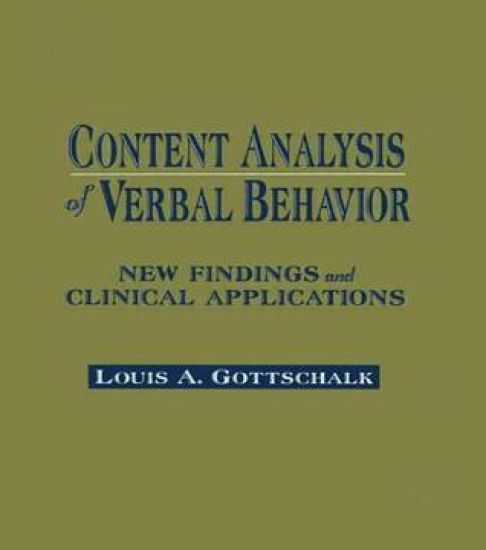
Content Analysis of Verbal Behavior

Content Analysis of Verbal Behavior

Louis A. Gottschalk

Routledge Member of the Taylor and Francis Group
1995
sidottu
Focusing on language and the assessment of its meaning, this volume concentrates on a method of content analysis developed by the author and Goldine Gleser. Applicable to transcripts of speech or verbal texts, this method uses the grammatical clause as its smallest unit of communication, considers whether or not a verb is transitive and involves an object, or is intransitive and describes a state of being. It derives scores on many scales that have been tested for reliability of scoring and for construct validity with concurrently administered measures, such as rating and self-report scales as well as biochemical and pharmacological criteria. Finally, this volume provides detailed descriptions of the clinical and basic research establishing the validity of these scales, so that a reader can locate studies that have pertinence to any special interest area. A major achievement described in this book is the development of computer software that understands grammar and syntax, can parse natural language, knows most of the words in the Merriam-Webster dictionary, has been taught to identify idioms and slang, and is capable of continuing to learn. The program can score all the scales, report whether the scores obtained from a verbal sample are one to three standard deviations from the norms, and suggest APA DSM-IIIR diagnostic classifications the clinician might consider in assessing the patient.
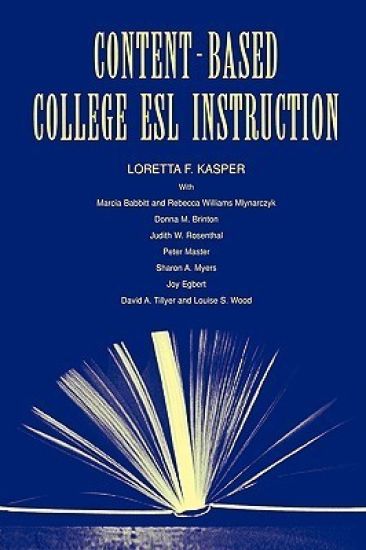
Content-Based College ESL Instruction

Content-Based College ESL Instruction

Loretta F. Kasper; Marcia Babbitt; Rebecca William Mlynarczyk; Donna M. Brinton; Judith W. Rosenthal

Routledge Member of the Taylor and Francis Group
1999
nidottu
This book is carefully designed to inform and train readers in the techniques of content-based ESL instruction and to assist them in developing and implementing content-based materials and programs appropriate to their educational institutions and situations. Every chapter presents a balance of theory and practice, focusing on a detailed description, with clear examples of classroom practices including information, suggestions, and instructional tools. Each chapter addresses assessment issues as they apply to the particular methodology described.
Content and Complexity

Content and Complexity

Routledge Member of the Taylor and Francis Group
2003
sidottu
Information design is an emerging area in technical communication, garnering increased attention in recent times as more information is presented through both old and new media. In this volume, editors Michael J. Albers and Beth Mazur bring together scholars and practitioners to explore the issues facing those in this exciting new field. Treating information as it applies to technical communication, with a special emphasis on computer-centric industries, this volume delves into the role of information design in assisting with concepts, such as usability, documenting procedures, and designing for users. Influential members in the technical communication field examine such issues as the application of information design in structuring technical material; innovative ways of integrating information design within development methodologies and social aspects of the workplace; and theoretical approaches that include a practical application of information design, emphasizing the intersection of information design theories and workplace reality. This collection approaches information design from the language-based technical communication side, emphasizing the role of content as it relates to complexity in information design. As such, it treats as paramount the rhetorical and contextual strategies required for the effective design and transmission of information. Content and Complexity: Information Design in Technical Communication explores both theoretical perspectives, as well as the practicalities of information design in areas relevant to technical communicators. This integration of theoretical and applied components make it a practical resource for students, educators, academic researchers, and practitioners in the technical communication and information design fields.
Content and Complexity

Content and Complexity

Routledge Member of the Taylor and Francis Group
2003
nidottu
Information design is an emerging area in technical communication, garnering increased attention in recent times as more information is presented through both old and new media. In this volume, editors Michael J. Albers and Beth Mazur bring together scholars and practitioners to explore the issues facing those in this exciting new field. Treating information as it applies to technical communication, with a special emphasis on computer-centric industries, this volume delves into the role of information design in assisting with concepts, such as usability, documenting procedures, and designing for users. Influential members in the technical communication field examine such issues as the application of information design in structuring technical material; innovative ways of integrating information design within development methodologies and social aspects of the workplace; and theoretical approaches that include a practical application of information design, emphasizing the intersection of information design theories and workplace reality. This collection approaches information design from the language-based technical communication side, emphasizing the role of content as it relates to complexity in information design. As such, it treats as paramount the rhetorical and contextual strategies required for the effective design and transmission of information. Content and Complexity: Information Design in Technical Communication explores both theoretical perspectives, as well as the practicalities of information design in areas relevant to technical communicators. This integration of theoretical and applied components make it a practical resource for students, educators, academic researchers, and practitioners in the technical communication and information design fields.
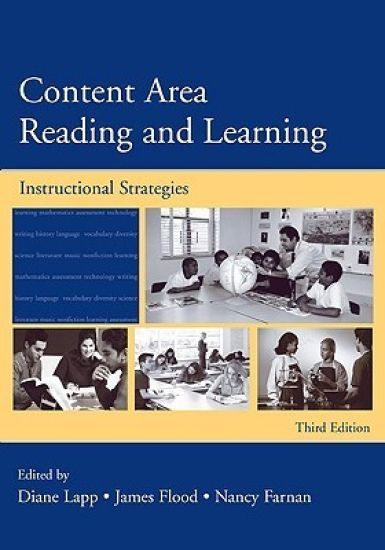
Content Area Reading and Learning

Content Area Reading and Learning

Routledge Member of the Taylor and Francis Group
2007
nidottu
How can teachers make content-area learning more accessible to their students? This text addresses instructional issues and provides a wealth of classroom strategies to help all middle and secondary teachers effectively enable their students to develop both content concepts and strategies for continued learning. The goal is to help teachers model, through excellent instruction, the importance of lifelong content-area learning. This working textbook provides students maximum interaction with the information, strategies, and examples presented in each chapter. This book is organized around five themes:Content Area Reading: An OverviewThe Teacher and the TextThe StudentsThe Instructional ProgramSchool Culture and Environment in Middle and High School Classrooms.Pedagogical features in each chapter include: a graphic organizer; a chapter overview, Think Before, Think While and Think After Reading Activities - which are designed to integrate students’ previous knowledge and experience with their new learnings about issues related to content area reading, literacy, and learning, and to serve as catalysts for thinking and discussions.This textbook is intended as a primary text for courses on middle and high school content area literacy and learning.
Content Management Systems for Libraries

Content Management Systems for Libraries

Bradford Lee Eden

Scarecrow Press
2008
sidottu
Content management systems (CMS) within libraries are becoming more and more important as mechanisms for content and services to be provided in the digital environment. They allow for consistency in branding, look and feel, and the delivery of information; they also help to centralize input and maintenance of content and services by allowing multiple authors and creators to manage and edit their content without an intermediary, i.e. another staff person. In addition, CMS have the capability to produce test environments that assist libraries in exploring new tools, services, and presentation of content, without having to recreate these environments manually multiple times. Content Management Systems in Libraries documents case studies related to two types of CMS implementations: those that manage content on library websites and those that manage digital content. This book brings together a number of case studies on current CMS implementations, using both open source and proprietary systems, and reflects on the current state and future of CMS in libraries.
Content Area Literacy Strategies That Work

Content Area Literacy Strategies That Work

Lori G. Wilfong

CRC Press Inc
2019
sidottu
Content area teachers are now being tasked with incorporating reading and writing instruction, but what works? In this essential book from Routledge and AMLE, author Lori G. Wilfong describes ten best practices for content area literacy and how to implement them in the middle-level classroom. She also points out practices that should be avoided, helping you figure out which ideas to ditch and which to embrace. Topics covered include… Building background knowledge quickly Using specific strategies to scaffold focus while reading Using small group reading strategies to bring personal response and accountability to the content Understanding items that make reading in different disciplines unique Teaching content area vocabulary in meaningful ways Making writing an authentic process through daily and weekly assignments Planning and teaching effective informational and argumentative pieces Each chapter includes Common Core connections and practical templates and tools. The templates are available as free eResources so you can easily print them for classroom use.
Content Area Literacy Strategies That Work

Content Area Literacy Strategies That Work

Lori G. Wilfong

CRC Press Inc
2019
nidottu
Content area teachers are now being tasked with incorporating reading and writing instruction, but what works? In this essential book from Routledge and AMLE, author Lori G. Wilfong describes ten best practices for content area literacy and how to implement them in the middle-level classroom. She also points out practices that should be avoided, helping you figure out which ideas to ditch and which to embrace. Topics covered include… Building background knowledge quickly Using specific strategies to scaffold focus while reading Using small group reading strategies to bring personal response and accountability to the content Understanding items that make reading in different disciplines unique Teaching content area vocabulary in meaningful ways Making writing an authentic process through daily and weekly assignments Planning and teaching effective informational and argumentative pieces Each chapter includes Common Core connections and practical templates and tools. The templates are available as free eResources so you can easily print them for classroom use.
Content of Faith

Content of Faith

Karl Rahner

Crossroad Publishing Co ,U.S.
2013
nidottu
While no single anthology could hope to capture the full scope of Karl Rahner’s thought—his publications number more than 3,500 separate works in the years between 1924 and 1979—this collection is the best that could possibly be devised, containing 174 selections that reflect the best of Rahner’s thought from the early 1950s to 1980.
Content-Area Collaborations for Secondary Grades

Content-Area Collaborations for Secondary Grades

Liz Deskins

AMERICAN LIBRARY ASSOCIATION
2019
nidottu
Using the AASL Standards Framework for Learners, this book demonstrates ways to use the Shared Foundations and Domains in your instructional design while collaboratively planning personalized learning experiences with content-area educators. Incorporating contributions from secondary school librarians across the country, this resource contains 20 units rooted in the AASL Standards and tailored to foster collaboration with content areas through alignments with other sets of national standards. This ready-to-go resource, enhanced with discussion questions, rubrics, worksheets, and assessment activities, providesthree or four learning units in chapters for each Shared Foundation, each unit containing four lessons moving learners through the Domains of Think, Create, Share, and Grow;connections between the AASL Standards and other sets of national and content-area standards, highlighting opportunities to approach content area educators with collaboration ideas;tips and a template for getting started developing your own collaborative opportunities; andnumerous additional resources to aid in personalization.This tool will support school librarians and other educators working together as they strive to deliver and design creative, personalized, and authentic learning experiences using the AASL Standards.
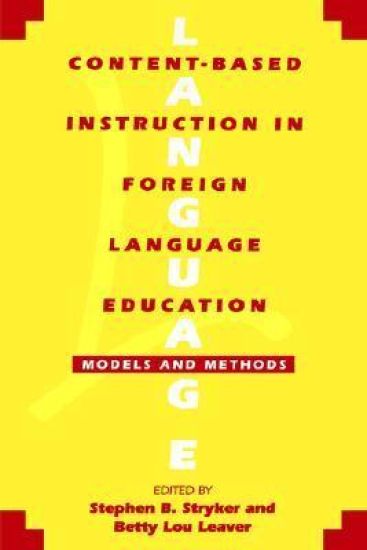
Content-Based Instruction in Foreign Language Education
This book offers concrete and practical ideas for implementing content-based instruction - using subject matter rather than grammar - through eleven case studies of cutting-edge models in a broad variety of languages, academic settings, and levels of proficiency. The highly innovative models illustrate content-based instruction programs for both commonly and less-commonly taught languages - Arabic, Croatian, French, German, Indonesian, Italian, Russian, Serbian, and Spanish - and for proficiency levels ranging from beginners to fluent speakers. They include single-teacher and multi-teacher contexts and such settings as typical language department classrooms, specialty schools, intensive language programs, and university programs in foreign languages across the curriculum. All of the contributors are pioneers and practitioners of content-based instruction, and the methods they present are based on actual classroom experiences. Each describes the rationale, curriculum design, materials, and evaluation procedures used in an actual curriculum and discusses the implications of the approach for adult language acquisition.
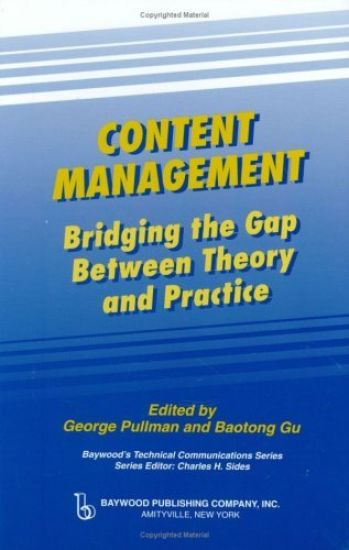
Content Management

Content Management

Baywood Publishing Company Inc
2008
sidottu
This collection of articles is the first attempt by academics and professional writers to delve into the world of content management systems. The knowledge economy's greatest asset and primary problem is information management: finding it, validating it, re-purposing it, keeping it current, and keeping it safe. In the last few years content management software has become as common as word-processing software was five years ago. But unlike word processors, which are designed for single authorization and local storage, content management systems are designed to accommodate large-scale information production, with many authors providing many different pieces of information kept in a web-accessible database, any piece of which might find its way into electronic documents that the author doesn't even know exist. These software systems are complex, to say the least, and their impact on the field of writing will be immense.