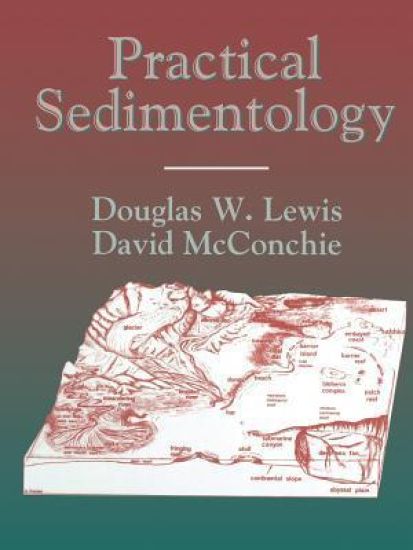
Sedimentology has neither been adequately popularized nor This book begins with a consideration of the complex end commonly taught as an interdisciplinary subject, and many product of processes and materials, the sedimentary environ workers in the areas of modem environment studies have very ment. It then proceeds to discuss the processes and materials limited knowledge of sedimentology. Practical Sedimentol themselves. The emphasis is on geological interpretations of ogy (henceforth PS) is designed to provide an introduction and ancient deposits, but most discussions are also relevant to review of principles and interpretations related to sedimentary modem sediments and can be used to predict environmental processes, environments, and deposits. Its companion volume, changes. A basic knowledge of geological jargon is antici Analytical Sedimentology (henceforth AS), provides "cook pated for users of this book; we try to define most of the more book recipes" for common analytical procedures dealing with esoteric terms in context, but if there are additional incom sediments, and an introduction to the principles and reference prehensible terms, refer to Bates and Jackson's Glossary of sources for procedures that generally would be performed by Geology (AGI, 1987). specialist consultants or commercial laboratories. Specialist sedimentologists will find in them useful reviews, whereas sci ACKNOWLEDGMENTS entists from other disciplines will find in them concepts and procedures that may contribute to an expanded knowledge of Many chapter drafts ofPS were critically reviewed by Dr. M.
This book brings together some of the results and ideas produced by a large number of people-colleagues and students with whom I am privileged to work in the laboratory at Rockefeller University. In terms of my personal history I see it as a confluence of creative forces persons from whom I have learned. I was instructed in neuroanatomy by Walle J. H. Nauta at M. I. T. , and later in a course at Harvard Medical School under the direction of Richard Sidman. At Harvard Medical School, where M. I. T. graduate students were allowed to cross register, the superb neurophysiology course was under the guiding spirit of Stephen Kuffler. Later, I benefited greatly from participating in his summer course in electrophysiological techniques at Woods Hole. Eric Kandel and his colleagues have provided us with the most exciting contemporary approach to the conceptualization and study of cellular mechanisms for behavior. Here at Rockefeller, Carl Pfaffmann and Neal Miller have been leaders in every sense of the word. Not only did they provide me with opportunities to grow to scientific maturity; they also set an example of clear thinking about mechanisms for mammalian behavior patterns. I wrote this book to show how the systematic use of increasingly detailed electrophysiological, neuroanatomical, and neuroendocrine tech niques can explain the mechanism for a mammalian behavioral response. The behavior in question happens to be sensitive to steroid hormones and plays a central role in reproduction.
Nought's had, all's spent, Where our desire is got without content: 'Tis safer to be that which we destroy Than by destruction dwell in doubtful joy. So speaks Lady Macbeth upon the attainment of the aim of her ambition (act 3, scene 2). Is this expression of a fear of success the consequence of the highly competitive arena in which she is striving to achieve? Will this sentiment later lead to the avoidance of this or other forms of success? Does she fear success because she is a woman? While the fear and avoidance of success are ideas that are not new to psychology or to human behavior, recent work by Matina Homer has excited great interest in the psychological measure of a personal disposition to avoid success and a behavioral measure of that avoidance. It is with this recent wave of research and writing that Part II of this book is concerned. Great personal interest was stimulated in the "fear of success" concept. It is not only the hypochondriacs who find in the idea of a "fear of success" syndrome an explanation for the course of their lives. In Part I are presented the earlier forms which the concept of "fear of success" took, especially in psychoanalytic theory and per sonality theory, originating with Freud's discussion of "those wrecked by success," but citing some of the much older cultural traditions involving a fear and/or avoidance of success.
This book is intended for mathematicians. Its origins lie in a course of lectures given by an algebraist to a class which had just completed a substantial course on abstract algebra. Consequently, our treatment of the subject is algebraic. Although we assume a reasonable level of sophistication in algebra, the text requires little more than the basic notions of group, ring, module, etc. A more detailed knowledge of algebra is required for some of the exercises. We also assume a familiarity with the main ideas of set theory, including cardinal numbers and Zorn's Lemma. In this book, we carry out a mathematical study of the logic used in mathematics. We do this by constructing a mathematical model of logic and applying mathematics to analyse the properties of the model. We therefore regard all our existing knowledge of mathematics as being applicable to the analysis of the model, and in particular we accept set theory as part of the meta-Ianguage. We are not attempting to construct a foundation on which all mathematics is to be based--rather, any conclusions to be drawn about the foundations of mathematics come only by analogy with the model, and are to be regarded in much the same way as the conclusions drawn from any scientific theory.
During the Korean War, John Ediford, a young U.S. Army officer, must fully trust his men and his own decision making ability, often in life and death situations. In doing so, Lieutenant Ediford faces the challenge of confronting both his past and also his uncertain future back home. The playwright's father was a veteran of both World War II and the Korean War. Mr. Engelhardt's father often recounted battlefield stories of those times. This play is based upon the critical circumstances detailed in some of those accounts. This story also details a soldier's return home and the problems he encounters with family and friends.
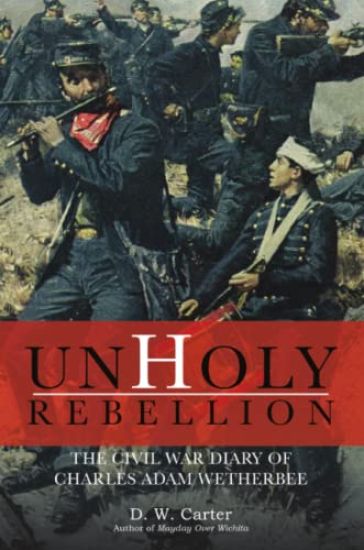
"I left three years ago to do my part in putting down this unholy rebellion." By 1861, Charles Adam Wetherbee had officially traded his comfortable life as a college student for one that included drafty Sibley tents, long marches in weather and wilderness of all kinds, and bloodshed. A Union infantryman with the Thirty-Fourth Illinois Volunteer Regiment, he survived the battles of Shiloh, Stones River, Liberty Gap, Atlanta, and others. One hundred years later, long after Wetherbee had died, a tattered and faded diary was found at a home in Lawrence, Kansas. The homeowner opened its pages and was astonished to discover that Wetherbee had penned every detail of his daily life during the Civil War. Wetherbee's diary presents a realistic view of what a soldier's life entailed, as the reader is thrust into the firsthand drama of the Civil War as it was endured by enlisted participants. Get a true sense of what the Civil War was like from someone who was there to witness an Unholy Rebellion.
"I left three years ago to do my part in putting down this unholy rebellion." By 1861, Charles Adam Wetherbee had officially traded his comfortable life as a college student for one that included drafty Sibley tents, long marches in weather and wilderness of all kinds, and bloodshed. A Union infantryman with the Thirty-Fourth Illinois Volunteer Regiment, he survived the battles of Shiloh, Stones River, Liberty Gap, Atlanta, and others. One hundred years later, long after Wetherbee had died, a tattered and faded diary was found at a home in Lawrence, Kansas. The homeowner opened its pages and was astonished to discover that Wetherbee had penned every detail of his daily life during the Civil War. Wetherbee's diary presents a realistic view of what a soldier's life entailed, as the reader is thrust into the firsthand drama of the Civil War as it was endured by enlisted participants. Get a true sense of what the Civil War was like from someone who was there to witness an Unholy Rebellion.