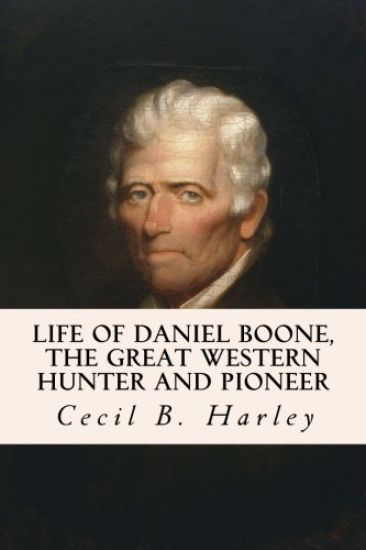
Venture into the untamed American West with "Life & Times of Col. Daniel Boone," a captivating biography by Cecil B. Harley that chronicles the remarkable life of Daniel Boone, the legendary frontiersman. More than just a biography, this volume includes Boone's own autobiography, dictated by himself, offering unparalleled insight into his experiences. Explore the rugged landscape of Kentucky through the eyes of a true pioneer. This account details Boone's adventures, challenges, and triumphs as he navigated the dangers and opportunities of frontier life. Discover the skills and resilience required to thrive in the wilderness and understand Boone's enduring legacy as a symbol of American exploration and self-reliance. This historical text offers a glimpse into a formative period in American history, capturing the spirit of adventure and the allure of the frontier that continues to fascinate readers. Delve into the world of early Kentucky and experience the life of a man who helped shape the American West.This work has been selected by scholars as being culturally important, and is part of the knowledge base of civilization as we know it.This work is in the public domain in the United States of America, and possibly other nations. Within the United States, you may freely copy and distribute this work, as no entity (individual or corporate) has a copyright on the body of the work.Scholars believe, and we concur, that this work is important enough to be preserved, reproduced, and made generally available to the public. We appreciate your support of the preservation process, and thank you for being an important part of keeping this knowledge alive and relevant.
This Daniel Boone biography tells of one of the most remarkable men which this country has produced. His character is marked with originality, and his actions were important and influential in one of the most interesting periods of our history--that of the early settlement of Kentucky. Boone is generally acknowledged as the founder of that State. Daniel Boone (November 2, 1734 O.S. October 22] - September 26, 1820) was an American pioneer, explorer, woodsman, and frontiersman, whose frontier exploits made him one of the first folk heroes of the United States. Boone is most famous for his exploration and settlement of what is now Kentucky, which was then part of Virginia but on the other side of the mountains from the settled areas. As a young adult, Boone supplemented his farm income by hunting and trapping game, and selling their pelts in the fur market. Through this occupational interest, Boone first learned the easy routes to the area. Despite some resistance from American Indian tribes such as the Shawnee, in 1775, Boone blazed his Wilderness Road through the Cumberland Gap in the Appalachian Mountains from North Carolina and Tennessee into Kentucky. There, he founded the village of Boonesborough, Kentucky, one of the first American settlements west of the Appalachians. Before the end of the 18th century, more than 200,000 Americans migrated to Kentucky/Virginia by following the route marked by Boone. Boone was a militia officer during the Revolutionary War (1775-83), which, in Kentucky, was fought primarily between the American settlers and the British-aided Indians. Boone was captured by Shawnee warriors in 1778. He escaped and alerted Boonesborough that the Shawnees were planning an attack. Although heavily outnumbered, Americans repelled the Shawnee warriors in the Siege of Boonesborough. Boone was elected to the first of his three terms in the Virginia General Assembly, during the Revolutionary War, and fought in the Battle of Blue Licks in 1782. Blue Licks, a Shawnee victory over the Patriots, was one of the last battles of the Revolutionary War, coming after the main fighting ended in October 1781. 3] Following the war, Boone worked as a surveyor and merchant, but fell deeply into debt through failed Kentucky land speculation. Frustrated with the legal problems resulting from his land claims, in 1799, Boone emigrated to eastern Missouri, where he spent most of the last two decades of his life (1800-20). Boone remains an iconic figure in American history. He was a legend in his own lifetime, especially after an account of his adventures was published in 1784 by John Filson, making him famous across Europe as the typical all-American frontiersman. An American edition made him equally famous across the United States. After his death, he was frequently the subject of heroic tall tales and works of fiction. His adventures-real and legendary-were influential in creating the archetypal Western hero of American folklore. In American popular culture, he is remembered as one of the foremost early frontiersmen. The epic Daniel Boone mythology often overshadows the historical details of his life.
Reprint of the original, first published in 1865. Comprising an Account of His Early History, His Daring and Remarkable Career as the First Settler of Kentucky, His Thrilling Adventures With the Indians, and His Wonderful Skill, Coolness and Sagacity under All the Hazardous and Trying Circumstances of Western Border Life.
Reprint of the original, first published in 1865. Comprising an Account of His Early History, His Daring and Remarkable Career as the First Settler of Kentucky, His Thrilling Adventures With the Indians, and His Wonderful Skill, Coolness and Sagacity under All the Hazardous and Trying Circumstances of Western Border Life.
Life of Daniel Boone, the Great Western Hunter and Pioneer, has been acknowledged as a major work throughout human history, and we have taken precautions to assure its preservation by republishing this book in a modern manner for both present and future generations. This book has been completely retyped, revised, and reformatted. The text is readable and clear because these books are not created from scanned copies.
Chief Daniel Bread (1800-1873) played a key role in establishing the Oneida Indians' presence in Wisconsin after their removal from New York, yet no monument commemorates his deeds as the community's founder. Laurence M. Hauptman and L. Gordon McLester, III, redress that historical oversight, connecting Bread's life story with the nineteenth-century history of the Oneida Nation.Bread was often criticized for his support of acculturation and missionary schools as well as for his working relationship with Indian agents; however, when the Federal-Menominee treaties slashed Oneida lands, he fought back, taking his people's cause to Washington and confronting President Andrew Jackson. The authors challenge the long-held views about Eleazer Williams's leadership of the Oneidas and persuasively show that Bread's was the voice vigorously defending tribal interests.
Chief Daniel Bread (1800-1873) played a key role in establishing the Oneida Indians' presence in Wisconsin after their removal from New York, yet no monument commemorates his deeds as the community's founder. Laurence M. Hauptman and L. Gordon McLester, III, redress that historical oversight, connecting Bread's life story with the nineteenth-century history of the Oneida Nation.Bread was often criticized for his support of acculturation and missionary schools as well as for his working relationship with Indian agents; however, when the Federal-Menominee treaties slashed Oneida lands, he fought back, taking his people's cause to Washington and confronting President Andrew Jackson. The authors challenge the long-held views about Eleazer Williams's leadership of the Oneidas and persuasively show that Bread's was the voice vigorously defending tribal interests.
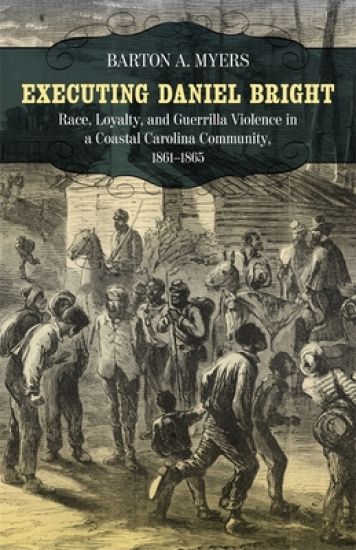
On December 18, 1863, just north of Elizabeth City in rural northeastern North Carolina, a large group of white Union officers and black enlisted troops under the command of Brigadier General Edward Augustus Wild executed a local citizen for his involvement in an irregular resistance to Union army incursions along the coast. Daniel Bright, by conflicting accounts either a Confederate soldier home on leave or a deserter and guerrilla fighter guilty of plundering farms and harassing local Unionists, was hanged inside an unfinished postal building. The initial fall was not mortal, and according to one Union soldier's account, Bright suffered a slow death by ""strangulation, his heart not ceasing to beat for twenty minutes."" Until now, Civil War scholars considered Bright and the Union incursion that culminated in his gruesome death as only a historical footnote. In Executing Daniel Bright, Barton A. Myers uses these events as a window into the wider experience of local guerrilla conflict in North Carolina's Great Dismal Swamp region and as a representation of a larger pattern of retaliatory executions and murders meant to coerce appropriate political loyalty and military conduct on the Confederate homefront. Race, political loyalties, power, and guerrilla violence all shaped the life of Daniel Bright and the home he died defending, and Myers shows how the interplay of these four dynamics created a world where irregular military activity could thrive. Myers opens with an analysis of antebellum slavery, race relations, slavery debates, and the role of the environment in shaping the antebellum economy of northeastern North Carolina. He then details the emergence of a rift between Unionist and Confederate factions in the area in 1861, the events in 1862 that led to the formation of local guerrilla bands, and General Wild's 1863 military operation in Pasquotank, Camden, and Currituck counties. He explores the local, state, regional, and Confederate Congress's responses to the events of the Wild raid and specifically to Daniel Bright's hanging, revealing the role of racism in shaping those responses. Finally, Myers outlines the outcome of efforts to negotiate neutrality and the state of local loyalties by mid-1864.Revising North Carolina's popular Civil War mythology, Myers concludes that guerrilla violence such as Bright's execution occurred not only in the highlands or Piedmont region of the state's homefront; rather, local irregular wars stretched from one corner of the state to the other. He explains how violence reshaped this community and profoundly affected the ways loyalties shifted and manifested themselves during the war. Above all, Myers contends, Bright's execution provides a tangible illustration of the collapse of social order on the southern homefront that ultimately led to the downfall of the Confederacy. Microhistory at its finest, Executing Daniel Bright adds a thought-provoking chapter to the ever-expanding history of how Americans have coped with guerrilla war.