Everything pharmacists and pharmacy students need to know about drug information managementA Doody's Core Title for 2024 & 2023! Drug Information: A Guide for Pharmacists provides you with the tools you need to to research, interpret, evaluate, collate, and disseminate drug information in the most effective and efficient manner possible. This trusted resource addresses essential topics such as formulating an effective response and recommendations for information, evaluation of drug literature, the application of statistical analysis in the biomedical sciences, medications and patient safety, investigational drugs, and more.This updated seventh edition also addresses other important issues such as the legal and ethical considerations of providing information, how to respond to requests for information, and how to determine what information should be made available.
The iPhone and iPod touch have provided all software developers with a level playing field—developers working alone have the same access to consumers as multinational software publishers. Very cool indeed! To make your application stand out from the crowd, though, it has to have that something extra. You must learn the skills to take your apps from being App Store filler to download chart-topping blockbusters. Developers with years of experience helped write this book. Spend some time understanding their code and why they took the approach they did. You will find the writing, illustrations, code, and sample applications second to none. No matter what type of application you are writing, you will find something in this book to help you make your app that little bit cooler. The book opens with Wolfgang Ante, the developer behind the Frenzic puzzle game, showing how timers, animation, and intelligence are used to make game play engaging. It moves on to Rogue Amoeba's Mike Ash explaining how to design a network protocol using UDP, and demonstrating its use in a peer-to-peer application—a topic not normally for the faint of heart, but explained here in a way that makes sense to mere mortals. Gary Bennett then covers the important task of multithreading. Multithreading can be used to keep the user interface responsive while working on other tasks in the background. Gary demonstrates how to do this and highlights traps to avoid along the way. Next up, Canis Lupus (aka Matthew Rosenfeld) describes the development of the Keynote-controlling application Stage Hand, how the user interface has evolved, and the lessons he has learned from that experience. Benjamin Jackson then introduces two open source libraries: cocos2d, for 2D gaming; and Chipmunk, for rigid body physics (think “collisions”). He describes the development of ArcadeHockey, an air hockey game, and explains some of the code used for this. Neil Mix of Pandora Radio reveals the science behind processing streaming audio. How do you debug what you can't see? Neil guides you through the toughest challenges, sharing his experience of what works and what to watch out for when working with audio. Finally, Steven Peterson demonstrates a comprehensive integration of iPhone technologies. He weaves Core Location, networking, XML, XPath, and SQLite into a solid and very useful application. Software development can be hard work. Introductory books lay the foundation, but it can be challenging to understand where to go next. This book shows some of the pieces that can be brought together to make complete, cool applications.
Robert G. Gunn; Bruno David; Jean-Jacques Delannoy; Benjamin Smith; Damien Finch; Augustine Unghangho; Ian Waina; Leigh Douglas; Pauline Heaney; Cecilia Myers; Sven Ouzman; Peter Veth
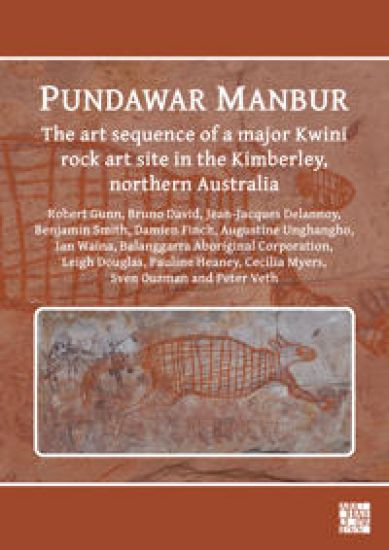
Pundawar Manbur is one of the largest painted rock shelters in the Drysdale River valley of the Kimberley, Western Australia. It contains more than 600 rock paintings, engravings and rock markings with a complex series of overlapping styles of rock art. It is a cultural jewel of Kwini Country, within the lands of the Balanggarra Native Title determination. This monograph presents the first detailed recording and analysis of the site and its art. There are many figures in superposition, and many also in carefully targeted patterns of superimposition, making for a rich story of sequential engagements going back many thousands of years. There is much figurative art, including images from the earliest purported phase of Kimberley art, the Irregular Infill Animal Period, but there are also stencils and other markings. There is evidence of additive reuse – some of the figures have been repainted. There is also fascinating evidence of subtractive reuse, some of the images showing signs of having been ‘battered’ and/or scratched, that is, directly engaged with subsequent to their painting. This monograph is unusual in Australian archaeology as it does not focus on an excavated site; it focuses solely on the rock art of Pundawar Manbur and gives it the attention it deserves.
Interesting and important ethical questions confront researchers, regulators, institutional review boards, support personnel, and research participants committed to the ethical conduct of human subjects research at all stages of research. Questions encompass - but are not limited to - study design, enrolling participants, balancing the clinical needs of participants against the research agenda, ending trials, discharging post-trial obligations, and resolving conflicts. Straightforward solutions to these types of questions are often not found in regulations, ethics codes, or the bioethics literature. These resources may leave room for interpretation, offer conflicting guidance, or simply fail to address particular questions. Ethics consultation, which has been offered in clinical care settings with regularity since the 1980s, has since the turn of the century increasingly been sought in the clinical research context. Because there has only lately been recognition that ethics consultants can play a valuable role helping the research community conduct research in the most ethically informed way, there are many open questions in the field of research ethics consultation including the appropriate role of consultants and the best methods of consultation. The Clinical Center Bioethics Consultation Service has been serving the NIH community of researchers, administrators, healthcare providers, and research participants for more than a decade, conducting nearly 1,000 consultations in that time. In this book, members of the Bioethics Consultation Service reflect on this long track-record and unparalleled range of research ethics consultations to share a collection of their most interesting and informative research ethics consultations and to start a dialogue on remaining open questions. Although the NIH experience is unique, this book focuses on cases - and associated lessons - that are generalizable and valuable for the entire clinical research community. This book will be valuable to ethics consultants, clinical investigators, students and teachers, and others desiring insight into clinical research ethics and ethics consultation.
This title examines how the urban physical, social, and political environment constrains aerospace operations; identifies key operational tasks that aerospace forces can help accomplish; and discusses strategies and technologies that can improve success in urban operations.
This addition to the ISOR series introduces complementarity models in a straightforward and approachable manner and uses them to carry out an in-depth analysis of energy markets, including formulation issues and solution techniques. In a nutshell, complementarity models generalize: a. optimization problems via their Karush-Kuhn-Tucker conditions b. on-cooperative games in which each player may be solving a separate but related optimization problem with potentially overall system constraints (e.g., market-clearing conditions) c. conomic and engineering problems that aren’t specifically derived from optimization problems (e.g., spatial price equilibria) d. roblems in which both primal and dual variables (prices) appear in the original formulation (e.g., The National Energy Modeling System (NEMS) or its precursor, PIES). As such, complementarity models are a very general and flexible modeling format. A natural question is why concentrate on energy markets for this complementarity approach? s it turns out, energy or other markets that have game theoretic aspects are best modeled by complementarity problems. The reason is that the traditional perfect competition approach no longer applies due to deregulation and restructuring of these markets and thus the corresponding optimization problems may no longer hold. Also, in some instances it is important in the original model formulation to involve both primal variables (e.g., production) as well as dual variables (e.g., market prices) for public and private sector energy planning. Traditional optimization problems can not directly handle this mixing of primal and dual variables but complementarity models can and this makes them all that more effective for decision-makers.
This addition to the ISOR series introduces complementarity models in a straightforward and approachable manner and uses them to carry out an in-depth analysis of energy markets, including formulation issues and solution techniques. In a nutshell, complementarity models generalize: a. optimization problems via their Karush-Kuhn-Tucker conditions b. on-cooperative games in which each player may be solving a separate but related optimization problem with potentially overall system constraints (e.g., market-clearing conditions) c. conomic and engineering problems that aren’t specifically derived from optimization problems (e.g., spatial price equilibria) d. roblems in which both primal and dual variables (prices) appear in the original formulation (e.g., The National Energy Modeling System (NEMS) or its precursor, PIES). As such, complementarity models are a very general and flexible modeling format. A natural question is why concentrate on energy markets for this complementarity approach? s it turns out, energy or other markets that have game theoretic aspects are best modeled by complementarity problems. The reason is that the traditional perfect competition approach no longer applies due to deregulation and restructuring of these markets and thus the corresponding optimization problems may no longer hold. Also, in some instances it is important in the original model formulation to involve both primal variables (e.g., production) as well as dual variables (e.g., market prices) for public and private sector energy planning. Traditional optimization problems can not directly handle this mixing of primal and dual variables but complementarity models can and this makes them all that more effective for decision-makers.
Mark Pauly; Flaura Winston; Mary Naylor; Kevin Volpp; Lawton Robert Burns; Ralph Muller; David Asch; Rachel Werner; Bimal Desai; Krisda Chaiyachati; Benjamin Chartock
Consumers, public officials, and even managers of health care and insurance are unhappy about care quality, access, and costs. This book shows that is because efforts to do something about these problems often rely on hope or conjecture, not rigorous evidence of effectiveness. In this book, experts in the field separate the speculative from the proven with regard to how care is rendered, how patients can be in control, how providers should be paid, and how disparities can be reduced – and they also identify the issues for which evidence is currently missing. It provides an antidote to frustration and a clear-eyed guide for forward progress, helping health care and insurance innovators make better decisions on deciding whether to go ahead now based on current evidence, to seek and wait for additional evidence, or to move on to different ideas. It will be useful to practitioners in hospital systems, medical groups, and insurance organizations and can also be used in executive and MBA teaching.
Mark Pauly; Flaura Winston; Mary Naylor; Kevin Volpp; Lawton Robert Burns; Ralph Muller; David Asch; Rachel Werner; Bimal Desai; Krisda Chaiyachati; Benjamin Chartock
Consumers, public officials, and even managers of health care and insurance are unhappy about care quality, access, and costs. This book shows that is because efforts to do something about these problems often rely on hope or conjecture, not rigorous evidence of effectiveness. In this book, experts in the field separate the speculative from the proven with regard to how care is rendered, how patients can be in control, how providers should be paid, and how disparities can be reduced – and they also identify the issues for which evidence is currently missing. It provides an antidote to frustration and a clear-eyed guide for forward progress, helping health care and insurance innovators make better decisions on deciding whether to go ahead now based on current evidence, to seek and wait for additional evidence, or to move on to different ideas. It will be useful to practitioners in hospital systems, medical groups, and insurance organizations and can also be used in executive and MBA teaching.
Mamtimin Ala; Richard Thompson Ford; Jaroslaw Anders; Sean Wilentz; Ange Mlinko; Benjamin Moser; Jonathan Zimmerman; Leonard Cohen; Cass R. Sunstein; Mark Lilla; Helen Vendler; Holly Brewer; Shaul Tchernikhovsky; David Thomson
“A Meteor of Intelligent Substance”“Something was Missing in our Culture, and Here It Is”"Liberties is THE place to be. Change starts in the mind."Liberties, a journal of Culture and Politics, is essential reading for those engaged in the cultural and political issues and causes of our time. Liberties features serious, independent, stylish, and controversial essays by significant writers and leaders throughout the world; new poetry; and, introduces the next generation of writers and voices to inspire and impact the intellectual and creative lifeblood of today’s culture and politics.This issue of Liberties includes: new work from Nobel Prize winner Mario Vargas Llosa; drawings by Leonard Cohen published for the first time; Mamtimin Ala’s essay on China’s genocide of the Uyghurs; Jaroslaw Anders’ analysis of the crisis in Belarus; Cass R. Sunstein on liberalism inebriated; Richard Thompson Ford on what slavery does and does not explain; Sean Wilentz on the historical strategy of the Republican Party; Benjamin Moser writes about translation as a form of tourism in literary life; Jonathan Zimmerman on the scandal of college teaching; Mark Lilla on cults of innocence and their victims; Helen Vendler on Adrienne Rich; Holly Brewer on race and enlightenment; David Thomson asks, What shall we watch now?; Celeste Marcus (managing editor) on the legend of Alice Neel; Leon Wieseltier (editor) on Zionism’s beautiful stubbornness of survival; and new poetry from Ange Mlinko and Shaul Tchernikhovsky, translated by Robert Alter.
Michael Ignatieff; Mary Gaitskill; Sergei Lebedev; Antonia Bouis; Karen Solie; Michael Walzer; David A. Bell; Justin E.H. Smith; Michael C. Kimmage; Andrew Scull; Robert Alter; Steven B. Smith; Benjamin Moser; Helen Vendler; John Hodgen; Adam Zagajewski
Liberties, a Journal of Culture and Politics, is essential reading for those engaged in the cultural and political issues of our time. In this issue of Liberties: Michael Ignatieff - The Mind’s Emancipation; Mary Gaitskill - The Trials of the Young; Sergei Lebedev - Putin’s Philosopher: A Memoir; Michael Walzer - Moral Concern; Justin E. H. Smith – The Happiness Industrial Complex; Andrew Scull – The Fashions in Trauma; David A. Bell – The Triumph of Anti-Politics in America; Michael Kimmage – A Defense of Delight in a Dark Time; Robert Alter – Proust and the Mystification of the Jews; Steven B. Smith – What is a Statesman?; Benjamin Moser – Rembrandt’s shadows; Helen Vendler – The Poetry of Charm; Celeste Marcus – Priorism, or the Joshua Katz Affair; Leon Wieseltier – Problems and Struggles; and, new poems by Karen Solie, Adam Zagajewski, and John Hodgen.Published quarterly, Liberties, is a collection of the most significant writers today as well as launching the voices of tomorrow.Liberties features serious, independent, stylish, and controversial essays by significant writers and introduces the next generation of writers and poets to inspire and impact the intellectual and creative lifeblood of today’s culture and politics. Nobel Prize winners, leading op-ed writers, well-known non-fiction writers, rising talents, and poets from around the world are part of the Liberties series.There’s a reason why engaged citizens, cultural warriors, political leaders, opinion makers, and activists from across the cultural and political spectrum read and cherish Liberties.
Giles Kepel; Ingrid Rowland; Vladimir Kara-Murza; Enrique Krauze; Paul Muldoon; Mitchell Abidor; Agnes Callard; Henri Cole; William Deresiewicz; Benjamin Moser; David Nirenberg; Peter Phillips; Becca Rothfeld; Paul Starr; David Thomson; Chaim Nacham Bialik
“A Meteor of Intelligent Substance” “Something was Missing in our Culture, and Here It Is” “Liberties sure is needed in these times.”In a short time since its launch, Liberties - A Journal of Culture and Politics, a quarterly, has become essential reading for those engaged in the cultural and political issues and causes of our time. The writers in Liberties offer deep experience from across borders, national identities, political affiliations and artistic achievements. As the introductory essay in the inaugural edition noted, “At this journal we are betting on what used to be called the common reader, who would rather reflect than belong and asks of our intellectual life more than a choice between orthodoxies.” Each issue of Liberties features original in-depth essays and compelling new poetry from some of the world's most significant writers, artists, and scholars, as well as introducing new talent, to inspire and impact the intellectual and creative lifeblood of today’s culture and politics. This spring issue of Liberties includes: Giles Kepel on the Murder of Samuel Paty; Ingrid Rowland’s Long Live the Classics!; Vladimir Kara-Murza Surviving Putin’s Poisons; Paul Starr on Reckoning with National Failure from Covid; Becca Rothfeld on Today's Sanctimony Literature; Enrique Krauze explores What is Latin America?; William Deresiewicz on Why Great Visual Art Forces Us to Think; Benjamin Moser on Rediscovering Frans Hals; David Nirenberg on What We Can Learn from Earlier Plagues; Agnes Callard’s view of Romance without Love, Love without Romance; Mitchell Abidor looks back to “Social Media” in 1895 to Understand a Crowd’s “Wisdom”; The Tallis Scholars' Peter Phillips on the Secrets of Josquin; David Thomson on Movies’ Poetic Desire; Poetry from Henri Cole, Chaim Nachman Bialik, and Paul Muldoon; and, Leon Wieseltier (editor) asks "Where Are the Americans?” and Celeste Marcus (managing editor) writes for a Pluralistic Heart.
Blundell Geoffrey; Christopher Chippindale; Clottes Jean; Conkey Margaret W.; Edward B. Eastwood; Francis Julie E.; Helskog Knut; Imogene L. Lim; Loendorf Lawrence L.; Johannes Loubser; David Morris; Sven Ouzman; Neil Price; Saetersdal Tore; Benjamin Smith; Patricia Vinnicombe; Eva Walderhaug; Walker Nick; Whitley David S.
This collection focuses on David Lewis-Williams and the extent of his personal impact on the field of rock art research. It is largely through his work that San rock art has come to be understood so well, as a complex symbolic and metaphoric representation of San religious beliefs and practices. The purpose of this volume is to demonstrate the depth and wide geographical impact of Lewis-Williams' contribution, with particular emphasis on the use of theory and methodology drawn from ethnography that he has used with inspirational effect in understanding the meaning and context of rock art in various parts of the world. Seeing and Knowing explores how best archaeologists study rock art when there exist ethnographic or ethno - historic bases of insight, and how they study rock art when there do not appear to exist ethnographic or ethnohistoric bases of insight - in short, how to understand and learn from rock art with and without ethnography. Because many of the chapters are based on solid fieldwork and ethnographic research, they offer a new body of work that provides the evidence for differentiation between knowing and simply seeing.
Johan Brandtler; Mikael Kalm; Maia Andréasson; Kristian Blensenius; Gustav Bockgård; Maria Bylin; Philippe Collberg; Pernilla Hallonsten Halling; David Håkansson; Susanna Karlsson; Per Klang; Ida Larsson; Filippa Lindahl; Josefin Lindgren; Benjamin Lyngfelt; Johanna Prytz; Anna-Lena Wiklund
Det är välkänt att grundläggande läroböcker i grammatik av pedagogiska skäl behöver utgå från en starkt idealiserad bild av språket och grammatiken. Men efter det alldeles nödvändiga tragglandet av form, funktion och klassificering väcks också nyfikenheten för vad som kan finnas mer att förstå om språkets mönster och principer. Grammatisk fördjupning innebär därför att i viss mån slå sönder flera av de ”sanningar” och föreställningar som den grundläggande grammatiska beskrivningen förmedlar. I 18 kapitel problematiserar författarna en rad olika aspekter av svenskans grammatik och diskuterar grammatikbeskrivningens praktiska och teoretiska nytta. Hur många ordklasser finns det, egentligen? Hur kan man skilja mellan adverb och adjektiv, eller huvudverb och hjälpverb? Och hur gör man med konstruktioner som förekommer i vardagligt språk? Nyanser av grammatik är avsedd för universitetskurser i svenska och nordiska språk samt för ämneslärarutbildning i svenska.
John Andersson; Valerio Bindi; Jonna Björnstjerna; Ruben Dahlstrand; Sara Granér; Åsa Grennvall; Simon Gärdenfors; Fabian Göransson; Stina Hjelm; Mats Jonsson; Kanarp; Tom Karlsson; Megan Kelson; David Liljemark; Pontus Lundkvist; Jay McInerny; Joakim Pirinen; John Porcellino; Emma Rendel; Benjamin Stengård; Liv Strömquist; Tiitu Takalo; Jaques Tardi; Pär Thörn
Galago, sedan nästan 30 år tillbaka Sveriges ledande tidskrift för alternativa serier, har blivit en serieantologi i bokform. I tre 200-sidiga volymer per år publiceras de bästa svenska och utländska serierna gjorda för en vuxen publik, tillsammans med tecknarintervjuer, rikt illustrerade noveller och diverse infall. I Galago volym 92 presenterar David Liljemark och Ruben Dahlstrand en lång originalserie om frijazz och förvriden sexualitet,Fabian Göranson låter sin kaosskapande apa löpa amok och Åsa Grennvall tränger djupt in i föraktets mekanismer. Numrets novell är en lång historia av New York-eleganten Jay McInerney, stilfullt illustrerad av Loka Kanarp. Pär Thörn skriver sinnesförminskande text och Frej från Slagsmålsklubben intervjuar Simon Gärdenfors om mastodontprojektet Simons 120 dagar. Dessutom: Mats Jonsson går runt i Stockholm med barnvagn! Liv Strömquist brinner! Italienarna är över oss! Och mycket, mycket mer.
Samuel Gulliksson; Johannes Milich; Ulrika Nettelblad; Joaquim Fräki Martins; Emil Bendix; Ted Godsom Treacy; Otto Ruin; David Janouch; Sigrid Arén; Niall Balfe; Benjamin Miller Olsson
Katharsis institut grundades i Göteborg men är sedan 2022 verksamt också i Stockholm. Samma år var det hundra år sedan James Joyces mastodontverk Ulysses publicerades i Paris. För att fira detta jubileum arrangerade institutet en skrivartävling tillsammans med Irlands ambassad i Stockholm. Bidragen skulle vara inspirerade av en av romanens tre huvudkaraktärer, ha någon form av koppling till Sverige och vara skrivna på antingen svenska eller engelska. Juryns ordförande var institutets Sigrid Arén. Oändliga samtal samlar de fem kortlistade texterna från tävlingen, inklusive pristagaren Samuel Gullikssons bidrag. Dessutom publiceras fyra texter skrivna av institutets redaktionsmedlemmar, en essä av kritikern och skribenten Otto Ruin samt foton från Dublin av den irländske fotografen Ted Godson Treacy. Antologins mångfacetterade texter visar hur Ulysses än idag ger kraft åt ett oändligt samtal. Kopplingen till Joyces verk varierar, och alla texterna kan gott och väl läsas utan förförståelse av det klassiska verket.
Everyone makes mistakes. Some mistakes can be greater then others, yet they all are still mistakes. In order to fix the mistakes you make you have to move on, but what happens when you can't fix the mistake? What if you just wanted to help fix someone else's mistake? What if that particular mistake was made years ago? I'll tell what happens: You'll lose your childhood, free will, and family. Trust me, I have some personal experience with mistakes.