

Kirjahaku
Etsi kirjoja tekijän nimen, kirjan nimen tai ISBN:n perusteella.
1000 tulosta hakusanalla David N. Plotkin

Designing a World-class Quality Management System for FDA Regulated Industries
David N. Muchemu
AuthorHouse
2008
pokkari

Designing a World-class Quality Management System for FDA Regulated Industries
David N. Muchemu
AuthorHouse
2008
sidottu


Nonlinear Optical Crystals: A Complete Survey
David N. Nikogosyan
Springer-Verlag New York Inc.
2010
nidottu
Nonlinear optical techniques are now recognized as the most efficient means available to generate laser radiation at wavelengths that are presently inaccessible via conventional sources. This technology uses nonlinear optical crystals for the frequency conversion of laser light. The book contains the most complete and up to date reference material on properties of nonlinear optical crystals, describes their applications, both traditional and specific, and provides the main mathematical formulas necessary for the calculation of the frequency conversion process. It is a vital source of information for scientists and engineers dealing with modern applications of nonlinear optical crystals in quantum electronics, optoelectronics and laser physics.

Identifying, Assessing, and Treating Self-Injury at School
David N. Miller; Stephen E. Brock
Springer-Verlag New York Inc.
2010
sidottu
Nonsuicidal self-injury (NSSI) among young people—most notably in the form of forearm- or wrist-cutting—occurs across cultural groups, social strata, and developmental stages, puzzling and repelling adults. Youth engaging in NSSI behaviors are at a higher risk for suicidality as well as other mental health and academic problems. And because NSSI is often first noticed in the school setting (as is the case with many children’s disorders), school professionals are being encouraged to take a more proactive role in intervention.The first book specifically geared toward education personnel, Identifying, Assessing, and Treating Self-Injury at School clearly defines NSSI, differentiating it from suicidal, borderline, and other behaviors and analyzing the psychological contexts in which it occurs. This school-based perspective gives readers a practical framework for earlier, more accurate diagnosis; relevant consulting with parents, teachers, and colleagues; and effective, science-based treatment.Included in the coverage: an overview of causes of self-injury, current findings on prevalence and associated conditions, early screening guidelines, including risk factors and warning signs, the latest information on assessment issues and diagnostic methods, a separate chapter on psychoeducational assessment and up-to-date research on interventions for NSSI.Identifying, Assessing, and Treating Self-Injury at School offers a solid foundation for school psychologists and allied educational professionals to understand students with NSSI and address their complex needs.
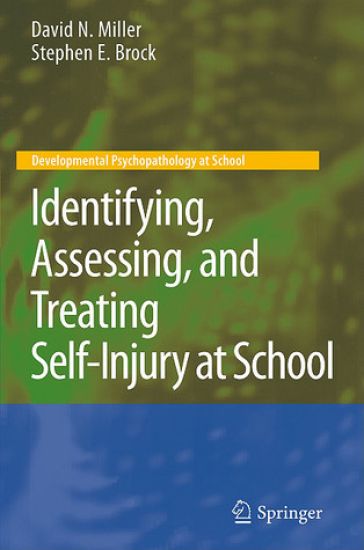
Identifying, Assessing, and Treating Self-Injury at School
David N. Miller; Stephen E. Brock
Springer-Verlag New York Inc.
2011
nidottu
Nonsuicidal self-injury (NSSI) among young people—most notably in the form of forearm- or wrist-cutting—occurs across cultural groups, social strata, and developmental stages, puzzling and repelling adults. Youth engaging in NSSI behaviors are at a higher risk for suicidality as well as other mental health and academic problems. And because NSSI is often first noticed in the school setting (as is the case with many children’s disorders), school professionals are being encouraged to take a more proactive role in intervention.The first book specifically geared toward education personnel, Identifying, Assessing, and Treating Self-Injury at School clearly defines NSSI, differentiating it from suicidal, borderline, and other behaviors and analyzing the psychological contexts in which it occurs. This school-based perspective gives readers a practical framework for earlier, more accurate diagnosis; relevant consulting with parents, teachers, and colleagues; and effective, science-based treatment.Included in the coverage: an overview of causes of self-injury, current findings on prevalence and associated conditions, early screening guidelines, including risk factors and warning signs, the latest information on assessment issues and diagnostic methods, a separate chapter on psychoeducational assessment and up-to-date research on interventions for NSSI.Identifying, Assessing, and Treating Self-Injury at School offers a solid foundation for school psychologists and allied educational professionals to understand students with NSSI and address their complex needs.


How To Perform Process Validation: A cGMP GUIDE FOR QUALITY ENGINEERS
David N. Muchemu
Createspace Independent Publishing Platform
2009
nidottu

How to write standard operating procedures and work Instructions.: A handbook For Quality Managers and Quality Engineers.
David N. Muchemu
Createspace Independent Publishing Platform
2010
nidottu

Principles of Process validation: A handbook for professionals in Medical Device, Pharmaceutical, and Biomedical Industries.
David N. Muchemu
Createspace Independent Publishing Platform
2010
nidottu


Basic Clean Room Protocol: How to gown for the clean room
David N. Muchemu
Createspace Independent Publishing Platform
2011
nidottu

This comprehensive resource--now revised and expanded--provides school practitioners with an evidence-based framework for preventing and effectively responding to youth suicidal behavior. David N. Miller guides readers to understand, screen, and assess for suicide risk in students in grades K-12. He presents collaborative strategies for intervening appropriately within a multi-tiered system of support. The book also shows how to develop a coordinated plan for postvention in the aftermath of a suicide, offering specific dos and don'ts for supporting students, parents, and school personnel. User-friendly tools include reproducible handouts; the book's large-size format facilitates photocopying. Purchasers get access to a webpage where they can download and print the reproducible materials. New to This Edition *Chapter on the roles and responsibilities of the school-based suicide prevention team. *Significantly revised coverage of screening and suicide risk assessment. *Situates prevention and intervention within a schoolwide multi-tiered system of support. *Updated throughout with current data, practical recommendations, and resources.
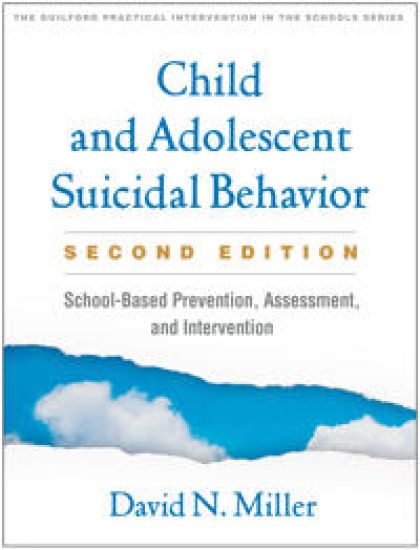
This comprehensive resource--now revised and expanded--provides school practitioners with an evidence-based framework for preventing and effectively responding to youth suicidal behavior. David N. Miller guides readers to understand, screen, and assess for suicide risk in students in grades K-12. He presents collaborative strategies for intervening appropriately within a multi-tiered system of support. The book also shows how to develop a coordinated plan for postvention in the aftermath of a suicide, offering specific dos and don'ts for supporting students, parents, and school personnel. User-friendly tools include reproducible handouts; the book's large-size format facilitates photocopying. Purchasers get access to a webpage where they can download and print the reproducible materials. New to This Edition *Chapter on the roles and responsibilities of the school-based suicide prevention team. *Significantly revised coverage of screening and suicide risk assessment. *Situates prevention and intervention within a schoolwide multi-tiered system of support. *Updated throughout with current data, practical recommendations, and resources.



Daddy, Can We Make Everyday a Christmas?: Based on a True Story
David N. Momah
Createspace Independent Publishing Platform
2010
nidottu