Kirjahaku
Etsi kirjoja tekijän nimen, kirjan nimen tai ISBN:n perusteella.
1000 tulosta hakusanalla Emile Augier

R impression inchang e de l' dition originale de 1839.
Reproduction of the original: mile by Jean Jacques Rousseau
Reproduction of the original: mile by Jean Jacques Rousseau
The book, Emile, has been considered important throughout the human history, and so that this work is never forgotten we have made efforts in its preservation by republishing this book in a modern format for present and future generations. This whole book has been reformatted, retyped and designed. These books are not made of scanned copies of their original work and hence the text is clear and readable.


This book edition of Emile has been formatted to the highest digital standards and adjusted for readability on all devices. ""Emile, or On Education"" or ""Emile, or Treatise on Education"" is a treatise on the nature of education and on the nature of man. Jean-Jacques Rousseau considered it to be the ""best and most important"" of all his writings. Due to a section of the book entitled ""Profession of Faith of the Savoyard Vicar"", Emile was banned in Paris and Geneva and was publicly burned in 1762, the year of its first publication. During the French Revolution, Emile served as the inspiration for what became a new national system of education. Rousseau seeks to describe a system of education that would enable the natural man he identifies in The Social Contract (1762) to survive corrupt society. He employs the novelistic device of Emile and his tutor to illustrate how such an ideal citizen might be educated. Emile is scarcely a detailed parenting guide but it does contain some specific advice on raising children. It is regarded by some as the first philosophy of education in Western culture to have a serious claim to completeness, as well as being one of the first Bildungsroman novels.


In his pioneering treatise on education the great French philosopher Jean-Jacques Rousseau (1712-1778) presents concepts that had a significant influence on the development of pedagogy in the eighteenth century, and yet many of his ideas still sound radical today. Written in reaction to the stultifying system of rote learning and memorization prevalent throughout Europe at the time, Emile is a utopian vision of child-centered education, full of the sentiments of Romanticism, a movement that Rousseau inspired. Imagining a typical boy named Emile, Rousseau creates an ideal model of one-on-one tutelage from infancy to manhood with himself as the child's mentor. As in so many of his other famous works, here, too, Rousseau asserts his main thesis that human beings are by nature good; it is only the distorting influences of civilization that have corrupted them.

Émile Zola was the leader of the literary movement known as 'naturalism' and is one of the great figures of the novel. In his monumental Les Rougon-Macquart (1871-93), he explored the social and cultural landscape of the late nineteenth century in ways that scandalized bourgeois society. Zola opened the novel up to a new realm of subjects, including the realities of working-class life, class relations, and questions of gender and sexuality, and his writing embodied a new freedom of expression, with his bold, outspoken voice often inviting controversy. In this Very Short Introduction, Brian Nelson examines Zola's major themes and narrative art. He illuminates the social and political contexts of Zola's work, and provides readings of five individual novels (The Belly of Paris, L'Assommoir, The Ladies' Paradise, Germinal, and Earth). Zola's naturalist theories, which attempted to align literature with science, helped to generate the stereotypical notion that his fiction was somehow nonfictional. Nelson, however, reveals how the most distinctive elements of Zola's writing go far beyond his theoretical naturalism, giving his novels their unique force. Throughout, he sets Zola's work in context, considering his relations with contemporary painters, his role in the Dreyfus Affair, and his eventual murder. ABOUT THE SERIES: The Very Short Introductions series from Oxford University Press contains hundreds of titles in almost every subject area. These pocket-sized books are the perfect way to get ahead in a new subject quickly. Our expert authors combine facts, analysis, perspective, new ideas, and enthusiasm to make interesting and challenging topics highly readable.

Zola made it his aim to write novels exploring the many compartments and classes of modern French life in the later nineteenth century—and he went on to carry it out, with novels that look at the longings and troubles and everyday lives of people in their specific social milieux. Travelling through the varieties of Zola's styles and settings, realistic and comic and tragic and critical, from shopping to mining to the fertility business, this book is a guide to the different pleasures and modes of thinking to be found in reading Zola today. The last part considers the different kinds of story involved in the final years of Zola's own life. It follows him first to England—to Upper Norwood, in south London, where he was in exile for almost a year in 1898-9, as a result of his intervention in the ongoing Dreyfus affair. Long letters home offer moving insights into Zola's whole way of being, in the intimacy of his daily life and his writing routines, set against the public events of the Dreyfus process that continue to resonate today.
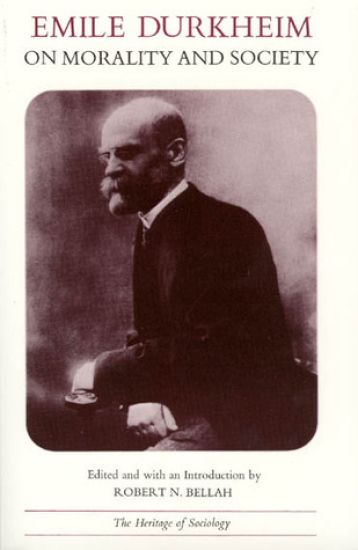
Selections from Durkheim's writings focus on the nature of his conception of society and its moral context
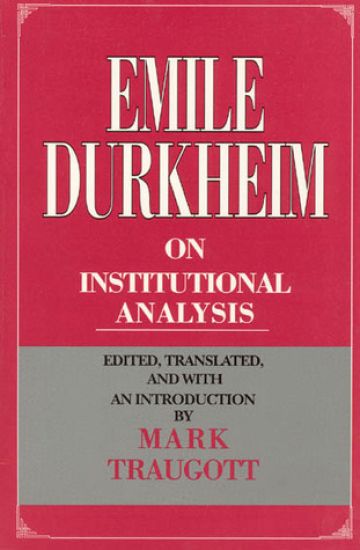
Ranging from Durkheim's original lecture in sociology to an excerpt from the work incomplete at his death, these selections illuminate his multiple approaches to the crucial concept of social solidarity and the study of institutions as diverse as the law, morality, and the family. Durkheim's focus on social solidarity convinced him that sociology must investigate the way that individual behavior itself is the product of social forces. As these writings make clear, Durkheim pursued his powerful model of sociology through many fields, eventually synthesizing both materialist and idealist viewpoints into his functionalist model of society.