Kirjojen hintavertailu. Mukana 11 377 714 kirjaa ja 12 kauppaa.

Kirjahaku

Etsi kirjoja tekijän nimen, kirjan nimen tai ISBN:n perusteella.

1000 tulosta hakusanalla F. Baker

Principles of Geometry

Principles of Geometry

H. F. Baker

Cambridge University Press
2010
pokkari
Henry Frederick Baker (1866–1956) was a renowned British mathematician specialising in algebraic geometry. He was elected a Fellow of the Royal Society in 1898 and appointed the Lowndean Professor of Astronomy and Geometry in the University of Cambridge in 1914. First published between 1922 and 1925, the six-volume Principles of Geometry was a synthesis of Baker's lecture series on geometry and was the first British work on geometry to use axiomatic methods without the use of co-ordinates. The first four volumes describe the projective geometry of space of between two and five dimensions, with the last two volumes reflecting Baker's later research interests in the birational theory of surfaces. The work as a whole provides a detailed insight into the geometry which was developing at the time of publication. This, the second volume, describes the principal configurations of space of two dimensions.
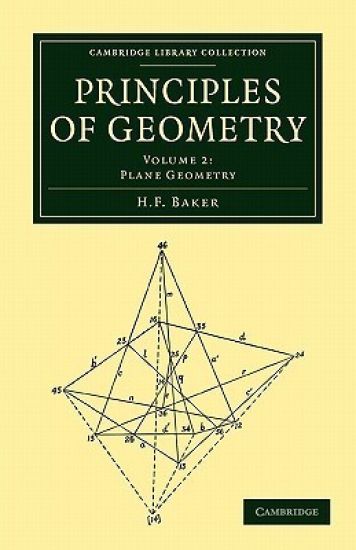
Principles of Geometry

Principles of Geometry

H. F. Baker

Cambridge University Press
2010
pokkari
Henry Frederick Baker (1866–1956) was a renowned British mathematician specialising in algebraic geometry. He was elected a Fellow of the Royal Society in 1898 and appointed the Lowndean Professor of Astronomy and Geometry in the University of Cambridge in 1914. First published between 1922 and 1925, the six-volume Principles of Geometry was a synthesis of Baker's lecture series on geometry and was the first British work on geometry to use axiomatic methods without the use of co-ordinates. The first four volumes describe the projective geometry of space of between two and five dimensions, with the last two volumes reflecting Baker's later research interests in the birational theory of surfaces. The work as a whole provides a detailed insight into the geometry which was developing at the time of publication. This, the third volume, describes the principal configurations of space of three dimensions.
Principles of Geometry

Principles of Geometry

H. F. Baker

Cambridge University Press
2010
pokkari
Henry Frederick Baker (1866–1956) was a renowned British mathematician specialising in algebraic geometry. He was elected a Fellow of the Royal Society in 1898 and appointed the Lowndean Professor of Astronomy and Geometry in the University of Cambridge in 1914. First published between 1922 and 1925, the six-volume Principles of Geometry was a synthesis of Baker's lecture series on geometry and was the first British work on geometry to use axiomatic methods without the use of co-ordinates. The first four volumes describe the projective geometry of space of between two and five dimensions, with the last two volumes reflecting Baker's later research interests in the birational theory of surfaces. The work as a whole provides a detailed insight into the geometry which was developing at the time of publication. This, the fourth volume, describes the principal configurations of space of four and five dimensions.
Principles of Geometry

Principles of Geometry

H. F. Baker

Cambridge University Press
2010
pokkari
Henry Frederick Baker (1866–1956) was a renowned British mathematician specialising in algebraic geometry. He was elected a Fellow of the Royal Society in 1898 and appointed the Lowndean Professor of Astronomy and Geometry in the University of Cambridge in 1914. First published between 1922 and 1925, the six-volume Principles of Geometry was a synthesis of Baker's lecture series on geometry and was the first British work on geometry to use axiomatic methods without the use of co-ordinates. The first four volumes describe the projective geometry of space of between two and five dimensions, with the last two volumes reflecting Baker's later research interests in the birational theory of surfaces. The work as a whole provides a detailed insight into the geometry which was developing at the time of publication. This, the fifth volume, describes the birational geometry of curves.
Principles of Geometry

Principles of Geometry

H. F. Baker

Cambridge University Press
2010
pokkari
Henry Frederick Baker (1866–1956) was a renowned British mathematician specialising in algebraic geometry. He was elected a Fellow of the Royal Society in 1898 and appointed the Lowndean Professor of Astronomy and Geometry in the University of Cambridge in 1914. First published between 1922 and 1925, the six-volume Principles of Geometry was a synthesis of Baker's lecture series on geometry and was the first British work on geometry to use axiomatic methods without the use of co-ordinates. The first four volumes describe the projective geometry of space of between two and five dimensions, with the last two volumes reflecting Baker's later research interests in the birational theory of surfaces. The work as a whole provides a detailed insight into the geometry which was developing at the time of publication. This, the sixth and final volume, describes the birational geometric theory of surfaces.
Organizations for People

Organizations for People

Michael O'Malley; William F. Baker

STANFORD UNIVERSITY PRESS
2019
sidottu
For many years, there has been quite a bit of talk about employee engagement as a means to lift corporate profits and reduce absenteeism and turnover. However, this talk has not produced better companies. In fact, the evidence shows that incivility and instances of employee abuse are getting worse. Additionally, with profit as the primary goal of organizations, most employees view any benign treatment they receive as a secondary convenience that will dissipate once corporate fortunes decline. That is, many employees still believe they are expendable in the eyes of their employers. This book turns that equation around by examining the practices of twenty-one companies that put the interests and needs of employees first. Profits are necessary but insufficient for corporate health. The companies featured in this book see it as their mission to offer people a better, more fulfilling life for themselves, and assist with that holistic journey by providing the organizational elements people need to reach their potential. They do this first by creating respectful and kind cultures that treat every person as an equal, sentient partner in the success of the company. Second, they diligently work to satisfy people's basic needs: financial security, belonging, meaning, autonomy, self-acceptance, self-confidence, and growth. The result is a web of fellow-feeling: earnest affection among people who feverishly work to live up to both the high standards of the institution and their obligations to one another. By providing a place where people can do their best work and thrive as individuals and as members of a cohesive community, everyone profits.
Media Literacy Education to Counter Truth Decay

Media Literacy Education to Counter Truth Decay

Alice Huguet; John F Pane; Garrett Baker

RAND
2021
nidottu
Media literacy (ML) education has emerged as a promising approach to slow Truth Decay, described as the diminishing role of facts, data, and analysis in political and civil discourse. However, teachers report a lack of guidance about implementing ML education, and rigorous research about what kinds of ML education work best remains limited. To address these gaps, this report presents a framework for implementing and evaluating ML educational efforts.
A History of the County of Middlesex

A History of the County of Middlesex

T. F. T. Baker

Early English Text Society
1971
sidottu
This contains histories of ten ancient parishes in north-west Middlesex. Wealthy Lon-doners began to buy property here during the Middle Ages and later settled in fine houses, exemplified by the Jacobean mansion of Swake-leys. Thearea in return supplied the capital with corn, livestock, and, increasingly, with hay and garden produce. In Uxbridge it possessed a medieval market town, whose prosperity grew with the coach trade, and in Harrow, from the 18th century, it boasted a fashionable school. Until the 19th century, however, the parishes were mainly rural and even backward, since agriculture was hampered by the heavy London Clay. The countryside receded only gradually, with thecutting of canals and the digging of brickearth, followed by the penetration of rail-ways and the spread of housing around the railway stations. In 1920 the hay-fields of Perivale, a parish centred around five farms, still contrasted with the factories of Southall, al-though the sale of private estates for development was soon to leave only some carefully preserved open spaces. Contrasts persist today: between the slopes along the Hertfordshire border, with their trees and large residences, and the housing estates which stretch away to the south; between the high streets of Harrow-on-the-Hill and Pinner, scarcely changed in the 20th century, and the M 1 and M 4 motorways; between the village greens at the heart of Norwood and Northolt and the shopping centre under con-struction at Uxbridge; between churches, alms-houses, moats, and barns on one hand, and on the other the stadium and Empire Pool and Arena atWembley, and London Airport, which has obliterated the hamlet of Heathrow and covered most of the parish of Harmondsworth. The volume contains 19 pages of illustrations, two street-plans, and nine maps.