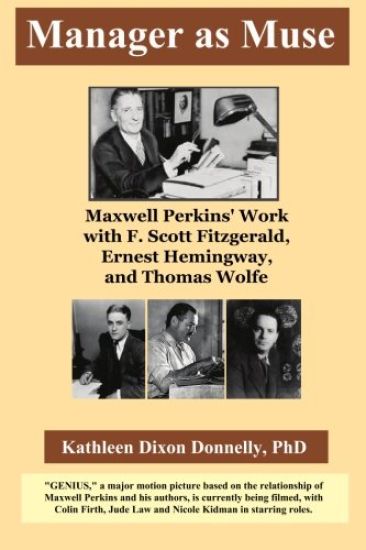
"My goodness, Miss Donnelly, Maxwell Perkins was one of the worst businessmen who ever lived." Interview with Charles Scribner, Jr., Chairman of Scribner's, 1980.One of the many legends surrounding Scribner's editor, Maxwell Perkins (1884-1947) is that he was a terrible businessman. If so, how did he manage to get such classic work out of such volatile creative personalities as F. Scott Fitzgerald, Ernest Hemingway and Thomas Wolfe, among others? And, how did so many of his authors contribute to Scribner's financial success over the decades?Starting with the excellent biography, Max Perkins, Editor of Genius, by A. Scott Berg, Dr. Kathleen Dixon Donnelly combined information from numerous sources, including several collections of letters, to determine what management skills Perkins used to motivate these three larger than life characters. Based on her thesis for her MBA at Duquesne University in her hometown of Pittsburgh, Pennsylvania, this version of Manager as Muse focuses on developing guidelines which today's managers of creative people can use in working with writers, artists, performers-any of those in the creative industries. The principles of management remain the same. What did Perkins do to keep these novelists writing? How much did he push? How much did he keep hands off? Through a detailed analysis of the relationships between Perkins and his three most well-known authors, Manager as Muse gives you insights in to how best to work with the creative people you manage to motivate them to achieve success.
Fitzgerald wird von der Forschung als scharfsinniger Chronist des Jazz Age bewertet. Daneben gilt er als rucksichtsloser Kritiker der Illusionen des American Dream. Die vorliegende Arbeit untersucht speziell die Beeinflussung seines Werkes durch das Phanomen des Reichtums, wobei inhaltliche, strukturelle und sprachliche Aspekte gleichermassen berucksichtigt werden. Die kunstlerische Leistung des Werkes wird in der Verwendung einer komplexen, aus der Welt des Reichtums schopfenden Bild- und Symbolsprache gesehen, mittels derer Fitzgerald amerikanische Nationalerfahrungen, aber auch menschliche Existenz uberhaupt zu deuten versucht."
A fascinating tale of the Jazz Age Literati and must read for fans of Hemingway and Fitzgerald In this historical novel, H. Rogers Clark brings to life the complex and turbulent relationship between Ernest Hemingway, F. Scott Fitzgerald and his beautiful wife, Zelda. Sometimes love can destroy everything in its path.About the Author: H. Rogers Clark is an American who has lived in Paris and walked the streets so aptly described in Hemingway's A MOVEABLE FEAST (or, in French, PARIS EST UNE F TE). His other works include AROUSAL JAG, S(K)IN, and SIGNS FOLLOW ON THE CHESAPEAKE.
F Scott Fitzgerald's St Paul is a city of winter dreams and ice palaces, lakeside parties and neighbourhood hijinks. These are stories of ambition and young love, insecurity and awkwardness, where a poor boy with energy and intelligence can break into the upper classes and become a glittering success. This selection brings together the best of Fitzgerald's St Paul stories -- some virtually unknown, others classics of short fiction. Patricia Hampl's incisive introduction traces the trajectory of Fitzgerald's blazing celebrity and its connections to his life in the city that gave him his best material. Headnotes by Dave Page provide specific ties between the stories and Fitzgerald's life in St Paul.