
Kirjahaku
Etsi kirjoja tekijän nimen, kirjan nimen tai ISBN:n perusteella.
1000 tulosta hakusanalla George M Stringam

Biographical Clinics; The Origin of the Ill - Health of de Quincey, Carlyle, Darwin, Huxley and Browning
George M Gould
Trieste Publishing
2018
nidottu





University of Toronto Students. Review of Historical Publications Relating to Canada. Volume XII
George M Wrong
Trieste Publishing
2018
nidottu

Review of Historical Publications Relating to Canada; Volume III
George M Wrong
Trieste Publishing
2018
nidottu

University of Toronto Studies; Review of Historical Publications Relating to Canada, Vol. XII
George M Wrong
Trieste Publishing
2018
nidottu


Because their work focuses primarily on the fields of theology and psychology, pastoral caregivers have often neglected to take into account the social forces that affect both the careseeker and the caregiver. In this groundbreaking book, sociologist and chaplain George Furniss introduces them to a third discipline, sociology, to draw upon in their work. Furniss offers an introduction to sociological approaches that are particularly relevant to those in the field. Brief biographical notes about key figures in sociology and a glossary of terms are supplied to assist those who lack extensive background in sociology.

“Cruel, merciful; peace-loving, a fighter; despising Negroes and letting them fight and vote; protecting slavery and freeing slaves.” Abraham Lincoln was, W. E. B. Du Bois declared, “big enough to be inconsistent.” Big enough, indeed, for every generation to have its own Lincoln—unifier or emancipator, egalitarian or racist. In an effort to reconcile these views, and to offer a more complex and nuanced account of a figure so central to American history, this book focuses on the most controversial aspect of Lincoln’s thought and politics—his attitudes and actions regarding slavery and race. Drawing attention to the limitations of Lincoln’s judgment and policies without denying his magnitude, the book provides the most comprehensive and even-handed account available of Lincoln’s contradictory treatment of black Americans in matters of slavery in the South and basic civil rights in the North.George Fredrickson shows how Lincoln’s antislavery convictions, however genuine and strong, were held in check by an equally strong commitment to the rights of the states and the limitations of federal power. He explores how Lincoln’s beliefs about racial equality in civil rights, stirred and strengthened by the African American contribution to the northern war effort, were countered by his conservative constitutional philosophy, which left this matter to the states. The Lincoln who emerges from these pages is far more comprehensible and credible in his inconsistencies, and in the abiding beliefs and evolving principles from which they arose. Deeply principled but nonetheless flawed, all-too-human yet undeniably heroic, he is a Lincoln for all generations.


A Working Bibliography of Greek Law
George M Calhoun; Catherine Delamere; Roscoe Pound
Harvard University Press
1927
sidottu


Mere Christianity, C. S. Lewis's eloquent and winsome defense of the Christian faith, originated as a series of BBC radio talks broadcast during the dark days of World War Two. Here is the story of the extraordinary life and afterlife of this influential and much-beloved book. George Marsden describes how Lewis gradually went from being an atheist to a committed Anglican--famously converting to Christianity in 1931 after conversing into the night with his friends J. R. R. Tolkien and Hugh Dyson--and how Lewis delivered his wartime talks to a traumatized British nation in the midst of an all-out war for survival. Marsden recounts how versions of those talks were collected together in 1952 under the title Mere Christianity, and how the book went on to become one of the most widely read presentations of essential Christianity ever published, particularly among American evangelicals. He examines its role in the conversion experiences of such figures as Charles Colson, who read the book while facing arrest for his role in the Watergate scandal. Marsden explores its relationship with Lewis's Narnia books and other writings, and explains why Lewis's plainspoken case for Christianity continues to have its critics and ardent admirers to this day. With uncommon clarity and grace, Marsden provides invaluable new insights into this modern spiritual classic.

Are antisemitism and white supremacy manifestations of a general phenomenon? Why didn't racism appear in Europe before the fourteenth century, and why did it flourish as never before in the eighteenth and nineteenth centuries? Why did the twentieth century see institutionalized racism in its most extreme forms? Why are egalitarian societies particularly susceptible to virulent racism? What do apartheid South Africa, Nazi Germany, and the American South under Jim Crow have in common? How did the Holocaust advance civil rights in the United States? With a rare blend of learning, economy, and cutting insight, George Fredrickson surveys the history of Western racism from its emergence in the late Middle Ages to the present. Beginning with the medieval antisemitism that put Jews beyond the pale of humanity, he traces the spread of racist thinking in the wake of European expansionism and the beginnings of the African slave trade. And he examines how the Enlightenment and nineteenth-century romantic nationalism created a new intellectual context for debates over slavery and Jewish emancipation. Fredrickson then makes the first sustained comparison between the color-coded racism of nineteenth-century America and the antisemitic racism that appeared in Germany around the same time. He finds similarity enough to justify the common label but also major differences in the nature and functions of the stereotypes invoked. The book concludes with a provocative account of the rise and decline of the twentieth century's overtly racist regimes--the Jim Crow South, Nazi Germany, and apartheid South Africa--in the context of world historical developments. This illuminating work is the first to treat racism across such a sweep of history and geography. It is distinguished not only by its original comparison of modern racism's two most significant varieties--white supremacy and antisemitism--but also by its eminent readability.

The life and times of C. S. Lewis's modern spiritual classicMere Christianity, C. S. Lewis's eloquent defense of the Christian faith, originated as a series of BBC radio talks broadcast during the dark days of World War Two. Here is the story of the extraordinary life and afterlife of this influential and inspiring book. George Marsden describes how Lewis gradually went from being an atheist to a committed Anglican—famously converting to Christianity in 1931 after conversing into the night with his friends J. R. R. Tolkien and Hugh Dyson—and how his plainspoken case for Christianity went on to become one of the most beloved spiritual books of all time.
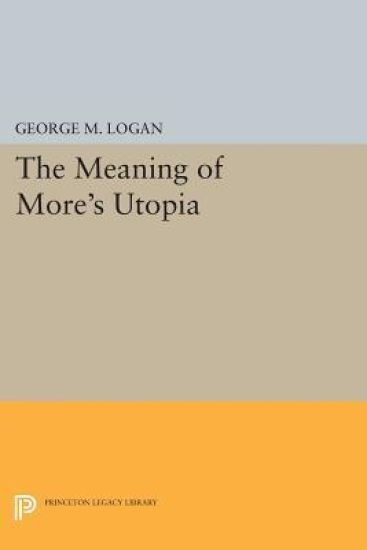
Examining its relation to ancient and Renaissance political thought, George M. Logan sees Thomas More's Utopia whole, in all its ironic complexity. He finds that the book is not primarily a prescriptive work that restates the ideals of Christian humanism or warns against radical idealism, but an exploration of a particular method of political study and the implications of that method for normative theory. Originally published in 1983. The Princeton Legacy Library uses the latest print-on-demand technology to again make available previously out-of-print books from the distinguished backlist of Princeton University Press. These editions preserve the original texts of these important books while presenting them in durable paperback and hardcover editions. The goal of the Princeton Legacy Library is to vastly increase access to the rich scholarly heritage found in the thousands of books published by Princeton University Press since its founding in 1905.

Examining its relation to ancient and Renaissance political thought, George M. Logan sees Thomas More's Utopia whole, in all its ironic complexity. He finds that the book is not primarily a prescriptive work that restates the ideals of Christian humanism or warns against radical idealism, but an exploration of a particular method of political study and the implications of that method for normative theory. Originally published in 1983. The Princeton Legacy Library uses the latest print-on-demand technology to again make available previously out-of-print books from the distinguished backlist of Princeton University Press. These editions preserve the original texts of these important books while presenting them in durable paperback and hardcover editions. The goal of the Princeton Legacy Library is to vastly increase access to the rich scholarly heritage found in the thousands of books published by Princeton University Press since its founding in 1905.