The Roman Empire is celebrating the eighth anniversary of Hadrian's succession. In Egypt, sacrifices are offered in the temples, chariot races are held in the Alexandrian Hippodrome, and in the arena, ten days of gladiatorial combats are fought in the blazing sun. Beyond the city, however, lies a turbulent province. Avidius Pollio, legate of the 22nd Legion, fears an uprising. Despite tight security, rebels make inroads from the desert, and robbers and river pirates are at their bloody work in the Delta. The imminent inundation of the Nile does little to allay the legate's fears, and there are also signs that the province has an enemy within. Back in Alexandria, stepping out for the first time onto the arena sands is a familiar figure. With Egypt on the verge of rebellion, why has Gaius Flaminius Drusus, imperial agent, begun a new career-as a gladiator? Part Five in ON HADRIAN'S SECRET SERVICE
The Reiving Rogue, book two in the Hadrian's Wall time travel trilogy, follows Ashlynn's sister, Jacklyn James, as she searches for answers to her sister's disappearance and finds herself transported back in time to the Anglo-Scottish border when reiving bands of men ran the countryside. Will Jacklyn find her sister or will she too be lost to the tides of time?
After the death of her husband William, Lynda James goes in search of her lost daughters. Ashlynn, an historian and archaeologist, disappeared while on a dig at Hadrian's Wall. Jacklyn, a free spirited journalist, went to the wall to search for her missing sister. Instead of finding Ashlynn, Jacklyn also disappears. Now, Lynda has come to the wall in search of her missing daughters.With the help of a mysterious taxi driver named John Graham, Lynda searches the length and breadth of Hadrian's Wall and the countryside beyond. Will Lynda find her missing girls, some kind of a sign as to where they went, or will she forever bear the pain of not knowing what happened to them?
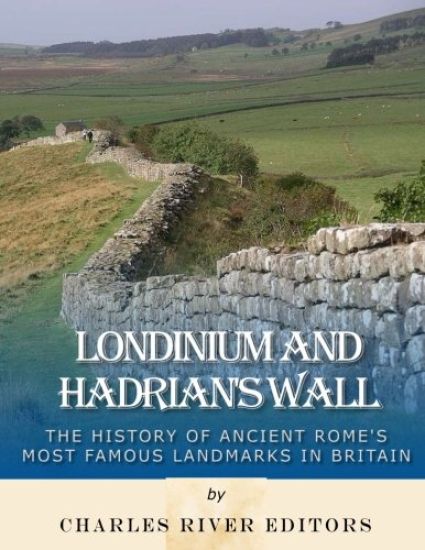
*Includes pictures *Includes ancient accounts of the landmarks *Includes online resources and a bibliography for further reading The famous conqueror from the European continent came ashore with thousands of men, ready to set up a new kingdom in England. The Britons had resisted the amphibious invasion from the moment his forces landed, but he was able to push forward. In a large winter battle, the Britons' large army attacked the invaders but was eventually routed, and the conqueror was able to set up a new kingdom. Over 1,100 years before William the Conqueror became the King of England after the Battle of Hastings, Julius Caesar came, saw, and conquered part of "Britannia," setting up a Roman province with a puppet king in 54 B.C. In the new province, the Romans eventually constructed a military outpost overlooking a bridge across the River Thames. The new outpost was named Londinium, and it covered just over two dozen acres. Londinium was initially little more than a small military outpost near the northern boundary of the Roman province of Britannia, but its access to the River Thames and the North Sea made it a valuable location for a port. During the middle of the first century A.D., the Romans conducted another invasion of the British Isles, after which Londinium began to grow rapidly. As the Romans stationed legions there to defend against the Britons, Londinium became a thriving international port, allowing trade with Rome and other cities across the empire. By the 2nd century A.D., Londinium was a large Roman city, with tens of thousands of inhabitants using villas, palaces, a forum, temples, and baths. The Roman governor ruled from the city in a basilica that served as the seat of government. What was once a 30 acre outpost now spanned 300 acres and was home to nearly 15,000 people, including Roman soldiers, officials and foreign merchants. The Romans also built heavy defenses for the city, constructing several forts and the massive London Wall, parts of which are still scattered across the city today. Ancient Roman remains continue to dot London's landscape today, reminding everyone that almost a millennium before it became the home of royalty, London was already a center of power. The Romans were master builders, and much of what they built has stood the test of time. Throughout their vast empire they have left grand structures, from the Forum and Pantheon in Rome to the theatres and hippodromes of North Africa and the triumphal gates in Anatolia and France. Wherever they went, the Romans built imposing structures to show their power and ability, and one of their most impressive constructions was built on the northernmost fringe of the empire. Shortly after the emperor Hadrian came to power in the early 2nd century CE, he decided to seal off Scotland from Roman Britain with an ambitious wall stretching from sea to sea. To accomplish this, the wall had to be built from the mouth of the River Tyne - where Newcastle stands today - 80 Roman miles (76 miles or 122 kilometers) west to Bowness-on-Solway. The sheer scale of the job still impresses people today, and Hadrian's Wall has the advantage of being systematically studied and partially restored. A study of the wall and its history provide an insight not only into the political context of Rome at the time but the empire's incredible engineering capabilities. Londinium and Hadrian's Wall: The History of Ancient Rome's Most Famous Landmarks in Britain analyzes the history of the influential Roman presence in England, and the ruins that remain thousands of years later. Along with pictures of important people, places, and events, you will learn about Londinium and Hadrian's Wall like never before.
Roman Britain, 313 AD. Barbarians living beyond Hadrian's Wall are causing problems. When the Legion arrives to sort it out, Felix wants to prove his bravery, and won't listen to Catrin's warning of danger. But when she disappears Felix knows he must venture into the wild country beyond the wall and find her before her premonition comes true.
Returning from his clash with the rebels in the Nile Delta, Gaius Flaminius Drusus searches Alexandria for their leader, Arctos. But other forces are at work. Unable to locate his enemy, the imperial agent finds himself accused of plotting against the emperor. On the run, he must struggle both to clear his name and to expose Arctos. In desperation, he visits a sinister Egyptian temple in hope of aid. After an enigmatic encounter with a mysterious priest, he awakens to find himself marooned on a distant shore. How can he hope to return to Egypt in time to save the empire from the chaos that will ensue if Arctos' plot is successful?
Unver nderter Nachdruck der Originalausgabe von 1884. Der Verlag Antigonos spezialisiert sich auf die Herausgabe von Nachdrucken historischer B cher. Wir achten darauf, dass diese Werke der ffentlichkeit in einem guten Zustand zug nglich gemacht werden, um ihr kulturelles Erbe zu bewahren.
The analysis of "Rev" 2:12-17.18-27;13; 17:9-14 and 21:1-8 confirms the hypothesis that the New Testament "Book of Revelation" was written around 132 AD. The main arguments the following: The two beasts of "Rev 13" can easily be identified with the emperor Hadrian and the sophist Antoninus Polemon, the throne of satan ("Rev" 2:13) with Traian's temple in Pergamum. This title contains German text.
Studienarbeit aus dem Jahr 2008 im Fachbereich Geschichte - Weltgeschichte - Fr hgeschichte, Antike, Helmut-Schmidt-Universit t - Universit t der Bundeswehr Hamburg, Sprache: Deutsch, Abstract: Das r mische Reich nimmt in der Geschichte eine einzigartige Stellung ein: Es ist nicht nur eines der gr ten Reiche, die die Welt bis dato gesehen hat, es hatte ber eine gewaltige Zeitspanne bestand. Betrachtet man die Geschichte des r mischen Reiches, so wird eines deutlich. Die r mische Geschichte ist eine symbiotische Beziehung zwischen Milit r und Gesellschaft. Beide Faktoren, Gesellschaft und Milit r, beeinflussen die Politik des Imperiums, beide k nnen nicht getrennt voneinander gesehen werden: Im Milit r bildet sich die Gesellschaft ab - die Gesellschaft erf hrt st ndige Ver nderungen durch das Milit r. Das Vorrangige Ziel der R mer ist es, durch fortw hrende Integration von Provinzbewohnern bzw. unterworfenen V lkern einen Staat zu schaffen, der nicht als Eroberer da steht, sondern als Heilsbringer der V lker. Die R mer erreichten in vielen F llen ihr Ziel - an einigen - hier sei auf "Germania Magna" und den vergeblichen Eroberungsversuch der rechtsrheinischen Gebiete bis zur Elbe verwiesen - Stellen scheiterte man jedoch. Diese Kombination aus Expansion und Integration war in den Jahren bis zur Regierungszeit Hadrians ein Erfolgsrezept. Gewaltige Ressourcen an Mensch und Material stehen der wohl besten Armee seiner Zeit zur Verf gung und verschaffen den Herren und Bewohnern des Weltreiches Wohlstand. Die aggressive Expansionspolitik Roms, die Eroberung eines gewaltigen Imperiums, erf hrt in der Zeit der Kaiser Trajan und Hadrian eine Z sur: Auf dem Zenit seiner Macht begann Rom scheinbar seine Au enpolitik in gro em Stil zu ndern. Nicht mehr Eroberung stand im Focus der Politik des Reiches, sondern Grenzsicherung. Wurde die bew hrte Praxis von Eroberung und Integration zur Sicherung aufgeben? Worauf ist der massi
"Whether you are new to the area or a frequent visitor, this book will be the perfect companion for your exploration of Northumberland and Hadrian’s Wall." — Worldwide Writer Hadrian’s Wall once marked the northern edge of the Roman Empire, and was built to intimidate the uncouth tribes of hostile local natives. Now a UNESCO world heritage site, Hadrian’s Wall is the largest and most important Roman site in Britain. Use this book to explore Hadrian’s Wall Country, from Tynemouth to the Solway Firth. You’ll discover how the Romans took a bath – and where they went to spend a penny; why aliens came to stay in a small rural town; where King Arthur lies sleeping until his country needs him; and whether Robin Hood really did take a wrong turn on his journey from Dover to Sherwood Forest. You can also find out if Hadrian was a great emperor or a ruthless tyrant; why pubs were state-owned in Carlisle; where to find the Centre of Britain; and why treasure may lie unclaimed at the bottom of a deep, dark lake. Written by someone with extensive knowledge of the region, this book will help you discover the delights of Hadrian’s Wall Country, and even learn some local dialect along the way.