

Kirjahaku
Etsi kirjoja tekijän nimen, kirjan nimen tai ISBN:n perusteella.
1000 tulosta hakusanalla Herman Tester

Hermans Tales is the fifth book in a series about Herman the mouse and his family. In Herman and the Calf the mice celebrate the birth of a new calf down on the donkey farm. In Hermans Valentine, Harry, his son, finds a way to celebrate with the new girl in the mouse school. Then Herman and his family discover a cherry tree with lots of ripe cherries. Somehow the mice must find a way to get the cherries home. Finally Hermans Boating Adventure gets pretty scary when they lose their paddles in the middle of the pond.


Herman Melville, Collection novels
Herman Melville
Createspace Independent Publishing Platform
2014
nidottu
Herman Melville (1819 - 1891) was an American novelist, poet, and writer of short stories. His contributions to the Western canon are the whaling novel Moby-Dick (1851); the short work Bartleby, the Scrivener (1853) about a clerk in a Wall Street office; the slave ship narrative Benito Cereno (1855); and Billy Budd, Sailor (1924). When asked which of the great American writers he most admired, Vladimir Nabokov replied: "When I was young I liked Poe, and I still love Melville, whom I did not read as a boy." Around his twentieth year he was a schoolteacher for a short time, then became a seaman when his father met business reversals. On his first voyage he jumped ship in the Marquesas Islands, where he lived for a time. His first book, an account of that time, Typee, became a bestseller and Melville became known as the "man who lived among the cannibals". After Omoo, the sequel to his first book, Melville began to work philosophical issues in his third book, the elaborate Mardi (1849). The public indifference to Moby-Dick (1851), and Pierre (1852), put an end to his career as a popular author. From 1853 to 1856 he wrote short fiction for magazines, collected as The Piazza Tales (1856). In this book: Moby Dick; or The Whale Bartleby, The Scrivener A Story of Wall-Street The Piazza Tales Typee A Romance of the South Sea, A Romance of the South Sea Pierre; or The Ambiguities
Herman Lake Fun Book: A Fun and Educational Book on Herman Lake
Jobe Leonard
Createspace Independent Publishing Platform
2014
nidottu
DISCOVER:: FUN on the lake. This body of water is a true gem. Now you can work your way through the majestic shores that make this lake so special. Fun for all ages. Share the gift of Lake Fun with someone you love today. ***Limited Time Discount Offer *** ***Regular Price $12.99*** - -***Plus, As a Special Thank-you for buying this Book Today, You Will Receive FREE puzzles and games inside the book*** - -Do you want to see a side of the lake a child rarely gets to see? Do you or a child you love need to express their creative side while enjoying a fun cultural experience? Read on to find out more about how this book can solve your problem... Buy:: The one and only Lake Fun Coloring Book Here's a preview of what you'll find inside this book: - -Fisherman First Aid Kit Tent Sleeping Bag Beach Towell Fish Net Flippers Boat Paddle Hat Visor Swim Trunks Bikini Radio Playing Music Life jacket Rafts Knee Board Tubes Friends Fire Wood Camp Fire Grill Sun Screen Lotion Money Drinks Goggles Wake board Ski Rope Anchor Bug repellent Beach Chairs Binoculars Book Playing Cards Cooler Coozie Camera Snacks Tackle Box Fishing Rod Worms Cricket Water Shoes Skipping Rocks Water bottle Floaties Swim Noodle Dry Clothes Phone Trash Bag Toilet Paper Paper Towels Watermelon Lantern Flash light Boat light Ski rope Bobber Fishing Hook Catfish Bluegill Turtle Minnow Crickett Water Snake Duck Pelican Seagull Frog Large Mouth Bass Small Mouth Bass Trout Laptop Computer Tablet Swim Cap Nose plug Fish food Bag of ice Dog Pop sickle Marshmallows Chocolate Graham crackers Smores Canoe Kayak Paddlebaord Flip flops Lake Map Swim Noodle And much, much more Want to Know More? Scroll to the top of the page and select the "BUY" button for instant purchase. Buy Your Copy Right Now

Herman Lake Safety Book: The Essential Lake Safety Guide For Children
Jobe Leonard
Createspace Independent Publishing Platform
2015
nidottu
The Condensed Writings of Herman S. Rubin
Herman S. Rubin
Createspace Independent Publishing Platform
2015
nidottu

Bartleby, the Scrivener: (Herman Melville Classics Collection)
Herman Melville
Createspace Independent Publishing Platform
2015
nidottu

I And My Chimney: (Herman Melville Classics Collection)
Herman Melville
Createspace Independent Publishing Platform
2015
nidottu

Israel Potter: (Herman Melville Classics Collection)
Herman Melville
Createspace Independent Publishing Platform
2015
nidottu
Mardi: And A Voyage Thither Vol 1: (Herman Melville Classics Collection)
Herman Melville
Createspace Independent Publishing Platform
2015
nidottu
Mardi: And A Voyage Thither Vol 2: (Herman Melville Classics Collection)
Herman Melville
Createspace Independent Publishing Platform
2015
nidottu

Pierre: (Herman Melville Classics Collection)
Herman Melville
Createspace Independent Publishing Platform
2015
nidottu

The Piazza Tales: (Herman Melville Classics Collection)
Herman Melville
Createspace Independent Publishing Platform
2015
nidottu

Typee: (Herman Melville Classics Collection)
Herman Melville
Createspace Independent Publishing Platform
2015
nidottu

White-Jacket: (Herman Melville Classics Collection)
Herman Melville
Createspace Independent Publishing Platform
2015
nidottu

Redburn. His First Voyage: (Herman Melville Classics Collection)
Herman Melville
Createspace Independent Publishing Platform
2015
nidottu
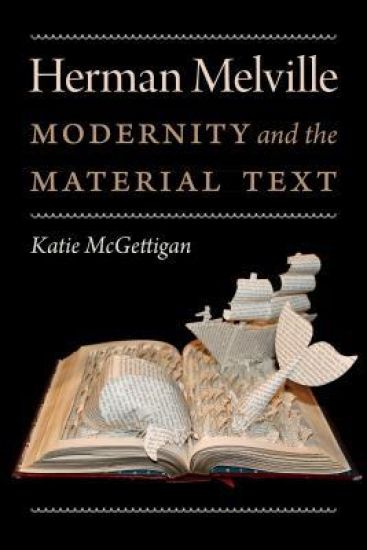
In this imaginative book, Katie McGettigan argues that Melville's novels and poetry demonstrate a sustained engagement with the physical, social, and economic materiality of industrial and commercial forms of print. Further, she shows that this "aesthetics of the material text," central both to Melville's stylistic signature and to his innovations in form, allows Melville to explore the production of selfhood, test the limits of narrative authenticity, and question the nature of artistic originality. Combining archival research in print and publishing history with close reading, McGettigan situates Melville's works alongside advertising materials, magazine articles, trade manuals, and British and American commentary on the literary industry to demonstrate how Melville's literary practice relies on and aestheticizes the specific conditions of literary production in which he worked. For Melville, the book is a physical object produced by particular technological processes, as well as an entity that manifests social and economic values. His characters carry books, write on them, and even sleep on them; they also imagine, observe, and participate in the buying and selling of books. Melville employs the book's print, paper, and binding-and its market circulations-to construct literary figures, to shape textual form, and to create irony and ambiguity.Exploring the printed book in Melville's writings brings neglected sections of his poetry and prose to the fore and invites new readings of familiar passages and images. These readings encourage a reassessment of Melville's career as shaped by his creative engagements with print, rather than his failures in the literary marketplace. McGettigan demonstrates that a sustained and deliberate imaginative dialogue with the material text is at the core of Melville's expressive practice and that, for Melville, the printed book served as a site for imagining the problems and possibilities of modernity.

Herman Haeberlin Regained: Anthropology and Artifacts of Puget Sound 1916-17
Jay Miller
Createspace Independent Publishing Platform
2015
nidottu