Kirjojen hintavertailu. Mukana 12 390 323 kirjaa ja 12 kauppaa.

Kirjahaku

Etsi kirjoja tekijän nimen, kirjan nimen tai ISBN:n perusteella.

1000 tulosta hakusanalla J F Cavanagh

A Reader on the Sanskrit Grammarians
The achievements of Panini and the Indian grammarians, beginning nearly 2500 years ago, have never been fully appreciated by Western scholars -- partly because of the great technical difficulties presented by such an inquiry, and partly because relevant tutorial articles have been confined to obscure and inaccessible publications.This book makes available to linguists and Sanskritists a collection of the most important articles on the Sanskrit grammarians, and provides a connected historical outline of their activities. It covers studies and fragments ranging from early 7th-century accounts of the grammarians -- recorded by Buddhist pilgrims from China and Tibet, by Muslim travelers from the Near East, and by Christian missionaries -- to some of the best articles that have appeared during the last century and a half.Chapters in the book cover the foundation of Sanskrit studies in the West laid by British scholars working in India and including the detailed and accurate information provided by Henry Thomas Colebrooke; the linguistic evaluations of Panini by von Schlegel and von Humboldt; the work of Bhandarkar and of Kielhorn; William Dwight Whitney's low evaluation of the "native" grammarians; and the philological work of modern Western, Indian, and Japanese scholars.The editor observes that materials in the Reader reveal problems tackled by the Sanskrit grammarians which closely parallel developments in contemporary linguistics. He has provided historical and linguistic commentary and bibliographic data in the introductions and notes that accompany each selection. Articles are in their original English, German, and French. Texts or passages in Chinese, Tibetan, Arabic, Sanskrit, Latin, and Greek have, for the most part, been translated into English, and all Sanskrit passages have been translated into the Latin alphabet.
The Generalship Of Alexander The Great

The Generalship Of Alexander The Great

J.F.C. Fuller

Da Capo Press Inc
2004
pokkari
In a brief and meteoric life (356-323 BC) the greatest of all conquerors redirected the course of world history. Alexander the Great accomplished this feat with a small army-no more than 40,000 men-and a constellation of bold, revolutionary ideas about the conduct of war and the nature of government. In a style both clear and witty, Fuller imparts the many sides to Alexander's genius and the full extent of his empire, stretching from India to Egypt.
History of a Brigade of South Carolinians
THE regiments which composed Gregg's brigade of South Carolina infantrywere: the First South Carolina volunteers, the Twelfth South Carolina volunteers, the Thirteenth South Carolina volunteers, the Fourteenth South Carolina volunteers, and Orr's regiment of rifles, also from South Carolina.
The Triumphant Victim

The Triumphant Victim

J.F. Miller

Routledge
2019
sidottu
This book examines the unrecognised prevalence of sadomasochism and perverse thinking in personal relationships as well as the public domain, and discusses the way it contributes to the culture of the victim.The first part traces the origins of perverse pathology and how it operates in obstructing emotional development and producing dysfunctional relationships. This is put in the context of hysteria, exhibitionism, voyeurism, and projective identification and is illustrated with clinical material drawn from the author's thirty years of psychoanalytical practice as well as experiences of couple- and family-therapy and educational consultations. The second half of the book examines current modes of thinking and belief systems with particular emphasis on tribal, basic-assumption mentality. The author examines the legacy of Cartesian dualism and the Enlightenment in contributing to the marginalization of feminine values in favour of negative, masculine control. Fundamentalist belief, the 'New Atheism' and feminism are subjected to particular scrutiny for evidence of perverse thinking leading to internal contradictions and the manifestation of these in the consulting room is illustrated with clinical material.
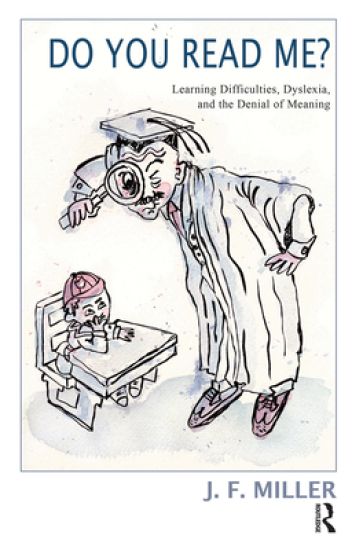
Do You Read Me?

Do You Read Me?

J.F. Miller

Routledge
2019
sidottu
A fascinating and compelling exploration of the learning process for parents, teachers, and anyone with an interest in education. Reading and writing are fundamentally about the communication of meaning. Yet, when a child has difficulty in learning to read and write, the one area that is never seen as having any relevance is the child's life experiences. The author's contention is that the concept of dyslexia is something that has been invented, rather than discovered, in order to evade the question of meaning and the understanding of the individual. Based on the author's thirty years' experience of both educational psychology and analytical therapy, the book sets out a radical approach to learning difficulties in which the primary assumption is that there will usually be underlying emotional conflicts, tensions, and anxieties. Any learning disability is thus more likely to be the symptom of less-evident, personal difficulties, rather than a problem in itself. The book examines, with examples, typical patterns of personal and emotional difficulty that give rise to learning problems.
Ecological Responses to the 1980 Eruption of Mount St. Helens

Ecological Responses to the 1980 Eruption of Mount St. Helens

J.F. Franklin

Springer-Verlag New York Inc.
2005
nidottu
Recon?guring Disturbance, Succession, and Forest Management: The Science of Mount St. Helens When Mount St. Helens erupted on May 18, 1980, it did more than just recon?gure a large piece of Cascadian landscape. It also led to dramatic revisions in our perspectives on disturbances, secondary succession, and forestry practices. The Mount St. Helens landscape turned out to be a far more complex place than the “moonscape” that it initially appeared to be. Granted, a large area was literally scoured and sterilized, and that vast expanse of newly formed rock, mud?ows, and avalanche debris up and down the mountain made the Mount St. Helens landscape unique. But I still remember my surprise when, as I stepped out of the helicopter on ?rst landing within the extensive “devastated zone,” I saw hundreds of plants pushing their way up through the mantel of tephra. Surviving organisms were stunning in their diversity, abundance, and the mechanisms by which they survived. They persisted as whole organisms living below ground, encased within late-persisting snowbanks, and buried in lake and stream sediments. They survived as rhizomes transported along with the massive landslide that accompanied the eruption and as stems that suffered the abrasion of mud?ows. Mud?ows ?oated nurse logs covered with tree seedlings and then redeposited them on the ?oor of a forested river terrace. Millions, perhaps billions, of plants survived as rootstocks and rhizomes that pushed their way up through the tephra, and others survived on the bases of uprooted trees.
Ecological Responses to the 1980 Eruption of Mount St. Helens

Ecological Responses to the 1980 Eruption of Mount St. Helens

J.F. Franklin

Springer-Verlag New York Inc.
2005
sidottu
Recon?guring Disturbance, Succession, and Forest Management: The Science of Mount St. Helens When Mount St. Helens erupted on May 18, 1980, it did more than just recon?gure a large piece of Cascadian landscape. It also led to dramatic revisions in our perspectives on disturbances, secondary succession, and forestry practices. The Mount St. Helens landscape turned out to be a far more complex place than the “moonscape” that it initially appeared to be. Granted, a large area was literally scoured and sterilized, and that vast expanse of newly formed rock, mud?ows, and avalanche debris up and down the mountain made the Mount St. Helens landscape unique. But I still remember my surprise when, as I stepped out of the helicopter on ?rst landing within the extensive “devastated zone,” I saw hundreds of plants pushing their way up through the mantel of tephra. Surviving organisms were stunning in their diversity, abundance, and the mechanisms by which they survived. They persisted as whole organisms living below ground, encased within late-persisting snowbanks, and buried in lake and stream sediments. They survived as rhizomes transported along with the massive landslide that accompanied the eruption and as stems that suffered the abrasion of mud?ows. Mud?ows ?oated nurse logs covered with tree seedlings and then redeposited them on the ?oor of a forested river terrace. Millions, perhaps billions, of plants survived as rootstocks and rhizomes that pushed their way up through the tephra, and others survived on the bases of uprooted trees.
Cancer Precursors

Cancer Precursors

J.F. Fraumeni

Springer-Verlag New York Inc.
2002
sidottu
Dramatic advances in our understanding of cancer causation have come from epidemiologic and laboratory research, particularly over the past two decades. These developments have included a broadening interest in the critical events that take place during the early stages of the dynamic multistep process leading to - vasive cancer. Increasingly, cancer epidemiologists are pursuing research into the origins and natural history of premalignant lesions, including intermediate or surrogate endpoints, a trend - celerated by the development of molecular technologies that are revolutionizing our understanding of the transformation of normal to malignant cells. There seems little doubt that this emerging knowledge will provide further insights not only into carcinogenic processes, but also into more sensitive methods of early detection and more effective means of prevention. In this book, Drs. Franco and Rohan have succeeded in prep- ing a comprehensive, timely, and critical review of the substantial progress that has been made in our understanding of cancer p- cursors. They have enlisted experts in the ?eld who have c- tributed authoritative chapters on the precursors to a wide variety of cancers,with emphasis on etiology and natural history,including the role of environmental and heritable factors that provoke normal cells to undergo malignant transformation. Epidemiologic data are linked whenever possible to molecular as well as classical cellular pathology, providing a fuller understanding of the causal events and mechanisms that initiate the carcinogenic process.
Polymer Photodegradation

Polymer Photodegradation

J.F. Rabek

Chapman and Hall
1994
sidottu
During the last two decades, the production of polymers and plastics has been increasing rapidly. In spite of developing new polymers and polymeric materials, only 40~60 are used commercially on a large scale. It has been estimated that half of the annual production of polymers is employed outdoors. The photochemical instability of most polymers limits their outdoor application as they are photodegraded quickly over periods from months to a few years. To the despair of technologists and consumers alike, photodegradation and environmental ageing of polymers occur much faster than can be expected from knowledge collected in laboratories. In order to improve polymer photostability there has been a very big effort during the last 30 years to understand the mechanisms involved in photodegradation and environmental ageing. This book represents the author's attempt, based on his 25 years' experience in research on photodegradation and photo stabilization, to collect and generalize a number of available data on the photodegradation of polymers. The space limitation and the tremendous number of publications in the past two decades have made a detailed presentation of all important results and data difficult. The author apologizes to those whose work has not been quoted or widely presented in this book. Because many published results are very often contradictory, it has been difficult to present a fully critical review of collected knowledge, without antagonizing authors. For that reason, all available theories, mechanisms and different suggestions have been presented together, and only practice can evaluate which of them are valid.
The Japanese and the Jesuits

The Japanese and the Jesuits

J F Moran; J. F. Moran

Routledge
1992
sidottu
The Japanese and the Jesuits examines the attempt by sixteenth century Jesuits to convert the Japanese to Christianity. Directing the Jesuits was the Italian Alessandro Valignano, whose own magisterial writings, many of them not previously translated or published, are the principle source material for this account of one of the most remarkable of all meetings between East and West.Valignano arrived in Japan in 1579. In promoting Christianity, he always sought the support of the ruling classes, but an important part of his strategy was also to have the missionaries adapt themselves thoroughly to Japanese customs, etiquette and culture. He was insistent that they must master the Japanese language, and he brought to Japan a European printing press, which turned out grammars and dictionaries for the missionaries, and works of instruction and devotion for the Japanese Christians.Following Valignano's death, Christianity was proscribed and missionaries banished from Japan. This does not detract from his remarkable achievements. He understood perfectly well that foreign missionaries by themselves were not capable of converting Japan to Christianity, and one of his principal concerns was the training of Japanese Jesuits and priests, and breaking down the barriers between them and the Europeans. Few people have ever been more acutely aware of, or grappled more determinedly with, problems in Japanese-Western relationships.
The Japanese Village Ils 56

The Japanese Village Ils 56

J.F. Embree

Routledge
1998
sidottu
This is Volume V of six in a collection on the Sociology of East Asia. Initially published in 1946, Dr. Embree's book is a description, based on direct observation, of the life of a Japanese village community. Its chief purpose is to provide material for that comparative study' of the forms of: human society that is known as social anthropology; but it should have an appeal to a wider audience of general readers as giving additional insight from a new 'angle into Japanese civilization.
Studies in the Social Psychology of Adolescence

Studies in the Social Psychology of Adolescence

J.F. Forrester et al; J Richardson

Routledge
1998
sidottu
This is Volume X of twelve in a collection of the Sociology of Youth and Adolescence. Originally published in 1951, this is a book of studies in social psychology The study of children in their social relationships, the effect of membership of groups, the school as a social therapeutic institution. These are relatively novel phrases and like all such fresh phrases they point to a new emphasis in the observation of human beings and in the formulation of basic hypotheses as to their nature.
A History of the Working Men's College
Originally published in 1954, this is the first full-length account of the history of the Working Men’s College in St.Pancras, London. One hundred and fifty years on from its foundation in 1854, it is the oldest adult educational institute in the country. Self-governing and self-financing, it is a rich part of London’s social history. The college stands out as a distinctive monument of the voluntary social service founded by the Victorians, unchanged in all its essentials yet adapting itself to the demands of each generation of students and finding voluntary and unpaid teachers to continue its tradition.
The Japanese Village Ils 56

The Japanese Village Ils 56

J.F. Embree

Routledge
2013
nidottu
This is Volume V of six in a collection on the Sociology of East Asia. Initially published in 1946, Dr. Embree's book is a description, based on direct observation, of the life of a Japanese village community. Its chief purpose is to provide material for that comparative study' of the forms of: human society that is known as social anthropology; but it should have an appeal to a wider audience of general readers as giving additional insight from a new 'angle into Japanese civilization.
The Japanese and the Jesuits

The Japanese and the Jesuits

J F Moran; J. F. Moran

Routledge
2014
nidottu
The Japanese and the Jesuits examines the attempt by sixteenth century Jesuits to convert the Japanese to Christianity. Directing the Jesuits was the Italian Alessandro Valignano, whose own magisterial writings, many of them not previously translated or published, are the principle source material for this account of one of the most remarkable of all meetings between East and West.Valignano arrived in Japan in 1579. In promoting Christianity, he always sought the support of the ruling classes, but an important part of his strategy was also to have the missionaries adapt themselves thoroughly to Japanese customs, etiquette and culture. He was insistent that they must master the Japanese language, and he brought to Japan a European printing press, which turned out grammars and dictionaries for the missionaries, and works of instruction and devotion for the Japanese Christians.Following Valignano's death, Christianity was proscribed and missionaries banished from Japan. This does not detract from his remarkable achievements. He understood perfectly well that foreign missionaries by themselves were not capable of converting Japan to Christianity, and one of his principal concerns was the training of Japanese Jesuits and priests, and breaking down the barriers between them and the Europeans. Few people have ever been more acutely aware of, or grappled more determinedly with, problems in Japanese-Western relationships.