For years, criminologists have studied the relationship between crime and below-average intelligence, concluding that offenders possess IQ scores 8-10 points below those of non-offenders. Little, however, is known about the criminal behavior of those with above-average IQ scores. This book provides some of the first empirical information about the self-reported crimes of people with genius-level IQ scores. Combining quantitative data from 72 different offenses with qualitative data from 44 follow-up interviews, this book describes the nature of high-IQ crime while shedding light on a population of offenders often ignored in research and sensationalized in media.
For years, criminologists have studied the relationship between crime and below-average intelligence, concluding that offenders usually possess IQ scores of 8 to 10 points below those of nonoffenders. Little, however, is known about the criminal behavior of those with above-average IQ scores. This book provides some of the first empirical information about the self-reported crimes of people with genius-level IQ scores. Combining quantitative data from 72 different offenses with qualitative data from 44 follow-up interviews, James C. Oleson describes the nature of crime by offenders of high IQ thereby shedding light on a population often ignored in research and yet sensationalized by media.
James J. C. K.’s The Biology of Race offers a comprehensive and scientifically grounded exploration of human diversity, providing critical insights into the intricate relationships between genetic inheritance, individual variation, and cultural influences. This revised edition builds on the success of the original work, incorporating advancements in molecular biology and evolving perspectives on intelligence and heritability since the book’s initial publication. Through its detailed examination of biological and environmental interactions, this volume aims to guide readers in understanding the concept of race from a scientific lens, unearthing both the biological foundations and the sociocultural complexities intertwined with this sensitive topic. Designed for readers across disciplines—including biology, genetics, anthropology, sociology, and psychology—the book begins with a dispassionate discussion of group differences in the animal world before extending these principles to the human species. The text moves through the scientific framework of species, subspecies, and genetic units, blending it with an analysis of cultural and emotional factors that challenge the objective study of human variation. With its accessible language, glossary of terms, and multi-disciplinary approach, The Biology of Race serves as an invaluable resource for students, scholars, and thoughtful lay readers seeking clarity amid contemporary debates on race, equality, and diversity. This title is part of UC Press's Voices Revived program, which commemorates University of California Press’s mission to seek out and cultivate the brightest minds and give them voice, reach, and impact. Drawing on a backlist dating to 1893, Voices Revived makes high-quality, peer-reviewed scholarship accessible once again using print-on-demand technology. This title was originally published in 1981.
James J. C. K.’s The Biology of Race offers a comprehensive and scientifically grounded exploration of human diversity, providing critical insights into the intricate relationships between genetic inheritance, individual variation, and cultural influences. This revised edition builds on the success of the original work, incorporating advancements in molecular biology and evolving perspectives on intelligence and heritability since the book’s initial publication. Through its detailed examination of biological and environmental interactions, this volume aims to guide readers in understanding the concept of race from a scientific lens, unearthing both the biological foundations and the sociocultural complexities intertwined with this sensitive topic. Designed for readers across disciplines—including biology, genetics, anthropology, sociology, and psychology—the book begins with a dispassionate discussion of group differences in the animal world before extending these principles to the human species. The text moves through the scientific framework of species, subspecies, and genetic units, blending it with an analysis of cultural and emotional factors that challenge the objective study of human variation. With its accessible language, glossary of terms, and multi-disciplinary approach, The Biology of Race serves as an invaluable resource for students, scholars, and thoughtful lay readers seeking clarity amid contemporary debates on race, equality, and diversity. This title is part of UC Press's Voices Revived program, which commemorates University of California Press’s mission to seek out and cultivate the brightest minds and give them voice, reach, and impact. Drawing on a backlist dating to 1893, Voices Revived makes high-quality, peer-reviewed scholarship accessible once again using print-on-demand technology. This title was originally published in 1981.
Between 1800 and 2000 life expectancy at birth rose from about 30 years to a global average of 67 years, and to more than 75 years in favored countries. This dramatic change, called the health transition, is characterized by a transition both in how long people expected to live, and how they expected to die. The most common age at death jumped from infancy to old age. Most people lived to know their children as adults, and most children became acquainted with their grandparents. Whereas earlier people died chiefly from infectious diseases with a short course, by later decades they died from chronic diseases, often with a protracted course. The ranks of people living in their most economically productive years filled out, and the old became commonplace figures everywhere. Rising Life Expectancy: A Global History examines the way humans reduced risks to their survival, both regionally and globally, to promote world population growth and population aging.
The social market economy has served as a fundamental pillar of post-war Germany. Today, it is associated with the European welfare state. Initially, it meant the opposite. Rebuilding Germany examines the 1948 West German economic reforms that dismantled the Nazi command economy and ushered in the fabled 'European Miracle' of the 1950s. Van Hook evaluates the US role in German reconstruction, the problematic relationship of Chancellor Konrad Adenauer and his economics minister, Ludwig Erhard, the West German 'economic miracle', and the extent to which the social market economy represented a departure from the German past. In a nuanced and fresh account, Van Hook evaluates the American role in West German recovery and the debates about economic policy within West Germany, to show that Germans themselves had surprising room to shape their economic and industrial system.
The effective management of plants is fundamental to all agricultural enterprise, making plant science a key discipline for all growers. This book provides an integrated explanation of all aspects of plant structure and function for students of agriculture, horticulture and applied biology, with the aim of highlighting the practical relevance of plant science to agriculture. Each chapter is self-contained and self-explanatory, with specific chapters covering energy, water, minerals, structure, growth and development from sowing to harvest, environmental effects and controls, breeding, vegetative propagation, field production and yield, and the nutritional content of produce. Taken as a whole, Plants in Agriculture fulfills the need for a single text which promotes a comprehensive understanding of how plants operate in agriculture.
This refreshing, introductory textbook covers both standard techniques for solving ordinary differential equations, as well as introducing students to qualitative methods such as phase-plane analysis. The presentation is concise, informal yet rigorous; it can be used either for 1-term or 1-semester courses. Topics such as Euler's method, difference equations, the dynamics of the logistic map, and the Lorenz equations, demonstrate the vitality of the subject, and provide pointers to further study. The author also encourages a graphical approach to the equations and their solutions, and to that end the book is profusely illustrated. The files to produce the figures using MATLAB are all provided in an accompanying website. Numerous worked examples provide motivation for and illustration of key ideas and show how to make the transition from theory to practice. Exercises are also provided to test and extend understanding: solutions for these are available for teachers.
This book develops the theory of global attractors for a class of parabolic PDEs which includes reaction-diffusion equations and the Navier-Stokes equations, two examples that are treated in detail. A lengthy chapter on Sobolev spaces provides the framework that allows a rigorous treatment of existence and uniqueness of solutions for both linear time-independent problems (Poisson's equation) and the nonlinear evolution equations which generate the infinite-dimensional dynamical systems of the title. Attention then switches to the global attractor, a finite-dimensional subset of the infinite-dimensional phase space which determines the asymptotic dynamics. In particular, the concluding chapters investigate in what sense the dynamics restricted to the attractor are themselves 'finite-dimensional'. The book is intended as a didactic text for first year graduates, and assumes only a basic knowledge of Banach and Hilbert spaces, and a working understanding of the Lebesgue integral.
This book develops the theory of global attractors for a class of parabolic PDEs which includes reaction-diffusion equations and the Navier-Stokes equations, two examples that are treated in detail. A lengthy chapter on Sobolev spaces provides the framework that allows a rigorous treatment of existence and uniqueness of solutions for both linear time-independent problems (Poisson's equation) and the nonlinear evolution equations which generate the infinite-dimensional dynamical systems of the title. Attention then switches to the global attractor, a finite-dimensional subset of the infinite-dimensional phase space which determines the asymptotic dynamics. In particular, the concluding chapters investigate in what sense the dynamics restricted to the attractor are themselves 'finite-dimensional'. The book is intended as a didactic text for first year graduates, and assumes only a basic knowledge of Banach and Hilbert spaces, and a working understanding of the Lebesgue integral.
The Netherlands is known among foreigners today for its cheese and its windmills, its Golden Age paintings and its experimentation in social policies such as cannabis and euthanasia. Yet the historical background for any of these quintessentially Dutch achievements is often unfamiliar to outsiders. This Concise History offers an overview of this surprisingly little-known but fascinating country. Beginning with the first humanoid settlers, the book follows the most important contours of Dutch history, from Roman times through to the Habsburgs, the Dutch Republic and the Golden Age. The author, a modernist, pays particularly close attention to recent developments, including the signature features of contemporary Dutch society. In addition to being a political history, this overview also gives systematic attention to social and economic developments, as well as in religion, the arts and the Dutch struggle against the water. The Dutch Caribbean is also included in the narrative.
This accessible text covers key results in functional analysis that are essential for further study in the calculus of variations, analysis, dynamical systems, and the theory of partial differential equations. The treatment of Hilbert spaces covers the topics required to prove the Hilbert–Schmidt theorem, including orthonormal bases, the Riesz representation theorem, and the basics of spectral theory. The material on Banach spaces and their duals includes the Hahn–Banach theorem, the Krein–Milman theorem, and results based on the Baire category theorem, before culminating in a proof of sequential weak compactness in reflexive spaces. Arguments are presented in detail, and more than 200 fully-worked exercises are included to provide practice applying techniques and ideas beyond the major theorems. Familiarity with the basic theory of vector spaces and point-set topology is assumed, but knowledge of measure theory is not required, making this book ideal for upper undergraduate-level and beginning graduate-level courses.
The social market economy has served as a fundamental pillar of post-war Germany. Today, it is associated with the European welfare state. Initially, it meant the opposite. Rebuilding Germany examines the 1948 West German economic reforms that dismantled the Nazi command economy and ushered in the fabled 'European Miracle' of the 1950s. Van Hook evaluates the US role in German reconstruction, the problematic relationship of Chancellor Konrad Adenauer and his economics minister, Ludwig Erhard, the West German 'economic miracle', and the extent to which the social market economy represented a departure from the German past. In a nuanced and fresh account, Van Hook evaluates the American role in West German recovery and the debates about economic policy within West Germany, to show that Germans themselves had surprising room to shape their economic and industrial system.
Poverty and Life Expectancy is a multidisciplinary study that reconstructs Jamaica's rise from low to high life expectancy and explains how that was achieved. Jamaica is one of the small number of countries that have attained a life expectancy nearly matching the rich lands, despite having a much lower level of per capita income. Why this is so is the Jamaica paradox. This book provides an answer, surveying possible explanations of Jamaica's rapid gains in life expectancy. The rich countries could invest large sums in reducing mortality, but Jamaica and other low-income countries had to find inexpensive means of doing so. Jamaica's approach especially emphasized that schoolchildren and their parents master lessons about how to manage disease hazards. This book also argues that low-income countries with high life expectancy, such as Jamaica, provide more realistic models as to how other poor countries where life expectancy remains low can improve survival.
A practical, clinically-oriented handbook of iron overload disorders giving a compact guide to normal iron metabolism, iron-related pathobiology, and the diagnosis and management of heritable and acquired iron overload disorders. Many of these disorders were discovered and characterized only in the last decade, and are unmentioned or inadequately described in most texts. Written by clinicians for clinicians, this handbook summarizes information on diverse iron overload conditions, including their history, signs, symptoms, physical examination findings, genetics, genotype-phenotype correlations, pathophysiology, differential diagnosis and treatment. Most physicians, regardless of specialty, encounter patients with systemic or organ-specific iron overload conditions. This book contains essential information for practising adult and pediatric medical specialists in the fields of hematology, gastroenterology, hepatology, rheumatology, endocrinology, diabetology, neurology, oncology, dermatology and internal medicine. Pathologists, pharmacologists, geneticists, genetic counselors and epidemiologists will also find substantial, up-to-date sections in this handbook that are pertinent to their respective fields of interest.
The Netherlands is known among foreigners today for its cheese and its windmills, its Golden Age paintings and its experimentation in social policies such as cannabis and euthanasia. Yet the historical background for any of these quintessentially Dutch achievements is often unfamiliar to outsiders. This concise history offers an overview of this surprisingly little-known but fascinating country. Beginning with the first humanoid settlers, the book follows the most important contours of Dutch history, from Roman times through to the Habsburgs, the Dutch Republic and the Golden Age. The author, a modernist, pays particularly close attention to recent developments, including the signature features of contemporary Dutch society. In addition to being a political history, this overview also gives systematic attention to social and economic developments, as well as in religion, the arts and the Dutch struggle against the water. The Dutch Caribbean is also included in the narrative.
This accessible research monograph investigates how 'finite-dimensional' sets can be embedded into finite-dimensional Euclidean spaces. The first part brings together a number of abstract embedding results, and provides a unified treatment of four definitions of dimension that arise in disparate fields: Lebesgue covering dimension (from classical 'dimension theory'), Hausdorff dimension (from geometric measure theory), upper box-counting dimension (from dynamical systems), and Assouad dimension (from the theory of metric spaces). These abstract embedding results are applied in the second part of the book to the finite-dimensional global attractors that arise in certain infinite-dimensional dynamical systems, deducing practical consequences from the existence of such attractors: a version of the Takens time-delay embedding theorem valid in spatially extended systems, and a result on parametrisation by point values. This book will appeal to all researchers with an interest in dimension theory, particularly those working in dynamical systems.
This accessible text covers key results in functional analysis that are essential for further study in the calculus of variations, analysis, dynamical systems, and the theory of partial differential equations. The treatment of Hilbert spaces covers the topics required to prove the Hilbert–Schmidt theorem, including orthonormal bases, the Riesz representation theorem, and the basics of spectral theory. The material on Banach spaces and their duals includes the Hahn–Banach theorem, the Krein–Milman theorem, and results based on the Baire category theorem, before culminating in a proof of sequential weak compactness in reflexive spaces. Arguments are presented in detail, and more than 200 fully-worked exercises are included to provide practice applying techniques and ideas beyond the major theorems. Familiarity with the basic theory of vector spaces and point-set topology is assumed, but knowledge of measure theory is not required, making this book ideal for upper undergraduate-level and beginning graduate-level courses.
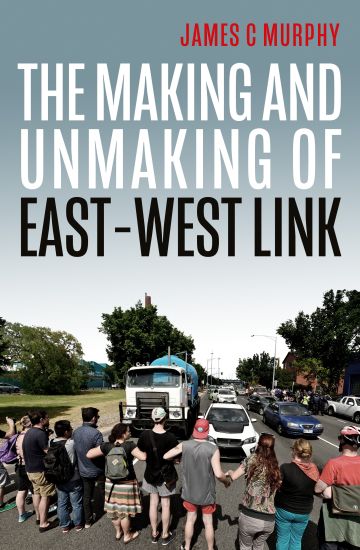
Melbourne's aborted East–West Link — the massive, multi-billion-dollar inner-city toll road project that promised to knit Melbourne closer together — was stymied from the start. Intense picketing and protests, multiple court challenges, breathless media coverage and bitter politicking consumed the Victorian parliament for some years. The Link brought the downfall of the single-term Baillieu–Napthine Liberal government; its cancellation cost the state half a billion dollars; and it lives on in infamy, a byword in the Australian lexicon for political brinkmanship, waste and politicisation of infrastructure. But where did this notorious megaproject come from, and what explains its fate? Was it a project hand-picked by state premiers for party-political reasons and mismanaged by bureaucrats? Was it foisted on the government by cunning roads chiefs, unprepared for the public backlash? Or was it simply that opponents of the project succeeded by turning it into an election issue? In The Making and Unmaking of East–West Link, James Murphy explores the saga from competing vantage points, detailing the layers of politics that saturate infrastructure policymaking in Australia.