Kirjojen hintavertailu. Mukana 11 342 296 kirjaa ja 12 kauppaa.

Kirjahaku

Etsi kirjoja tekijän nimen, kirjan nimen tai ISBN:n perusteella.

1000 tulosta hakusanalla Jochen P Handel

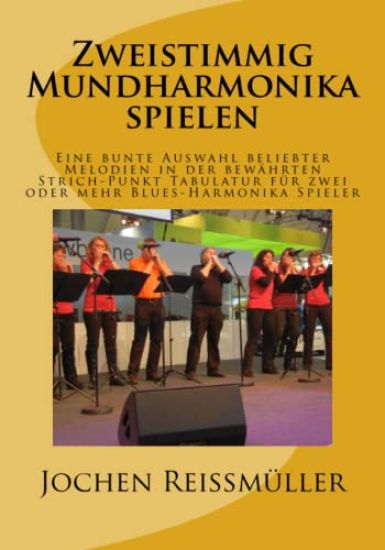
Zweistimmig Mundharmonika spielen: Eine bunte Auswahl beliebter Melodien in der bewährten Strich-Punkt Tabulatur für zwei oder mehr Blues-Harmonika Sp
Mundharmonika spielen ganz ohne Noten. In diesem Sammelband findest du 56 buntgemischte Musiktitel, die alle mit separater erster und zweiter Stimme im genial-einfachen Happy-Harmonica-System geschrieben sind: A ganze Weil -Alle Jahre wieder -Andante Grazioso - nnchen von Tharau -Arrival -Auf dr schw bsche Eisebahne - Avanti Popolo -Bajazzo -Barcarole -Bye Bye Love -Careless Love -Ciribiribela Mare Moja -Dat du mien Leewsten buest -Doxa To Theo -Die Gedanken sind frei -Dixie's Land -Es freit ein wilder Wassermann -Es h ngt ein Pferdehalfter an der Wand -Es l scht das Meer die Sonne aus - Es waren zwei K nigskinder -Es wird scho glei dumpa -Etinaxe -Farewell to Tarwathie -Fuhrmannslied Polka -Gaudeamus Hodie -Gib einem Kind deine Hand -Hab mein Wage vollgelade -Heisser Sand -Hohe Tannen -Horch, was kommt von draussen rein -Ich bete an die Macht der Liebe -I ll Tell Me Ma -Kaiserwalzer -Kein sch ner Land -Kokkino Garifalo (Rote Nelke) -Liebte Gott, der Herr uns nicht -Little Brown Jug -M gen sich die Wege -Muss i denn zum St dtele naus -My Bonnie Is Over The Ocean -Puff, the Magic Dragon -Santo Domingo -Scarborough Fair -Shenandoah -Stenka Rasin -The Field Of Athenry -The Irish Washerwoman -The Leaving Of Liverpool -The Rose -This Land Is Your Land -Tiritomba -We Shall Overcome -Wenn das Brot, das wir teilen -Wenn die Sonne erwacht in den Bergen -Zogen einst f nf wilde Schw ne -Zusammenleben S mtliche Melodien sind spielbar auf einer so genannten diatonischen Richter-Mundharmonika mit zehn ungeteilten Kanaelen - meist einfach nur Blues-Harmonika oder Harp genannt, z.B. "Blues-Band", "Big River", "Lee Oskar", "HOHNER Special 20", "SEYDEL 1847" oder "SEYDEL Session". Das System besteht aus untereinander angeordneten Punkten und Querstrichen, verteilt auf zehn Spalten, welche den zehn Kan len einer Harp entsprechen: Punkt bedeutet einatmen bzw. ziehen, Strich bedeutet ausatmen bzw. blasen.Einfach loslegen: Die Harp zwischen Zeigefinger und Daumen der linken Hand so halten, dass die Beschriftung der Kan le 1 bis 10 nach oben zeigt und bei leicht ge ffneten Lippen an den Mund ansetzen. Links sind dann die tiefen Toene und rechts die hohen. Jetzt einfach die Grafik von oben nach unten spielen und dabei die Mundposition entsprechend der Anordnung von Punkten und Strichen nach links oder rechts ver ndern.Je dicker der Punk oder Strich, umso l nger den Ton anhalten Weitere Infos auf www.muha-jochen.de
The Curse Of The Temple

The Curse Of The Temple

Jochen Reier

Jochen Reier
2016
nidottu
German architect Jochen Reier recounts his ambitious project to build a Nepalese Pagoda for the 1983 International Garden Exhibition in Munich, Germany, and the unexpected turn of events surrounding this project. After the Exhibition authorities withdraw their pledged project funding, he crafts a desperate plan to smuggle hashish from Nepal to Munich, in order to cover the long outstanding construction costs. This fateful decision eventually leads to a high seas escape from Australia and on through the south seas with his yacht "Restless" - the German judiciary in relentless pursuit. Mr. Reier's intriguing descriptions of the islands, seas and weather, his brief encounters with customs authorities, the plethora of characters he encounters "on the run", and the haunting prospect of a long prison sentence awaiting back in Germany reveal the toll this adventure takes on his psyche and physical stamina which can best be summarized with the caption "truth is sometimes stranger than fiction".
Quantum Mechanics for Pedestrians 1
This book, the first in a two-volume set, provides an introduction to the fundamentals of (mainly) non-relativistic quantum mechanics. This first volume chiefly focuses on the essential principles, while applications and extensions of the formalism can be found in volume 2. Including but also moving beyond material that is covered in traditional textbooks on quantum mechanics, the book discusses in detail current issues such as interaction-free quantum measurements or neutrino oscillations, as well as fundamental problems and epistemological questions, such as the measurement problem. A chapter on the postulates of quantum mechanics rounds off this first volume. In order to quickly and clearly present the main principles of quantum mechanics and its mathematical formulation, there is a systematic transition between wave mechanics and algebraic representation in the first few chapters, in which the required mathematical tools are introduced step by step. Moreover, the appendix concisely reviews the most important mathematical tools, allowing readers to largely dispense with supplementary literature. The appendix also explores advanced topics, such as the Quantum-Zeno effect and time-delay experiments. Over 250 exercises, most of them with solutions, help to deepen the reader’s understanding of the topics discussed. This revised second edition is expanded by an introduction to some ideas and problems of relativistic quantum mechanics. In this first volume, the Klein-Gordon and the Dirac equations are treated. Fundamentals of other areas are compiled in compact form, i.e., outlines of special relativity, classical field theory and electrodynamics. The book is chiefly intended for student science teachers and all students of physics, majors and minors alike, who are looking for a reasonably easy and modern introduction to quantum mechanics.
Quantum Mechanics for Pedestrians 2
This book, the second in a two-volume set, provides an introduction to the basics of (mainly) non-relativistic quantum mechanics. While the first volume addresses the basic principles, this second volume discusses applications and extensions to more complex problems. In addition to topics dealt with in traditional quantum mechanics texts, such as symmetries or many-body problems, it also treats issues of current interest such as entanglement, Bell’s inequality, decoherence and various aspects of quantum information in detail. Furthermore, questions concerning the basis of quantum mechanics and epistemological issues which are relevant e.g. to the realism debate are discussed explicitly. A chapter on the interpretations of quantum mechanics rounds out the book. Readers are introduced to the requisite mathematical tools step by step. In the appendix, the most relevant mathematics is compiled in compact form, and more advanced topics such as the Lenz vector, Hardy’s experiment and Shor’s algorithm are treated in more detail. As an essential aid to learning and teaching, 130 exercises are included, most of them with solutions. This revised second edition is expanded by an introduction into some ideas and problems of relativistic quantum mechanics. In this second volume, an overview of quantum field theory is given and basic conceptions of quantum electrodynamics are treated in some detail. Originally written as a course for students of science education, the book addresses all those science students and others who are looking for a reasonably simple, fresh and modern introduction to the field.
Many-Body Methods for Atoms, Molecules and Clusters

Many-Body Methods for Atoms, Molecules and Clusters

Jochen Schirmer

Springer Nature Switzerland AG
2018
nidottu
This book provides an introduction to many-body methods for applications in quantum chemistry. These methods, originating in field-theory, offer an alternative to conventional quantum-chemical approaches to the treatment of the many-electron problem in molecules. Starting with a general introduction to the atomic and molecular many-electron problem, the book then develops a stringent formalism of field-theoretical many-body theory, culminating in the diagrammatic perturbation expansions of many-body Green's functions or propagators in terms of Feynman diagrams. It also introduces and analyzes practical computational methods, such as the field-tested algebraic-diagrammatic construction (ADC) schemes. The ADC concept can also be established via a wave-function based procedure, referred to as intermediate state representation (ISR), which bridges the gap between propagator and wave-function formulations. Based on the current rapid increase in computer power and the development of efficient computational methods, quantum chemistry has emerged as a potent theoretical tool for treating ever-larger molecules and problems of chemical and physical interest. Offering an introduction to many-body methods, this book appeals to advanced students interested in an alternative approach to the many-electron problem in molecules, and is suitable for any courses dealing with computational methods in quantum chemistry.
Stable Isotope Geochemistry

Stable Isotope Geochemistry

Jochen Hoefs

Springer Nature Switzerland AG
2019
nidottu
This classic textbook is an introduction to the systematics and the use of stable isotopes in geosciences. It is subdivided into three parts: i) theoretical and experimental principles, ii) fractionation processes of light and heavy elements, iii) the natural variations of geologically important reservoirs. Since the publication of the previous edition advances in multicollector-ICP-mass-spectrometry allow precise measurements of new isotope systems. In this new edition therefore, 42 elements with resolvable natural variations in isotope composition are discussed. New findings from non-traditional isotope systems have been incorporated. Many new references have been added, which enable quick access to recent literature.
Stable Isotope Geochemistry

Stable Isotope Geochemistry

Jochen Hoefs

Springer Nature Switzerland AG
2021
sidottu
This classic textbook is an introduction to the systematics and the use of stable isotopes in geosciences. It is subdivided into three parts: i) theoretical and experimental principles, ii) fractionation processes of light and heavy elements, iii) the natural variations of geologically important reservoirs. Since the publication of the previous edition improvements in multi-collector ICP mass-spectrometry have increased the ability to measure isotope ratios with very high precision for many elements of the periodic table. The amount of published data has increased tremendously in the last years; thus, conclusions based on a limited database are now better constrained. In this new edition, therefore, 47 elements with resolvable natural variations in isotope composition are discussed. This increase of elements, together with advances in the calculation of equilibrium isotope fractionation using ab initio methods, has led to an unbelievable rise of publications, making substantial major revisions and extensions of the last edition necessary. Many new references have been added, which enable quick access to recent literature.
Stable Isotope Geochemistry

Stable Isotope Geochemistry

Jochen Hoefs

Springer Nature Switzerland AG
2022
nidottu
This classic textbook is an introduction to the systematics and the use of stable isotopes in geosciences. It is subdivided into three parts: i) theoretical and experimental principles, ii) fractionation processes of light and heavy elements, iii) the natural variations of geologically important reservoirs. Since the publication of the previous edition improvements in multi-collector ICP mass-spectrometry have increased the ability to measure isotope ratios with very high precision for many elements of the periodic table. The amount of published data has increased tremendously in the last years; thus, conclusions based on a limited database are now better constrained. In this new edition, therefore, 47 elements with resolvable natural variations in isotope composition are discussed. This increase of elements, together with advances in the calculation of equilibrium isotope fractionation using ab initio methods, has led to an unbelievable rise of publications, making substantial major revisions and extensions of the last edition necessary. Many new references have been added, which enable quick access to recent literature.
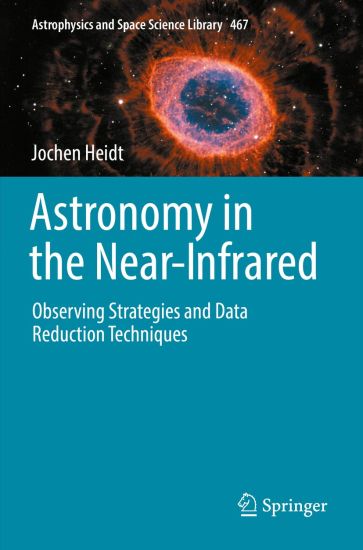
Astronomy in the Near-Infrared - Observing Strategies and Data Reduction Techniques
Near-infrared astronomy has become one of the most rapidly developing branches in modern astrophysics. Innovative observing techniques, near-infrared detectors with quantum efficiencies in excess of 90%, highly specialised instruments as well as advanced data reduction techniques have allowed major breakthroughs in various areas like exoplanets, star-forming regions, the supermassive black hole in the Galactic center, and the high-redshift Universe. In this book, the reader will be introduced to the basic concepts of how to prepare near-infrared observations with maximized scientific return. Equal weight is given to all aspects of the data reduction for both - imaging and spectroscopy. Information is also provided on the state of the art instrumentation available and planned, on detector technology or the physics of the atmosphere, all of which influence the preparation and execution of observations and data reduction techniques. The beginner but also the expert will find alot of information in compact form which is otherwise widely dispersed across the internet or other sources.
Astronomy in the Near-Infrared - Observing Strategies and Data Reduction Techniques
Near-infrared astronomy has become one of the most rapidly developing branches in modern astrophysics. Innovative observing techniques, near-infrared detectors with quantum efficiencies in excess of 90%, highly specialised instruments as well as advanced data reduction techniques have allowed major breakthroughs in various areas like exoplanets, star-forming regions, the supermassive black hole in the Galactic center, and the high-redshift Universe. In this book, the reader will be introduced to the basic concepts of how to prepare near-infrared observations with maximized scientific return. Equal weight is given to all aspects of the data reduction for both - imaging and spectroscopy. Information is also provided on the state of the art instrumentation available and planned, on detector technology or the physics of the atmosphere, all of which influence the preparation and execution of observations and data reduction techniques. The beginner but also the expert will find alot of information in compact form which is otherwise widely dispersed across the internet or other sources.
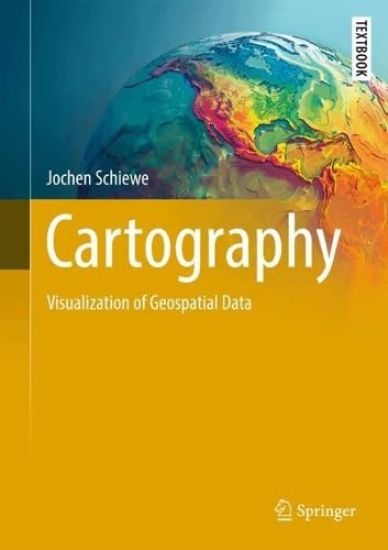
Cartography

Cartography

Jochen Schiewe

Springer International Publishing AG
2025
sidottu
What would our lives look like if there were no (good) maps? Maps are essential for orientation, navigation, and simplifying complex environments, ultimately enhancing our understanding of the world. The visualization of geospatial data supports both laypeople and experts in various aspects of life—whether in personal, professional, or scientific contexts. With the growing availability of maps online, they are increasingly used in daily life on devices such as smartphones and tablets. However, the surge in map creation does not necessarily equate to the production of "good" maps—those that effectively and efficiently fulfill their intended purpose. This book explores the full breadth of the field of Cartography. It delves into the core of the discipline, focusing on the graphical representation of geospatial data, spatial reference, and map projections. Additionally, it addresses key peripheral topics that contribute to a comprehensive understanding, such as usability testing, data collection and processing, and cartographic law. Rather than providing technical or software-specific guidance, the author emphasizes the fundamental concepts and methods of modern Cartography. Introductory chapter overviews, numerous illustrations, and practical exercises support this approach. This textbook is a valuable resource for students and educators across various fields—Cartography, Geography, Geodesy, Urban and Regional Planning, Environmental Sciences, and more. It aids in the creation and use of "good maps" and provides a solid foundation in modern Cartography for anyone with an interest in maps.
Stochastische Modelle der Versicherungsmathematik

Stochastische Modelle der Versicherungsmathematik

Jochen Blath; Marcel Ortgiese; Michael Scheutzow

BIRKHAUSER VERLAG AG
2025
nidottu
Das Ziel dieses kompakten und einführenden Lehrbuches ist es, im Rahmen des Stoffumfangs einer vierstündigen Mathematikvorlesung wesentliche stochastische Modelle der Versicherungsmathematik systematisch einzuführen und in ihren Grundzügen zu analysieren. Das Buch gibt eine Einführung u.a. in die Themen: • Lebensversicherungsmathematik, insbesondere zufällige Zahlungsströme und Satz von Hattendorff• Schadenversicherungsmathematik, insbesondere Risiko- und Ruintheorie, auch für Großschäden• Prämienberechnungsprinzipien, Risikomaße und Erfahrungstarifierung Das Buch legt einen Schwerpunkt auf die Erläuterung klassischer und teils fortgeschrittener stochastischer und maßtheoretischer Methoden und Ergebnisse unter Rückgriff auf möglichst vollständige Beweise. Geeignet ist das Buch für fortgeschrittene Bachelor- sowie Master-Studierende mathematischer Studiengänge mit Vorkenntnissen in Maß-, Integrations- und Wahrscheinlichkeitstheorie.
Erinnerung, Schuld Und Neubeginn

Erinnerung, Schuld Und Neubeginn

Jochen Vogt

Peter Lang AG
2014
nidottu
Das "gespenstische Nachleben" des Faschismus beklagt 1959 der Philosoph Theodor W. Adorno; dass die "deutsche Nachkriegsliteratur" ebendies zu ihrem Thema gemacht hat, konstatiert wenig spater der Erzahler Heinrich Boell. Die mehr als zwanzig Essays dieses Bandes, verfasst zwischen 1980 und 2012, spuren diesem historischen, sozialpsychologischen und literarischen Zusammenhang nach. Sie zeigen, wie die westdeutsche "Nachkriegsliteratur" wegweisend und stellvertretend fur Staat und Gesellschaft agierte, die sich dieser Aufgabe nur zoegerlich stellten. Stand dabei zunachst die Kriegserfahrung im Vordergrund, so ruckte Mitte der 1960er Jahre der spater so benannte Holocaust in den Blick, und wieder sind es dann Literatur und Theater, die der juristischen und wissenschaftlichen "Aufarbeitung der Vergangenheit" wichtige Impulse geben und sie verstarken. Dieser Band geht diesen Fragen im historischen UEberblick wie in detaillierten Einzelanalysen nach; besonderes Interesse gilt Klassikern der Nachkriegsliteratur wie Heinrich Boell und Peter Weiss, aber auch Autoren der nachfolgenden Generation wie Bernward Vesper, Christoph Meckel oder Uwe Timm. Die Studien fragen nach der historischen Leistung der Nachkriegsliteratur, ihrem Beitrag zu einer post- und nichtfaschistischen deutschen Identitat, aber auch nach ihren Defiziten und Unzulanglichkeiten, und reflektieren schliesslich ihre Abloesung durch vielfaltige neue Themen, Formen und Schreibweisen seit Anfang der 1980er Jahre.
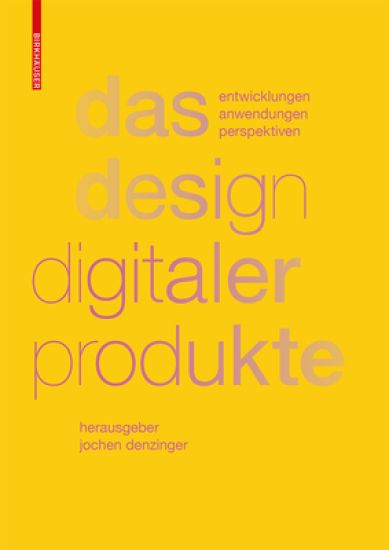
Das Design digitaler Produkte

Das Design digitaler Produkte

Jochen Denzinger

Birkhauser
2018
sidottu
Die Digitalisierung und die tiefe Integration von Computern in unseren Alltag verändern die Entwicklung von Produkten und damit auch das Produktdesign selbst: An der Entwicklung digitaler Produkte sind mittlerweile Disziplinen wie Design, Mensch-Maschine-Kommunikation, Informatik oder die Ingenieurswissenschaften beteiligt. Mit Beiträgen von Autoren aus diesen Bereichen greift das Buch aktuelle Positionen auf und stellt exemplrasich deren Vorgehensweisen und Methoden dar. Beispiele aus der Praxis ergänzen die Essays. So entsteht eine aktuelle Einführung in das Design digitaler Produkte und damit ein Bild, das das Design in seinen Intentionen neu verortet.
Global Prayers

Global Prayers

Jochen Becker; Kathrin Klingan; Stephan Lanz

Lars Muller Publishers
2013
nidottu
Religious communities inscribe themselves into the cityscape not only socially and politically, but also acoustically and architecturally. Global Prayers examines the mutual influence of religion and urbanism, looking at how various forms of faith manifest themselves in the cities of the world. Photo essays, interviews, reports, scientific texts, and artistic photo spreads inquire into the making of urban religion and the production of religious urbanity. With contributions by Nezar AlSayyad, Filip de Boeck, Hengameh Golestan, Brian Larkin, Aernout Mik, Werner Schiffauer, AbdouMaliq Simone, Camilo Jose Vergara, Paola Yacoub.
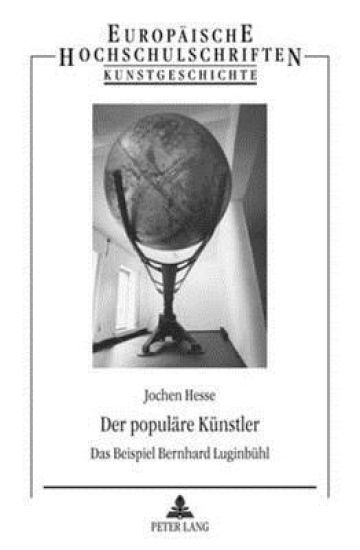
Der populaere Kuenstler

Der populaere Kuenstler

Jochen Hesse

Peter Lang Gmbh, Internationaler Verlag Der Wissenschaften
2008
nidottu
Der Berner K nstler Bernhard Luginb hl ist nicht nur der Produzent seiner Kunstwerke, sondern auch deren Verk ufer. Als Kurator seiner Ausstellungen erkennt Luginb hl die Bedeutung der Eventkultur, lange bevor der Begriff existiert. Der hehre Ernst der Kunst wird in seinen Werken zugunsten der Freude an der Unterhaltung des Publikums durchbrochen: F r die Kinder fertigt er Spielplastiken mit Rutschbahnen, f r die Erwachsenen l sst er mit den rollenden und l rmenden Kugeln der kinetischen Plastiken Jahrmarktstimmung aufkommen, und mit den knisternden Verbrennungsaktionen zieht er alle in Bann. In seinem Skulpturenpark in M tschwil, wo Chaos mit gewollter berf lle k mpft, setzt er seine inszenatorische Begabung um. Der Selbstdarsteller mit dem unverbl mten, kernigen Stil beh lt mit seinen Publikationen stets die Deutungshoheit ber das eigene Schaffen. Jochen Hesse, der Autor des Werkkataloges der Plastiken des K nstlers, legt im vorliegenden Buch dar, warum Luginb hl popul r wurde und weshalb seine Bekanntheit bis heute anh lt. Erstmals werden OEuvre und K nstlerpers nlichkeit in einer unabh ngigen Publikation kritisch gew rdigt.