Kirjojen hintavertailu. Mukana 11 377 968 kirjaa ja 12 kauppaa.

Kirjahaku

Etsi kirjoja tekijän nimen, kirjan nimen tai ISBN:n perusteella.

1000 tulosta hakusanalla M J H Simmonds

Fractional and Multivariable Calculus

Fractional and Multivariable Calculus

A.M. Mathai; H.J. Haubold

Springer International Publishing AG
2018
nidottu
This textbook presents a rigorous approach to multivariable calculus in the context of model building and optimization problems. This comprehensive overview is based on lectures given at five SERC Schools from 2008 to 2012 and covers a broad range of topics that will enable readers to understand and create deterministic and nondeterministic models. Researchers, advanced undergraduate, and graduate students in mathematics, statistics, physics, engineering, and biological sciences will find this book to be a valuable resource for finding appropriate models to describe real-life situations.The first chapter begins with an introduction to fractional calculus moving on to discuss fractional integrals, fractional derivatives, fractional differential equations and their solutions. Multivariable calculus is covered in the second chapter and introduces the fundamentals of multivariable calculus (multivariable functions, limits and continuity, differentiability, directionalderivatives and expansions of multivariable functions). Illustrative examples, input-output process, optimal recovery of functions and approximations are given; each section lists an ample number of exercises to heighten understanding of the material. Chapter three discusses deterministic/mathematical and optimization models evolving from differential equations, difference equations, algebraic models, power function models, input-output models and pathway models. Fractional integral and derivative models are examined. Chapter four covers non-deterministic/stochastic models. The random walk model, branching process model, birth and death process model, time series models, and regression type models are examined. The fifth chapter covers optimal design. General linear models from a statistical point of view are introduced; the Gauss–Markov theorem, quadratic forms, and generalized inverses of matrices are covered. Pathway, symmetric, and asymmetric models are covered in chapter six, the concepts are illustrated with graphs.

Präoperative Diagnostik

Präoperative Diagnostik

P.M. Osswald; H.-J. Hartung; U. Muth

Springer-Verlag Berlin and Heidelberg GmbH Co. K
1986
nidottu
Das vorliegende Taschenbuch wendet sich an Studenten der Medizin glei- chermassen wie an klinisch tatige AErzte und an Hochschullehrer. Dem Stu- denten soll es eine systematische Diagnostik am Patienten vermitteln. Dem klinisch tatigen Arzt vermittelt es Einzelheiten zu bestimmten Pro- blemen, dem Hochschullehrer mag das Taschenbuch didaktische Vor- bereitungshilfen bieten. Das Buch soll dazu beitragen, die praoperative Diagnostik zur Vorberei- tung zur Narkose und Operation in einem groesseren Rahmen der problem- orientierten Diagnostik zu sehen. An diesen genannten Zwecken orientiert sich auch der jeweilige Umfang. Indikationen zu weiteren Untersuchungen bei spezifischen Symptomen oder infolge spezieller Untersuchungsergeb- nisse sind als Empfehlungen zu betrachten und eben nur so gemeint. Die beschriebenen diagnostischen Verfahren erfordern oftmals optimale Bedingungen, d. h. die dazu erforderliche Zeit und auch die diagnostischen Moeglichkeiten" die dann auch zur entsprechenden Therapie verpflichten. Nicht immer aber verfugt der klinisch tatige Arzt uber solche Vorausset- zungen, so dass die Entscheidung der Auswahl der derjeweiligen Situation angepassten und geeigneten Diagnostik einzig und allein bei ihm bleiben muss.
Planung von Fabrikanlagen

Planung von Fabrikanlagen

Carl M. Dolezalek; H.J. Warnecke

Springer-Verlag Berlin and Heidelberg GmbH Co. K
2012
nidottu
Die meisten unserer Unternehmen sind aus kleinen oder kleinsten Anfiingen hervorgegangen und im Laufe der Jahre allmahlim zu ihrer heutigen GroBe ange- wachsen. Das laBt es manchem zweifelhaft ersmeinen, ob eine Fabrikplanung iiber- haupt einen Sinn hat. Es ist smwer fiir jemanden, der ein neues Unternehmen anfangt, vorauszusehen, ob und in weImer Zeit sim daraus eine groBere Fabrik- anlage entwickeln konnte. Wie die Erfahrung der letzten 150 Jahre jedom gezeigt hat, erkannten die erfolgreichen Unternehmer mit der Zeit, daB eine Neu-Vberlegung der Anord- nung der nunmehr vorhandenen Fabrikanlage von groBem Wert sein wiirde. Hier scheiden sim die Geister: Die weitsimtigen Unternehmer waren sim iiber das voraussimtlime weitere Wamstum ihrer Fabrikanlagen im klaren und fiihrten eine Planung durm, die oft viele Jahrzehnte unverandert beibehalten werden konnte. Andere dagegen versumten, auf dem ihnen gehorenden Geliinde so viel Gebaude- flame wie moglim zu smafien, urn den Aufwand fiir die Errimtung eines Zweig- betriebes oder gar Tomterunternehmens zu sparen. Oft hatten sie aum eine aus- gespromene Furmt vor leerstehenden Fabrikflamen. Mamhmal entstanden trotz solmer Einstellung weltweite Unternehmen, die ihre Lebenskraft aus der Wahl der rimtigen Produkte, aus der hervorragenden Qualitat ihrer Produkte und aus vielen anderen Elementen des industriellen Lebens smopften. Andere blieben im zu engen Anzug des kleinen Betriebes stecken und beschieden sim mit einem Umfang der Aufgabe, den sie damit erfiillen konnten.
Tumoren der Atmungsorgane und des Mediastinums A

Tumoren der Atmungsorgane und des Mediastinums A

M. Austgen; H.-W. Beckenkamp; H.-J. Brandt; U. Dold; H. Dürschmied; E. Dundalek; R. Felix; P. Georgi; H.-J. Herold; P. Hilgard; W. Jacob; H. O. Klein; N. Konietzko; R. Loddenkemper; W. Maaßen; E. Matsui; W. Matthiessen; H. Meents; K.-M. Müller; H. Ostertag; P. Schlimmer; D. Schmähl; R. Schober; O. H. Wegener; W. Wolfart; W. J. Zeller; Friedrich Trendelenburg

Springer-Verlag Berlin and Heidelberg GmbH Co. K
2011
nidottu
Unter Mitwirkung zahlreicher Fachwissenschaftler
Anleitungen zur anästhesiologischen Praxis

Anleitungen zur anästhesiologischen Praxis

P.M. Osswald; H.-J. Hartung

JF Bergmann Verlag
1984
nidottu
Dieses Buch ist zum bevorzugten Gebrauch flir Medizinstudenten, Assi- stenzarzte in Weiterbildung, Anasthesie- und Intensivschwestern bzw. -pfleger geschrieben. Es solI als praktisch orientierte, stichwortartige Anlei- tung ein Leitfaden flir die tagliche Praxis im Operationssaal sein. In den grundlegenden Kapiteln: Praoperative Uberlegungen, Techni- ken der GefaBpunktion, Standardverfahren der Narkoseeinleitung, Praxis der Intubation, Betrieb des Narkoseapparates, Prinzipien der MeBwerter- fassung des intraoperativen Monitorings, Aufrechterhaltung der Anasthe- sie und Medikamentensupplementierung, Narkosekomplikationen, Reani- mationstechniken, Durchflihrung regionaler Verfahren wird besonders auf die moglichen Fehler-und Gefahrenquellen sowie deren Vermeidung hin- gewiesen. Unterschiedliche Erkrankungen erfordern ein differenziertes Vorgehen bei der Anasthesie und Medikation ebenso wie die Interaktion von Me- dikamenten und Anasthetika. Dies wird genauso berlicksichtigt wie die Dosierungsangaben von Narkotika und vasoaktiven Medikamenten. Ein sehr ausflihrlicher Tabellenanhang liefert die wichtigsten Parame- ter flir Herz-und Kreislauf-, Lungen-, Blut-und Harnwerte. Das vorliegende Werk reflektiert seiner Natur nach die Einstellung der Autoren, was aber nicht bedeutet, daB wir nicht versucht haben, allge- meingliltige Regeln in der Durchflihrung einer Anasthesie zu berlicksichti- gen. Flir kritische Anmerkungen sind wir dankbar. 1. Pdioperative Dberlegungen Die Dringlichkeit des chirurgischen Eingriffs beziiglich der gegenwartigen Beschwerden und/oder der vitalen Beeintrachtigung des Patienten ist flir die anasthesiologische Planung und Vorbereitung des Patienten entschei- dend. Prinzipiell gilt: je dringender der Eingriff beziiglich der Sicherstellung der vitalen Funktionen indiziert ist, desto weniger Zeit verbleibt flir die anasthesiologische Vorbereitung. Bei elektiven Eingriffen muB der Patient praoperativ in den best- moglichen Zustand gebracht werden.
Psychology and Education

Psychology and Education

H.N. Drewry; J.M. Notterman

Kluwer Academic/Plenum Publishers
1993
sidottu
Drawing on the tradition of John Dewey and William James, the authors offer a concise overview of psychological theories and their applications to education, while managing to maintain the distinction between the two disciplines. Their seminal work will prove invaluable for educators, administrators, students in teacher preparation programs, as well as psychologists.
Timber

Timber

H.E. Desch; J.M. J.M. Dinwoodie

Red Globe Press
1996
nidottu
Since the sixth edition of this classic text/reference was published in 1981, there have been so many developments in the field that the new seventh edition represents an almost total rewrite of the subject matter. The opportunity has been taken to rearrange the structure and broaden the scope to cover areas of conversion, machining and the application of paints and finishes; the format has also been enlarged to improve readability. Part 1 contains chapters that deal with the structure of wood at the gross, cellular and molecular levels; variability is also covered. Part 2 has five chapters on the properties of wood, with special coverage of elastic behaviour, toughness and the use of structural-sized timber for strength tests. Part 3 on processing has material on several new areas not covered in earlier editions of the book; for example, log conversion, seasoning, and the machining of wood and board. The discussion of grading and grade stresses is fully updated. Part 4 on utilisation examines the latest techniques and standards for the manufacture of wood products. Part 5 examines all aspects of timber in service, including protection and preservation. The book will appeal to a wide readership, both as a student text and reference. Students of wood science and forestry at undergraduate and equivalent level will find it of special value. All institutions with courses in the built environment will wish to make the book available as a reference source.
Distance Learning

Distance Learning

C.M. Chang; H.F.M Crombag; K.D.J.M. van der Drift; J.F. Moonen

Kluwer Academic Publishers
1982
sidottu
History The present book is a translation and in part an adaptation of a study the authors conducted for the Dutch Ministry of Education. Several years ago, the Dutch authorities decided to found an Open University, a system of distance learning especially suited to students only able or willing to devote part of their time to their studies, and, moreover, not generally capable of studying at fixed times or places. A preparatory committee was created, which published a preliminary report in 1 1978. This report was largely concerned with the kinds of courses the Open University should offer and the kinds of students it planned to enroll. The report also discussed possible teaching methods or media of the Open University. The predominant conclusion was that written instruction should constitute the basic teaching medium, and that other media (e. g. , computerized instruction or televi­ sion) were only to be added if the written medium failed to realize the desired teaching objectives. This preference was mainly based on considerations of cost, since the committee expected written instruction to be the cheapest alternative possible. Whether this is in fact true will be discussed later in this book. We were then asked to reconsider the different possibilities of teaching methods and media in more detail, in terms of their differential teaching effects, costs of application, and the committee's preference for the print medium. Work was started on this assignment in 1978 and completed a year later.
Dough Rheology and Baked Product Texture

Dough Rheology and Baked Product Texture

H. Faridi; J.M. Faubion

Springer-Verlag New York Inc.
2011
nidottu
Cereal chemists are interested in rheology because the dough undergoes some type of deformation in every phase of the conversion of flour into baked products. During mixing, dough is subjected to extreme deformations, many that exceed the rupture limit; during fermentation, the deformations are much smaller and therefore exhibit a different set of rheological properties; during sheeting and molding, deformations are at an intermediate level; and, finally, during proofing and baking, the dough is subjected to a range of deformations at varying temperatures. Accordingly, the application of rheological concepts to explain the behavior of dough seems a natural requirement of research on the interrelationships among flour constituents, added ingredients, process parameters, and the required characteristics of the final baked product. At any moment in the baking process, the rheological behavior, that is, the nature of the deformation, exhibited by a specific dough derives from the applied stress and how long the stress is maintained. The resulting deformation may be simple, such as pure viscous flow or elastic deformation, and therefore easy to define precisely. Moreover, under some conditions of stress and time (i. e. , shear rate), doughs behave as ideal materials and their behavior follows theory derived from fundamental concepts. Under usual conditions encountered in baking, however, the rheological behavior is far from ideal; shear rates vary widely and sample size and dimensions are ill-defined.
Psychology and Education

Psychology and Education

H.N. Drewry; J.M. Notterman

Springer-Verlag New York Inc.
2013
nidottu
Drawing on the tradition of John Dewey and William James, the authors offer a concise overview of psychological theories and their applications to education, while managing to maintain the distinction between the two disciplines. Their seminal work will prove invaluable for educators, administrators, students in teacher preparation programs, as well as psychologists.
Geburtshilfe unter einfachen Bedingungen

Geburtshilfe unter einfachen Bedingungen

Jürgen Wacker; H.J. 01Diesfeld; M.Dioulde Balde; H.J. Diesfeld; Gunther Bastert

Springer-Verlag Berlin and Heidelberg GmbH Co. K
1994
nidottu
Die Autoren zeigen, wie unter einfachen Bedingungen Erkrankungen und Komplikationen in der Schwangerschaft und bei der Geburt erkannt und behandelt werden können. Praxisbezogen und an die speziellen Erfordernisse angepaßt werden Untersuchungsmethoden, operative wie auch alternative Entbindungsarten (z.B. kombinierte Wendung, Symphysiotomie) und wirklich praktikable Labormethoden fast "rezeptartig" beschrieben. Weitere Themen sind Infektionen, anästhesiologische Probleme, Notfälle, Versorgung des Neugeborenen, Fisteln, Ernährung, Familienplanung u.v.a. Ärzte und Hebammen, die unter ähnlich einfachen Bedingungen tätig sind, können von diesem Buch ebenso profitieren wie Studenten, die eine grundlegende Orientierungshilfe suchen.
Vom Belastungs-EKG zur Koronarangiographie

Vom Belastungs-EKG zur Koronarangiographie

M. Kaltenbach; H. Roskamm; G. Kober; W.D. Bussmann; L. Samek; P. Stürzen-Hofecker; H.-J. Becker; J. Petersen

Springer-Verlag Berlin and Heidelberg GmbH Co. K
2012
nidottu
Die koronare Herzkrankheit fordert in allen zivilisierten Landern einen hohen Zoll an Mortalitat und Morbiditat. Es ist deshalb notwendig, nach Wegen zu suchen, dieser - zumindest in Deutsch- land ungebrochenen -Entwicklung Einhalt zu gebieten. In manchen Fallen genugt allein schon eine Anamnese, um relativ fruh und mit hoher Treffsicherheit eine Myokardischamie auf dem Boden einer stenosierenden Koronarsklerose zu diagnostizieren. In den meisten Fallen sind jedoch wei- tergehende diagnostische Schritte zum Ausschluss oder zur Bestatigung einer koronaren Herz- krankheit erforderlich. Das vorliegende Buch will praktische Wege aufzeigen, die mit moeglichst geringem Aufwand zu einer adaquaten Diagnose fuhren. Deshalb ist bei der Darstellung der verschiedenen Krankheits- stadien bzw. Symptomkonstellationen stets auf ein ausgewogenes Verhaltnis zwischen diagnosti- schem Aufwand und moeglichen therapeutischen Konsequenzen abgehoben. Entsprechend ihrer diagnostischen Wertigkeit werden zunachst die nichtinvasiven Methoden dargestellt. Dabei gilt dem Belastungs-EKG als dem wohl wichtigsten Parameter unser besonderes Augenmerk. Neben zahlreichen subtilen technischen Details findet der Leser Angaben uber Treffsicherheit und Gren- zen dieser Methode. Besondere Aufmerksamkeit wird auch dem Stellenwert eventuell notwendi- ger erganzender Untersuchungsmethoden gewidmet, wie u. a. der konventionellen Roentgendia- gnostik, der Echokardiographie und der Nuklearmedizin. Die Verfasser sind der Meinung, dass die Koronarangiographie in jedem Falle einer strengen Indikation bedarf. Andererseits darf den Patienten, fur die lebenswichtige therapeutische Mass- nahmen von dieser Untersuchung abhangen, die Koronarangiographie nicht vorenthalten werden.
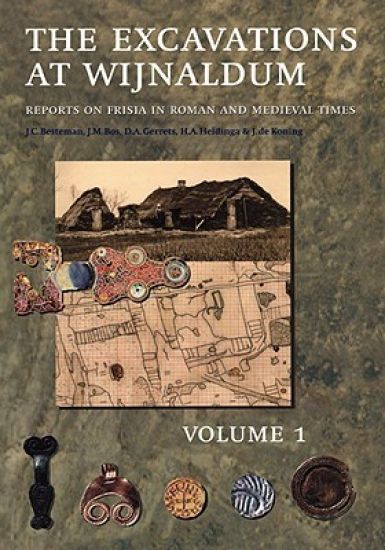
The Excavation Near Wijnaldum

The Excavation Near Wijnaldum

J.C. Besteman; J.M. Bos; D.A. Gerrts; H.A. Heidinga; J de Koning

A A Balkema Publishers
1999
sidottu
This volume contains the first results from the excavation of a terp at Wijnaldum in the province of Friesland, the Netherlands. The excavation was carried out as a joint venture between the University of Groningen and the University of Amsterdam from 1991 until 1993, and was the starting point of an interdisciplinary project on Frisia Magna in the first millennium AD: a time when Frisia became an important influence on the international trade and political stage in Northwest Europe. This volume describes Wijnaldum, how it was once a cradle of political and economic growth, and how the cultural heritage of the great days of Frisian history is now severely threatened in parts of the terp region.
Distance Learning

Distance Learning

C.M. Chang; H.F.M Crombag; K.D.J.M. van der Drift; J.F. Moonen

Springer
2011
nidottu
History The present book is a translation and in part an adaptation of a study the authors conducted for the Dutch Ministry of Education. Several years ago, the Dutch authorities decided to found an Open University, a system of distance learning especially suited to students only able or willing to devote part of their time to their studies, and, moreover, not generally capable of studying at fixed times or places. A preparatory committee was created, which published a preliminary report in 1 1978. This report was largely concerned with the kinds of courses the Open University should offer and the kinds of students it planned to enroll. The report also discussed possible teaching methods or media of the Open University. The predominant conclusion was that written instruction should constitute the basic teaching medium, and that other media (e. g. , computerized instruction or televi­ sion) were only to be added if the written medium failed to realize the desired teaching objectives. This preference was mainly based on considerations of cost, since the committee expected written instruction to be the cheapest alternative possible. Whether this is in fact true will be discussed later in this book. We were then asked to reconsider the different possibilities of teaching methods and media in more detail, in terms of their differential teaching effects, costs of application, and the committee's preference for the print medium. Work was started on this assignment in 1978 and completed a year later.
Rheumatologie C

Rheumatologie C

M. Aufdermaur; G. L. Bach; J.-M. Engel; R. Filchner; F. Graser; E. Gundel; H. Hess; F. Husmann; H. Kather; H. Kerl; G. Klein; W. Krämer; H. Kresbach; H. Leinisch; S. Marghescu; R. Maurach; W. Miehle; W. Mohr; H. Müller-Fassbender; D. Pongratz; W. Schmidt-Vanderheyden; P. Schneider; B. Simon; G. Stöckl; S. Stotz; F. Strian; F. J. Wagenhäuser; A. Weintraub; D. Wessinghage; H. Mathies

Springer-Verlag Berlin and Heidelberg GmbH Co. K
2012
nidottu
Bearbeitet von zahlreichen Fachwissenschaftlern
Handbook of Systems Thinking Methods

Handbook of Systems Thinking Methods

Paul M. Salmon; Neville A. Stanton; Guy H. Walker; Adam Hulme; Natassia Goode; Jason Thompson; Gemma J.M. Read

TAYLOR FRANCIS LTD
2022
sidottu
The systems thinking philosophy has become popular in human factors and ergonomics and safety science. These methods are being used to understand and resolve complex societal problems in areas such as transport safety, workplace safety, medication error, disaster management, child abuse, financial crises, terrorism, climate change and public health and wellbeing. This handbook presents practical step-by-step guidance for practitioners and researchers wishing to use these methods to tackle complex problems. Each method includes an example case study which demonstrates how the method can be applied and how the results can be interpreted and translated into practical recommendations.The book presents practical guidance on state-of-the-art systems thinking methods and offers case study applications describing systems thinking methods in novel areas. It explains how to translate the outputs of systems thinking methods in practice and introduces systems thinking with an overview of Human Factors and Ergonomics applications.This book will serve as a great reference for students and engineers in the field of systems engineering, complex systems and the design and development of systems, including ergonomics/human factors and systems engineers, designers, architects, industrial engineers, project management engineers, reliability engineers, risk engineers, software engineers and computer engineers.
Structured Electronic Design

Structured Electronic Design

Arie van Staveren; Chris J.M. Verhoeven; Arthur H.M. van Roermund

Springer
2000
sidottu
Analog design still has, unfortunately, a flavor of art. Art can be beautiful. However, art in itself is difficult to teach to students and difficult to transfer from experienced analog designers to new trainee designers in companies. Structured Electronic Design: High-Performance Harmonic Oscillators and Bandgap References aims to systemize analog design. The use of orthogonalization of the design of the fundamental quality aspects (noise, distortion, and bandwidth) and hierarchy in the subsequent design steps, enables designers to achieve high-performance designs, in a relatively short time. As a result of the systematic design procedure, the effect of design decisions on the circuit performance is made clear. Additionally, the use of resources for reaching a specified performance is tracked. This book, therefore, describes the structured electronic design of high-performance harmonic oscillators and bandgap references. The structured design of harmonic oscillators includes the maximization of the carrier-to- noise ratio by means of tapping, i.e. an impedance adaption method for noise matching. The bandgap reference, a popular implementation of a voltage reference, is studied via the unusual concept of the linear combination of base-emitter voltages. The presented method leads to the design of high-performance references in CMOS and Bipolar technology. Using this concept, on a high level of abstraction the quality with respect to, for instance, noise and power-supply rejection can be identified. In this book, it is shown with several design examples that this method provides an excellent starting point for the design of high-performance bandgap references. Auxiliary to the harmonic-oscillator and bandgap reference design are the negative- feedback amplifiers. In this book the systematic design of the dynamic behavior is emphasized. By means of the identification of the dominant poles, it is possibleto give an upper limit of the attainable bandwidth, even before the real frequency compensation is accomplished. Structured Electronic Design: High-Performance Harmonic Oscillators and Bandgap References is a valuable book for researchers and designers, as well as students in the field of analog design. It helps both the experienced and trainee designer to come to grips with the design of analog circuits. The presented method is illustrated by several well- described design examples.
Handbook of Systems Thinking Methods

Handbook of Systems Thinking Methods

Paul M. Salmon; Neville A. Stanton; Guy H. Walker; Adam Hulme; Natassia Goode; Jason Thompson; Gemma J.M. Read

TAYLOR FRANCIS LTD
2025
nidottu
The systems thinking philosophy has become popular in human factors and ergonomics and safety science. These methods are being used to understand and resolve complex societal problems in areas such as transport safety, workplace safety, medication error, disaster management, child abuse, financial crises, terrorism, climate change and public health and wellbeing. This handbook presents practical step-by-step guidance for practitioners and researchers wishing to use these methods to tackle complex problems. Each method includes an example case study which demonstrates how the method can be applied and how the results can be interpreted and translated into practical recommendations.The book presents practical guidance on state-of-the-art systems thinking methods and offers case study applications describing systems thinking methods in novel areas. It explains how to translate the outputs of systems thinking methods in practice and introduces systems thinking with an overview of Human Factors and Ergonomics applications.This book will serve as a great reference for students and engineers in the field of systems engineering, complex systems and the design and development of systems, including ergonomics/human factors and systems engineers, designers, architects, industrial engineers, project management engineers, reliability engineers, risk engineers, software engineers and computer engineers.
Structured Electronic Design

Structured Electronic Design

Arie van Staveren; Chris J.M. Verhoeven; Arthur H.M. van Roermund

Springer-Verlag New York Inc.
2010
nidottu
Analog design still has, unfortunately, a flavor of art. Art can be beautiful. However, art in itself is difficult to teach to students and difficult to transfer from experienced analog designers to new trainee designers in companies. Structured Electronic Design: High-Performance Harmonic Oscillators and Bandgap References aims to systemize analog design. The use of orthogonalization of the design of the fundamental quality aspects (noise, distortion, and bandwidth) and hierarchy in the subsequent design steps, enables designers to achieve high-performance designs, in a relatively short time. As a result of the systematic design procedure, the effect of design decisions on the circuit performance is made clear. Additionally, the use of resources for reaching a specified performance is tracked. This book, therefore, describes the structured electronic design of high-performance harmonic oscillators and bandgap references. The structured design of harmonic oscillators includes the maximization of the carrier-to- noise ratio by means of tapping, i.e. an impedance adaption method for noise matching. The bandgap reference, a popular implementation of a voltage reference, is studied via the unusual concept of the linear combination of base-emitter voltages. The presented method leads to the design of high-performance references in CMOS and Bipolar technology. Using this concept, on a high level of abstraction the quality with respect to, for instance, noise and power-supply rejection can be identified. In this book, it is shown with several design examples that this method provides an excellent starting point for the design of high-performance bandgap references. Auxiliary to the harmonic-oscillator and bandgap reference design are the negative- feedback amplifiers. In this book the systematic design of the dynamic behavior is emphasized. By means of the identification of the dominant poles, it is possibleto give an upper limit of the attainable bandwidth, even before the real frequency compensation is accomplished. Structured Electronic Design: High-Performance Harmonic Oscillators and Bandgap References is a valuable book for researchers and designers, as well as students in the field of analog design. It helps both the experienced and trainee designer to come to grips with the design of analog circuits. The presented method is illustrated by several well- described design examples.