Kirjojen hintavertailu. Mukana 12 016 292 kirjaa ja 12 kauppaa.

Kirjahaku

Etsi kirjoja tekijän nimen, kirjan nimen tai ISBN:n perusteella.

1000 tulosta hakusanalla Manfred Sack

Numerical Methods and Optimization in Finance

Numerical Methods and Optimization in Finance

Manfred Gilli; Dietmar Maringer; Enrico Schumann

Academic Press Inc
2011
sidottu
This book describes computational finance tools. It covers fundamental numerical analysis and computational techniques, such as option pricing, and gives special attention to simulation and optimization. Many chapters are organized as case studies around portfolio insurance and risk estimation problems. In particular, several chapters explain optimization heuristics and how to use them for portfolio selection and in calibration of estimation and option pricing models. Such practical examples allow readers to learn the steps for solving specific problems and apply these steps to others. At the same time, the applications are relevant enough to make the book a useful reference. Matlab and R sample code is provided in the text and can be downloaded from the book's website.

Heat Exchanger Design Guide

Heat Exchanger Design Guide

Manfred Nitsche; Raji Olayiwola Gbadamosi

Butterworth-Heinemann Inc
2015
nidottu
Heat Exchanger Design Guide: A Practical Guide for Planning, Selecting and Designing of Shell and Tube Exchangers takes users on a step-by-step guide to the design of heat exchangers in daily practice, showing how to determine the effective driving temperature difference for heat transfer. Users will learn how to calculate heat transfer coefficients for convective heat transfer, condensing, and evaporating using simple equations. Dew and bubble points and lines are covered, with all calculations supported with examples. This practical guide is designed to help engineers solve typical problems they might encounter in their day-to-day work, and will also serve as a useful reference for students learning about the field. The book is extensively illustrated with figures in support of the text and includes calculation examples to ensure users are fully equipped to select, design, and operate heat exchangers.
Numerical Methods and Optimization in Finance

Numerical Methods and Optimization in Finance

Manfred Gilli; Dietmar Maringer; Enrico Schumann

Academic Press Inc
2019
nidottu
Computationally-intensive tools play an increasingly important role in financial decisions. Many financial problems—ranging from asset allocation to risk management and from option pricing to model calibration—can be efficiently handled using modern computational techniques. Numerical Methods and Optimization in Finance presents such computational techniques, with an emphasis on simulation and optimization, particularly so-called heuristics. This book treats quantitative analysis as an essentially computational discipline in which applications are put into software form and tested empirically. This revised edition includes two new chapters, a self-contained tutorial on implementing and using heuristics, and an explanation of software used for testing portfolio-selection models. Postgraduate students, researchers in programs on quantitative and computational finance, and practitioners in banks and other financial companies can benefit from this second edition of Numerical Methods and Optimization in Finance.
Globalization

Globalization

Manfred B. Steger

Oxford University Press
2023
nidottu
Very Short Introductions: Brilliant, Sharp, Inspiring We live today in an interconnected world in which ordinary people can became instant online celebrities to millions of fans thousands of miles away, in which religious leaders can influence billions globally, in which humans are altering the climate and environment, in which new infectious diseases spread across continents at lightning speed, and in which complex social forces are increasingly impacted by digital technology. This is globalization. In the sixth edition of his bestselling Very Short Introduction, Manfred B. Steger offers concise definitions of pertinent key terms and concepts. He provides an accessible overview of the long history of globalization followed by an examination of its major dimensions: economic, political, cultural, ideological, and ecological. He also engages the hotly contested question of whether it is, ultimately, a good or a bad thing. From climate change to the COVID-19 pandemic, resurgent nationalism to global social media, trade wars to China's growing global profile, Russia's expansionism to renewed fears of nuclear conflicts, he explores today's unprecedented levels of planetary integration and disruption. ABOUT THE SERIES: The Very Short Introductions series from Oxford University Press contains hundreds of titles in almost every subject area. These pocket-sized books are the perfect way to get ahead in a new subject quickly. Our expert authors combine facts, analysis, perspective, new ideas, and enthusiasm to make interesting and challenging topics highly readable.
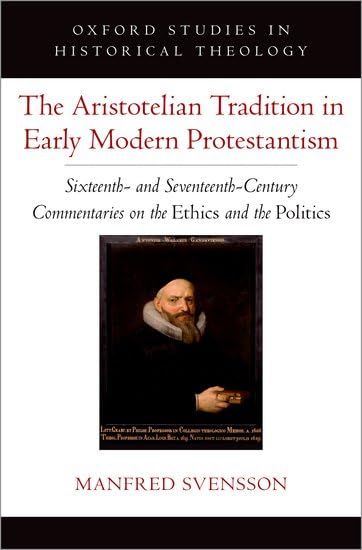
The Aristotelian Tradition in Early Modern Protestantism

The Aristotelian Tradition in Early Modern Protestantism

Manfred Svensson

OXFORD UNIVERSITY PRESS INC
2024
sidottu
Aristotle's moral and political thought formed the backbone of education in practical philosophy for centuries during the classical and medieval periods. It has often been presumed, however, that with the advent of the Protestant Reformation, this tradition was broken. Originally a topic belonging to Roman Catholic polemics, this interpretation of Protestant relations with Aristotle gradually became a part of the Protestant self-understanding as well. Lack of engagement with the actual curriculum of early Protestant schools allowed Luther's dismissive comments on Aristotle to be taken as representative of early Protestant teaching. In The Aristotelian Tradition in Early Modern Protestantism Manfred Svensson shows how the days of this view as a dominant narrative are over. Between 1529 and 1670, Protestants published around 55 commentaries on the Ethics and around 15 on the Politics, several of these in numerous editions. In academies and universities in Lutheran and Reformed territories throughout the Reformation and post-Reformation era, the exposition of these works continued to form the backbone of moral and political education. This tradition has, however, largely flown under the radar and is now for the first time presented in a comprehensive way. Offering a discussion of the medieval context and debt to Renaissance Aristotelianism, Svensson maps the relationships between these commentaries and their authors, presenting their shared understanding of practical philosophy in its relation to the Christian faith and offering in-depth discussions of key ethical and political concepts.
Organometallics 1

Organometallics 1

Manfred Bochmann

Oxford University Press
1994
nidottu
This succinct text outlines the main classes of transition metal organometallic complexes and introduces the reader to the chemistry of compounds with metal-carbon *s-bonds: metal carbonyls, metal alkyls, and metal alkylidenes and alkylidnes. The synthetic methods leading to each class of compounds are illustrated with pertinent examples, followed by the discussion of characteristic structures and reactivity patterns. The aim is to allow undergraduate students a quick overview over this area of chemistry. Highlights and excursions stress general principles and relate the material to specific applications such as catalytic processes.
Organometallics 2

Organometallics 2

Manfred Bochmann

Oxford University Press
1994
nidottu
The interaction of transition metals with unsaturated molecules has led to fundamental insights in the nature of the chemical bond which, in turn, has provided the basis of important present-day applications such as transition metal mediated synthesis or homogeneous and heterogeneous catalysis. This slim volume outlines the chemistry and discusses the bonding in of some of the most important classes of organometallic compounds: the complexes of transition metals with Pi-ligands such as alkenes, alkynes, arenes, and cyclopentadienyl and allyl ligands. The material covered follows on from Organometallics I which covers the chemistry of complexes with metal-carbon delta-bonds. Synthetic and reactivity aspects of each class of compounds are illustrated with pertinent examples from the recent chemical literature. Highlighted excursions relate the fundamental chemistry to current synthetic or catalytic applications.
From Strange Simplicity to Complex Familiarity

From Strange Simplicity to Complex Familiarity

Manfred Eigen

Oxford University Press
2013
sidottu
This book presents a vivid argument for the almost lost idea of a unity of all natural sciences. It starts with the "strange" physics of matter, including particle physics, atomic physics and quantum mechanics, cosmology, relativity and their consequences (Chapter I), and it continues by describing the properties of material systems that are best understood by statistical and phase-space concepts (Chapter II). These lead to entropy and to the classical picture of quantitative information, initially devoid of value and meaning (Chapter III). Finally, "information space" and dynamics within it are introduced as a basis for semantics (Chapter IV), leading to an exploration of life and thought as new problems in physics (Chapter V). Dynamic equations - again of a strange (but very general) nature - bring about the complex familiarity of the world we live in. Surprising new results in the life sciences open our eyes to the richness of physical thought, and they show us what can and what cannot be explained by a Darwinian approach. The abstract physical approach is applicable to the origins of life, of meaningful information and even of our universe.
From Strange Simplicity to Complex Familiarity

From Strange Simplicity to Complex Familiarity

Manfred Eigen

Oxford University Press
2019
nidottu
This book presents a vivid argument for the almost lost idea of a unity of all natural sciences. It starts with the "strange" physics of matter, including particle physics, atomic physics and quantum mechanics, cosmology, relativity and their consequences (Chapter I), and it continues by describing the properties of material systems that are best understood by statistical and phase-space concepts (Chapter II). These lead to entropy and to the classical picture of quantitative information, initially devoid of value and meaning (Chapter III). Finally, "information space" and dynamics within it are introduced as a basis for semantics (Chapter IV), leading to an exploration of life and thought as new problems in physics (Chapter V). Dynamic equations - again of a strange (but very general) nature - bring about the complex familiarity of the world we live in. Surprising new results in the life sciences open our eyes to the richness of physical thought, and they show us what can and what cannot be explained by a Darwinian approach. The abstract physical approach is applicable to the origins of life, of meaningful information and even of our universe.
Neoliberalism

Neoliberalism

Manfred B. Steger; Ravi K. Roy

Oxford University Press
2021
nidottu
Very Short Introductions: Brilliant, Sharp, Inspiring Anchored in the principles of free-market economics, neoliberalism emerged in the 1990s as the world's most dominant economic paradigm. It has been associated with various political leaders from Ronald Reagan, Margaret Thatcher, and Bill Clinton, to Tony Blair, Barack Obama, and Manmohan Singh. Neoliberalism even penetrated deeply into communist China's powerful economic system. However, the 2008 Global Financial Crisis and the related European Sovereign Debt Crisis triggered a decade of economic volatility and insecurity that boosted the fortunes of the 1 per cent while saddling the 99 per cent with stagnant wages and precarious work. As a result of this Great Recession, neoliberalism fortunes have waned considerably. This downward trend further accelerated with the recent surge of national populism around the world that brought to power outspoken critics of neoliberalism like Donald Trump, Boris Johnson, Jair Bolsonaro, and Narendra Modi. Is neoliberalism doomed or will it regain its former glory? And what are the major types of neoliberalism, and how did they evolve over the decades? Responding to these crucial questions, this Very Short introduction explores the considerable variations of neoliberalism around the world, and discusses the origins, evolution, and core ideas of neoliberalism. This new edition brings the story of neoliberalism up to date, and asks whether new versions of neoliberalism might succeed in drowning out the rising tide of national populism and its nostalgic longing for a return to territorial sovereignty and national greatness. ABOUT THE SERIES: The Very Short Introductions series from Oxford University Press contains hundreds of titles in almost every subject area. These pocket-sized books are the perfect way to get ahead in a new subject quickly. Our expert authors combine facts, analysis, perspective, new ideas, and enthusiasm to make interesting and challenging topics highly readable.
English in Europe

English in Europe

Manfred Görlach

Oxford University Press
2004
nidottu
English in Europe charts the English invasion of Europe since 1945. Sixteen distinguished European scholars report on the English words and phrases that have become integral parts of their languages. Each describes the effect of English on the host language, and shows how the process of incorporation often modifies pronunciation and spelling and frequently transforms meaning and use. The languages surveyed are Icelandic, Dutch, French, Spanish, Norwegian, German, Italian, Romanian, Polish, Croatian, Finnish, Albanian, Russian, Bulgarian, Hungarian, and Greek. The book is designed as a companion to A Dictionary of European Anglicisms but may be read as an independent work. This is the first systematic survey of a phenomenon that is fascinating, alarming, and apparently unstoppable.
The Rise of the Global Imaginary

The Rise of the Global Imaginary

Manfred B. Steger

Oxford University Press
2008
sidottu
Neoliberalism. Neoconservatism. Postmarxism. Postmodernism. Is there really something genuinely new about today's isms? Have we moved past our traditional ideological landscape? Combining political history, philosophical interpretation, and good old-fashioned story-telling, Manfred Steger traces ideology's remarkable journey from Count Destutt de Tracy's Enlightenment "science of ideas" to President George W. Bush's "imperial globalism." Rejecting futile attempts to "update" modern political belief systems by adorning them with prefixes, the author offers instead a highly original explanation for their novelty-their increasing ability to articulate deep-seated understandings of community in global rather than national terms. This growing awareness of globality fuels the visions of social elites who reside in the privileged spaces of our global cities. It erupts in the hopes and demands of migrants who traverse national boundaries in search of their piece of the global promise. Stoked by cross-cultural encounters, technological change, and scientific innovation, the rising global imaginary has destabilized the grand political ideologies codified during the national age. The national is slowly losing its grip on people's minds, but the global has not yet ascended to the commanding heights once occupied by its predecessor. Still, the first rays of the rising global imaginary have provided enough light to capture the contours of a profoundly altered ideological landscape. Pointing in this direction, the book ends with a timely interpretation of the apparent convergence of ideology and religion in the dawning global age-a broad phenomenon that extends beyond the obvious cases of Christian fundamentalism and Islamic jihadism.
The Rise of the Global Imaginary

The Rise of the Global Imaginary

Manfred B. Steger

Oxford University Press
2009
nidottu
Neoliberalism. Neoconservatism. Postmarxism. Postmodernism. Is there really something genuinely new about today's isms? Have we moved past our traditional ideological landscape? Combining political history, philosophical interpretation, and good old-fashioned story-telling, Manfred Steger traces ideology's remarkable journey from Count Destutt de Tracy's Enlightenment "science of ideas" to President George W. Bush's "imperial globalism." Rejecting futile attempts to "update" modern political belief systems by adorning them with prefixes, the author offers instead a highly original explanation for their novelty-their increasing ability to articulate deep-seated understandings of community in global rather than national terms. This growing awareness of globality fuels the visions of social elites who reside in the privileged spaces of our global cities. It erupts in the hopes and demands of migrants who traverse national boundaries in search of their piece of the global promise. Stoked by cross-cultural encounters, technological change, and scientific innovation, the rising global imaginary has destabilized the grand political ideologies codified during the national age. The national is slowly losing its grip on people's minds, but the global has not yet ascended to the commanding heights once occupied by its predecessor. Still, the first rays of the rising global imaginary have provided enough light to capture the contours of a profoundly altered ideological landscape. Pointing in this direction, the book ends with a timely interpretation of the apparent convergence of ideology and religion in the dawning global age-a broad phenomenon that extends beyond the obvious cases of Christian fundamentalism and Islamic jihadism.
The Global Studies Reader

The Global Studies Reader

Manfred B. Steger

Oxford University Press Inc
2014
nidottu
The Global Studies Reader, Second Edition, offers an accessible introduction to globalization that will provide students with a better understanding of what constitutes Global Studies-the transdisciplinary field dedicated to the study of globalization. Thus, the book has been carefully designed to provide a representative selection of transdisciplinary writings appropriate for undergraduate students in Global Studies. This book brings together in a single volume some of the best pieces on the subject written by recognized scholars. These twenty seminal contributions have been kept to an easily digestible length while at the same time covering the major dimensions of globalization: politics and societies; economies and technologies; cultures and histories; and spaces and environments. Although The Global Studies Reader purposely contains no additional sectional introductions that might interrupt the conceptual flow of the writings, it offers at the end of each of its four parts five discussion points designed to help clarify the authors' arguments and to stimulate further conversation. You will also find suggestions for additional readings and recommended websites to guide students' further research.
Organometallics and Catalysis: An Introduction

Organometallics and Catalysis: An Introduction

Manfred Bochmann

Oxford University Press
2014
nidottu
Organometallic chemistry explores the chemistry of the often bewildering variety of compounds featuring metal-carbon bonds. A field that has underpinned the development of new synthetic methods and materials, it is also central to our understanding of catalysis. In his text, Manfred Bochmann distils the extensive knowledge of the field into a succinct overview of essential concepts. The book is enriched throughout with examples that demonstrate how our understanding of organometallic chemistry has led to new applications in research and industry - not least in relation to catalysis - and an extensive reaction schemes and structures give added clarity to the concepts being explained. Striking just the right balance between breadth and depth - and with features throughout to support the learning process - Organometallics and Catalysis is the perfect introduction for undergraduate and graduate students who need a thorough grounding on the subject or are embarking on new research areas. Online Resources: The online resources to accompany Organometallics and Catalysis: An Introduction features: For registered adopters of the text: - Figures from the book in electronic format For everyone: - Curated links to relevant video materials on YouTube
Coach and Couch

Coach and Couch

Manfred F. r. kets De Vries; Konstantin Korotov; Elizabeth Florent-Treacy

Palgrave Macmillan
2007
sidottu
The INSEAD Global Leadership Centre (IGLC) was founded, and is directed by Professor Kets de Vries. IGLC has helped thousands of executives to increase their effectiveness in dealing with colleagues and clients, and to refocus their own professional and personal aspirations. This book is a volume of essays on topics relevant to leadership development. Drawing upon substantial research, this book presents the essential leadership models and equips practitioners with tools for developing executive coaches and working with business leaders.
The Mind within the Net

The Mind within the Net

Manfred Spitzer

Bradford Books
2000
pokkari
A highly readable, non-mathematical introduction to neural networks-computer models that help us to understand how we perceive, think, feel, and act.How does the brain work? How do billions of neurons bring about ideas, sensations, emotions, and actions? Why do children learn faster than elderly people? What can go wrong in perception, thinking, learning, and acting? Scientists now use computer models to help us to understand the most private and human experiences. In The Mind Within the Net, Manfred Spitzer shows how these models can fundamentally change how we think about learning, creativity, thinking, and acting, as well as such matters as schools, retirement homes, politics, and mental disorders.Neurophysiology has told us a lot about how neurons work; neural network theory is about how neurons work together to process information. In this highly readable book, Spitzer provides a basic, nonmathematical introduction to neural networks and their clinical applications. Part I explains the fundamental theory of neural networks and how neural network models work. Part II covers the principles of network functioning and how computer simulations of neural networks have profound consequences for our understanding of how the brain works. Part III covers applications of network models (e.g., to knowledge representation, language, and mental disorders such as schizophrenia and Alzheimer's disease) that shed new light on normal and abnormal states of mind. Finally, Spitzer concludes with his thoughts on the ramifications of neural networks for the understanding of neuropsychology and human nature.
The Linguistic History of English

The Linguistic History of English

Manfred Gorlach

Red Globe Press
1997
nidottu
The great structural changes of the English language in the course of its history are taught in this textbook by continuous reference to translations of identical Biblical passages, which date from different periods and are printed in parallel. Analysis progresses from spelling and phonology to inflexion, word-formation, syntax, lexicology and semantics and ends with a chapter on foreign influences. Description is consistently based on functional-structuralist methods which provide the best tool for the didactic aim here envisaged. The book is intended for an introductory course into English historical linguistics at university level.