Kirjahaku
Etsi kirjoja tekijän nimen, kirjan nimen tai ISBN:n perusteella.
1000 tulosta hakusanalla Mark V. Stivers
This work has been selected by scholars as being culturally important and is part of the knowledge base of civilization as we know it.This work is in the public domain in the United States of America, and possibly other nations. Within the United States, you may freely copy and distribute this work, as no entity (individual or corporate) has a copyright on the body of the work.Scholars believe, and we concur, that this work is important enough to be preserved, reproduced, and made generally available to the public. To ensure a quality reading experience, this work has been proofread and republished using a format that seamlessly blends the original graphical elements with text in an easy-to-read typeface.We appreciate your support of the preservation process, and thank you for being an important part of keeping this knowledge alive and relevant.
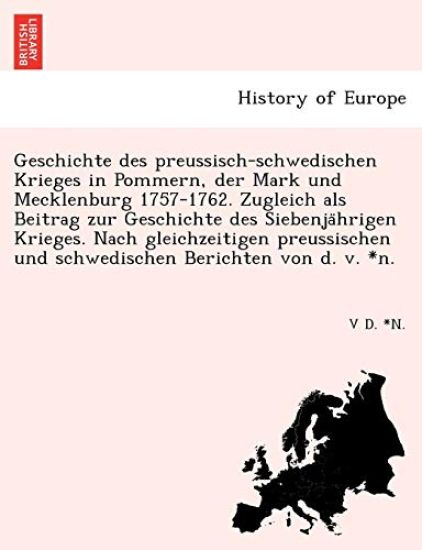
Geschichte Des Preussisch-Schwedischen Krieges in Pommern, Der Mark Und Mecklenburg 1757-1762. Zugleich ALS Beitrag Zur Geschichte Des Siebenja Hrigen Krieges. Nach Gleichzeitigen Preussischen Und Schwedischen Berichten Von D. V. *N.
V D *N
British Library, Historical Print Editions
2011
pokkari
Mark Barrett Cosby, Petitioner, V. David H. Harts, Florence J. Harts, and Percy B. Johnston. U.S. Supreme Court Transcript of Record with Supporting Pleadings
B Lacey Catron; Leland P Miller
Gale Ecco, U.S. Supreme Court Records
2011
pokkari
Mark Avrech, Petitioner, V. Secretary of the Navy. U.S. Supreme Court Transcript of Record with Supporting Pleadings
Dorian Bowman; Robert H Bork
Gale, U.S. Supreme Court Records
2011
pokkari
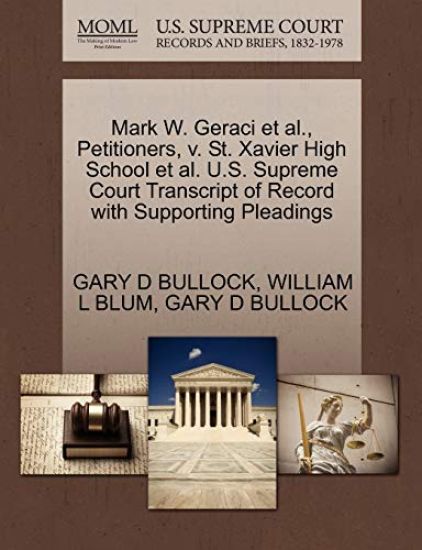
Mark W. Geraci et al., Petitioners, V. St. Xavier High School et al. U.S. Supreme Court Transcript of Record with Supporting Pleadings
William L Blum; Gary D Bullock
Gale, U.S. Supreme Court Records
2011
pokkari
Ever Ready Incorporated and Mark Gilbert, Petitioners, V. Union Carbide Corporation. U.S. Supreme Court Transcript of Record with Supporting Pleadings
Francis J McConnell; John H Morrison
Gale Ecco, U.S. Supreme Court Records
2011
pokkari
Contested-election Case Of Sammuel W. Beakes V. Mark R. Bacon
Hutson Street Press
2025
sidottu
Contested-election Case Of Sammuel W. Beakes V. Mark R. Bacon
Hutson Street Press
2025
pokkari
G. Garvin Brown, III, Petitioner, V. Mark Paul Felsen. U.S. Supreme Court Transcript of Record with Supporting Pleadings
Deanna E Hickman; Alex Stephen Keller
Gale, U.S. Supreme Court Records
2011
pokkari
In 1919 American Communist Party member Benjamin Gitlow was arrested for distributing a ""Left Wing Manifesto,"" a publication inspired by the Russian Revolution. He was charged with violating New York's Criminal Anarchy Law of 1902, which outlawed the advocacy of any doctrine advocating to the violent overthrow of government. Gitlow argued that the law violated his right to free speech but was still convicted. He appealed and five years later the Supreme Court upheld his sentence by a vote of 7-2.Throughout the legal proceedings, much attention was devoted to the ""bad tendency"" doctrine - the idea that speakers and writers were responsible for the probable effects of their words - which the Supreme Court explicitly endorsed in its decision. According to Justice Edward T. Sanford, ""A state may punish utterances endangering the foundations of organized government and threatening its overthrow by unlawful means."" More important was Justice Oliver Wendell Holmes' dissent, in which he argued that the mere expression of ideas, separated from action, could not be punished under the ""clear and present danger"" doctrine. As Holmes put it, ""Every idea is an incitement"" and the expression of an idea, no matter how disagreeable, was protected by the First Amendment. While the majority disagreed, it also raised and endorsed the idea that the Bill of Rights could be violated by neither the federal government nor individual states - an idea known as ""incorporation"" that was addressed for the first time in this case. In recreating Gitlow, Marc Lendler opens up the world of American radicalism and brings back into focus a number of key figures in American law: defense attorney Clarence Darrow; New York Court of Appeals justices Roscoe Pound and Benjamin Cardozo; Walter Pollak of the fledgling ACLU; and dissenting justices Oliver Wendell Holmes and Louis Brandeis. Lendler also traces the origins of the incorporation doctrine and the ebb and flow of Gitlow as a precedent through the end of the Cold War.In a time when Islamic radicalism raises many of the same questions as domestic Communism did, Lendler's cogent explication of this landmark case helps students and Court-watchers alike better understand ""clear and present danger"" tests, ongoing debates over incitement, and the importance of the Holmes-Brandeis dissent in our jurisprudence.