Kirjojen hintavertailu. Mukana 12 459 402 kirjaa ja 12 kauppaa.

Kirjahaku

Etsi kirjoja tekijän nimen, kirjan nimen tai ISBN:n perusteella.

1000 tulosta hakusanalla Martyn Hilbert

A new Dictionary of Natural History; or, Compleat Universal Display of Animated Nature. With Accurate Representations of the Most Curious and Beautiful Animals, Elegantly Coloured. By William Frederic Martyn, Esq. In two Volumes. ... of 2; Volume 1
The 18th century was a wealth of knowledge, exploration and rapidly growing technology and expanding record-keeping made possible by advances in the printing press. In its determination to preserve the century of revolution, Gale initiated a revolution of its own: digitization of epic proportions to preserve these invaluable works in the largest archive of its kind. Now for the first time these high-quality digital copies of original 18th century manuscripts are available in print, making them highly accessible to libraries, undergraduate students, and independent scholars.Medical theory and practice of the 1700s developed rapidly, as is evidenced by the extensive collection, which includes descriptions of diseases, their conditions, and treatments. Books on science and technology, agriculture, military technology, natural philosophy, even cookbooks, are all contained here.++++The below data was compiled from various identification fields in the bibliographic record of this title. This data is provided as an additional tool in helping to insure edition identification: ++++British LibraryT081840William Frederick Martyn = William Fordyce Mavor (DNB). Titlepages in red and black. Horizontal chain lines. The plates are dated 1784-87.London: printed for Harrison and Co., 1785 i.e.1787]. 2v., plates; 2
A new Dictionary of Natural History; or, Compleat Universal Display of Animated Nature. With Accurate Representations of the Most Curious and Beautiful Animals, Elegantly Coloured. By William Frederic Martyn, Esq. In two Volumes. ... of 2; Volume 2
The 18th century was a wealth of knowledge, exploration and rapidly growing technology and expanding record-keeping made possible by advances in the printing press. In its determination to preserve the century of revolution, Gale initiated a revolution of its own: digitization of epic proportions to preserve these invaluable works in the largest archive of its kind. Now for the first time these high-quality digital copies of original 18th century manuscripts are available in print, making them highly accessible to libraries, undergraduate students, and independent scholars.Medical theory and practice of the 1700s developed rapidly, as is evidenced by the extensive collection, which includes descriptions of diseases, their conditions, and treatments. Books on science and technology, agriculture, military technology, natural philosophy, even cookbooks, are all contained here.++++The below data was compiled from various identification fields in the bibliographic record of this title. This data is provided as an additional tool in helping to insure edition identification: ++++British LibraryT081840William Frederick Martyn = William Fordyce Mavor (DNB). Titlepages in red and black. Horizontal chain lines. The plates are dated 1784-87.London: printed for Harrison and Co., 1785 i.e.1787]. 2v., plates; 2
Pub. Virgilii Maronis Georgicorum Libri Quatuor. the Georgics of Virgil, with an English Translation and Notes. Illustrated with Copper Plates. by John Martyn, ...
The 18th century was a wealth of knowledge, exploration and rapidly growing technology and expanding record-keeping made possible by advances in the printing press. In its determination to preserve the century of revolution, Gale initiated a revolution of its own: digitization of epic proportions to preserve these invaluable works in the largest archive of its kind. Now for the first time these high-quality digital copies of original 18th century manuscripts are available in print, making them highly accessible to libraries, undergraduate students, and independent scholars.Western literary study flows out of eighteenth-century works by Alexander Pope, Daniel Defoe, Henry Fielding, Frances Burney, Denis Diderot, Johann Gottfried Herder, Johann Wolfgang von Goethe, and others. Experience the birth of the modern novel, or compare the development of language using dictionaries and grammar discourses. ++++The below data was compiled from various identification fields in the bibliographic record of this title. This data is provided as an additional tool in helping to insure edition identification: ++++British LibraryT067047Each poem has its own pagination, but the register is continuous.Dublin: printed by John Exshaw, 1778. xvi,117, 1],127, 1],132,95, 13]p., plates; 8
Publii Virgilii Maronis Georgicorum libri quatuor. The Georgicks of Virgil, with an English translation and notes. By John Martyn, ... The third edition.
The 18th century was a wealth of knowledge, exploration and rapidly growing technology and expanding record-keeping made possible by advances in the printing press. In its determination to preserve the century of revolution, Gale initiated a revolution of its own: digitization of epic proportions to preserve these invaluable works in the largest archive of its kind. Now for the first time these high-quality digital copies of original 18th century manuscripts are available in print, making them highly accessible to libraries, undergraduate students, and independent scholars.Western literary study flows out of eighteenth-century works by Alexander Pope, Daniel Defoe, Henry Fielding, Frances Burney, Denis Diderot, Johann Gottfried Herder, Johann Wolfgang von Goethe, and others. Experience the birth of the modern novel, or compare the development of language using dictionaries and grammar discourses. ++++The below data was compiled from various identification fields in the bibliographic record of this title. This data is provided as an additional tool in helping to insure edition identification: ++++British LibraryT067046Titlepage in red and black. With an advertisement leaf opposite the titlepage, and an index at the end.London: printed for T. Osborne and J. Shipton, 1755. xvi,487,4, 13]p.; 8
Letters on the Elements of Botany. Addressed to a Lady. By ... J. J. Rousseau. Translated Into English, With Notes, and Twenty-four Additional Letters, ... By Thomas Martyn, ... The Second Edition, With Corrections and Improvements
The 18th century was a wealth of knowledge, exploration and rapidly growing technology and expanding record-keeping made possible by advances in the printing press. In its determination to preserve the century of revolution, Gale initiated a revolution of its own: digitization of epic proportions to preserve these invaluable works in the largest archive of its kind. Now for the first time these high-quality digital copies of original 18th century manuscripts are available in print, making them highly accessible to libraries, undergraduate students, and independent scholars.Medical theory and practice of the 1700s developed rapidly, as is evidenced by the extensive collection, which includes descriptions of diseases, their conditions, and treatments. Books on science and technology, agriculture, military technology, natural philosophy, even cookbooks, are all contained here.++++The below data was compiled from various identification fields in the bibliographic record of this title. This data is provided as an additional tool in helping to insure edition identification: ++++British LibraryT137987With a half-title and an index. Variant: p. xxv is unnumbered.London: printed for B. White and Son, 1787. 2], xxv, 1],500, 28]p., table; 8
Radicals, Rebels and Royals

Radicals, Rebels and Royals

Martyn Routledge; Elspeth Wills

HARPERCOLLINS PUBLISHERS
2024
sidottu
“A fascinating trawl through history as filtered through the ultimate pub crawl.” – CHOICE MAGAZINE A beautifully illustrated alternative history book, tracing the history of the British Isles through its landmark pubs with recreations of their pub signs in stunning colour. The perfect combination of Britain’s two favourite past-times – talking about history and going to the pub! Be transported around the British Isles with this plotted history of the most interesting, and sometimes surprising facts about the history of Britain. Radicals, Rebels and Royals is packed with trivia, stories, and practical ‘Out and About’ segments for each location which will leave any pub-goer satiated. Learn how pub history has memorialised the Celts, World War II, football teams and much more as well as reading about their most famous patrons. With tales of pirates, highwaymen and secret affairs Radicals, Rebels and Royals features over 70 pubs from England, Wales, Scotland and Ireland. Brush up on your local history, or discover your next watering hole all from the comfort of your own home. Pubs include: The Shakespeare’s Head in London; The Robert the Bruce in Dumfries, Scotland; The King’s Head in Galway, Republic of Ireland; The Star and Garter in Manchester; the Blue Boar in Essex; and many more! Come for the history and leave drunk on the fun with Radicals, Rebels and Royals!
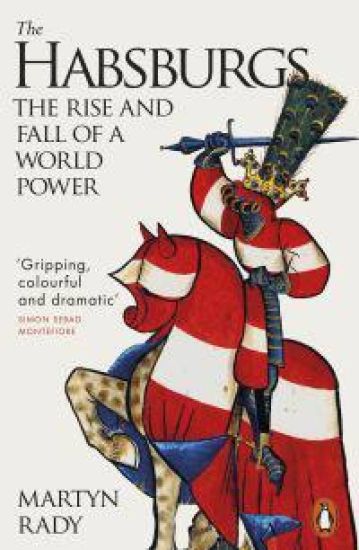
The Habsburgs

The Habsburgs

Martyn Rady

Penguin Books Ltd
2022
pokkari
'This is probably the best book ever written on the Habsburgs in any language, certainly the best I have ever read ... Students, scholars and the general reader will never find a better guide to Habsburg history' Alan Sked, Times Literary SupplementIn The Habsburgs, Martyn Rady tells the epic story of a dynasty and the world it built - and then lost - over nearly a millennium.From modest origins, the Habsburgs grew in power to gain control of the Holy Roman Empire in the fifteenth century. Then, in just a few decades, their possessions rapidly expanded to take in a large part of Europe stretching from Hungary to Spain, and from the Far East to the New World. The family continued to dominate Central Europe until the catastrophe of the First World War.With its seemingly disorganized mass of large and small territories, its tangle of laws and privileges and its medley of languages, the Habsburg Empire has always appeared haphazard and incomplete. But here Martyn Rady shows the reasons for the family's incredible endurance, driven by the belief that they were destined to rule the world as defenders of the Roman Catholic Church, guarantors of peace and patrons of learning. The Habsburg emperors were themselves absurdly varied in their characters - from warlords to contemplatives, from clever to stupid, from idle to frenzied - but all driven by the same sense of family mission. Scattered around the world, countless buildings, institutions and works of art continue to bear witness to their overwhelming impact.The Habsburgs is the definitive history of a remarkable dynasty that, for better or worse, shaped Europe and the world.
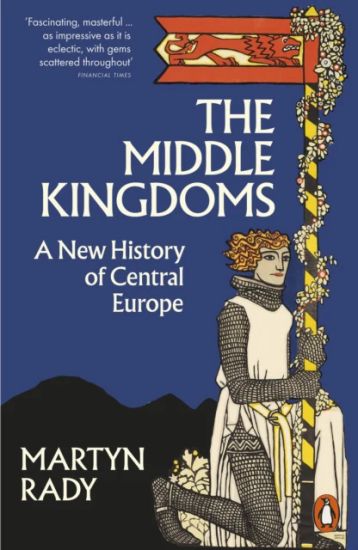
The Middle Kingdoms

The Middle Kingdoms

Martyn Rady

PENGUIN BOOKS LTD
2024
pokkari
'Fascinating, masterful ... gems scattered throughout the book' Peter Frankopan, Spectator'Quirkily original but also scholarly and authoritative, to be read for pleasure and serious reflection' Telegraph*The dramatic history of Europe's shape-shifting centre, from the author of The Habsburgs*Central Europe is not just a space on a map but also a region of shared experience - of mutual borrowings, impositions and misapprehensions. From the Roman Empire onwards, it has been the target of invasion from the east. In the Middle Ages, Central Europeans cast their eastern foes as 'the dogmen'. They would later become the Turks, Swedes, Russians and Soviets, all of whom pulled the region apart and remade it according to their own vision.Competition among Europe's Middle Kingdoms yielded repeated cultural effervescences. This was the first home of the High Renaissance outside Italy, the cradle of the Reformation, the starting point of the Enlightenment, Romanticism, the symphony and modern nationalism. It was a permanent battleground too for religious and political ideas.Most recent histories of Central Europe confine themselves to the lands in between Germany and Russia, homing in on Poland, Hungary, and what is now the Czech Republic. This new history embraces the whole of Central Europe, including the German lands as well as Ukraine and Switzerland. The story of Europe's Middle Kingdoms is a reminder of Central Europe's precariousness, of its creativity and turbulence, and of the common cultural trends that make these lands so distinctive.
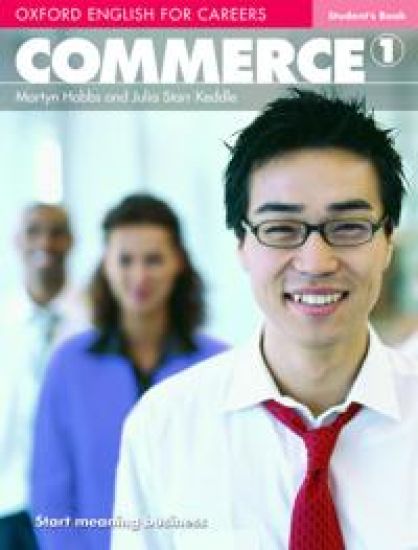
Oxford English for Careers: Commerce 1: Student's Book

Oxford English for Careers: Commerce 1: Student's Book

Martyn Hobbs; Julia Starr Keddle

Oxford University Press
2006
nidottu
Commerce is ideal for pre-work students, studying at pre-intermediate to intermediate levels, who will need to use English in work situations. Commerce develops the vocabulary, language, and skills that students need to communicate effectively in both formal and informal scenarios in the workplace. These include taking part in meetings, giving presentations, and socializing with colleagues.
Project X Origins: Dark Blue Book Band, Oxford Level 15: Endangered: Class Pack of 30

Project X Origins: Dark Blue Book Band, Oxford Level 15: Endangered: Class Pack of 30

Martyn Beardsley; Jan Burchett; Sara Vogler; Deborah Chancellor; Alison Hawes; Chloe Rhodes; Jo Tregenza

Oxford University Press
2014
muu
Project X Origins is a ground-breaking guided reading programme for the whole school. Action-packed stories, fascinating non-fiction and comprehensive guided reading support meet the needs of children at every stage of their reading development. Each book contains inside cover notes that highlight challenge words, prompt questions and a range of follow-up activities to support children in their reading. Project X Origins guided reading notes offer step-by-step teaching support for each book with guidance about phonics, comprehension, vocabulary, fluency, spelling, grammar, punctuation and writing. Each set of notes has in-built assessment and is fully correlated to all UK curricula. This pack contains 1 set of guided reading notes and 30 reading books, 6 of each of: The Swarm, Piranha!, The Amazon, Big Game Adventure, Facing Danger.
Project X Origins: Dark Blue Book Band, Oxford Level 15: Endangered: The Swarm
Project X Origins is a ground-breaking guided reading programme for the whole school. Action-packed stories, fascinating non-fiction and comprehensive guided reading support meet the needs of children at every stage of their reading development. In The Swarm Team X are on a mission to discover why all the bees around the world are disappearing. Their investigations lead them to the Sahara Desert, where they discover the Collector's cunning plan. Each book contains inside cover notes that highlight challenge words, prompt questions and a range of follow-up activities to support children in their reading.
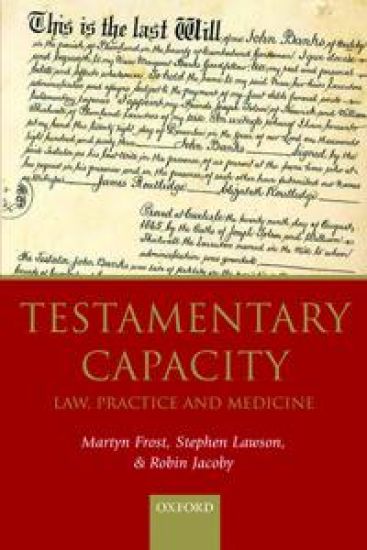
Testamentary Capacity

Testamentary Capacity

Martyn Frost; Stephen Lawson; Robin Jacoby

Oxford University Press
2015
nidottu
Testamentary capacity is an increasingly difficult and important area in will preparation. The rise in capacity issues, associated with the increasing aging population and longer life expectancy, has become a fruitful area for dispute and litigation. This book equips practitioners with the knowledge and practical guidance needed in this complex but commonplace problem area. Featuring an explanation of the law relating to testamentary capacity, the book also includes a practical section on the role of the will draftsman. Covering all associated areas such as interviews, questioning, recording of relevant information, and risk management policies, these issues are put into context by a guide to mental health issues that can affect capacity. This books also features a section on litigating in this area including pre-litigation considerations, a guide to ADR and settlement, and procedural issues. Written by experienced wills practitioners and an expert in old age psychiatry, this book is the first to link relevant medical issues directly to law and practice, presenting all the information a draftsman or litigator needs on the subject. This is an invaluable resource for all concerned with issues of testamentary capacity.
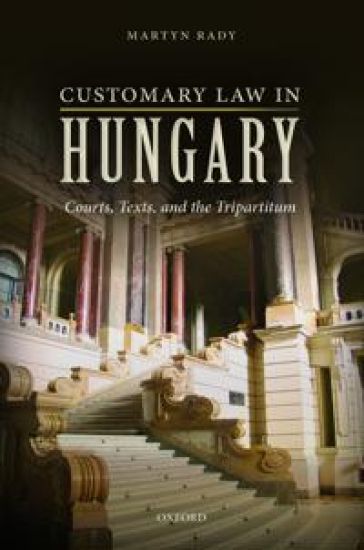
Customary Law in Hungary

Customary Law in Hungary

Martyn Rady

Oxford University Press
2015
sidottu
This is the first comprehensive treatment in any language of the history of customary law in Hungary, from the thirteenth to the twentieth centuries. Hungary's customary law was described by Stephen Werboczy in 1517 in the extensive law code known as the Tripartitum. As Werboczy explained, Hungarian law derived from the interplay of Romano-canonical law, statute, written instruments, and court judgments. It was also responsive, however, to popular conceptions of the law's content and application, as communicated through the lay membership of the kingdom's courts. Publication of the Tripartitum was intended to make the law more certain by fixing it in writing. Nevertheless, its text was customized by actual use, in the same way as the statute laws of the kingdom were adjusted as a consequence of court practice and of errors in their transmission. The reputation attaching to the Tripartitum and Hungary's insulation from the Roman Law Reception meant that the Tripartitum continued to retain authority until well into the nineteenth century. Attempts to replace it foundered and it was the principal text on which the courts and the schools relied, not only in Habsburg Hungary but also in Transylvania. Courts, nevertheless, continued to modify its provisions in the interests of rendering judgments that they deemed either to be right or in conformity with developing practices. Even after the establishment of a parliamentary form of government in the nineteenth century, a strong customary element attached to Hungarian law, which was amplified by the association of customary law with national traditions. The consequence was that Hungary maintained aspects of a customary law regime until the Communist period.
The Habsburg Empire

The Habsburg Empire

Martyn Rady

Oxford University Press
2017
nidottu
The Habsburgs are the most famous dynasty in continental Europe. From the thirteenth to the twentieth centuries, they ruled much of Central Europe, and for two centuries were also rulers of Spain. Through the Spanish connection, they acquired lands around the Mediterranean and a chunk of the New World, spreading eastwards to include the Philippines. Reaching from South-East Asia to what is now Ukraine, the Habsburg Empire was truly global. In this Very Short Introduction Martin Rady looks at the history of the Habsburgs, from their tenth-century origins in Switzerland, to the dissolution of the Habsburg Empire in 1918. He introduces the pantheon of Habsburg rulers, which included adventurers, lunatics, and at least one monarch who was so malformed that his true portrait could never be exhibited. He also discusses the lands and kingdoms that made up the Habsburg Empire, and the decisive moments that shaped their history. Dynasty, Europe, global power, and the idea of the multi-national state all converge on the history of the Habsburg Empire. ABOUT THE SERIES: The Very Short Introductions series from Oxford University Press contains hundreds of titles in almost every subject area. These pocket-sized books are the perfect way to get ahead in a new subject quickly. Our expert authors combine facts, analysis, perspective, new ideas, and enthusiasm to make interesting and challenging topics highly readable.
Risk and Negligence in Wills, Estates, and Trusts

Risk and Negligence in Wills, Estates, and Trusts

Martyn Frost; Penelope Reed QC; Mark Baxter

Oxford University Press
2014
nidottu
Risk and Negligence in Wills, Estates, and Trusts provides essential guidance for all will draftsmen. It offers in-depth analysis of negligence and wills, together with commentary on safe practice and the avoidance of risk. Together the areas covered provide a framework for the safe practice that is now essential in this much disputed area of work. This updated edition examines the new developments in will preparation and what is needed for safe practice as well as the important cases since the last edition. This work contains indispensable practical guidance, tailored to meet the demands of all those involved in wills, trusts, and estates and disputes relating to them. Practical advice in establishing best practice to avoid disputes is given and the appendices include practical forms and checklists to assist this. In addition there is analysis of the allied subjects of estate and trust administration and commonly encountered problem areas. A section also concentrates on duties in relation to taxation aspects of this work. Negligence and private client work is a fast developing area of modern law. The recent financial crisis has helped to focus attention closely on what risk is and how it should be managed. This has not merely been in the financial sector but in all areas of business. The legal profession has seen some major financial failures and an operating climate that is increasingly difficult. The rise in PI claims, the insurers' restrictions on cover, and the increased cost of cover have led to an increased focus on professional ability and risk management. Therefore, knowledge of the risks, what constitutes safe practice, and how to manage risk, are essential for anyone practising in this area.
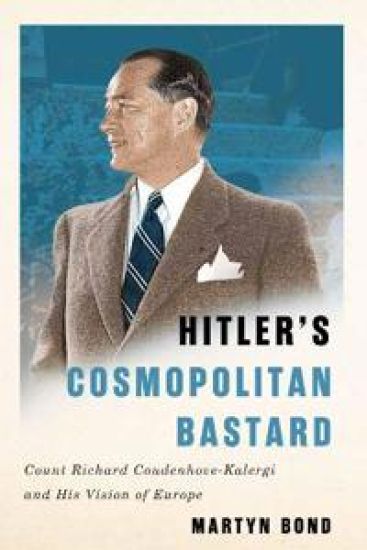
Hitler's Cosmopolitan Bastard

Hitler's Cosmopolitan Bastard

Martyn Bond

McGill-Queen's University Press
2021
sidottu
In the turbulent period following the First World War the young Count Richard Coudenhove-Kalergi founded the Pan-European Union, offering a vision of peaceful, democratic unity for Europe, with no borders, a common currency, and a single passport. His political congresses in Vienna, Berlin, and Basel attracted thousands from the intelligentsia and the cultural elite, including Albert Einstein, Thomas Mann, and Sigmund Freud, who wanted a United States of Europe brought together by consent. The Count's commitment to this cooperative ideal infuriated Adolf Hitler, who referred to him as a "cosmopolitan bastard" in Mein Kampf.Communists and nationalists, xenophobes and populists alike hated the Count and his political mission. When the Nazis annexed Austria, the Count and his wife, the famous actress Ida Roland, narrowly escaped the Gestapo. He fled to the United States, where he helped shape American policy for postwar Europe. Coudenhove-Kalergi's profile was such that he served as the basis for the fictional resistance hero Victor Laszlo in the film Casablanca.A brilliant networker, the Count guided many European leaders, notably advising Winston Churchill before his 1946 Zürich speech on Europe. A friend to both Chancellor Konrad Adenauer and President Charles de Gaulle, Coudenhove-Kalergi was personally invited to the High Mass in Rheims Cathedral in 1961 to celebrate Franco-German reconciliation. A provocative visionary for Europe, Coudenhove-Kalergi thought and acted in terms of continents, not countries.For the Count, the United States of Europe was the answer to the challenges of communist Russia and capitalist America. Indeed, he launched his Pan-European Union thirty years before Jean Monnet set up the European Coal and Steel Community, the precursor to the European Union. Timely and captivating, Martyn Bond's biography offers an opportunity to explore a remarkable life and revisit the impetus and origins of a unified Europe.
Hitler's Cosmopolitan Bastard

Hitler's Cosmopolitan Bastard

Martyn Bond

MCGILL-QUEEN'S UNIVERSITY PRESS
2025
nidottu
In the turbulent period following the First World War the young Count Richard Coudenhove-Kalergi founded the Pan-European Union, offering a vision of peaceful, democratic unity for Europe, with no borders, a common currency, and a single passport. His political congresses in Vienna, Berlin, and Basel attracted thousands from the intelligentsia and the cultural elite, including Albert Einstein, Thomas Mann, and Sigmund Freud, who wanted a United States of Europe brought together by consent. The Count's commitment to this cooperative ideal infuriated Adolf Hitler, who referred to him as a "cosmopolitan bastard" in Mein Kampf.Communists and nationalists, xenophobes and populists alike hated the Count and his political mission. When the Nazis annexed Austria, the Count and his wife, the famous actress Ida Roland, narrowly escaped the Gestapo. He fled to the United States, where he helped shape American policy for postwar Europe. Coudenhove-Kalergi's profile was such that he served as the basis for the fictional resistance hero Victor Laszlo in the film Casablanca.A brilliant networker, the Count guided many European leaders, notably advising Winston Churchill before his 1946 Zürich speech on Europe. A friend to both Chancellor Konrad Adenauer and President Charles de Gaulle, Coudenhove-Kalergi was personally invited to the High Mass in Rheims Cathedral in 1961 to celebrate Franco-German reconciliation. A provocative visionary for Europe, Coudenhove-Kalergi thought and acted in terms of continents, not countries.For the Count, the United States of Europe was the answer to the challenges of communist Russia and capitalist America. Indeed, he launched his Pan-European Union thirty years before Jean Monnet set up the European Coal and Steel Community, the precursor to the European Union. Timely and captivating, Martyn Bond's biography offers an opportunity to explore a remarkable life and revisit the impetus and origins of a unified Europe.
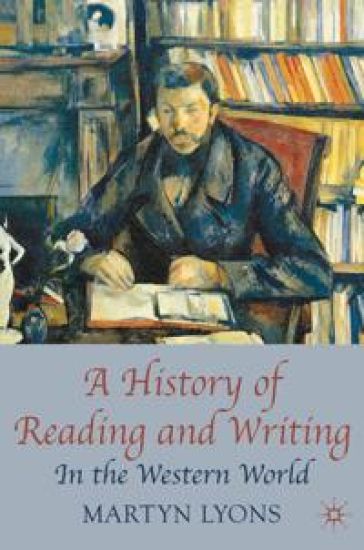
A History of Reading and Writing

A History of Reading and Writing

Martyn Lyons

Red Globe Press
2009
sidottu
Martyn Lyons surveys the changing relationships enjoyed by men and women with the written word, from early times to the present day. He provides a highly-readable account of the social history of reading and writing, relating it to key historical moments such as the Renaissance, the Reformation and the Enlightenment. Offering a fresh history centred on the reactions and experiences of ordinary readers and writers, Lyons deals with key turning points that occurred throughout the centuries, such as the invention of the codex, the transition from scribal to print culture, the reading revolution and the industrialisation of the book. Tracing the major historical developments across Europe and North America which revolutionised our relationship with texts, this book provides an engaging and invaluable overview of the history of scribal and print culture.