Kirjojen hintavertailu. Mukana 11 238 394 kirjaa ja 12 kauppaa.

Kirjahaku

Etsi kirjoja tekijän nimen, kirjan nimen tai ISBN:n perusteella.

1000 tulosta hakusanalla Moses Stuart

Moses

Moses

Avivah Gottlieb Zornberg

Yale University Press
2017
sidottu
From the prizewinning Jewish Lives series, an unprecedented portrait of Moses's inner world and perplexing character, by a distinguished biblical scholar "Bringing together copious, diverse and sometimes dissonant references (spanning Hasidic masters, George Eliot, Zizek and Beckett, among others), Zornberg gives a new tour of the life of Moses."—Clemence Boulouque, New York Times Book Review “For those wishing to engage the legacy of Moses more deeply, this is a must-read.”—Publishers Weekly, Starred Review No figure looms larger in Jewish culture than Moses, and few have stories more enigmatic. Avivah Gottlieb Zornberg, acclaimed for her many books on Jewish thought, turns her attention to Moses in this remarkably rich, evocative book. Drawing on a broad range of sources—literary as well as psychoanalytic, a wealth of classical Jewish texts alongside George Eliot, W. G. Sebald, and Werner Herzog—Zornberg offers a vivid and original portrait of the biblical Moses. Moses's vexing personality, his uncertain origins, and his turbulent relations with his own people are acutely explored by Zornberg, who sees this story, told and retold, as crucial not only to the biblical past but also to the future of Jewish history. About Jewish Lives: Jewish Lives is a prizewinning series of interpretative biography designed to explore the many facets of Jewish identity. Individual volumes illuminate the imprint of Jewish figures upon literature, religion, philosophy, politics, cultural and economic life, and the arts and sciences. Subjects are paired with authors to elicit lively, deeply informed books that explore the range and depth of the Jewish experience from antiquity to the present. In 2014, the Jewish Book Council named Jewish Lives the winner of its Jewish Book of the Year Award, the first series ever to receive this award. More praise for Jewish Lives: "Excellent." –New York Times "Exemplary." –Wall Street Journal "Distinguished." –New Yorker "Superb." –The Guardian
Moses, Man of the Mountain

Moses, Man of the Mountain

Zora Neale Hurston

HARPERCOLLINS PUBLISHERS INC
2008
pokkari
"A narrative of great power. Warm with friendly personality and pulsating with . . . profound eloquence and religious fervor." --New York TimesIn this novel based on the familiar story of the Exodus, Zora Neale Hurston blends the Moses of the Old Testament with the Moses of black folklore and song to create a compelling allegory of power, redemption, and faith.
Moses in America

Moses in America

Melanie Jane Wright

Oxford University Press Inc
2002
sidottu
This book explores the retelling of the life of Moses in three 20th-century American narratives: Moses in Red, by Lincoln Steffens; Moses, Man of the Mountain, by Zora Neale Hurston; and Cecil B. DeMille's film, The Ten Commandments. Wright's analysis reveals that the figure of Moses has strong currency in American culture at many levels: mainstream, white and black, intellectual and academic, religious and secular. More generally, she seeks throughout to address the question of why these three artists believed their arguments - and wright insists that they are arguments - were best advanced by the re-presentation of an ancient biblical narrative.
Moses Maimonides

Moses Maimonides

Herbert Davidson

Oxford University Press Inc
2005
sidottu
Moses Maimonides, rabbinist, philosopher, and physician, had a greater impact on Jewish history than any other medieval figure. Born in Cordova, Spain, in 1137 or 1138, he spent a few years in Morocco, visited Palestine, and settled in Egypt by 1167. He died there in 1204. Maimonides was a man of superlatives. He wrote the first commentary to cover the entire Mishna corpus; composed what quickly became the dominant work on the 613 commandments believed to have been given by God to Moses; produced the most comprehensive and most intensely studied code of rabbinic law to emerge from the Middle Ages; and his Guide for the Perplexed has had a greater influence on Jewish thought than any other Jewish philosophic work. During the last decades of his life, he conducted an active medical practice, which extended into the royal court--the Sultan Saladin is reported to have been his patient--and composed some ten or eleven works on medicine. This book offers a fresh look at every aspect of Maimonides' life and works: the course of his life, his education, his personality, and his rabbinic, philosophical, and medical writings. At a number of junctures, Davidson points out that information about Maimonides which has been accepted for decades or centuries as common knowledge is in actuality supported by no credible evidence and often, more disconcertingly, is patently incorrect. Maimonides' diverse writings are frequently viewed as expressions of several distinct personas, uncomfortably and awkwardly bundled into a single human frame; the present book treats his writings as expressions of a single, integrated, albeit complex, mind.
Moses Maimonides

Moses Maimonides

Ross Brann

OXFORD UNIVERSITY PRESS INC
2025
nidottu
Moses Maimonides, a scientist, physician, philosopher, rabbinic scholar, and communal leader, was perhaps the most imposing Jewish figure of the pre-modern age. Yet, more than eight centuries after his death, the meaning of his life and his work remains contested. This Very Short Introduction to Moses Maimonides surveys Maimonides' many intellectual, literary, and professional ventures. Born in Islamic Cordoba, he ultimately settled in Cairo, where he served as jurist and civic leader and a highly esteemed physician with responsibilities at the Fatimid and Ayyubid courts, even as he deepened his philosophical-theological pursuits. He moved seamlessly between specialized, private, and public Jewish and Muslim spheres. Indeed, his written works traverse multiple disciplines, employ several literary genres, and address various elite and popular audiences. Beginning with his Commentary on the Mishnah and culminating in the seminal Mishneh Torah (Code of Jewish Law), Maimonides reorganized and systematized all of rabbinic law. He regarded the attainment of wisdom as the ultimate goal of human life. Like many Jewish and Muslim religious intellectuals of the period Maimonides was preoccupied with the problem posed by the language religious tradition deploys in referring to God. His Guide for the Perplexed treats this central challenge to knowing God's absolute, unchanging unity, as well as defining the purpose of divine law and supposed interruption of the natural order in the form of prophecy and miracles. This book organizes Maimonides' thinking and writings thematically and puts his works into dialogue with one another. It proposes that the key to engaging Maimonides on his own terms is to understand he applied a rationalist's regimen characteristic of his scientific research and practice of medicine to all of his life's work: he observed and studied a problem, diagnosed it, and then prescribed a remedy for it whether the concern was physical, metaphysical, spiritual, intellectual, or social in nature. His Arabic and Hebrew contributions to each of his fields of inquiry were translated and disseminated far and wide and found a prominent place among religious and scientific intellectuals in the Latin West and throughout the Jewish and Islamic worlds.
Moses Maimonides

Moses Maimonides

Herbert Davidson

Oxford University Press Inc
2010
nidottu
Moses Maimonides (1137/38-1204), scholar, physician, and philosopher, was the most influential Jewish thinker of the Middle Ages. In this magisterial biography, Herbert Davidson provides an exhaustive guide to Maimonides' life and works. After considering Maimonides' upbringing and education, Davidson expounds all of his many writings in exhaustive detail, with separate chapters on rabbinic, philosophical, and medical texts. Moses Maimonides has been recognized as the standard work on a towering figure of Western intellectual history.
Moses Ascending

Moses Ascending

Sam Selvon

Penguin Classics
2020
pokkari
Moses thinks he's got it made. Originally a poor Caribbean immigrant, he is now the proud landlord of a ramshackle house in Shepherd's Bush, London. He has visions of being master of his own domain, writing his memoirs while his trusty sidekick and handyman, Bob, does all the work. But Moses' problems are far from over...Soon a Black Power group take over the basement, headed by the indomitable - but very sexy - Brenda, and an illegal people-smuggling ring is discovered upstairs. Not to mention harassment from racist police, sheep-slaughtering in the back yard and a Black Panther (the human kind) on the loose.Will Moses' elaborately constructed castle in the air be demolished by these unruly forces?Following the fortunes of characters from Selvon's The Lonely Londoners, Moses Ascending is a hilarious and telling depiction of 1970s Britain.
Moses The Matador

Moses The Matador

Bill Darlison

Lulu.com
2019
pokkari
The story of the Exodus has been consistently misinterpreted for millennia; it has been considered as history when, in fact, it is a spiritual treatise based on an astronomical metaphor. The Exodus is the movement of the equinoctial sun from the constellation Taurus to the constellation Aries, which occurred around 2,000 BCE, and not the unlikely passage of an estimated two million Hebrews from Egypt to Canaan, a supposed event for which little (if any) archaeological evidence can be found. The book introduces the reader to the concept of astrological ages and explores the importance of number and astrology in the ancient world. It considers the spiritual meaning of the story's various components, and the significance of the story to our developing understanding of God. An appendix details the astronomical, mythological and astrological meaning of each of the zodiacal signs. Bill Darlison is the Minister Emeritus of Dublin Unitarian Church.
Moses and the Monster and Miss Anne

Moses and the Monster and Miss Anne

Carole C. Marks

University of Illinois Press
2009
sidottu
This engaging history presents the extraordinary lives of Patty Cannon, Anna Ella Carroll, and Harriet Tubman, three "dangerous" women who grew up in early-nineteenth-century Maryland and were vigorously enmeshed in the social and political maelstrom of antebellum America. The "monstrous" Patty Cannon was a reputed thief, murderer, and leader of a ruthless gang who kidnapped free blacks and sold them back into slavery, whereas Miss Anna Ella Carroll, a relatively genteel unmarried slaveholder, foisted herself into state and national politics by exerting influence on legislators and conspiring with Governor Thomas Holliday Hicks to keep Maryland in the Union when many state legislators clamored to join the Confederacy. And, of course, Harriet Tubman--slave rescuer, abolitionist, and later women's suffragist--was both hailed as "the Moses of her people" and hunted as an outlaw with a price on her head worth at least ten thousand dollars. All three women lived for a time in close proximity on the Eastern Shore of Maryland, an isolated region that thrived on tobacco and then lost it, procured slaves and then lost them, and produced strong-minded women and then condemned them. Though they never actually met, and their backgrounds and beliefs differed drastically, these women's lives converged through their active experiences of the conflict over slavery in Maryland and beyond, the uncertainties of economic transformation, the struggles in the legal foundation of slavery and, most of all, the growing dispute in gender relations in America. Throughout this book, Carole C. Marks gleans historical fact and sociological insight from the persistent myths and exaggerations that color the women's legacies, and she investigates the common roots and motivations of three remarkable figures who bucked the era's expectations for women. She also considers how each woman's public identity reflected changing ideas of domesticity and the public sphere, spirituality, and legal rights and limitations. Cannon, Carroll, and Tubman, each in her own way, passionately fought for the future of Maryland and the United States, and from these unique vantage points, Moses and the Monster and Miss Anne portrays the intersecting and conflicting forces of race, economics, and gender that threatened to rend a nation apart.
Moses Mendelssohn's Living Script

Moses Mendelssohn's Living Script

Elias Sacks

Indiana University Press
2016
sidottu
Moses Mendelssohn (1729–1786) is often described as the founder of modern Jewish thought and as a leading philosopher of the late Enlightenment. One of Mendelssohn's main concerns was how to conceive of the relationship between Judaism, philosophy, and the civic life of a modern state. Elias Sacks explores Mendelssohn's landmark account of Jewish practice—Judaism's "living script," to use his famous phrase—to present a broader reading of Mendelssohn's writings and extend inquiry into conversations about modernity and religion. By studying Mendelssohn's thought in these dimensions, Sacks suggests that he shows a deep concern with history. Sacks affords a view of a foundational moment in Jewish modernity and forwards new ways of thinking about ritual practice, the development of traditions, and the role of religion in society.
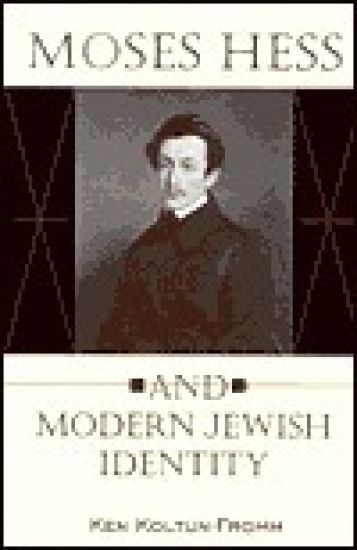
Moses Hess and Modern Jewish Identity

Moses Hess and Modern Jewish Identity

Ken Koltun-Fromm

Indiana University Press
2001
sidottu
"Koltun-Fromm's reading of Hess is of crucial import for those who study the construction of self in the modern world as well as for those who are concerned with Hess and his contributions to modern thought. . . . a reading of Hess that is subtle, judicious, insightful, and well supported." —David Ellenson Moses Hess, a fascinating 19th-century German Jewish intellectual figure, was at times religious and secular, traditional and modern, practical and theoretical, socialist and nationalist. Ken Koltun-Fromm's radical reinterpretation of his writings shows Hess as a Jew struggling with the meaning of conflicting commitments and impulses. Modern readers will realize that in Hess's life, as in their own, these commitments remain fragmented and torn. As contemporary Jews negotiate multiple, often contradictory allegiances in the modern world, Koltun-Fromm argues that Hess's struggle to unite conflicting traditions and frameworks of meaning offers intellectual and practical resources to re-examine the dilemmas of modern Jewish identity. Adopting Charles Taylor's philosophical theory of the self to uncover Hess's various commitments, Koltun-Fromm demonstrates that Hess offers a rich, textured, though deeply conflicted and torn account of the modern Jew. This groundbreaking study in conceptions of identity in modern Jewish texts is a vital contribution to the diverse fields of Jewish intellectual history, philosophy, Zionism, and religious studies. Jewish Literature and Culture—Alvin H. Rosenfeld, editor Published with the generous support of the Koret Foundation
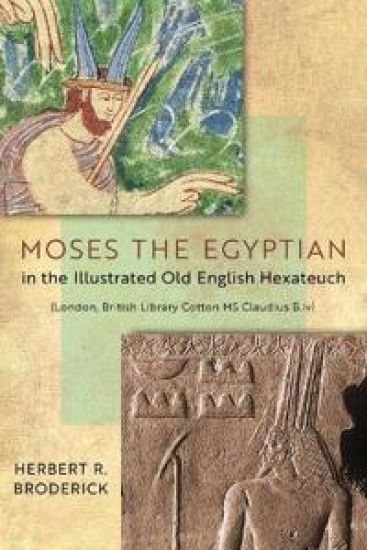
Moses the Egyptian in the Illustrated Old English Hexateuch (London, British Library Cotton MS Claudius B.iv)
In Moses the Egyptian, Herbert Broderick analyzes the iconography of Moses in the famous illuminated eleventh-century manuscript known as the Illustrated Old English Hexateuch. A translation into Old English of the first six books of the Bible, the manuscript contains over 390 images, of which 127 depict Moses with a variety of distinctive visual attributes. Broderick presents a compelling thesis that these motifs, in particular the image of the horned Moses, have a Hellenistic Egyptian origin. He argues that the visual construct of Moses in the Old English Hexateuch may have been based on a Late Antique, no longer extant, prototype influenced by works of Hellenistic Egyptian Jewish exegetes, who ascribed to Moses the characteristics of an Egyptian-Hellenistic king, military commander, priest, prophet, and scribe. These Jewish writings were utilized in turn by early Christian apologists such as Clement of Alexandria and Eusebius of Caesarea. Broderick's analysis of this Moses imagery ranges widely across religious divides, art-historical religious themes, and classical and early Jewish and Christian sources. Herbert Broderick is one of the foremost historians in the field of Anglo-Saxon art, with a primary focus on Old Testament iconography. Readers with interests in the history of medieval manuscript illustration, art history, and early Jewish and Christian apologetics will find much of interest in this profusely illustrated study.
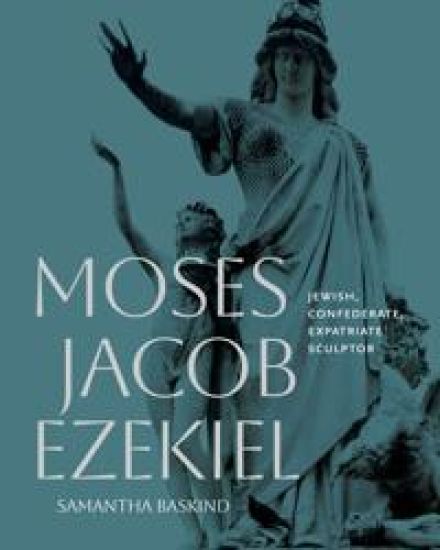
Moses Jacob Ezekiel

Moses Jacob Ezekiel

Samantha Baskind

Pennsylvania State University Press
2025
sidottu
How is it that the prolific nineteenth-century sculptor Moses Jacob Ezekiel is largely forgotten today? Ezekiel was the first renowned Jewish American artist and one of the most popular artist-celebrities of his day. In terms of drama, his life story rivals Alexander Hamilton’s. Ezekiel fought for the Confederacy at the Battle of New Market as a teenager and was friends with Robert E. Lee. After the war, he established himself as an artist in Rome, and he was honored by European royalty and enjoyed friendships with the likes of Franz Liszt, Queen Margherita, and Kaiser Wilhelm II. Ezekiel created well over one hundred sculptures, but his hotly contested Confederate works have since obscured his other major accomplishments.Drawing on a wealth of primary sources, Moses Jacob Ezekiel resurrects this complicated artist’s life and work and presents the fascinating details of how his sculptures were commissioned and made. Samantha Baskind shows how Ezekiel’s sculptures shed light on a range of issues, including the modernization of American Jewry, radical changes in the art world concerning style and patronage, and Civil War commemoration. The conflicting allegiances that motivated Ezekiel’s statues—his conservative Confederate leanings alongside his liberal views on peace, Judaism, and religious liberty—make him an intriguing lens through which to understand nineteenth-century transatlantic culture and history.This compelling book provides a complete picture of Ezekiel’s oeuvre and his renowned home studio, which drew international visitors. It will appeal to scholars of art history, Jewish studies, Civil War studies, and American studies as well as readers interested in public monuments.
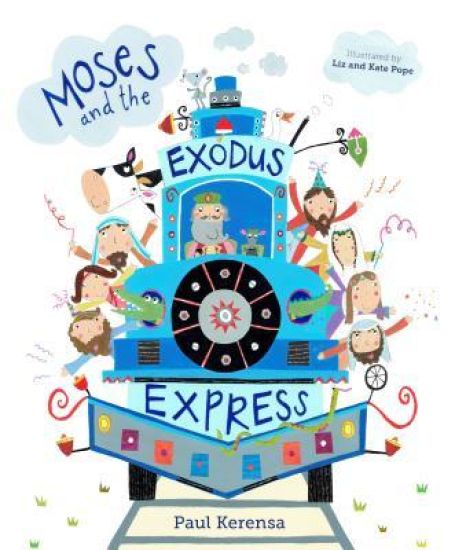
Moses and the Exodus Express

Moses and the Exodus Express

Paul Kerensa

SPCK Publishing
2018
pokkari
Moses knows his people are in trouble. Plucked from the River Nile, he’s a shy guy sent by God to get the Israelites back on track. And what an escape plan – free tickets for all on the Exodus Express! Will nasty Pharaoh stop them in their tracks? Or will they make it through the Red Sea channel tunnel to the promised land? This beautifully illustrated, rhyming retelling of the story of Moses will entertain young children and adults alike.
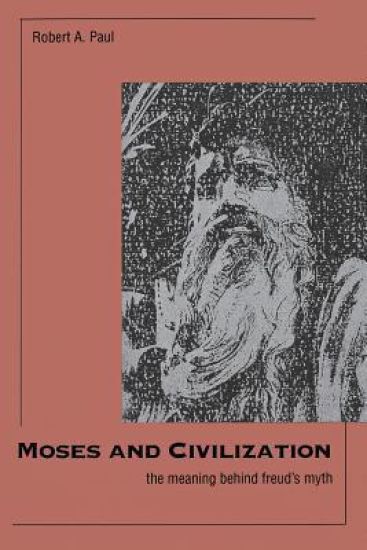
Moses and Civilization

Moses and Civilization

Robert A. Paul

Yale University Press
2013
pokkari
Freud's major cultural books, Totem and Taboo and Moses and Monotheism, have long been viewed as failed attempts at historical reconstruction. This book, by an anthropologist and practicing psychoanalyst, offers a brilliant reinterpretation of these works, presenting them instead as versions and unwitting analyses of the great mythic narrative underlying Judeo-Christian civilization, found principally in the Five Books of Moses.Synthesizing aspects of structural anthropology, symbolic anthropology, evolutionary theory, and psychoanalysis, Robert A. Paul reveals the numerous parallels between Freud's myth of the primal horde and the Torah text. He shows how the primal-horde scenario is the basis for the Christian myth of the life and death of Jesus. And he details the way Freud's myth corresponds to the unconscious fantasy structure of the obsessional personality—a style of personality dynamics Paul sees as essential to maintaining the bureaucratic institutions that make up Western civilization's most distinctive features. Paul thus corrects and completes Freud's project, creating a valid psychoanalytic account of Western civilization that rests not on faulty speculation, as Freud's did, but on a detailed reading of the biblical text and of the legends, folklore, commentaries, and social practices surrounding it.
Moses and the Doctor: Two Men, One Championship, and the Birth of Modern Basketball
The rousing story of two trailblazing superstars--Julius "Dr. J" Erving and Moses Malone--whose improbable alliance and unsung legacies shaped the wildest and most innovative era of basketball history. In the early 1970s, playground courts across the United States were jammed with hoops buffs experimenting with showy moves and aerial shots that were changing the look and feel of a sport once stubbornly earthbound. Out of this scene emerged a pair of incomparable yet dissimilar streetball sensations, both of whom would make their name in the American Basketball Association, an upstart professional league characterized as much by flamboyance as invention. Julius Erving, better known as Dr. J, became a mythic figure whose airborne acrobatics inspired an army of high-flying acolytes. Moses Malone, a down-and-dirty banger, scrambled basketball apprenticeships forever by skipping directly from high school to the pros. Into the 1980s, Erving and Malone switched leagues, won MVPs, shattered records, and led their respective clubs into the playoff's championship round. But one prize eluded them: an NBA title. After suffering perennial defeat at the hands of Magic Johnson's Los Angeles Lakers and Larry Bird's Boston Celtics, the two eventually joined forces on the Philadelphia 76ers, blending their contrasting talents into a seamless whole. Together, Erving and Malone set out to accomplish what no other NBA team fronted by ex-ABA superstars had managed. An enthralling social history as well as an uplifting underdog story, Moses and the Doctor intimately chronicles the hopes and heartbreaks of two basketball legends who revolutionized what was possible on the ground and in the air, and fueled one of the most thrilling and momentous championship seasons ever.
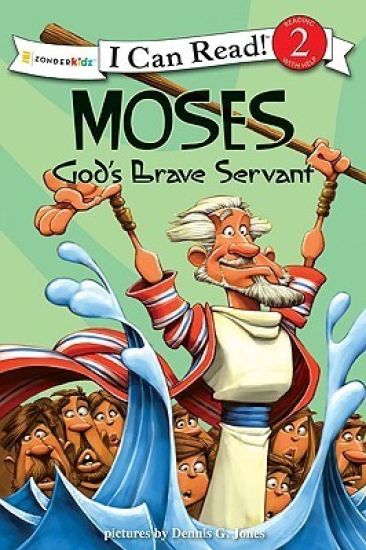
Moses, God's Brave Servant
God wants Moses to lead his people out of Egypt. But the stubborn Egyptian king won’t let them go! What will Moses do?This is a Level Two I Can Read! book, which means it’s perfect for children learning to sound out words and sentences. It aligns with guided reading level J and will be of interest to children Pre-K to 3rd grade.
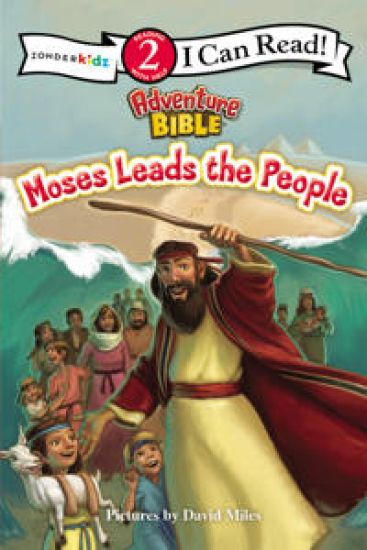
Moses Leads the People
The Israelites are slaves in Egypt, and God wants Moses to help set them free. Will the pharaoh let God’s people go? Can Moses find the courage to help God’s people?This is a Level Two I Can Read! book, which means it’s perfect for children learning to sound out words and sentences. It aligns with guided reading level J and will be of interest to children Pre-K to 3rd grade.