Kirjojen hintavertailu. Mukana 11 244 527 kirjaa ja 12 kauppaa.

Kirjahaku

Etsi kirjoja tekijän nimen, kirjan nimen tai ISBN:n perusteella.

416 tulosta hakusanalla Ovidia Yu

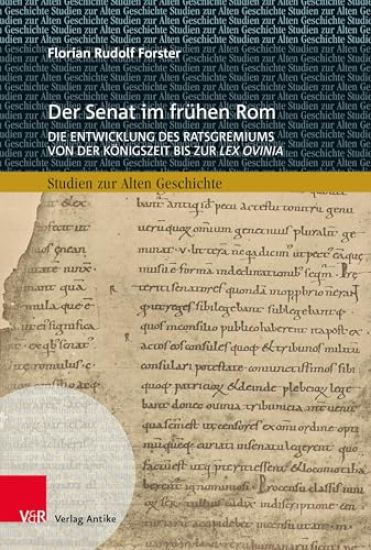
Der Senat Im Fruhen ROM: Die Entwicklung Des Ratsgremiums Von Der Konigszeit Bis Zur Lex Ovinia
Florian Rudolf Forster Studie bietet erstmals eine lang erwartete Untersuchung der Entwicklung des Senats von der romischen Fruhzeit bis zu den entscheidenden Veranderungen durch die lex Ovinia, die entgegen der bisherigen Datierungen wohl erst in die Jahre nach 287 v. Chr. zu datieren ist. Damit schliesst er eine Forschungslucke: Entgegen der in der Forschung verbreiteten Ansicht war der Senat schon in der Anfangszeit nie ausschliesslich ein schwaches Beratungsgremium, sondern als Versammlung der machtvollen Vertreter der romischen Familien stets auch das zentrale Ratsgremium der Aristokratie. Eine Veranderung erfuhr der Senat jedoch in der personellen Zusammensetzung: So wandelte sich der Senat in der fruhen Republik von einem exklusiven Ratsgremium der Patricier zur Versammlung der gesamten Nobilitat. Die lex Ovinia bildete einen Endpunkt der Entwicklungen und beinhaltete insbesondere neue Regeln fur die Zusammensetzung des Senats. Die Auswirkungen der Reform werden im Anschluss noch bis zum Zweiten Punischen Krieg weiterverfolgt.
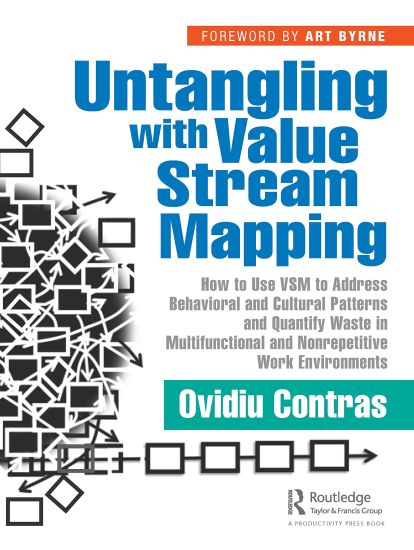
Untangling with Value Stream Mapping

Untangling with Value Stream Mapping

Ovidiu Contras

TAYLOR FRANCIS LTD
2022
nidottu
The standard belief in books about Lean initiatives and value stream mapping (VSM) is that VSM works well on transactional processes (which are primarily linear processes where handoffs are well defined and the outcome is known) and it is useful for repetitive projects or products. This book counters these statements by clearly demonstrating how a VSM exercise can be successfully performed in complex, multifunctional environments involving nonrepetitive work, such as aircraft new product development, custom engineering, software development and project management. The methodology described in this book is the result of more than ten years of refinement and is based on practice while working with multidisciplinary teams and helping them achieve their goals. This is a novel approach to capturing the information flow in a VSM by recognizing it as the place where most of the issues are generated, especially for the previously mentioned environments and the fact that classical mapping methodologies (including classical VSM) do not capture it well. The VSM methodology that the author developed goes to the essence of a VSM (activities flow, information flow, timeline), uses conventional VSM icons and some custom information flow icons and helps the following: Quantifying waste (VSM literature gap) Making disconnects visible (VSM literature gap) Making behavioral and cultural patterns visible (VSM literature gap) If the steps are followed thoroughly, then lead time reductions ranging from 60% to 88% are achieved, along with increased availability of resources, more output with the same resources, projects delivered on time and, most importantly, colleagues embracing the Lean mindset, which greatly contributes to maintaining the gains.Essentially, this book helps readers perform a VSM in environments where multiple stakeholders interact with each other to deliver a product or a service with unclear aspects, such as what the product/service is, how all involved can contribute to the product or service transformation and how the interactions between them occur. For example, the products/services targeted in this book include test results, analysis results, a custom design, a process, a methodology, an engineering change, integrated enterprise software and engineering drawings.Concurrently, this book helps readers map behavioral patterns, such as micromanagement, and company culture aspects, such as excessive governance and "decisions by committee."
Untangling with Value Stream Mapping

Untangling with Value Stream Mapping

Ovidiu Contras

TAYLOR FRANCIS LTD
2022
sidottu
The standard belief in books about Lean initiatives and value stream mapping (VSM) is that VSM works well on transactional processes (which are primarily linear processes where handoffs are well defined and the outcome is known) and it is useful for repetitive projects or products. This book counters these statements by clearly demonstrating how a VSM exercise can be successfully performed in complex, multifunctional environments involving nonrepetitive work, such as aircraft new product development, custom engineering, software development and project management. The methodology described in this book is the result of more than ten years of refinement and is based on practice while working with multidisciplinary teams and helping them achieve their goals. This is a novel approach to capturing the information flow in a VSM by recognizing it as the place where most of the issues are generated, especially for the previously mentioned environments and the fact that classical mapping methodologies (including classical VSM) do not capture it well. The VSM methodology that the author developed goes to the essence of a VSM (activities flow, information flow, timeline), uses conventional VSM icons and some custom information flow icons and helps the following: Quantifying waste (VSM literature gap) Making disconnects visible (VSM literature gap) Making behavioral and cultural patterns visible (VSM literature gap) If the steps are followed thoroughly, then lead time reductions ranging from 60% to 88% are achieved, along with increased availability of resources, more output with the same resources, projects delivered on time and, most importantly, colleagues embracing the Lean mindset, which greatly contributes to maintaining the gains.Essentially, this book helps readers perform a VSM in environments where multiple stakeholders interact with each other to deliver a product or a service with unclear aspects, such as what the product/service is, how all involved can contribute to the product or service transformation and how the interactions between them occur. For example, the products/services targeted in this book include test results, analysis results, a custom design, a process, a methodology, an engineering change, integrated enterprise software and engineering drawings.Concurrently, this book helps readers map behavioral patterns, such as micromanagement, and company culture aspects, such as excessive governance and "decisions by committee."
Viability, Invariance and Applications

Viability, Invariance and Applications

Ovidiu Carja; Mihai Necula; Ioan I. Vrabie

Elsevier Science Ltd
2007
sidottu
The book is an almost self-contained presentation of the most important concepts and results in viability and invariance. The viability of a set K with respect to a given function (or multi-function) F, defined on it, describes the property that, for each initial data in K, the differential equation (or inclusion) driven by that function or multi-function) to have at least one solution. The invariance of a set K with respect to a function (or multi-function) F, defined on a larger set D, is that property which says that each solution of the differential equation (or inclusion) driven by F and issuing in K remains in K, at least for a short time. The book includes the most important necessary and sufficient conditions for viability starting with Nagumo’s Viability Theorem for ordinary differential equations with continuous right-hand sides and continuing with the corresponding extensions either to differential inclusions or to semilinear or even fully nonlinear evolution equations, systems and inclusions. In the latter (i.e. multi-valued) cases, the results (based on two completely new tangency concepts), all due to the authors, are original and extend significantly, in several directions, their well-known classical counterparts.
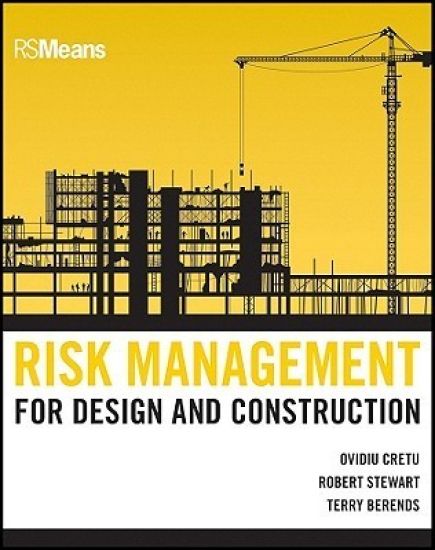
Risk Management for Design and Construction

Risk Management for Design and Construction

Ovidiu Cretu; Robert B. Stewart; Terry Berends

John Wiley Sons Inc
2011
sidottu
This text provides a balance of theory, technique and facilitation. The emphasis is on providing a practical and proven framework for risk management on real projects with a clear, concise description of the complex topic of risk for professionals. Written by experts in the field, it offers a practical, proven means of quantifying and minimizing risk, to inform business decisions in the design and construction field. Case studies and examples on the proper application of software and principles help make this book an important reference to the field.
Sub-Riemannian Geometry

Sub-Riemannian Geometry

Ovidiu Calin; Der-Chen Chang

Cambridge University Press
2009
sidottu
Sub-Riemannian manifolds are manifolds with the Heisenberg principle built in. This comprehensive text and reference begins by introducing the theory of sub-Riemannian manifolds using a variational approach in which all properties are obtained from minimum principles, a robust method that is novel in this context. The authors then present examples and applications, showing how Heisenberg manifolds (step 2 sub-Riemannian manifolds) might in the future play a role in quantum mechanics similar to the role played by the Riemannian manifolds in classical mechanics. Sub-Riemannian Geometry: General Theory and Examples is the perfect resource for graduate students and researchers in pure and applied mathematics, theoretical physics, control theory, and thermodynamics interested in the most recent developments in sub-Riemannian geometry.
Geometric Mechanics on Riemannian Manifolds

Geometric Mechanics on Riemannian Manifolds

Ovidiu Calin; Der-Chen Chang

Birkhauser Boston Inc
2004
sidottu
Differential geometry techniques have very useful and important applications in partial differential equations and quantum mechanics. This work presents a purely geometric treatment of problems in physics involving quantum harmonic oscillators, quartic oscillators, minimal surfaces, and Schrödinger's, Einstein's and Newton's equations. Geometric Mechanics on Riemannian Manifolds is a fine text for a course or seminar directed at graduate and advanced undergraduate students interested in elliptic and hyperbolic differential equations, differential geometry, calculus of variations, quantum mechanics, and physics. The text is enriched with good examples and exercises at the end of every chapter. It is also an ideal resource for pure and applied mathematicians and theoretical physicists working in these areas.
Heat Kernels for Elliptic and Sub-elliptic Operators

Heat Kernels for Elliptic and Sub-elliptic Operators

Ovidiu Calin; Der-Chen Chang; Kenro Furutani; Chisato Iwasaki

Birkhauser Boston Inc
2010
sidottu
With each methodology treated in its own chapter, this monograph is a thorough exploration of several theories that can be used to find explicit formulas for heat kernels for both elliptic and sub-elliptic operators. The authors show how to find heat kernels for classical operators by employing a number of different methods. Some of these methods come from stochastic processes, others from quantum physics, and yet others are purely mathematical. What is new about this work is the sheer diversity of methods that are used to compute the heat kernels. It is interesting that such apparently distinct branches of mathematics, including stochastic processes, differential geometry, special functions, quantum mechanics and PDEs, all have a common concept – the heat kernel. This unifying concept, that brings together so many domains of mathematics, deserves dedicated study. Heat Kernels for Elliptic and Sub-elliptic Operators is an ideal resource for graduate students, researchers, and practitioners in pure and applied mathematics as well as theoretical physicists interested in understanding different ways of approaching evolution operators.
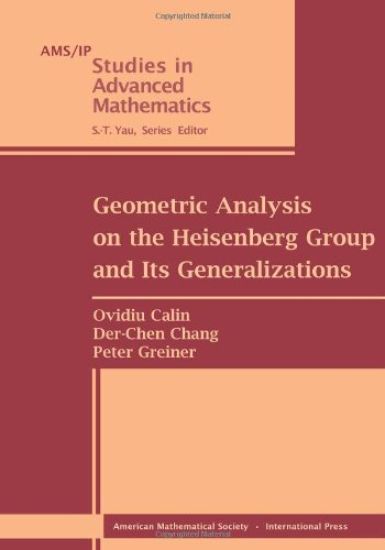
Geometric Analysis on the Heisenberg Group and Its Generalizations

Geometric Analysis on the Heisenberg Group and Its Generalizations

Ovidiu Calin; Der-Chen Chang; Peter Greiner

Amer Mathematical Society
2007
sidottu
The theory of subRiemannian manifolds is closely related to Hamiltonian mechanics. In this book, the authors examine the properties and applications of subRiemannian manifolds that automatically satisfy the Heisenberg principle, which may be useful in quantum mechanics. In particular, the behavior of geodesics in this setting plays an important role in finding heat kernels and propagators for Schrodinger's equation. One of the novelties of this book is the introduction of techniques from complex Hamiltonian mechanics. Information for our distributors: Titles in this series are co-published with International Press, Cambridge, MA.