Kirjojen hintavertailu. Mukana 11 342 296 kirjaa ja 12 kauppaa.

Kirjahaku

Etsi kirjoja tekijän nimen, kirjan nimen tai ISBN:n perusteella.

1000 tulosta hakusanalla Patrick M. Brantlinger

International Security

International Security

Patrick M. Morgan

CQ Press
2006
nidottu
Conflict--be it war between states, ethnic violence, civil war, or terrorist activity--endures, despite immense efforts to end it. How do states cope with conflict, minimize future threats, and reduce the risk of insecurity? Morgan outlines a spectrum of solutions states use to manage violent conflict, ranging from strategies that individual governments enact largely on their own, such as distribution of power, deterrence, or arms control, to those such as collective security and multilateralism that are more global in nature. The book progresses into tactical and practical actions, from negotiation and mediation to peace imposition. Morgan evaluates each strategy and tactic in terms of how well it addresses three levels of security--systemic, state, and societal--to show how they are interrelated and complementary to each other in important ways. Addressing insecurity at one level often elicits further insecurity at another. Morgan shows students how these various levels interact-either to a state’s advantage or to its detriment-so they can comprehensively analyze the ways that political actors manage (or incite) conflict.Useful pedagogical features help students master the material:Terms and Concepts boxes go beyond simple definitions and provide students with a concept’s evolution over time or the controversy surrounding the meaning of a certain term.Cases and Context boxes offer needed background and interesting detail about pivotal cases of conflict, both historical and contemporary in nature.Key terms are bolded throughout and compiled in a glossary.Annotated bibliographic essays at the end of each chapter point students to additional sources for further study.
Multimedia and the Web from A to Z, 2nd Edition

Multimedia and the Web from A to Z, 2nd Edition

Patrick M. Dillon; David C. Leonard

Oryx Press Inc
1998
nidottu
As technology changes rapidly, new words and phrases are being introduced into our vocabulary, many with Net or Web affixed to them. The convergence of the media industries often brings with it a clash of professional vocabularies. Over time, some terms remain stable while others seem to disappear or transform their meaning. Multimedia and the Web from A-Z is a comprehensive dictionary aimed at stabilizing and clearly defining the language of multimedia. This second edition has been completely revised and expanded and contains 1,500 entries, including 500 new terms or phrases, all clearly and concisely defined.Extensive cross-referencing, an annotated bibliography, and an acronym table are other useful additions to this dictionary.
Equine Embryo Transfer

Equine Embryo Transfer

Patrick M. McCue; Edward L. Squires

Teton NewMedia
2015
nidottu
This book briefly reviews the history of equine embryo transfer, covering in clinically practical terms the techniques, equipment, and management protocols currently in use. Embryo transfer has become a big business, especially for breeding racing stock (horses and camels), and is therefore a very important aspect of equine practice. Ed Squires and Pat McCue have been involved with the development of embryo collection and transfer procedures since the early 60s and have both contributed important techniques and innovations to the process through their research and clinical experience. This book captures the clinical experience, so far, and applies it directly to equine practice. The book is of great value to general equine practitioners for reference, equine reproduction specialists, animal science at the graduate level (equine track), and breeders.
Sixteen Million One

Sixteen Million One

Patrick M. Regan

Paradigm
2008
sidottu
Sixteen million people have died in civil wars in the past 50 years. In view of that, civil wars may be the single most destabilizing force in world politics today. The only greater killer is the suffering that pushes individuals into them. Civil wars create regional and global instability that threatens economic initiatives and political continuity. Preventing civil wars is a challenge that the policy community is ill-equipped to handle. Rwanda is an example-a tragedy that the world did nothing to stop. Iraq and Afghanistan are tragedies the world did much to inflame. This book uses argument, evidence, and intuition born of experience to provide an account of civil wars and the steps we can take to reduce them.
Sixteen Million One

Sixteen Million One

Patrick M. Regan

Paradigm
2009
nidottu
Sixteen million people have died in civil wars in the past 50 years. In view of that, civil wars may be the single most destabilizing force in world politics today. The only greater killer is the suffering that pushes individuals into them. Civil wars create regional and global instability that threatens economic initiatives and political continuity. Preventing civil wars is a challenge that the policy community is ill-equipped to handle. Rwanda is an example-a tragedy that the world did nothing to stop. Iraq and Afghanistan are tragedies the world did much to inflame. This book uses argument, evidence, and intuition born of experience to provide an account of civil wars and the steps we can take to reduce them.
Design Charrettes for Sustainable Communities
A step-by-step guide to more synthetic, holistic, and integrated urban design strategies, "Design Charrettes for Sustainable Communities" is a practical manual to accomplish complex community design decisions and create more green, clean, and equitable communities.The design charrette has become an increasingly popular way to engage the public and stakeholders in public planning, and "Design Charrettes for Sustainable Communities" shows how citizens and officials can use this tool to change the way they make decisions, especially when addressing issues of the sustainable community.Designed to build consensus and cooperation, a successful charrette produces a design that expresses the values and vision of the community. Patrick Condon outlines the key features of the charrette, an inclusive decision-making process that brings together citizens, designers, public officials, and developers in several days of collaborative workshops.Drawing on years of experience designing sustainable urban environments and bringing together communities for charrettes, Condon's manual provides step-by-step instructions for making this process work to everyone's benefit. He translates emerging sustainable development concepts and problem-solving theory into concrete principles in order to explain what a charrette is, how to organize one, and how to make it work to produce sustainable urban design results.
Seven Rules for Sustainable Communities

Seven Rules for Sustainable Communities

Patrick M. Condon; Robert Yaro

Island Press
2010
nidottu
Questions of how to green the North American economy, create a green energy and transportation infrastructure, and halt the deadly increase in greenhouse gas buildup dominate our daily news. Related questions of how the design of cities can impact these challenges dominate the thoughts of urban planners and designers across the U.S. and Canada. With admirable clarity, Patrick Condon discusses transportation, housing equity, job distribution, economic development, and ecological systems issues and synthesizes his knowledge and research into a simple-to-understand set of urban design rules that can, if followed, help save the planet.
Man Alive

Man Alive

Patrick M Morley

Multnomah Press
2012
nidottu
You Don't Have to Settle "Over the last four decades, I've met one-on-one with thousands of men. Most of them know that Jesus promised "a rich and satisfying life" (John 10:10), but too many are confused about what that looks like. In fact, I'd estimate that 90 percent of Christian men lead lukewarm, stagnant, defeated lives - and they hate it. When men try to put into words what's holding them back, they invariably describe one or more of these seven symptoms: - "I just feel like I'm in this thing alone." - "I don't feel like God cares about me personally - not really." - "I don't feel like my life has a purpose. In fact, it seems random." - "I have destructive behaviors that keep dragging me down." - "My soul feels dry." - "My most important relationships are not working." - "I don't feel like I'm doing anything that will make a lasting difference." "Do you see yourself in these statements? In my experience, these inner aches and pains correspond to seven primal God-given needs that all men feel deeply.And in Man Alive, I'll show you something surprising - God's plan to harness that raw, restless energy you feel, pull you out of mediocrity, and propel you toward the life you were meant to live. I promise you...there is a way. No man should have to settle for half alive. You can become the man God created you to be. You can experience a powerful life transformed by Christ. In the book you're holding, I'll show you how." - Patrick Morley, PhD "Most men want to leave a positive moral and spiritual legacy. Yet we know that in order to do that, we must be living out our moral and spiritual beliefs in the present. Man Alive shows how to make this desire a reality. I highly recommend this book to men of all ages." - Gary Chapman, author, The Five Love Languages "Something is missing from the average Christian man's life, but what is it? Man Alive gives men permission to dig down and discover the fire within." - Craig Groeschel, Senior Pastor of LifeChurch.tv; author of Dare to Drop the Pose, Chazown, and Weird "A great many men I've met want so much to experience the rich and abundant life Jesus promised but don't. As a result, they feel dissatisfied, caught in conflicting emotions.Are you one? In Man Alive, Pat Morley--who has probably had more deeply personal conversations with men than anyone I know--goes straight to the heart of your dissatisfaction. He delivers a world of wisdom that will lead you to strength, confidence and clarity." - Bob Buford, Founder, Leadership Network, author of Halftime and Finishing Well
How God Makes Men

How God Makes Men

Patrick M Morley

Multnomah Press
2013
nidottu
Men's ministry expert Patrick Morley presents ten epic stories of the Bible's most talked-about men, and draws out ten principles based on their successes and failures, showing how God works in a man's life. Readers will learn how to become the men that God created them to be!
Leading For Democracy

Leading For Democracy

Patrick M. Jenlink; Lee Stewart; Sandra Stewart

Rowman Littlefield Education
2012
nidottu
At a time when America’s schools face many of the most difficult challenges ever, the authors of Leading for Democracy: A Case-Based Approach to Principal Preparation return the reader to an agenda for democratic leadership for schools. Emphasizing the need for leadership preparation programs to reexamine existing and more traditional approaches to principal preparation, this comprehensive book draws to the foreground the need for a case-based approach that reflects the real-world problems and challenges faced by principals in schools today. In particular, Leading for Democracy emphasizes both a case-based pedagogy for principal preparation and the democratic ideals that provide the foundation for democratic schools, bringing into specific relief the work ahead for professors of educational leaders in preparing principals ground in democratic practice. Equally important, Leading for Democracy provides practical insight to the challenges of today’s principal, offering a set of pedagogical tools for professors to guide students of leadership in learning and understanding the difficult work required of leading democratically, set against the backdrop of a changing America.
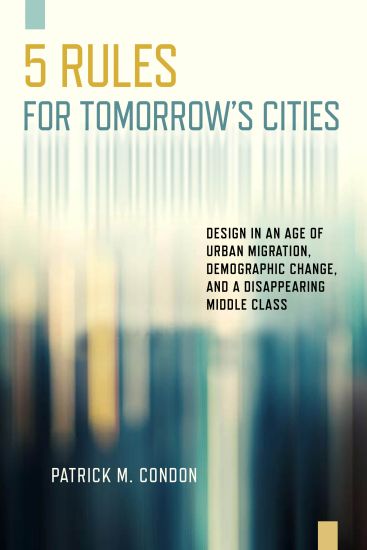
Five Rules for Tomorrow's Cities

Five Rules for Tomorrow's Cities

Patrick M Condon

Island Press
2020
pokkari
How we design our cities over the next four decades will be critical for our planet. If we continue to spill excessive greenhouse gas into the atmosphere, we will run out of time to keep our global temperature from increasing. Since approximately 80% of greenhouse gases come from cities, it follows that in the design of cities lies the fate of the world. As urban designers respond to the critical issue of climate change, they must also address three cresting cultural waves: the worldwide rural-to-urban migration; the collapse of global fertility rates; and the disappearance of the middle class. In Five Rules for Tomorrow's Cities, planning and design expert Patrick Condon explains how urban designers can assimilate these interconnected changes into their work. Condon shows how the very things that constrain cities, climate change, migration, financial stress, population change, could actually enable the emergence of a more equitable and resource-efficient city. He provides five rules for urban designers: (1) See the City as a System; (2) Recognise Patterns in the Urban Environment; (3) Apply Lighter, Greener, Smarter Infrastructure; (4) Strengthen Social and Economic Urban Resilience; and (5) Adapt to Shifts in Jobs, Retail, and Wages. In Five Rules for Tomorrow's Cities, Condon provides grounded and financially feasible design examples for tomorrow's sustainable cities, and the design tools needed to achieve them.
The Politics of Global Climate Change

The Politics of Global Climate Change

Patrick M. Regan

Paradigm
2014
sidottu
In 2009 the US House of Representatives passed legislation requiring reductions in greenhouse gas emissions by 18 percent over the coming decade. Later that year, President Obama went to Copenhagen to sign a treaty requiring reductions by 50 percent over a two-decade period. The President came back with nothing: no firm commitment to reduce emissions and only a vague target to hold global temperature rises to under 2 C. How does a President who has a 75-vote majority in the House and a 19-vote majority in the Senate who has pre-approval for a treaty reducing greenhouse gas production by 18 percent not achieve a treaty with at least the minimum goal of 18 percent reductions by 2020?Others have answered the puzzle by looking at institutional designs or negotiation dynamics. This book articulates a multilevel process that starts with local politics to explain how they can influence international negotiations and why President Obama s efforts in Copenhagen were doomed to fail. Understanding the role of local private interests can help form strategies for overcoming national resistance to climate change legislation and ultimately international agreements that could change the environmentally self-destructive course we are on.
The Politics of Global Climate Change

The Politics of Global Climate Change

Patrick M. Regan

Paradigm
2015
nidottu
In 2009 the US House of Representatives passed legislation requiring reductions in greenhouse gas emissions by 18 percent over the coming decade. Later that year, President Obama went to Copenhagen to sign a treaty requiring reductions by 50 percent over a two-decade period. The President came back with nothing: no firm commitment to reduce emissions and only a vague target to hold global temperature rises to under 2 C. How does a President who has a 75-vote majority in the House and a 19-vote majority in the Senate who has pre-approval for a treaty reducing greenhouse gas production by 18 percent not achieve a treaty with at least the minimum goal of 18 percent reductions by 2020?Others have answered the puzzle by looking at institutional designs or negotiation dynamics. This book articulates a multilevel process that starts with local politics to explain how they can influence international negotiations and why President Obama s efforts in Copenhagen were doomed to fail. Understanding the role of local private interests can help form strategies for overcoming national resistance to climate change legislation and ultimately international agreements that could change the environmentally self-destructive course we are on.
Mood

Mood

Patrick M. Burke

PROMETHEUS BOOKS
2013
pokkari
A reader-friendly yet in-depth overview of the latest research on mood as the way we are tuned to the world. This book examines the central role that mood plays in determining our outlook on life and our ability to cope with its challenges. The central theme is that mood determines how we are tuned to the world. Tuning emerges over the course of our earliest development as environmental and genetic influences form the neural circuits and set how they function across the lifespan in daily life and under conditions of stress. How each person is tuned becomes the basis for resilience or vulnerability to events. Some will take events in stride; others may become angry, anxious, or sad. A child psychiatrist with decades of clinical experience treating patients, the author stresses that relationships play a central role in shaping our mood. Security or insecurity, loss or the fear of loss of key relationships, especially in childhood, can have telling effects on the way we view the world. A chapter is devoted to each of the disorders where mood is a central issue: depression, anxiety, bipolar disorder, and antisocial disruptive disorders. The author then discusses the various "talking therapies" and the main classes of medication often administered to treat emotional disturbances. Burke concludes by summarizing the latest research on preventing mood disorders and discussing the impact that illness can have on emotional well-being and the role of mood in resilience and recovery.
Spy Chiefs: Volume 1

Spy Chiefs: Volume 1

Patrick M. Hughes

Georgetown University Press
2018
sidottu
In literature and film the spy chief is an all-knowing, all-powerful figure who masterfully moves spies into action like pieces on a chessboard. How close to reality is that depiction, and what does it really take to be an effective leader in the world of intelligence? This first volume of Spy Chiefs broadens and deepens our understanding of the role of intelligence leaders in foreign affairs and national security in the United States and United Kingdom from the early 1940s to the present. The figures profiled range from famous spy chiefs such as William Donovan, Richard Helms, and Stewart Menzies to little-known figures such as John Grombach, who ran an intelligence organization so secret that not even President Truman knew of it. The volume tries to answer six questions arising from the spy-chief profiles: how do intelligence leaders operate in different national, institutional, and historical contexts? What role have they played in the conduct of international relations and the making of national security policy? How much power do they possess? What qualities make an effective intelligence leader? How secretive and accountable to the public have they been? Finally, does popular culture (including the media) distort or improve our understanding of them? Many of those profiled in the book served at times of turbulent change, were faced with foreign penetrations of their intelligence service, and wrestled with matters of transparency, accountability to democratically elected overseers, and adherence to the rule of law. This book will appeal to both intelligence specialists and general readers with an interest in the intelligence history of the United States and United Kingdom.
Spy Chiefs: Volume 1

Spy Chiefs: Volume 1

Patrick M. Hughes

Georgetown University Press
2018
pokkari
In literature and film the spy chief is an all-knowing, all-powerful figure who masterfully moves spies into action like pieces on a chessboard. How close to reality is that depiction, and what does it really take to be an effective leader in the world of intelligence? This first volume of Spy Chiefs broadens and deepens our understanding of the role of intelligence leaders in foreign affairs and national security in the United States and United Kingdom from the early 1940s to the present. The figures profiled range from famous spy chiefs such as William Donovan, Richard Helms, and Stewart Menzies to little-known figures such as John Grombach, who ran an intelligence organization so secret that not even President Truman knew of it. The volume tries to answer six questions arising from the spy-chief profiles: how do intelligence leaders operate in different national, institutional, and historical contexts? What role have they played in the conduct of international relations and the making of national security policy? How much power do they possess? What qualities make an effective intelligence leader? How secretive and accountable to the public have they been? Finally, does popular culture (including the media) distort or improve our understanding of them? Many of those profiled in the book served at times of turbulent change, were faced with foreign penetrations of their intelligence service, and wrestled with matters of transparency, accountability to democratically elected overseers, and adherence to the rule of law. This book will appeal to both intelligence specialists and general readers with an interest in the intelligence history of the United States and United Kingdom.