Kirjojen hintavertailu. Mukana 11 342 296 kirjaa ja 12 kauppaa.

Kirjahaku

Etsi kirjoja tekijän nimen, kirjan nimen tai ISBN:n perusteella.

1000 tulosta hakusanalla Pi Eriksson

Raspberry Pi Hacks

Raspberry Pi Hacks

Ruth Suehle

O'Reilly Media, Inc, USA
2014
nidottu
With more than 80 hacks, this book helps you turn the low-cost Raspberry Pi into the centerpiece of some cool electronics projects. The Pi's custom Linux distribution, Raspbian, has many alternative configurations that you can advantage of. Want to create a controller for a camera or a robot? Or set up alternative Linux distributions for media centers or PBX phone systems? That's just the beginning of what you'll find inside Raspberry Pi Hacks. This single-board computer was originally developed to help young people learn programming, but - predictably - the first adopters have been ingenious hardware hackers and hobbyists who are discovering new capabilities all the time. If you're looking to build either a software or hardware project with more computing power than Arduino alone can provide, Raspberry Pi is just the ticket. And the hacks in this book will give you lots of great ideas.
Raspberry Pi Cookbook

Raspberry Pi Cookbook

Simon Monk

O'Reilly Media
2014
nidottu
The world of Raspberry Pi is evolving quickly, with many new interface boards and software libraries becoming available all the time. In this cookbook, prolific hacker and author Simon Monk provides more than 200 practical recipes for running this tiny low-cost computer with Linux, programming it with Python, and hooking up sensors, motors, and other hardware - including Arduino. You'll also learn basic principles to help you use new technologies with Raspberry Pi as its ecosystem develops. Python and other code examples from the book are available on GitHub. This cookbook is ideal for programmers and hobbyists familiar with the Pi through resources such as Getting Started with Raspberry Pi (O'Reilly). Set up and manage your Raspberry Pi Connect the Pi to a network Work with its Linux-based operating system Use the Pi's ready-made software Program Raspberry Pi with Python Control hardware through the GPIO connector Use Raspberry Pi to run different types of motors Work with switches, keypads, and other digital inputs Hook up sensors for taking various measurements Attach different displays, such as an LED matrix Create dynamic projects with Raspberry Pi and Arduino
Raspberry Pi and AVR Projects

Raspberry Pi and AVR Projects

Cefn Hoile; Clare Bowman; Sjoerd Meijer; Brian Corteil; Lauren Orsini; Troy Mott

O'Reilly Media, Inc, USA
2014
nidottu
As an incredibly cheap, credit-card sized computer, the Raspberry Pi is breaking down barriers by encouraging people of all ages to experiment with code and build new systems and objects; and this book provides readers with inspiring and insightful examples to explore and build upon. Written for intermediate to seasoned Raspberry Pi users, this book explores four projects from around the world, explained by their makers. These projects cover five major categories in the digital maker space: music, light, games, home automation, and the Internet of Things.
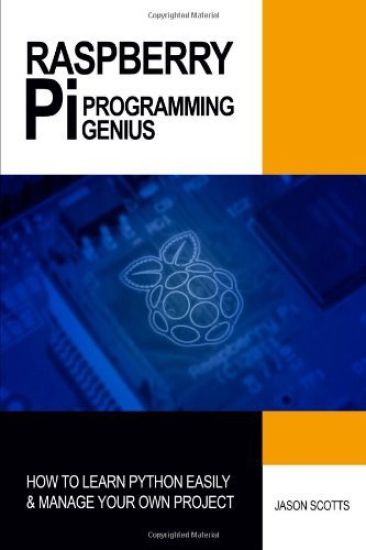
Raspberry Pi Programming Genius: How to Learn Python Easily & Manage Your Own Project
"Raspberry Pi Programming Guide" is a text that gives the reader a bit of insight into this form of technology. It is European based and is just making a debut in North America so many are curious about it and what exactly this technology can do. The aim that the author has with this text is to highlight the main functions of Raspberry Pi and how it can be beneficial to the consumer in the long run. The text is extremely informative and to the point and it is simple to read. The great thing about the book is that anyone, even someone who does not know much about this form of technology can understand the process. It is a great text to have in any household that has a keen interest in technology.
Raspberry Pi System Software Reference
Raspberry Pi is Linux, but it's a unique flavor of Linux, specifically for the ARM-based Pi. Raspberry Pi Software Reference guides you through the boot process, including options for tweaking HDMI, memory, and other boot options. You'll learn the details of run levels and creating new services, and how to use the custom command vcgencmd for doing things like reporting temperature, clock speeds, and voltage. And while there are cross-compilers available for some flavors of Linux, one of the most important things you'll get from Raspberry Pi Software Reference is how to build your own Raspberry Pi cross-compiler on your Mac OSX, Linux, or Windows computer.
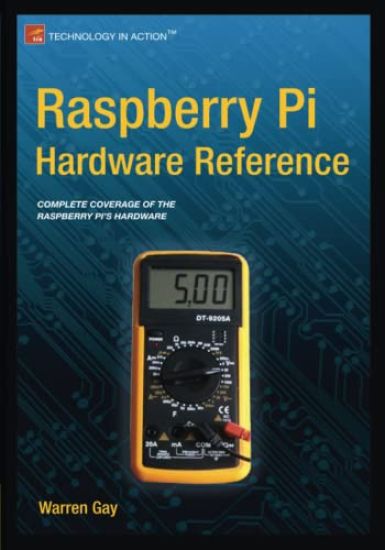
Raspberry Pi Hardware Reference
The Raspberry Pi is deceptively simple. Plug it in, boot it up, and use it as a personal computer, or attach a million gizmos and modules and invent something new and amazing. Either way, what it can actually do is not simple, and you should know exactly what the Raspberry Pi hardware is all about. Raspberry Pi Hardware Reference, from Mastering the Raspberry Pi, is the hardware guide you need on your desk or workbench. Every detail is covered: from power to memory, from the CPU to working with USB. You'll find all the details about working with both wired and wireless Ethernet, SD cards, and the UART interface. The GPIO chapter is invaluable, covering power budgeting, access, and even small but important details like the correct usage of sudo when working with GPIO pins. You'll also find details about the 1-Wire driver, the I2C bus, and the SPI bus. If you need to know anything about your Raspberry Pi's hardware, you will find it here, in Raspberry Pi Hardware Reference.
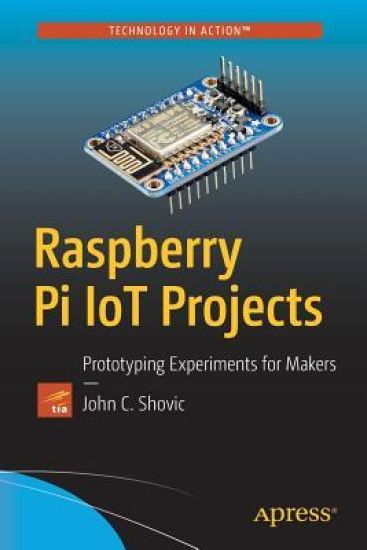
Raspberry Pi IoT Projects

Raspberry Pi IoT Projects

Shovic John C.

APress
2016
nidottu
Build your own Internet of Things (IoT) projects for prototyping and proof-of-concept purposes. This book contains the tools needed to build a prototype of your design, sense the environment, communicate with the Internet (over the Internet and Machine to Machine communications) and display the results.Raspberry Pi IoT Projects provides several IoT projects and designs are shown from the start to the finish including an IoT Heartbeat Monitor, an IoT Swarm, IoT Solar Powered Weather Station, an IoT iBeacon Application and a RFID (Radio Frequency Identification) IoT Inventory Tracking System. The software is presented as reusable libraries, primarily in Python and C with full source code available. Raspberry Pi IoT Projects: Prototyping Experiments for Makers is also a valuable learning resource for classrooms and learning labs.What You'll Learnbuild IOT projects with the Raspberry PiTalk to sensors with the Raspberry PiUse iBeacons with the IOT Raspberry PiCommunicate your IOT data to the InternetBuild security into your IOT deviceWho This Book Is ForPrimary audience are those with some technical background, but not necessarily engineers. It will also appeal to technical people wanting to learn about the Raspberry Pi in a project-oriented method.
Raspberry Pi GPU Audio Video Programming
Delve into the Broadcom VideoCore GPU used on the Raspberry Pi and master topics such as OpenGL ES and OpenMAX. Along the way, you’ll also learn some Dispmanx, OpenVG, and GPGPU programming.The author, Jan Newmarch bumped into a need to do this kind of programming while trying to turn the RPi into a karaoke machine: with the CPU busting its gut rendering MIDI files, there was nothing left for showing images such as karaoke lyrics except for the GPU, and nothing really to tell him how to do it.Raspberry Pi GPU Audio Video Programming scratches his itch and since he had to learn a lot about RPi GPU programming, he might as well share it with you. What started as a side issue turned into a full-blown project of its own; and this stuff is hard.What You'll LearnUse Dispmanx and EGL on Raspberry PiWork with OpenMAX and its components, state, IL Client Library, * * Buffers, and more on RPiProcess images and video on RPiHandle audio on RPiRender OpenMAX to OpenGL on the RPiPlay multimedia files on the RPiUse OpenVG for text processing and moreMaster overlaysWho This Book Is ForYou should be comfortable with C programming and at least some concurrency and thread programming using it. This book is for experienced programmers who are new or learning about Raspberry Pi.
Raspberry Pi Supercomputing and Scientific Programming
Build an inexpensive cluster of multiple Raspberry Pi computers and install all the required libraries to write parallel and scientific programs in Python 3. This book covers setting up your Raspberry Pis, installing the necessary software, and making a cluster of multiple Pis. Once the cluster is built, its power has to be exploited by means of programs to run on it. So, Raspberry Pi Supercomputing and Scientific Programming teaches you to code the cluster with the MPI4PY library of Python 3. Along the way, you will learn the concepts of the Message Passing Interface (MPI) standards and will explore the fundamentals of parallel programming on your inexpensive cluster. This will make this book a great starting point for supercomputing enthusiasts who want to get started with parallel programming. The book finishes with details of symbolic mathematics and scientific and numerical programming in Python, using SymPi, SciPy, NumPy, and Matplotlib. You’ll see how to process signals and images, carry out calculations using linear algebra, and visualize your results, all using Python code. With the power of a Raspberry Pi supercomputer at your fingertips, data-intensive scientific programming becomes a reality at home.What You Will Learn Discover the essentials of supercomputingBuild a low-cost cluster of Raspberry Pis at homeHarness the power of parallel programming and the Message Passing Interface (MPI)Use your Raspberry Pi for symbolic, numerical, and scientific programmingWho This Book Is ForPython 3 developers who seek the knowledge of parallel programming, Raspberry Pi enthusiasts, researchers, and the scientific Python community.
Raspberry Pi for Arduino Users

Raspberry Pi for Arduino Users

James R. Strickland

APress
2018
nidottu
Leverage your Arduino skills in the Raspberry Pi world and see how to cross the two platforms into sophisticated programs.The Arduino and Raspberry Pi communities overlap more than you might think. Arduinos can be expanded to have network capabilities with a variety of “shields,” all of which increase the cost and complexity of the system. By contrast, Raspberry Pis all run Linux, which is a very network-competent platform. The newest Pi, the Raspberry Pi Zero W, is WiFi and Bluetooth capable, and costs around $10 U.S. For network enabled gadgets, it makes far more sense to cross to the Raspberry PI platform, if only someone would make it easy to do. That's what this book is about.You'll learn some survival level Linux system administration, so you know how to set the machine up and how to establish at least minimal security for your gadget. You''ll set up and learn the Geany IDE on your Pi, which is fairly similar to the Arduino IDE. Where the two platforms overlap the most is the GPIO system. You'll see that several projects use and explain the WiringPi system. This is is deliberately similar to the Arduino's 'Wiring' functionality, which is how sketches interact with GPIO pins. You'll learn the differences between the GPIO pins of the two devices, and how the Pi has some limitations on those pins that the Arduino does not. As a final project, in an effort to escape some of those limitations, you'll attach an AtMEGA 328P to the Raspberry Pi and configure it as a real, 8MHz Arduino with the Arduino IDE running on the Pi, and learn how to have the two platforms communicate, giving you the best of both worlds.What You'll LearnEstablish security with Linux system administrationSet up the Apache webserverWrite CGI programs so other computers can connect to your Pi and pull datain from it. Use C/C++ from Arduino sketches to write programs for the Pi Who This Book Is For The Arduino user who's been through all the tutorials and is comfortable writing sketches and connecting hardware to their Arduino.
Raspberry Pi Retro Gaming

Raspberry Pi Retro Gaming

Mark Frauenfelder; Ryan Bates

APress
2019
nidottu
Learn to configure a Raspberry Pi into multiple different devices capable of playing retro games. Beyond theory, this book focuses heavily on projects—such as making a console to attach to a TV or computer display and making a tabletop arcade machine. It also teaches you how to install and use the Kodi media center on your retro game player. tart with the big-picture of the Raspberry Pi retro-gaming landscape and the wide range of exciting project opportunities that exist. You'll then discover the various retro-gaming emulation platforms, such as RetroPie and Recalbox, and how to work with ROM files. This book even goes a step further and teaches you how to create game ROMs from your old cartridges! You’ll also study the types of game playing equipment people have made using Raspberry Pis and how to set up a Raspberry Pi with those devices. Retro-gaming enthusiasts are using the Pi to make a dizzying variety of game playing hardware. Thereare players that fit in an Altoids mint tin, players that look like classic systems, and players that let you choose from over 20,000 game titles. And there are emulators for every platform imaginable, and many models available online to download and make on a 3D printer or laser cutter. Raspberry Pi Retro Gaming includes everything you need to know about playing retro games on a Raspberry Pi and making cool machines that play thousands of retrogames.What You'll LearnUse Tinkercad to design your own cases Get your case 3D printed if you don’t have a 3D printer Design parts for laser cutting or jigsaw cutting Solder and use electronics components, batteries, and power suppliesSelect and set up different kinds of displaysWho This Book Is ForAnyone interested in playing retrocomputer games and making their own retro-game players.
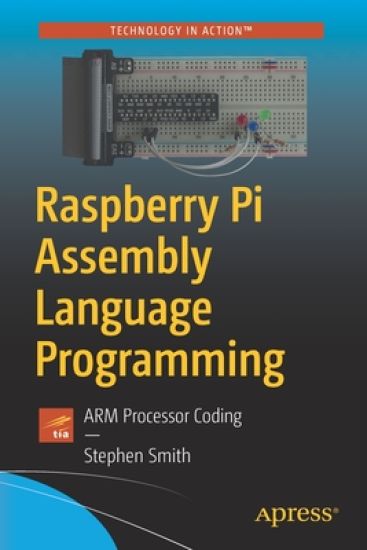
Raspberry Pi Assembly Language Programming
Gain all the skills required to dive into the fundamentals of the Raspberry Pi hardware architecture and how data is stored in the Pi’s memory. This book provides you with working starting points for your own projects while you develop a working knowledge of Assembly language programming on the Raspberry Pi. You'll learn how to interface to the Pi’s hardware including accessing the GPIO ports. The book will cover the basics of code optimization as well as how to inter-operate with C and Python code, so you'll develop enough background to use the official ARM reference documentation for further projects. With Raspberry Pi Assembly Language Programming as your guide you'll study how to read and reverse engineer machine code and then then apply those new skills to study code examples and take control of your Pi’s hardware and software both.What You'll LearnProgram basic ARM 32-Bit Assembly LanguageInterface with the various hardware devices on the Raspberry PiComprehend code containing Assembly languageUse the official ARM reference documentationWho This Book Is ForCoders who have already learned to program in a higher-level language like Python, Java, C#, or C and now wish to learn Assembly programming.
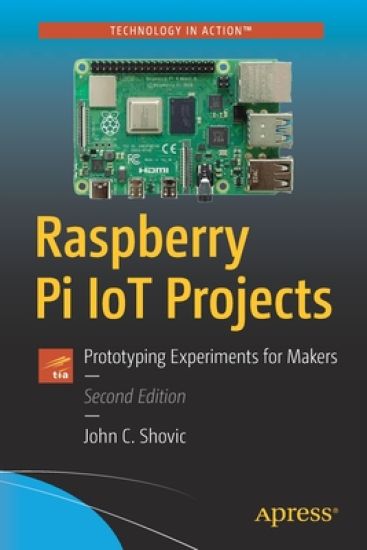
Raspberry Pi IoT Projects

Raspberry Pi IoT Projects

John C. Shovic

APress
2021
nidottu
Build your own Internet of Things (IoT) projects for prototyping and proof-of-concept purposes.Updated for the Raspberry Pi 4 and other recent boards, this book contains the tools needed to build a prototype of your design, sense the environment, communicate with the Internet (over the Internet and Machine to Machine communications) and display the results.Raspberry Pi IoT Projects, 2nd Edition provides several IoT projects and designs shown from the start to the finish including an IoT Heartbeat Monitor, an IoT Swarm, IoT Solar Powered Weather Station, an IoT iBeacon Application and a RFID (Radio Frequency Identification) IoT Inventory Tracking System. The software is presented as reusable libraries, primarily in Python and C with full source code available, making this version a valuable learning resource for classrooms and learning labs. What You'll LearnCreate IOT projects with the Raspberry PiTalk to sensors with the Raspberry PiUse iBeacons with the IOT Raspberry PiCommunicate your IOT data to the InternetBuild security into your IOT deviceWho This Book Is ForPrimary audience are those with some technical background, but not necessarily engineers. It will also appeal to technical people wanting to learn about the Raspberry Pi in a project-oriented method.
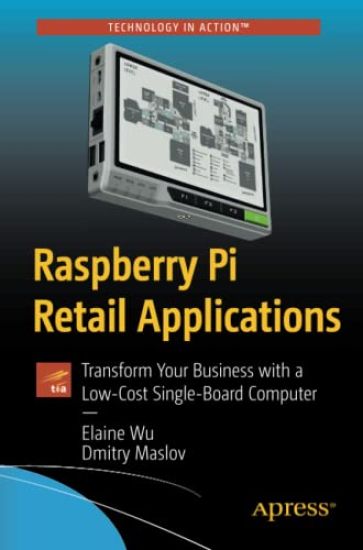
Raspberry Pi Retail Applications

Raspberry Pi Retail Applications

Elaine Wu; Dmitry Maslov

APRESS
2022
nidottu
Increase productivity and lower the operating cost of your business by automating crucial business processes with the Raspberry Pi. After completing this book's projects you'll be able to determine the best way to quickly apply automation to existing systems and processes in your retail outlet with Raspberry Pi. You’ll start by composing ideas to transform your business, and then gain practical, accessible methods for executing them. Find real-world ways to implement tech solutions to accelerate the growth of your business, and navigate the ever-changing landscape of retail automation with this book. Then see what automation can and cannot do at the current level of technical progress for retail businesses. By comparing the efficiency of machines with manual labor, you’ll be able to assess how open-source hardware performs in lowering operating costs and identify business components that can be improved with automation. Raspberry Pi Retail Applications features projects that are easy to dive into and will function readily in your day-to-day business right now. What You'll LearnIdentify business components that can be improved with automation Combine the existing array of Raspberry Pi hardware options to build customized solutions Implement tech ideas in a practical retail environment to reduce cost and streamline your business processes Who This Book Is ForSmall and medium business owners or technology officers looking for solutions to increase efficiency, lower operating costs, and drive up profits for their retail companies with automation. Familiarity with open-source hardware and programming skills is helpful, but not necessary.