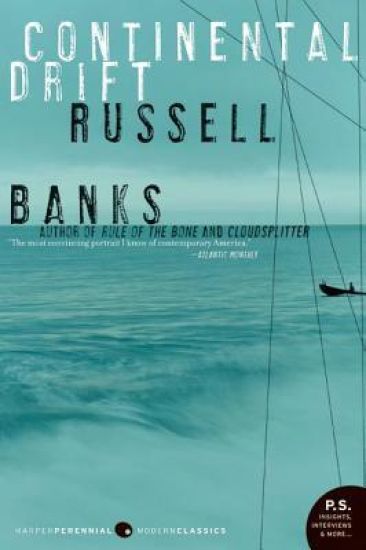
"The most convincing portrait I know of contemporary America . . . a great American novel." -- James Atlas, The Atlantic MonthlyFrom acclaimed author Russell Banks, a masterful novel of hope lost and gained--a gripping, indelible story of fragile lives uprooted and transformed by injustice, disappointment, and the seductions and realities of the American dream.Banks's searing tale of uprootedness, migration, and exploitation in contemporary America brings together two of the dominant realms of his fiction--New England and the Caribbean--skillfully braided into one taut narrative. Continental Drift is the story of a young blue-collar worker and family man who abandons his broken dreams in New Hampshire and the story of a young Haitian woman who, with her nephew and baby, flees the brutal injustice and poverty of her homeland.Continental Drift is a powerful literary classic from one of contemporary fiction's most important writers.
"Banks has taken on a profound theme, the ruinous and awful affliction of violence that seems to live like a secret blood-disease handed down in men like Wade. . . . He turns it into a living art that can bring recognition and awe." -- Los Angeles Book Review"A masterwork of contemporary American fiction" (Chicago Tribune) from one of the most acclaimed and important writers of our timeWade Whitehouse is an improbable protagonist for a tragedy. A well-digger and policeman in a bleak New Hampshire town, he is a former high-school star gone to beer fat, a loner with a mean streak. It is a mark of Russell Banks's artistry and understanding that Wade comes to loom in one's mind as a blue-collar American Everyman afflicted by the dark secret of the macho tradition. Told by his articulate, equally scarred younger brother, Wade's story becomes as spellbinding and inexorable as a fuse burning its way to the dynamite.
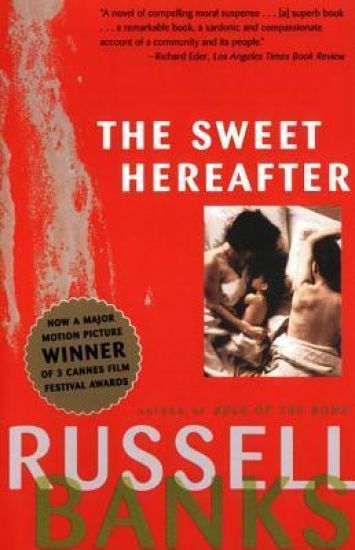
"Rich in imagery and the detail of small-town life and haunting in its portrayal of ordinary men and women struggling to understand loss. Under Mr. Banks's restrained craftsmanship, what begins as the story of senseless tragedy is transformed into an aspiring testament to hope and human resilience." -- Atlanta ConstitutionIn The Sweet Hereafter, Russell Banks tells a story that begins with a school bus accident. Using four different narrators, Banks creates a small-town morality play that addresses one of life's most agonizing questions: when the worst thing happens, who do you blame?Here is a stunning novel of "compelling moral suspense" (Los Angeles Times Book Review) from one of America's greatest storytellers.
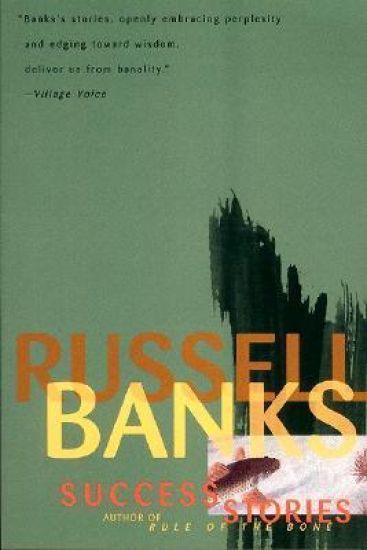
In Sucess Stories, an exceptionally varied yet coherent collection, Russell Banks proves himself one of the most astute and forceful writers in America today. Queen for a Day, Success Story, and Adultery trace fortunes of the Painter family in there pursuit of and retreat from the American dream. Banks also explores the ethos of rampant materialism in a group of contemporary moral fables. The Fish is an evocating parable of faith and greed set in a Southeast Asian village, The Gully tells of the profitability of violence and the ironies of upward mobility in a Latin American shantytown, and Chrildren's Story explores the repressed rage that boils beneath the surface of relationships between parents and children and between citizens of the first and third worlds.
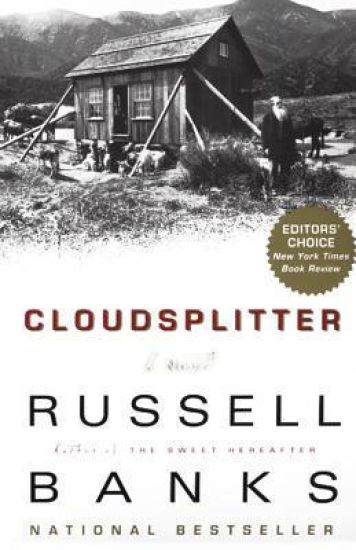
"Deeply affecting. . . . Like the best novels of Nadine Gordimer, it makes us appreciate the dynamic between the personal and the political, the public and the private, and the costs and causes of radical belief." -- New York TimesA triumph of the imagination and a masterpiece of modern storytelling, Cloudsplitter is narrated by the enigmatic Owen Brown, last surviving son of America's most famous and still controversial political terrorist and martyr, John Brown. Deeply researched, brilliantly plotted, and peopled with a cast of unforgettable characters both historical and wholly invented, Cloudsplitter is dazzling in its re-creation of the political and social landscape of our history during the years before the Civil War, when slavery was tearing the country apart. But within this broader scope, Russell Banks has given us a riveting, suspenseful, heartbreaking narrative filled with intimate scenes of domestic life, of violence and action in battle, of romance and familial life and death that make the reader feel in astonishing ways what it is like to be alive in that time.
Having fled to West Africa in the late 1970s for her work as a political radical and member of the Weather Underground, Hannah Musgrave befriends notorious former Liberian president Charles Taylor, whom she helps to escape from prison and who years later leads a rebellion that threatens Hannah's family. Reader's Guide available. Reprint. 75,000 first printing.
Hamilton Stark is a New Hampshire pipe fitter and the sole inhabitant of the house from which he evicted his own mother. He is the villain of five marriages and the father of a daughter so obsessed that she has been writing a book about him for years. Hamilton Stark is a boor, a misanthrope, a handsome man: funny, passionately honest, and a good dancer. The narrator, a middle-aged writer, decides to write about Stark as a hero whose anger and solitude represent passion and wisdom. At the same time that he tells Hamilton Stark's story, he describes the process of writing the novel and the complicated connections between truth and fiction. As Stark slips in and out of focus, maddeningly elusive and fascinatingly complex, this beguiling novel becomes at once a compelling meditation on identity and a thoroughly engaging story of life on the cold edge of New England.
"At once a harrowing mystery, an illuminating psychological novel of subverted love and family dysfunction, and a powerful commentary on class structure in America . . . Banks is] one of America's finest contemporary fiction writers." --Boston GlobePart love story, part murder mystery, set on the cusp of the Second World War, Russell Banks's sharp-witted and deeply engaging novel raises dangerous questions about class, politics, art, love, and madness--and explores what happens when two powerful personalities, trapped at opposite ends of a social divide, begin to break the rules. Vanessa Cole is a stunningly beautiful and wild heiress. Twice-married, she has been scandalously linked to rich and famous men. On the night of July 4, 1936, inside her family's remote Adirondack Mountain enclave known as the Reserve, Vanessa will lose her father to a heart attack--and meet Jordan Groves, a seductively carefree local artist. Jordan is easy prey for Vanessa's electrifying charm. But when Vanessa becomes unhinged by her father's unexpected death, she begins to spin out of control, manipulating and destroying the lives of all who cross her path.Moving from the secluded beauty of the Adirondacks to war-torn Spain and fascist Germany, and filled with characters that pierce the heart, The Reserve is a clever, incisive, and passionately romantic novel of suspense and drama.
"At once a harrowing mystery, an illuminating psychological novel of subverted love and family dysfunction, and a powerful commentary on class structure in America . . . Banks is] one of America's finest contemporary fiction writers." --Boston GlobePart love story, part murder mystery, set on the cusp of the Second World War, Russell Banks's sharp-witted and deeply engaging novel raises dangerous questions about class, politics, art, love, and madness--and explores what happens when two powerful personalities, trapped at opposite ends of a social divide, begin to break the rules. Vanessa Cole is a stunningly beautiful and wild heiress. Twice-married, she has been scandalously linked to rich and famous men. On the night of July 4, 1936, inside her family's remote Adirondack Mountain enclave known as the Reserve, Vanessa will lose her father to a heart attack--and meet Jordan Groves, a seductively carefree local artist. Jordan is easy prey for Vanessa's electrifying charm. But when Vanessa becomes unhinged by her father's unexpected death, she begins to spin out of control, manipulating and destroying the lives of all who cross her path.Moving from the secluded beauty of the Adirondacks to war-torn Spain and fascist Germany, and filled with characters that pierce the heart, The Reserve is a clever, incisive, and passionately romantic novel of suspense and drama.
"Of the many writers working in the great tradition today, one of the best is Russell Banks." --New York Times?"Like our living literary giants Toni Morrison and Thomas Pynchon, Russell Banks is a great writer wrestling with the hidden secrets and explosive realities of this country." --Cornel WestLost Memory of Skin is a provocative novel of spiritual and moral redemption from Russell Banks, the author of Affliction, Rule of the Bone, Continental Drift, Cloudsplitter, and other acclaimed masterworks of contemporary American fiction. Uncompromising and complex, Lost Memory of Skin is the story of The Kid, a young sex offender recently released from prison and forced to live beneath a South Florida causeway. When The Professor, a man of enormous intellect and appetite, takes The Kid under his wing, his own startling past will cause upheavals in both of their worlds. At once lyrical, witty, and disturbing, Banks's extraordinary novel showcases his abilities as a world-class storyteller as well as his incisive understanding of the dangerous contradictions and hypocrisies of modern American society.
A collection of short stories from the contemporary American master whom the New York Times declared "the most compassionate fiction writer working today."Suffused with Russell Banks's trademark lyricism and reckless humor, the twelve stories in A Permanent Member of the Family examine the myriad ways we try--and sometimes fail--to connect with one another, as we seek a home in the world.In the title story, a father looks back on the legend of the cherished family dog whose divided loyalties mirrored the fragmenting of his marriage. "A Former Marine" asks, to chilling effect, if one can ever stop being a parent. And in the haunting, evocative "Veronica," a mysterious woman searching for her daughter may not be who she claims she is.Moving between the stark beauty of winter in upstate New York and the seductive heat of Florida, Banks's acute and penetrating collection demonstrates the range and virtuosity of both his narrative prowess and his startlingly panoramic vision of modern American life.
"Banks's narrative seductively juxtaposes rambles through lush volcanic mountains, white sand beaches and coral reefs with a barrage of memories of the hash he's made of his private life." --The New York Times Book ReviewRussell Banks has indulged his wanderlust for more than half a century. This longing for escape has taken him from the "bright green islands and turquoise seas" of the Caribbean islands to peaks in the Himalayas, the Andes, and beyond.In each of these remarkable essays, Banks considers his life and the world. In Everglades National Park this "perfect place to time-travel," he traces his own timeline. Recalling his trips to the Caribbean in the title essay, "Voyager," Banks dissects his relationships with the four women who would become his wives. In the Himalayas, he embarks on a different quest of self-discovery. "One climbs a mountain not to conquer it, but to be lifted like this away from the earth up into the sky," he explains.Pensive, frank, beautiful, and engaging, Voyager brings together the social, the personal, and the historical, opening a path into the heart and soul of this revered writer.
The basis for the Major Motion Picture Oh, Canada directed by Paul Schrader and starring Richard Gere, Uma Thurman, Jacob Elordi, and Michael Imperioli.A searing novel about memory, abandonment, and betrayal from the acclaimed and bestselling Russell Banks "During a career stretching almost half a century, Russell Banks has published an extraordinary collection of brave, morally imperative novels. . . . In this complex and powerful novel, we come face to face with the excruciating allure of redemption." --Washington PostAt the center of Foregone is famed Canadian American leftist documentary filmmaker Leonard Fife, one of sixty thousand draft evaders and deserters who fled to Canada to avoid serving in Vietnam. Fife, now in his late seventies, is dying of cancer in Montreal and has agreed to a final interview in which he is determined to bare all his secrets at last, to demythologize his mythologized life. The interview is filmed by his acolyte and ex-star student, Malcolm MacLeod, in the presence of Fife's wife and alongside Malcolm's producer, cinematographer, and sound technician, all of whom have long admired Fife but who must now absorb the meaning of his astonishing, dark confession.Imaginatively structured around Fife's secret memories and alternating between the experiences of the characters who are filming his confession, the novel challenges our assumptions and understanding about a significant lost chapter in American history and the nature of memory itself. Russell Banks gives us a daring and resonant work about the scope of one man's mysterious life, revealed through the fragments of his recovered past.
The basis for the Major Motion Picture Oh, Canada directed by Paul Schrader and starring Richard Gere, Uma Thurman, Jacob Elordi, and Michael Imperioli.A searing novel about memory, abandonment, and betrayal from the acclaimed and bestselling Russell Banks "During a career stretching almost half a century, Russell Banks has published an extraordinary collection of brave, morally imperative novels. . . . In this complex and powerful novel, we come face to face with the excruciating allure of redemption." --Washington PostAt the center of Foregone is famed Canadian American leftist documentary filmmaker Leonard Fife, one of sixty thousand draft evaders and deserters who fled to Canada to avoid serving in Vietnam. Fife, now in his late seventies, is dying of cancer in Montreal and has agreed to a final interview in which he is determined to bare all his secrets at last, to demythologize his mythologized life. The interview is filmed by his acolyte and ex-star student, Malcolm MacLeod, in the presence of Fife's wife and alongside Malcolm's producer, cinematographer, and sound technician, all of whom have long admired Fife but who must now absorb the meaning of his astonishing, dark confession.Imaginatively structured around Fife's secret memories and alternating between the experiences of the characters who are filming his confession, the novel challenges our assumptions and understanding about a significant lost chapter in American history and the nature of memory itself. Russell Banks gives us a daring and resonant work about the scope of one man's mysterious life, revealed through the fragments of his recovered past.
Master the Art of the Workaround toBoost Your Productivity!“With the variety of challenges leaders face every day, Russell Bishop has hit on an amazingly simple and highly effective solution: the ‘workaround.’ This is a brilliant approach to facing day-to-day business challenges, and it works!”—Marshall Goldsmith, world-renowned executive coach and author of the New York Times bestsellers Mojo and What Got You Here Won’t Get You There“If you want to succeed big, there is no substitute for sticking your neck out. Russell Bishop shows how to do it without getting your head chopped off. Workarounds That Work offers practical, down-to-earth advice on overcoming obstacles on the job—both big and small. It’s a must-read for anyone trying to navigate the bumpy road of the modern workplace.”—Arianna Huffington, cofounder and editor-in-chief, the Huffington Post“Workarounds That Work tackles one problem area after another, busting myths and giving practical advice along the way.”—Dave Logan, professor at the Marshall School of Business at USC and bestselling coauthor of Tribal Leadership“Workarounds That Work goes where none of the other productivity books go—into the messy, cky, hard-to-control stuff that we all face every single day. You’ll finish this book with a fresh ake on how to think about productivity and at least a half-dozen new ways to get things done.”—Les McKeown, Wall Street Journal and USA Today bestselling author of Predictable Success“Today’s relentless demands of work require a new model of how we get things done. Workarounds that Work envisions work as a continuous stream of free-flowing accomplishments instead of the headaches, inefficiencies, and stresses we associate with work today. You’ll never experience red tape again.” —Tony Schwartz, CEO, The Energy Project, and bestselling author of The Way We’re Working Isn’t Working About the Book:You’ve experienced the frustration dozens of times: you need approval on a project, but a key sign-off person is out of town; a product is on a crash schedule, but you’re missing an important detail; you need to move ahead in a process, but company rules cause delays. What you need is a workaround.In Workarounds That Work, Russell Bishop—an expert in personal and organization transformation—teaches the art of the workaround: a method for accomplishing a task or goal when the normal process isn’t producing the desired results. Workarounds help you break through the tasks and systems that keep you from the important stuff. They even help you bring lasting change to your organization by doing away with frustrating institutional inefficiencies once and for all.Workarounds aren’t only about getting things done. They’re about getting the right things done. To ratchet up productivity, your organization needs someone who will ask the big questions, such as:How can our systems—from operational infrastructures to management processes—be more efficient and effective?Do we make the most of our talent?Do our teams work in isolation when collaboration would be more useful?Are we wasting time, placing blame, and fighting fires when we could instead be fixing problems?Is our direction clear, aligned, and focused?Are you ready to be that person—the one who gets things done, no matter what?Workarounds That Work explains how to identify problems that make workarounds necessary and then create the best solution available—without sacrificing quality or doing a less-than-stellar job.With Bishop’s strategies at your disposal, you can conquer anything that stands in your way at work—even when it seems like your organization’s culture is pitted against what you know is best for it.
Long recognised as a site where criminal elements have flourished, the waterfront has been exploited for centuries by opportunistic individuals for a whole raft of illicit purposes. Policing the Waterfront: Networks, Partnerships, and the Governance of Port Security is the first book of its kind to fully explore the intricacies of how crime is controlled on the waterfront, and in doing so, seeks to enhance current theoretical understandings of the policing partnerships that exist between state and non-state actors. Charting the complex configuration of security networks using a range of analytical techniques, this book presents new empirical data, which exposes and explains the social structures that enable policing partnerships to function on the waterfront. Particularly striking is the use of enhanced and adjusted theoretical discussions, to both shape and develop previous policing and security debates - resulting in a work that is both innovative and, yet, still routed in the traditions of empirical research. The analysis is achieved through a comparative research design, evaluating the narratives of both state and non-state security providers at the busiest ports in America and Australia: the Los Angeles/Long Beach Port Complex and the Port of Melbourne. Policing the Waterfront presents a rich and highly original account of the underlying structures that foster, facilitate, and enhance policing partnerships on the waterfront, and will be of interest to scholars in the fields of criminology, sociology, law, socio-legal and policy studies, as well as those researching and studying policing, regulation, security, mass transportation, and social capital.
There have been many studies of the generals who commanded the Union's victorious Army of the Potomac, but none has considered the corps, division, and brigade commanders (and their all-important staff officers) through the entire war- until now. Placing their actions in the social, political, military, and economic context of the day, this original and thought-provoking book examines in meticulous detail the command and performance of the brave and controversial officers of the Union's main fighting force.This study in command, the first of a multi-volume work, is based entirely on manuscript sources, many of which have never before been examined. As a result, the narrative and conclusions about the actions of many of the Union's prominent generals differ- often significantly- from traditional historical thinking. What emerges is a much different picture of these men and how their personalities influenced their command decisions and the political atmosphere that influenced and determined their military careers. The Army of the Potomac is about the leaders as men- their successes and failures commanding the Union's largest army.
Australia has long been thought of by Europeans as an exotic and mysterious land. During the nineteenth century, it was envisioned much as the moon and Mars are today: a distant and uncharted place with hidden possibilities for explorations and adventures. The continent captured the imagination of European writers in the 1800s, and with its settlement, Australia became the setting for tales of lost worlds and ancient civilizations. Australia has since developed a rich national literature, and perhaps because of its novelty and wilderness, it has inspired numerous science fiction writers. This book provides a critical survey of the history of Australian science fiction from its nineteenth century origins to the present.The volume proceeds chronologically, with an introductory section on the origins of Australian science fiction before 1925. It then turns to the rise of traditional science fiction in Australia from 1926 to 1959, with discussions of such writers as James Morgan Walsh, Norma Hemming, and Wynne Whiteford. A section on the period from 1960 to 1974 examines the growing national recognition given to such Australian science fiction writers as David Rome and Jack Wodhams, while a section on science fiction between 1975 and 1984 reviews the rise of small presses and the growth of literary criticism of the genre in Australia. A final section addresses the maturation of Australian science fiction from 1985 to 1998 with attention to Aussiecon Two. Extensive bibliographic information concludes the volume.
In late 1943, over seven thousand American soldiers were held as prisoners of war in the Japanese-occupied Philippines. The majority had survived the infamous Bataan Death March only to face starvation and torture in internment camps operated by the kempei, the Japanese military police.Written in 1944, Until They Eat Stones is the definitive account of the POW camps in the occupied Philippines as the situation unfolded. The camps held thousands of Filipino civilians (mostly from Manila) in addition to US and Allied soldiers. As a backdrop (and break) from the prison brutality, author Russell Brine provides detailed reports on Japanese strategy and tactics in Southeast Asia at the time. A unique perspective on events from someone in the middle of the maelstrom, Until They Eat Stones is essential reading for World War 2 buffs.
In late 1943, over seven thousand American soldiers were held as prisoners of war in the Japanese-occupied Philippines. The majority had survived the infamous Bataan Death March only to face starvation and torture in internment camps operated by the kempei, the Japanese military police.Written in 1944, Until They Eat Stones is the definitive account of the POW camps in the occupied Philippines as the situation unfolded. The camps held thousands of Filipino civilians (mostly from Manila) in addition to US and Allied soldiers. As a backdrop (and break) from the prison brutality, author Russell Brine provides detailed reports on mid-war Japanese strategy and tactics in Southeast Asia.