

Kirjahaku
Etsi kirjoja tekijän nimen, kirjan nimen tai ISBN:n perusteella.
1000 tulosta hakusanalla Simone Colwill


Simone's Pocket Posh Journal, Chevron
Andrews McMeel Publishing
2016
pokkari

Simone's Pocket Posh Journal, Mum
Andrews McMeel Publishing
2016
pokkari

Simone's Pocket Posh Journal, Polka Dot
Andrews McMeel Publishing
2016
pokkari

Simone's Pocket Posh Journal, Tulip
Andrews McMeel Publishing
2016
pokkari

The My Itty-Bitty Bio series are biographies for the earliest readers. This book examines the life of Simone Biles in a simple, age-appropriate way that will help children develop word recognition and reading skills. Includes a table of contents, author biography, timeline, glossary, index, and other informative backmatter.

Simone Histoire d'une jeune fille moderne
Victor Tissot
Createspace Independent Publishing Platform
2016
nidottu
a marche a marche Enfonc es les poup es anglaises Ce gamin de Bamberg est tonnant avec ses trucs. N'a-t-il pas imagin de remplacer les yeux de verre, des yeux fixes, des yeux b tes par des petites sph res, grosses comme des noisettes, qui pivotent sur elles-m mes d s que l'on appuie sur un levier minuscule dissimul sous le chignon ? Une pression sur la nuque et hop les yeux bleus s'enfoncent sous la paupi re sup rieure pendant qu'apparaissent des yeux noirs. Ce petit ing nieur est extraordinaire en machinations. L'hiver prochain je vais doubler ma vente. Ma petite Simone, qui est une habilleuse plus forte que Worth, chiffonnera du satin autour de mes princesses. Et allez donc ne pas acheter des b b s qui, v tus comme des princes, ont des yeux de rechange
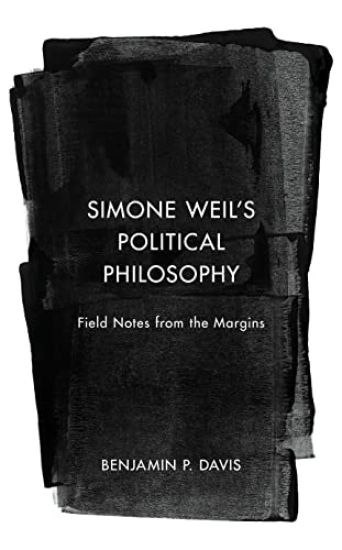
Davis demonstrates how Simone Weil’s Marxism challenges current neoliberal understandings of the self and of human rights. Explaining her related critiques of colonialism and of political parties, it presents Weil as a twentieth-century political philosopher who anticipated and critically responded to the most contemporary political theory.Simone Weil’s short life (1909–1943) is best understood as deeply invested in and engaged with the world around her, one she knew she would leave behind sooner rather than later if she continued to take risks on the side of the oppressed. In this important and timely book, Benjamin P. Davis presents Simone Weil first and foremost as a political philosopher. To do so, he places Weil’s political writings in conversation with feminist philosophy, decolonial philosophy, aesthetic theory, human rights discourse, and Marxism. Against the backdrop of Weil’s commitments, Davis provides reads Weil explicitly into debates in contemporary Critical Theory. Davis argues that in the battles of today, we urgently need to reconnect with Simone Weil’s ethical and political imagination, which offers a critique of oppression as part of a deeper attention to the world.
This book argues that Simone Weil’s short life (1909–1943) is best understood as deeply invested in and engaged with the world around her, which she knew she would leave behind sooner rather than later if she took risks on the side of the oppressed. To present Weil first and foremost as a political philosopher, Benjamin Davis places her work in conversation with feminist philosophy, decolonial philosophy, and Marxism. Against the backdrop of Weil’s commitments, Davis reads Weil into debates in contemporary Critical Theory. He argues that in the battles of today, we need to reconnect with Simone Weil’s ethical and political imagination, which offers a critique of oppression as part of a deeper attention to the world.
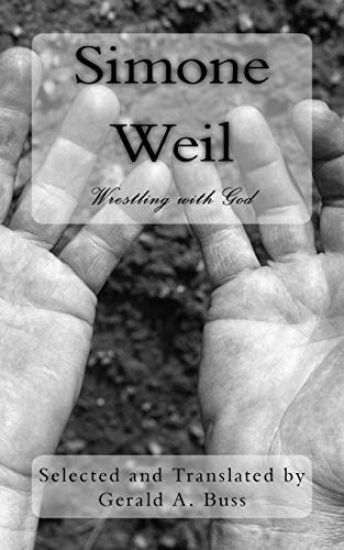
Simone Weil: Wrestling With God
Gerald Arthur Buss
Createspace Independent Publishing Platform
2017
nidottu
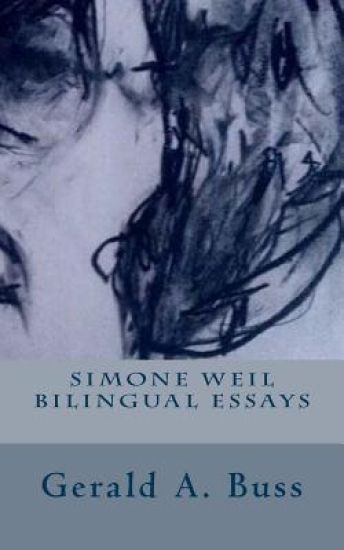
Simone Weil Bilingual Essays
Gerald Arthur Buss
Createspace Independent Publishing Platform
2017
nidottu
Contents of Simone Weil: Bilingual Essays: Translator's Note The Greek Pater (Lord's Prayer) & Simone Weil's French Version Love, by George Herbert & A French Translation Profession de Foi Profession of Faith Autobiographie spirituelle Spiritual Autobiography R flexions sur le bon usage des tudes scolaires en vue de l'amour de Dieu Reflections on the Good Use of School Studies as a Way to Come to a Love for God Cette Guerre est une guerre de religion This War is a Religious War R flexions sans ordre sur l'amour de Dieu Various Reflections on the Love of God Bibliography Postscript On the thirteenth of April 1942] Simone Weil wrote to Jo Bousquet . . . "I was very moved . . . to see that you had paid real attention to some pages I had shown you . . . Attention is the rarest and purest form of generosity. It is given to very few minds to notice that things and beings exist. Since my childhood I have not wanted anything else but to receive the complete revelation of this before dying." (In Simone P trement, Simone Weil: A Life, tr. Raymond Rosenthal, p. 462) On Simone Weil Diogenes Allen, Professor Emeritus of Philosophy, Princeton University: She was a spokesperson on behalf of striking workers, a volunteer teacher in night schools for railroad workers, and an active trade unionist. By working in factories and on farms she sought to understand how the oppression of work could be alleviated and the social hierarchy dismantled. She once gave shelter to Trotsky (and is said to have argued him into the ground over the nature of social oppression), was a soldier at the front in the Spanish Civil War, sought dangerous service in World War II and served with the Free French in London. If personal heroism is a recommendation . . . Weil's credentials are impeccable. ("Liberation from Illusion," www.religion-online.org) Albert Camus, Nobel Prize in Literature 1957: I am still convinced that Simone Weil is the only great mind of our times . . . For my part, I would be satisfied if I could say that, with the humble means at my disposal, I helped to make known, to disseminate, her work, whose full impact we have yet to measure. (www.hermenaut.com) T. S. Eliot, Nobel Prize in Literature 1948: In trying to understand her, we must not be distracted - as is only too likely to happen on first reading - by considering how far, and at what points, we agree or disagree. We must simply expose ourselves to the personality of a woman of genius, of a kind of genius akin to that of the saints. (Preface, The Need for Roots, p. vi) Gustave Thibon, French Catholic lay theologian: People have found it possible to speak of a 'pathological predisposition to suffering' in connection with Simone Weil. That does not amount to very much: purely psychological explanations, when applied to anyone of such dimensions, suggest a garment that is absurdly tight and splits in all directions . . . She sailed for New York in May 1942. Shortly before our separation, I saw her again in Marseilles . . . To recall the details of this last conversation and to make of it just a memory among others seems to me a profanation today; things which pass beyond time cannot be confined to the memory. I will only say that I had the impression of being in the presence of an absolutely transparent soul which was ready to be reabsorbed into original light. I can still hear Simone Weil's voice in the deserted streets of Marseilles as she took me back to my hotel in the early hours of the morning; she was speaking of the Gospel; her mouth uttered thoughts as a tree gives its fruit, her words did not express reality, they poured it into me in its naked totality; I felt myself to be transported beyond space and time and literally fed with light. (Simone Weil as We Knew Her, tr. Emma Craufurd, pp. 122-123)

Hard Times: Force of Circumstance, Volume II: 1952-1962 (the Autobiography of Simone de Beauvoir)
Simone De Beauvoir; Richard Howard; Toril Moi
Grand Central Publishing
1994
nidottu
This volume of Simone de Beauvoir's legendary autobiography presents Beauvoir at the height of her international fame and portrays her inner struggle with aging. Beauvoir recounts her difficult long-distance romance with novelist Nelson Algren and her involvement with Claude Lanzmann (the future director of Shoah). She also vividly describes her travels with Sartre to Brazil and Cuba, reveals her private sense of despair in reaction to French atrocities in Algeria, and confronts her own deepening depression. Simone de Beauvoir's outstanding achievement is to have left us an admirable record of her unceasing battle to become an independent woman and writer.Introduction by Toril Moi

This book dives deep into the life and career of gymnastics icon Simone Biles. The book also includes a table of contents, a map of where each athlete's biggest accomplishments took place, a list of each athlete's accolades, additional resource links, a glossary, and an index. This Press Box Books title is aligned to a reading level of grades 3-4 and an interest level of grades 3-7.

This book dives deep into the life and career of gymnastics icon Simone Biles. The book also includes a table of contents, a map of where each athlete's biggest accomplishments took place, a list of each athlete's accolades, additional resource links, a glossary, and an index. This Press Box Books title is aligned to a reading level of grades 3-4 and an interest level of grades 3-7.
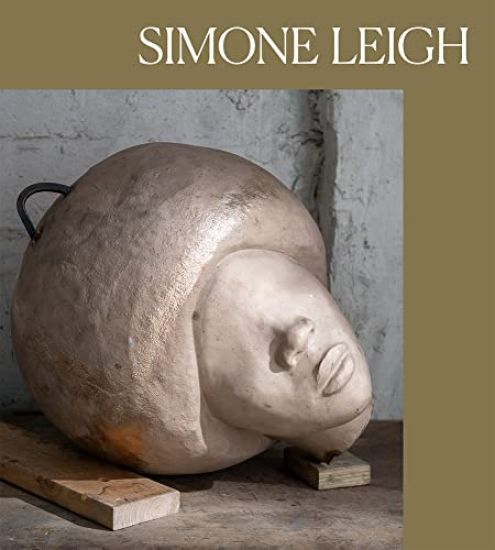
The first major monograph on Simone Leigh's multimedia explorations of community, Black feminism and the traditions and material cultures of the African diaspora A New York Times Book Review 2023 holiday gift guide pick Over the past two decades, Simone Leigh has created artwork that situates questions of Black femme-identified subjectivity at the center of contemporary art discourse. Her sculpture, video, installation and social practice explore ideas of race, beauty and community in visual and material culture. Leigh's art addresses a wide swath of historical periods, geographies and traditions, with specific references to materials across the African diaspora, as well as forms traditionally associated with African art and architecture.This publication includes substantial new scholarship addressing Leigh's work across mediums and topics. The volume, timed with the artist's first museum survey and national tour, includes contributions by her longtime collaborators, new scholars who add diverse insights and perspectives, and a conversation highlighting Leigh's voice. Additionally, generous and lushly illustrated plates feature her critically acclaimed work for the 59th Venice Biennale and works made throughout her 20-year career. A special section featuring Leigh's research images gives access to Leigh's research methodologies and encourages readers to fully engage with all aspects of Leigh's work. This monograph provides a timely opportunity to gain a holistic understanding of the complex and profoundly moving work of this groundbreaking artist. Born in Chicago in 1967, Simone Leigh received a BA in fine art with a minor in philosophy from Earlham College, Richmond, Indiana, in 1990. In 2022, Leigh represented the United States at the 59th Venice Biennale with her critically acclaimed exhibition Sovereignty. She has had solo presentations at the Kitchen, New York (2012); Creative Time, New York (2014); New Museum of Contemporary Art, New York (2016); Hammer Museum, Los Angeles (2016); and the High Line, New York (2019); among other venues. Leigh lives and works in Brooklyn.

Simone Biles has flipped and twisted her way to the top of the gymnastics world But she also takes care of herself. Find out how Simone wins medals and looks out for her mental health.
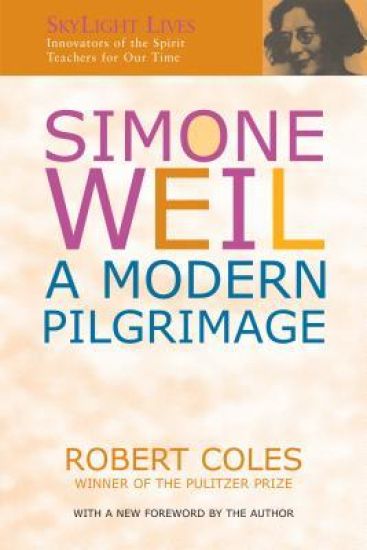
A brilliant portrait of a beloved and controversial figure in twentieth-century spirituality. Simone Weil (1906-1943) was a writer and philosopher who devoted her life to a search for God—while avoiding membership in organized religion. She wrote with the clarity of a brilliant mind educated in the best French schools, the social conscience of a grass-roots labor organizer, and the certainty and humility of a mystic—and she persistently carried out her search in the company of the poor and oppressed. Robert Coles's study of this strange and compelling figure includes the details of her short, eventful life: her academic career, her teaching, her political and social activism, and her mystical experiences. Coles also analyzes the major themes her life encompassed: her politics, her Jewish identity, her moral concerns, her intellect, and her experience of grace. This is the best, most accessible introduction to the woman who was a spiritual influence on the life and work of so many, among them T. S. Eliot, Flannery O'Connor, Adrienne Rich, and Albert Camus. Robert Coles, M.D., was awarded the Pulitzer Prize for his five-volume Children of Crisis series. He is Professor of Psychiatry and Medical Humanities at Harvard Medical School and the James Agee Professor of Social Ethics at Harvard University, and is the author of many books, including The Spiritual Life of Children, The Moral Life of Children, and Dorothy Day: A Radical Devotion.

A brilliant portrait of a beloved and controversial figure in twentieth-century spirituality. Simone Weil (1906-1943) was a writer and philosopher who devoted her life to a search for God—while avoiding membership in organized religion. She wrote with the clarity of a brilliant mind educated in the best French schools, the social conscience of a grass-roots labor organizer, and the certainty and humility of a mystic—and she persistently carried out her search in the company of the poor and oppressed. Robert Coles's study of this strange and compelling figure includes the details of her short, eventful life: her academic career, her teaching, her political and social activism, and her mystical experiences. Coles also analyzes the major themes her life encompassed: her politics, her Jewish identity, her moral concerns, her intellect, and her experience of grace. This is the best, most accessible introduction to the woman who was a spiritual influence on the life and work of so many, among them T. S. Eliot, Flannery O'Connor, Adrienne Rich, and Albert Camus. Robert Coles, M.D., was awarded the Pulitzer Prize for his five-volume Children of Crisis series. He is Professor of Psychiatry and Medical Humanities at Harvard Medical School and the James Agee Professor of Social Ethics at Harvard University, and is the author of many books, including The Spiritual Life of Children, The Moral Life of Children, and Dorothy Day: A Radical Devotion.