Kirjojen hintavertailu. Mukana 12 390 323 kirjaa ja 12 kauppaa.

Kirjahaku

Etsi kirjoja tekijän nimen, kirjan nimen tai ISBN:n perusteella.

1000 tulosta hakusanalla Thomas L. Constable

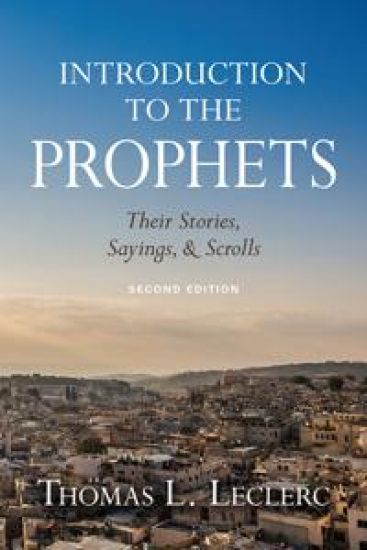
Introduction to the Prophets

Introduction to the Prophets

Thomas L. Leclerc

Paulist Press International,U.S.
2017
nidottu
Now in a second edition, this popular introductory text considers not only each of the prophetic books in the Hebrew Bible, but also treats the stories of prophets found in the Pentateuch and historical books. The biblical texts are approached from several different perspectives. The author places each story and prophetic book in its historical context to understand the concerns the prophets addressed in their own time. He examines literary aspects and theological significance of the texts, and finally the significance of the prophet in post-biblical traditions, especially in the Jewish and Christian lectionaries. Among the new features: ? An updated table of contents and visual aids was well as reference resources in “For Further Study.” ? “Questions for Review” at the end of each chapter. ? A chapter on the book of Daniel. †
Society Ties

Society Ties

Thomas L. Howard III; Owen W. Gallogly

University of Virginia Press
2017
sidottu
Society Ties is a history of the University of Virginia’s oldest student organization, the Jefferson Society. Founded in 1825, the Society has counted the likes of Woodrow Wilson and Edgar Allan Poe among its membership and continues to be one of the largest and most active student organizations on Grounds. Society Ties is more than just the story of the Jefferson Society, however; it is a history of student life at the University of Virginia. The book explores what motivates students during their time at the University and how they experience the ineffable place that is Jefferson’s Academical Village. Until now, no historian has been granted access to the Society’s archives. Society Ties offers a unique—students’—perspective on the vibrant history of the Society and the University at large.
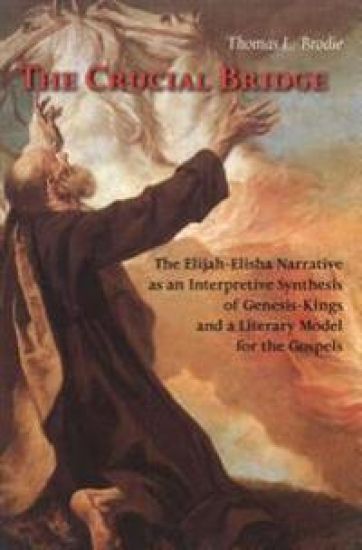
The Crucial Bridge

The Crucial Bridge

Thomas L. Brodie

Liturgical Press
2000
pokkari
The Elijah-Elisha narrative (1 Kgs 16:29–2 Kgs 13) is the most underestimated text in the Bible. Far from being a disparate collection, it is actually a carefully crafted double drama that both mirrors life and synthesizes systematically the entire Primary History (Genesis-Kings). In a bold hermeneutical move it transforms the language of historiography–of patriarchs and kings–into the language of prophetic biography.This prophetic biography, rooted in historiography, later becomes the evangelists' primary literary model. The Elijah-Elisha narrative is the crucial bridge between the foundational narratives of Judaism and Christianity.Since the 1970s there has been increasing evidence that Scripture texts that at first sight appear fragmented are in fact unified. Judges is a striking example of this. Because of the earlier exegetical models used, Judges was often regarded as a collection of rugged traditions that were independent of one another. Now, however, these apparently disconnected stories are intimately interconnected. Brodie explains that, as with earlier research on Judges, the quest for history–for underlying traditions–has tended to obscure the existing narrative account. In particular, the Elijah-Elisha narrative has often been read as consisting largely of two independent units, two cycles of traditions. The Elijah-Elisha narrative is indeed twofold–it clearly highlights two main prophets–but it is also a careful unity, as closely knit as Judges is now seen to be.Chapters are "The Unity of the Narrative (1 Kings 16:29–2 Kings 13)," "A Synthesis of the Primary History: Initial Comparison Quantity Analysis," "A Synthesis of the Primary History: A More Detailed Comparison," "A Reinterpretation of the Leading Scriptures," and "A Literary Model for the Gospels."Thomas L. Brodie, OP, has taught Hebrew Scriptures and New Testament in various institutions across the U.S. and in South Africa and is now teaching in his native Ireland. He is the author of several books and numerous articles on the Scriptures. "
A Politics of the Ordinary

A Politics of the Ordinary

Thomas L. Dumm

New York University Press
1999
sidottu
In A Politics of the Ordinary, Thomas Dumm dramatizes how everyday life in the United States intersects with and is influenced by the power of events, on the one hand, and forces of conformity and normalcy on the other. Combining poststructuralist analysis with a sympathetic reading of a strain of American thought that begins with Emerson and culminates in the work of Stanley Cavell, A Politics of the Ordinary investigates incidents from everyday life, political spectacles, and popular culture. Whether juxtaposing reflections about boredom in rural New Mexico with Emerson's theory of constitutional amendment, Richard Nixon's letter of resignation with Thoreau's writings to overcome quiet desperation, or demonstrating how Disney's Toy Story allegorizes the downsizing of the American white-collar work force, Dumm's constant concern is to show how the ordinary is the primary source of the democratic political imagination.
A Politics of the Ordinary

A Politics of the Ordinary

Thomas L. Dumm

New York University Press
1999
pokkari
In A Politics of the Ordinary, Thomas Dumm dramatizes how everyday life in the United States intersects with and is influenced by the power of events, on the one hand, and forces of conformity and normalcy on the other. Combining poststructuralist analysis with a sympathetic reading of a strain of American thought that begins with Emerson and culminates in the work of Stanley Cavell, A Politics of the Ordinary investigates incidents from everyday life, political spectacles, and popular culture. Whether juxtaposing reflections about boredom in rural New Mexico with Emerson's theory of constitutional amendment, Richard Nixon's letter of resignation with Thoreau's writings to overcome quiet desperation, or demonstrating how Disney's Toy Story allegorizes the downsizing of the American white-collar work force, Dumm's constant concern is to show how the ordinary is the primary source of the democratic political imagination.
Arms and Oil

Arms and Oil

Thomas L. McNaugher

Brookings Institution
1985
nidottu
In 1979, after a decade of enormous increases in the price of oil, U.S. influence in the oil-rich Persian Gulf region declined sharply. Early in the year the Iranian revolution replaced the shah, the principal pro-American leader in the region, with rulers hostile to the United States and to its remaining friends around the Gulf. In December Soviet troops moved into Afghanistan, bringing the Soviets closer to the Gulf and the Indian Ocean. In the United States these events spurred the announcement of the Carter Doctrine and the creation of a new military command to handle Gulf crises. Yet the United States established no new fighting forces, and U.S. friends around the Gulf proved less willing than the shah of Iran to host a U.S. military presence. Thus debate has continued about whether and how the United States can secure important interests in the Gulf region.In this book Thomas L. McNaugher offers a military strategy that integrates U.S. forces into the security framework that already exists in the region. He suggests that the United States should encourage Jordan, Pakistan, Great Britain, and others to continue their historical involvement in Gulf security, especially in such areas as internal security where U.S. forces are no better equipped than theirs and where U.S. participation may undermine the legitimacy of local rulers. In turn, the United States should focus on protecting the oil-rich states of the Arabian peninsula from external attack and on deterring further Soviet encroachment in the region. These missions demand an increase in the agility, rather than the size, of U.S. forces. But the more important requirement, McNaugher argues, is for skillfully blending U.S. military strategy into a diplomacy that exploits, rather than needlessly upsets, regional security mechanisms.
New Weapons, Old Politics

New Weapons, Old Politics

Thomas L. McNaugher

Brookings Institution
1989
nidottu
"Americans spend more than $100 billion a year to buy weapons, but no one likes the process that brings these weapons into existence. The problem, McNaugher shows, is that the technical needs of engineers and military planners clash sharply with the political demands of Congress. McNaugher examines weapons procurement since World War II and shows how repeated efforts to improve weapons acquisition have instead increased the harmful intrusion of political pressures into that technical development and procurement process.Today's weapons are more complicated than their predecessors. So are the nation's military forces. The design of new systems and their integration into the force structure demand more care, time, and flexibility. Yet time and flexibility are precisely what political pressures remove from the acquisitions process.In a series of case studies and conceptual discussions, McNaugher tackles concerns at the heart of the debate about acquisition—the slow and heavily bureaucratic approach to development, the preference for ultimate weapons over well-organized and trained forces, and the counterproductive incentives facing the nation's defense firms. He calls for changes that run against the current fashion—less centralization or procurement, less haste in developing new weapons, and greater use of competition as a means of removing the development process from political oversight.Above all, McNaugher shows how the United States tries to buy research and development on the cheap, and how costly this has been. The nation can improve its acquisition process, he concludes, only when it recognizes the need to pay for the full exploration of new technology."
Tonal Harmonic Dictation

Tonal Harmonic Dictation

Thomas L. Durham

University Press of America
1987
nidottu
This workbook supplies college-level theory instructors with over 720 examples of harmonic dictation for use in ear-training classes, and covers primary, diatonic, and chromatic harmonic materials. It is divided into three units with each unit containing ten sections. Each section follows the same format: twelve harmonic dictation examples in major mode and twelve in minor mode arranged in order of increasing difficulty. Designed specifically for freshman and sophomore theory and ear-training courses.
Evidence-Based Practice in Nursing

Evidence-Based Practice in Nursing

Thomas L. Christenbery

Springer Publishing Co Inc
2017
nidottu
Delivers unique systematic guidelines for understanding and applying EBP in nursing programs A fundamental, reader-friendly guide to evidence-based practice (EBP) for BSN, MSN, and DNP nursing students, Evidence-Based Practice in Nursing explains the conceptual underpinnings of EBP and demonstrates how nurses can put EBP concepts into practice. Replete with critical knowledge, skills, tools, and scholarly development to enable nurses to fully and confidently deliver the highest-quality EBP care, this book eschews a one-size-fits-all approach in favor of unique systematic guidelines for understanding and applying EBP. Building blocks of information grow progressively more complex, enabling their application to any point along nursing’s academic trajectory. Thoughtfully organized to fit a variety of EBP-related course objectives, Evidence-Based Practice in Nursing easily adapts for standalone EBP courses at any level as well as advanced practice specialty courses that integrate EBP content. This book addresses the needs of all nursing instructors, including those who teach at multiple levels simultaneously. Key content includes requisite conceptual knowledge of EBP for building clinical decision-making skills; conceptualizing, implementing, and evaluating EBP projects; applying translational science; quality improvement for implementation and evaluation of EBP; developing leadership and structural empowerment strategies; and analyzing how students at each degree/level work with EBP independently, interprofessionally, and intraprofessionally. Chapters align with AACN essentials. Key Features: Follows a methodical systematic trajectory, building from simple to complex concepts Includes abundant examples demonstrating both negative and positive EBP applications Enables instructors to adopt one textbook for students at different levels of knowledge and education Includes practical design templates for developing EBP implementation plans with critical guideposts Provides a quality improvement toolkit, key words and concepts, illustrative tables, and figures
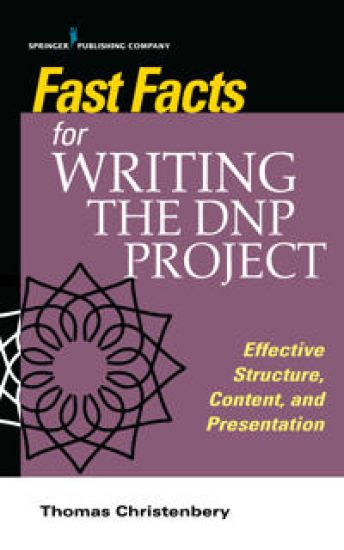
Fast Facts for Writing the DNP Project

Fast Facts for Writing the DNP Project

Thomas L. Christenbery

Springer Publishing Co Inc
2020
nidottu
Note to Readers: Publisher does not guarantee quality or access to any included digital components if book is purchased through a third-party seller. Write an exceptional, impactful DNP project paper! This mentor-in-a-book will help nursing students develop a high-quality, well-organized DNP project paper by using the time-tested, proven IMRaD (Introduction, Methods, Results, and Discussion) format—the gold standard for scientific writing in health care. Far beyond the simple outlines and rubrics usually offered to DNP students, this book provides guidance on how to write a DNP Project that presents scholarly work in an effective way. Written in concise “Fast Facts” format characterized by bulleted information and short paragraphs, this book delivers clear, step-by-step guidance to create each section of the DNP paper. To provide a consistent example of a well-crafted paper, this guide follows a specific clinical topic throughout to clearly demonstrate the paper’s development. It also discusses the foundational knowledge needed prior to writing the paper and presents a step-by-step guide for aligning EBP and QI projects to each IMRaD component. This guide offers key insights into what faculty will expect for each content section and presents talking points for student/faculty discussions. Literature appraisal tables and synthesis tables are presented in the literature review section along with detailed rationale for optimal use. Key Features:Serves as the only DNP resource to embrace the time-tested IMRaD model Describes the necessary components of DNP Project presentation, including dissemination Delivers clear, step-by-step guidance to complete the DNP Project Book chapters progress through the development of a DNP paper Provides faculty tips so instructors can help students produce quality scholarly work
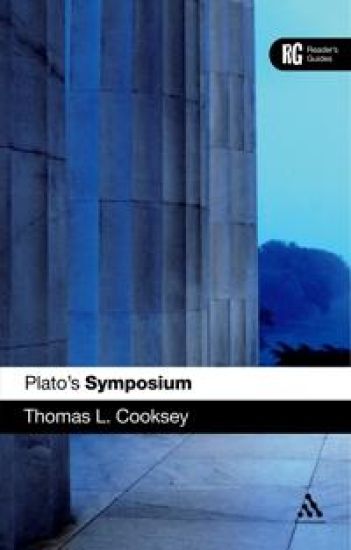
Plato's 'Symposium'

Plato's 'Symposium'

Thomas L. Cooksey

Continuum International Publishing Group Ltd.
2010
sidottu
This is a student-friendly introduction to a key text in Ancient Philosophy. In many regards the dialectical counterpart of the "Republic, the Symposium" is one of the richest and most influential of the Platonic dialogues, resonating not only with Western philosophy, but also with literature art and theology. While Plato ostensibly dramatizes a humorous account of a drinking party, he presents a profoundly serious explication of Eros that challenges the limits of reason, the nature of gender, identity and narrative form. "Plato's Symposium: A Reader's Guide" presents a concise introduction to the text, offering invaluable guidance on: historical, literary and philosophical context; key themes; reading the text; reception and influence; and, further reading. "Continuum Reader's Guides" are clear, concise and accessible introductions to key texts in literature and philosophy. Each book explores the themes, context, criticism and influence of key works, providing a practical introduction to close reading, guiding students towards a thorough understanding of the text. They provide an essential, up-to-date resource, ideal for undergraduate students.
Plato's 'Symposium'

Plato's 'Symposium'

Thomas L. Cooksey

Continuum International Publishing Group Ltd.
2010
nidottu
This is a student-friendly introduction to a key text in Ancient Philosophy. In many regards the dialectical counterpart of the "Republic, the Symposium" is one of the richest and most influential of the Platonic dialogues, resonating not only with Western philosophy, but also with literature art and theology. While Plato ostensibly dramatizes a humorous account of a drinking party, he presents a profoundly serious explication of Eros that challenges the limits of reason, the nature of gender, identity and narrative form. "Plato's Symposium: A Reader's Guide" presents a concise introduction to the text, offering invaluable guidance on: historical, literary and philosophical context; key themes; reading the text; reception and influence; and, further reading. "Continuum Reader's Guides" are clear, concise and accessible introductions to key texts in literature and philosophy. Each book explores the themes, context, criticism and influence of key works, providing a practical introduction to close reading, guiding students towards a thorough understanding of the text. They provide an essential, up-to-date resource, ideal for undergraduate students.