Observera att förlaget som ger ut denna produkt baserar innehållet i sina produkter på fria källor som Wikipedia. Boken är med stor sannolikhet endast ett utdrag ur dessa informationskällor, alltså inte en vanlig bok i den bemärkelsen.
This short story collection, a facsimile of the 1907 Authorized Edition, features the title story plus "A Madison Square Arabian Night," "A Midsummer Knight's Dream," "Elsie in New York," and many more.
This short story collection, a facsimile of the 1907 Authorized Edition, features the title story plus "A Madison Square Arabian Night," "A Midsummer Knight's Dream," "Elsie in New York," and many more.
The Trimmed Lamp (1907) is a collection of twenty-five short stories by American writer O. Henry. Inspired by his experiences as a fugitive and prisoner, these stories address themes of poverty and city life with humor and abundant empathy. Its focus on the regular, working class people of New York City makes The Trimmed Lamp a sequel of sorts to Henry’s The Four Million (1906), perhaps his most important collection. In “The Trimmed Lamp,” two friends discuss work, love, and money while standing on a city street-corner. They both came to New York in search of work, and though Nancy enjoys her low paying job as a shop girl at a department store, Lou brags about her employment as an ironer at a laundry and encourages her friend to look for something else to do. While they wait for Lou’s boyfriend Dan, Lou asks Nancy about the wealthy men who frequent her store, and secretly wonders what it would be like to marry into money. “The Last Leaf” is a story of two artists living in Greenwich Village. While Sue lies bedridden from pneumonia, each day growing closer to death, she watches from her window a vine across the street. As fall turns to winter, its leaves drop one by one, until nothing remains but one last leaf. In another apartment, an old artist named Behrman watches the vine as well, painting the leaf with a renewed sense of purpose and a lifetime of skill and precision. With a beautifully designed cover and professionally typeset manuscript, this edition of O. Henry’s The Trimmed Lamp is a classic of American literature reimagined for modern readers.
The Trimmed Lamp (1907) is a collection of twenty-five short stories by American writer O. Henry. Inspired by his experiences as a fugitive and prisoner, these stories address themes of poverty and city life with humor and abundant empathy. Its focus on the regular, working class people of New York City makes The Trimmed Lamp a sequel of sorts to Henry’s The Four Million (1906), perhaps his most important collection. In “The Trimmed Lamp,” two friends discuss work, love, and money while standing on a city street-corner. They both came to New York in search of work, and though Nancy enjoys her low paying job as a shop girl at a department store, Lou brags about her employment as an ironer at a laundry and encourages her friend to look for something else to do. While they wait for Lou’s boyfriend Dan, Lou asks Nancy about the wealthy men who frequent her store, and secretly wonders what it would be like to marry into money. “The Last Leaf” is a story of two artists living in Greenwich Village. While Sue lies bedridden from pneumonia, each day growing closer to death, she watches from her window a vine across the street. As fall turns to winter, its leaves drop one by one, until nothing remains but one last leaf. In another apartment, an old artist named Behrman watches the vine as well, painting the leaf with a renewed sense of purpose and a lifetime of skill and precision. With a beautifully designed cover and professionally typeset manuscript, this edition of O. Henry’s The Trimmed Lamp is a classic of American literature reimagined for modern readers.
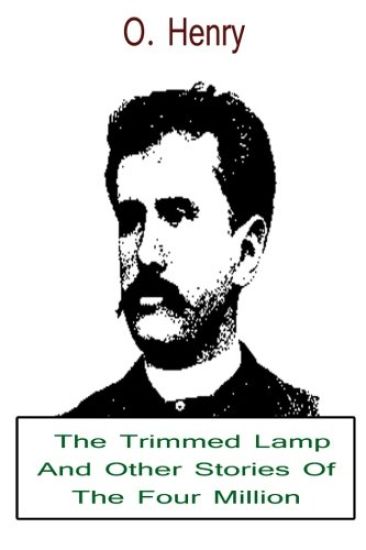
William Sydney Porter (September 11, 1862 - June 5, 1910), known by his pen name O. Henry, was an American short story writer. His stories are known for their surprise endings. Early life: William Sidney Porter was born on September 11, 1862, in Greensboro, North Carolina. He changed the spelling of his middle name to Sydney in 1898. His parents were Dr. Algernon Sidney Porter (1825-88), a physician, and Mary Jane Virginia Swaim Porter (1833-65). William's parents had married on April 20, 1858. When William was three, his mother died from tuberculosis, and he and his father moved into the home of his paternal grandmother. As a child, Porter was always reading, everything from classics to dime novels; his favorite works were Lane's translation of One Thousand and One Nights and Burton's Anatomy of Melancholy. Porter graduated from his aunt Evelina Maria Porter's elementary school in 1876. He then enrolled at the Lindsey Street High School. His aunt continued to tutor him until he was fifteen. In 1879, he started working in his uncle's drugstore and in 1881, at the age of nineteen, he was licensed as a pharmacist. At the drugstore, he also showed off his natural artistic talents by sketching the townsfolk. Move to Texas: Porter traveled with Dr. James K. Hall to Texas in March 1882, hoping that a change of air would help alleviate a persistent cough he had developed. He took up residence on the sheep ranch of Richard Hall, James' son, in La Salle County and helped out as a shepherd, ranch hand, cook, and baby-sitter. While on the ranch, he learned bits of Spanish and German from the mix of immigrant ranch hands. He also spent time reading classic literature. Porter's health did improve and he traveled with Richard to Austin in 1884, where he decided to remain and was welcomed into the home of the Harrells, who were friends of Richard's. Porter took a number of different jobs over the next several years, first as pharmacist then as a draftsman, bank teller, and journalist. He also began writing as a sideline. Porter led an active social life in Austin, including membership in singing and drama groups. He was a good singer and musician. He played both the guitar and mandolin. He became a member of the "Hill City Quartet", a group of young men who sang at gatherings and serenaded young women of the town. Porter met and began courting Athol Estes, then seventeen years old and from a wealthy family. Her mother objected to the match because Athol was ill, suffering from tuberculosis. On July 1, 1887, Porter eloped with Athol to the home of Reverend R. K. Smoot, where they were married.The couple continued to participate in musical and theater groups, and Athol encouraged her husband to pursue his writing. Athol gave birth to a son in 1888, who died hours after birth, and then a daughter, Margaret Worth Porter, in September 1889. Porter's friend Richard Hall became Texas Land Commissioner and offered Porter a job. Porter started as a draftsman at the Texas General Land Office (GLO) in 1887 at a salary of $100 a month, drawing maps from surveys and fieldnotes. The salary was enough to support his family, but he continued his contributions to magazines and newspapers. In the GLO building, he began developing characters and plots for such stories as "Georgia's Ruling" (1900), and "Buried Treasure" (1908). The castle-like building he worked in was even woven into some of his tales such as "Bexar Scrip No. 2692" (1894).............