Kirjojen hintavertailu. Mukana 11 342 296 kirjaa ja 12 kauppaa.

Kirjahaku

Etsi kirjoja tekijän nimen, kirjan nimen tai ISBN:n perusteella.

1000 tulosta hakusanalla William R Cook

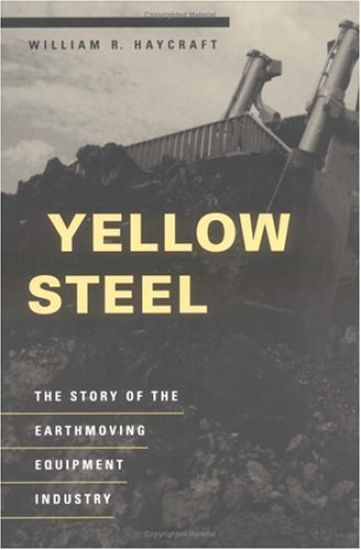
Yellow Steel

Yellow Steel

William R. Haycraft

University of Illinois Press
2002
nidottu
In Yellow Steel, the first overarching history of the earthmoving equipment industry, William Haycraft examines the tremendous increase in the scope of mining and construction projects, from the Suez Canal through the interstate highway system, made possible by innovations in earthmoving machinery. Led by Cyrus McCormick's invention in 1831 of a practical mechanical reaper, many of the builders of today's massive earthmoving machines began as makers of reapers, plows, threshers, and combines. Haycraft traces the efforts of manufacturers such as Caterpillar, Allis-Chalmers, International Harvester, J. I. Case, Deere, and Massey-Ferguson to diversify from farm equipment to specialized earthmoving equipment and the important contributions of LeTourneau, Euclid, and others in meeting the needs of the construction and mining industries. He shows how postwar economic and political events, especially the creation of the interstate highway system, spurred the development of more powerful and more agile machines. He also relates the precipitous fall of several major American earthmoving machine companies and the rise of Japanese competitors in the early 1980s. Extensively illustrated and packed with detailed information on both manufacturers and machines, Yellow Steel knits together the diverse stories of the many companies that created the earthmoving equipment industry-how they began, expanded, retooled, merged, succeeded, and sometimes failed. Their history, a step-by-step linking of need and invention, provides the foundation for virtually all modern transportation, construction, commerce, and industry.
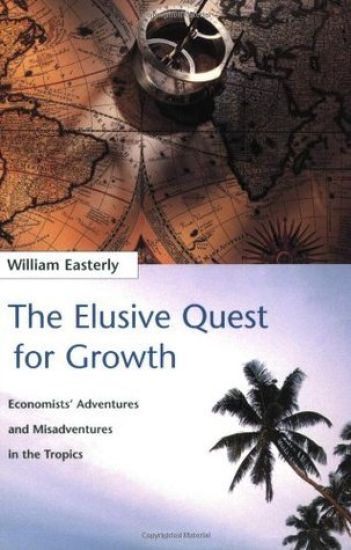
The Elusive Quest for Growth

The Elusive Quest for Growth

William R. Easterly

MIT Press
2002
pokkari
Why economists' attempts to help poorer countries improve their economic well-being have failed.Since the end of World War II, economists have tried to figure out how poor countries in the tropics could attain standards of living approaching those of countries in Europe and North America. Attempted remedies have included providing foreign aid, investing in machines, fostering education, controlling population growth, and making aid loans as well as forgiving those loans on condition of reforms. None of these solutions has delivered as promised. The problem is not the failure of economics, William Easterly argues, but the failure to apply economic principles to practical policy work.In this book Easterly shows how these solutions all violate the basic principle of economics, that people-private individuals and businesses, government officials, even aid donors-respond to incentives. Easterly first discusses the importance of growth. He then analyzes the development solutions that have failed. Finally, he suggests alternative approaches to the problem. Written in an accessible, at times irreverent, style, Easterly's book combines modern growth theory with anecdotes from his fieldwork for the World Bank.
The New Phrenology

The New Phrenology

William R. Uttal

Bradford Books
2003
pokkari
William Uttal is concerned that in an effort to prove itself a hard science, psychology may have thrown away one of its most important methodological tools-a critical analysis of the fundamental assumptions that underlie day-to-day empirical research. In this book Uttal addresses the question of localization: whether psychological processes can be defined and isolated in a way that permits them to be associated with particular brain regions. New, noninvasive imaging technologies allow us to observe the brain while it is actively engaged in mental activities. Uttal cautions, however, that the excitement of these new research tools can lead to a neuroreductionist wild goose chase. With more and more cognitive neuroscientific data forthcoming, it becomes critical to question their limitations as well as their potential. Uttal reviews the history of localization theory, presents the difficulties of defining cognitive processes, and examines the conceptual and technical difficulties that should make us cautious about falling victim to what may be a "neo-phrenological" fad.
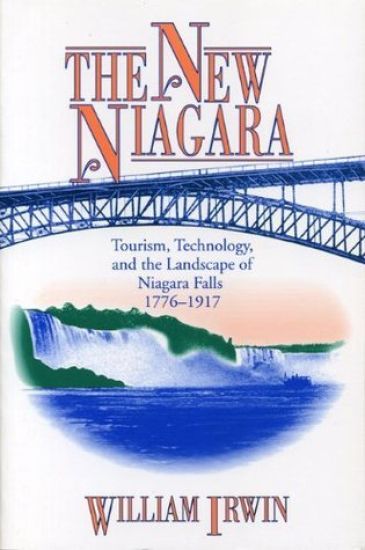
The New Niagara

The New Niagara

William R. Irwin

Pennsylvania State University Press
1996
pokkari
Visitors may wonder how Niagara Falls came to be the site of magnificent bridges, a famous cereal factory, and a picturesque New York state reservation, designed by Frederick Law Olmsted. Although many have always admired the natural splendor of the Falls, William Irwin explains that it was not until the mid-1800s that Niagara truly captured the American imagination. With the coming of John Roebling's railway suspension bridge in 1855 came the promise of a "new" Niagara, one in which nature and technology could flourish in harmony. Although some saw the transformation of Niagara Falls as a national shame, for many others it stimulated utopian visions of a great modern America. Tourists flocked to a place that showcased both the beauty of nature and the marvels of technology. Companies such as Shredded Wheat (later absorbed by Nabisco) fed on the public's expectations of novel and revolutionary progress at Niagara. The Shredded Wheat factory and the Niagara Power Company became tourist attractions in their own right. Some developers went so far as to claim that their works exceeded Niagara's natural beauty. It was not until the 1920s that failed expectations revealed the scope of the blighted landscape.By taking us back to a period when Niagara Falls was appreciated as much for its utopian promise as for its natural beauty, The New Niagara reveals America's remarkable romance with technology and its faith in human mastery of the environment.
Journeymen for Jesus

Journeymen for Jesus

William R. Sutton

Pennsylvania State University Press
1998
sidottu
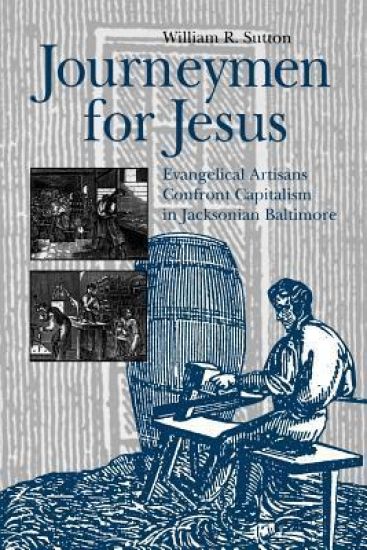
When industrialization swept through American society in the nineteenth century, it brought with it turmoil for skilled artisans. Changes in technology and work offered unprecedented opportunity for some, but the deskilling of craft and the rise of factory work meant dislocation for others. Journeymen for Jesus explores how the artisan community in one city, Baltimore, responded to these life-changing developments during the years of the early republic. Baltimore in the Jacksonian years (1820s and 1830s) was America's third largest city. Its unions rivaled those of New York and Philadelphia in organization and militancy, and it was also a stronghold of evangelical Methodism. These circumstances created a powerful mix at a time when workers were confronting the negative effects of industrialism. Many of them found within Methodism and its populist spirituality an empowering force that inspired their refusal to accept dependency and second-class citizenship. Historians often portray evangelical Protestantism as either a top-down means of social control or as a bottom-up process that created passive workers. Sutton, however, reveals a populist evangelicalism that undergirded the producer tradition dominant among those supportive of trade union goals. Producers were not socialists or social democrats, but they were anticapitalist and reform-minded. In populist evangelicalism they discovered a potent language and ethic for their discontent. Journeymen for Jesus presents a rich and unromanticized portrait of artisan culture in early America. In the process, it adds to our understanding of the class tensions present in Jacksonian America.
Journeymen for Jesus

Journeymen for Jesus

William R. Sutton

Pennsylvania State University Press
1998
pokkari
When industrialization swept through American society in the nineteenth century, it brought with it turmoil for skilled artisans. Changes in technology and work offered unprecedented opportunity for some, but the deskilling of craft and the rise of factory work meant dislocation for others. Journeymen for Jesus explores how the artisan community in one city, Baltimore, responded to these life-changing developments during the years of the early republic. Baltimore in the Jacksonian years (1820s and 1830s) was America's third largest city. Its unions rivaled those of New York and Philadelphia in organization and militancy, and it was also a stronghold of evangelical Methodism. These circumstances created a powerful mix at a time when workers were confronting the negative effects of industrialism. Many of them found within Methodism and its populist spirituality an empowering force that inspired their refusal to accept dependency and second-class citizenship. Historians often portray evangelical Protestantism as either a top-down means of social control or as a bottom-up process that created passive workers. Sutton, however, reveals a populist evangelicalism that undergirded the producer tradition dominant among those supportive of trade union goals. Producers were not socialists or social democrats, but they were anticapitalist and reform-minded. In populist evangelicalism they discovered a potent language and ethic for their discontent. Journeymen for Jesus presents a rich and unromanticized portrait of artisan culture in early America. In the process, it adds to our understanding of the class tensions present in Jacksonian America.
Nuclear Weapons, Policies, and the Test Ban Issue

Nuclear Weapons, Policies, and the Test Ban Issue

William R. van Cleave; S.T. Cohen

Praeger Publishers Inc
1987
sidottu
For nearly forty years, U.S. deterrence policy has depended on nuclear weapons, making the modernization of those weapons a key goal of every administration. Nuclear Weapons, Policies, and the Test Ban Issue presents a cogent discussion of the reasons why the United States should actively continue its nuclear weapons program. The authors claim that weapons testing and development has neither kept up with technological advances nor logically followed from professed U.S. policy. They attribute these shortcomings to such forces as budget limitations, alliance politics, domestic politics, and, most importantly, the signing of the Limited Test Ban Treaty.
Death in a Prairie House

Death in a Prairie House

William R. Drennan

Terrace Books
2008
nidottu
The most pivotal and yet least understood event of Frank Lloyd Wright's celebrated life involves the brutal murders in 1914 of seven adults and children dear to the architect and the destruction by fire of Taliesin, his landmark residence, near Spring Green, Wisconsin. Supplying both a gripping mystery story and a portrait of the artist in his prime, William Drennan wades through the myths surrounding Wright and the massacre, casting fresh light on the formulation of Wright's architectural ideology and the cataclysmic effects that the Taliesin murders exerted on the fabled architect and on his subsequent designs.
Transcendentalist Ministers

Transcendentalist Ministers

William R. Hutchison

Yale University Press
2005
pokkari
This book, awarded the Brewer Prize by the American Society of Church History, is a study of the efforts of the Transcendentalists of the New England Renaissance to reform the Unitarian Church. Scholarly interpreters have, in general, agreed on the basic religious orientation of the Transcendentalist Movement. Mr. Hutchison, however, believes that it was far more than a tendency to appraise the universe in terms of an intuitive faith. Most of the men closely associated with the Movement in New England were Unitarian ministers, and he has concentrated on their attempt to apply transcendental thinking to theology and to the everyday problems of the parish ministry. At the same time he has produced a sympathetic appraisal of the conservative Unitarian position in his review of the so-called Transcendentalist Controversy. Yale Historical Publications, Miscellany 71. Mr. Hutchison is associate professor of American civilization at The American University in Washington, D.C.
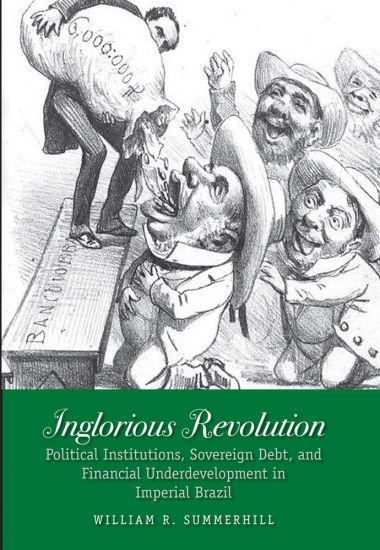
Inglorious Revolution

Inglorious Revolution

William R. Summerhill

Yale University Press
2015
sidottu
Nineteenth-century Brazil’s constitutional monarchy credibly committed to repay sovereign debt, borrowing repeatedly in international and domestic capital markets without default. Yet it failed to lay the institutional foundations that private financial markets needed to thrive. This study shows why sovereign creditworthiness did not necessarily translate into financial development. “Using a vast array of archival evidence, Summerhill convincingly shows that political commitment to a secure public debt was neither necessary nor sufficient to insure financial development in nineteenth-century Brazil. A must-read for economic and financial historians and for anyone interested in the politics of financial development.” —Jean-Laurent Rosenthal, California Institute of Technology
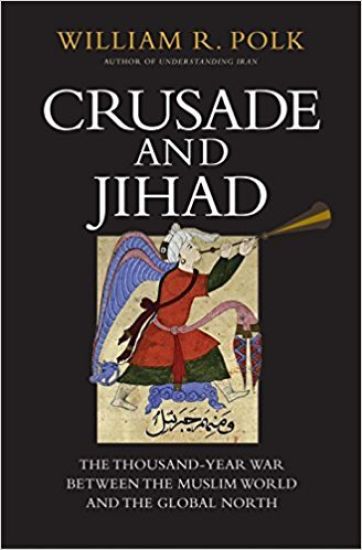
Crusade and Jihad

Crusade and Jihad

William R. Polk

Yale University Press
2018
sidottu
What really happened in the centuries of conflict between Europe, Russia, China, America, and the peoples of the Muslim world Crusade and Jihad is the first book to encompass, in one volume, the entire history of the catastrophic encounter between the Global North—China, Russia, Europe, Britain, and America—and Muslim societies from Central Asia to West Africa. William R. Polk draws on more than half a century of experience as a historian, policy planner, diplomat, peace negotiator, and businessman to explain the deep hostilities between the Muslim world and the Global North and show how they grew over the centuries. Polk shows how Islam arose and spread across North Africa into Europe, climaxed in the vibrant and sophisticated caliphate of al-Andalus in medieval Spain, and was the bright light in a European Dark Age. Simultaneously, Islam spread from the Middle East into Africa, India, and Southeast Asia. But following the Mongol invasions, Islamic civilization entered a decline while Europe began its overseas expansion. Portuguese buccaneers dominated the Indian Ocean; the Dutch and the English established powerful corporations that turned India and Indonesia into colonies; Russian armies pushed down the Volga into Central Asia, destroying its city-states; and the Chinese Qing dynasty slaughtered an entire Central Asian people. Britain crushed local industry and drained off wealth throughout its vast colonies. Defeated at every turn, Muslims tried adopting Western dress, organizing Westernstyle armies, and embracing Western ideas. None of these efforts stopped the conquests. For Europe and Russia, the nineteenth century was an age of colonial expansion, but for the Muslim world it was an age of brutal and humiliating defeat. Millions were driven from their homes, starved, or killed, and their culture and religion came under a century-long assault. In the twentieth century, brutalized and and disorganized native societies, even after winning independence, fell victim to “post-imperial malaise,” typified by native tyrannies, corruption, and massive poverty. The result was a furious blowback. A sobering, scrupulous, and frank account of imperialism, colonialism, insurgency, and terrorism, Crusade and Jihad is history for anyone who wishes to understand the civilizational conflicts of today’s world.
American Industrial Policy

American Industrial Policy

William R. Nester

Palgrave Macmillan
1997
sidottu
What is the government's proper role in the economy? Do free or managed markets best promote economic development? Who can best pick industrial winners and losers, the government or private sector? This book attempts to answer those and related questions by exploring the evolution and results of federal policies towards half a dozen economic sectors. Those policies are largely determined by the representatives of the targeted industry, bureaucrats from agencies and departments that administer that industry, and politicians with firms from that industry in their districts. These 'iron triangles' capture a 'virtuous' political economic cycle in which they use their united power to grant themselves favourable policies which in turn enhances their power. As will be seen, the results of such a politicized industrial policy process varies considerably from one industry to the next.
Contemporary Orthodontics

Contemporary Orthodontics

William R. Proffit; Henry Fields; Brent Larson; David M. Sarver

Mosby
2018
sidottu
**Selected for Doody’s Core Titles® 2024 with "Essential Purchase" designation in Dentistry** The leading text for orthodontic education! With a world-renowned author team led by Dr. William Proffit, Contemporary Orthodontics, 6th Edition continues its long tradition of excellence in providing detailed coverage of orthodontic diagnosis, treatment planning, and treatment techniques. Key topics include practical applications of computer technology, alternative treatment approaches, the biomechanics of orthodontic appliances, the selection of efficient treatment procedures, and the treatment of complex problems in both children and adults. A wealth of case studies with photographs and illustrations highlight and reinforce key concepts. UNIQUE! A clear writing style and logical organization help you more easily understand important and difficult concepts. NEW! Now on the Expert Consult platform, the printed textbook comes with an easy-to-access electronic version of the text that includes references linked to PubMed abstracts. Comprehensive coverage provides detailed information on diagnosis, treatment planning, and current treatment procedures. NEW and UPDATED! Evidence-based case studies throughout the text reinforce key information to prepare you for the orthodontics portion of the dental boards (which will be case-based starting in 2020), as well as for clinical practice. NEW and UNIQUE! Two additional chapters in this edition explore the key topics of Growth Modification in Transverse and Class III Problems and Growth Modification in Class II, Open Bite/Deep Bite, and Multidimensional Problems.
Markets and Conflict

Markets and Conflict

William R. Patterson; Daniel W Kuthy

Elsevier - Health Sciences Division
2024
nidottu
Markets and Conflict: Economics of War and Peace explores the causes, impacts, and linkages of contemporary geopolitics, markets, and conflict along with their economic impacts on all stakeholders. It compiles the most current research and insights about market behaviours during conflicts of different types and severity, detailing how markets actually respond and what readers can do to implement a proactive early-response strategy. Today’s international “order” is one characterized by instability and pervasive danger. Russia’s invasion of Ukraine, escalating tension over the status of Taiwan, frozen and active civil wars across dozens of countries, and continued turmoil in the Middle East, including in Syria, Yemen, and Israel, are only some examples of ongoing or potential conflicts. Major and minor armed conflicts flare up or threaten to do so on a continual basis. Market responses to this instability are often irrational and shortsighted. Fear induces volatility in markets, based on panicked efforts to protect individual interests. Markets and Conflict: Economics of War and Peace presents a comprehensive understanding of conflict and market dynamics to enable market participants to make informed judgments. Additionally, it provides lessons related to macro-level dynamics useful to governments and policy analysts.
Health System Management and Leadership

Health System Management and Leadership

William R. Vanwye; Dianna Lunsford

Elsevier - Health Sciences Division
2024
nidottu
Prepare to be a more effective physical or occupational therapy professional by learning skills in healthcare leadership, management, and policy! Health System Management and Leadership for Physical and Occupational Therapists provides a guide to essential topics such as health legislation, current issues in health care, professionalism, proposal and grant writing, business administration, quality assurance, insurance and billing, and managing a therapy practice in a variety of care settings. Written by a team of expert contributors led by physical and occupational therapy educators, William R. VanWye and Dianna Lunsford, this resource helps readers become well-informed and knowledgeable physical and occupational therapy professionals. Objectives and Key Terms at the beginning of each chapter guide your study and ensure that you understand important concepts and terminology. Chapter Summaries review the key content in each chapter. Figures with discussion prompts and key points are provided throughout the text. An eBook version is included with print purchase. The eBook allows you to access all of the text, figures and references, with the ability to search, customize your content, make notes and highlights, and have content read aloud.
Japanese Industrial Targeting

Japanese Industrial Targeting

William R. Nester

Palgrave Macmillan
1991
sidottu
Japan achieved it's present economic position by rejecting free trade theory and instead mastering neomercantilist policies which target strategic industries for development with a range of government sponsored cartels, subsidies, import barriers and export incentives. These policies stimulated an economic growth rate which averaged ten percent before 1973, and five percent since, rates four and two times greater than America's during the same periods. This book analyzes the policy making process, implementation, successes, occasional shortcomings, and challenges posed by Tokyo's neomercantilist policies toward its trade rivals.
Paradise in the Pacific

Paradise in the Pacific

William R Bliss

Lulu.com
2018
sidottu
William R. Bliss, a writer who visited Hawaii in the 1870s, wrote this evocative and vivid account of life on the island; how the native people lived day-to-day and traded with the Americans with whom they became close. An excellent account of historic Hawaii, Paradise in the Pacific offers a detailed and clear portrait of how life was. Bliss is keen to brief the reader on the history of the isles; particularly its kings, and how the peoples arrived and settled in what were then termed the 'Sandwich Islands'. Bliss demonstrates that all parts of Hawaii's culture, from its festivals to its courtrooms to its domestic life, are affected by old beliefs. The author seeks accuracy; the darker side of Hawaiian life, such as the segregated villages where leprosy is prominent, receive mention. Volcanic eruptions and destruction which changed the landscape are discussed. Lightheartedly, we hear about the islands' politics; disputatious yet lively, with populism and appeals to traditional values commonplace.
Paradise in the Pacific

Paradise in the Pacific

William R Bliss

Lulu.com
2018
pokkari
William R. Bliss, a writer who visited Hawaii in the 1870s, wrote this evocative and vivid account of life on the island; how the native people lived day-to-day and traded with the Americans with whom they became close. An excellent account of historic Hawaii, Paradise in the Pacific offers a detailed and clear portrait of how life was. Bliss is keen to brief the reader on the history of the isles; particularly its kings, and how the peoples arrived and settled in what were then termed the 'Sandwich Islands'. Bliss demonstrates that all parts of Hawaii's culture, from its festivals to its courtrooms to its domestic life, are affected by old beliefs. The author seeks accuracy; the darker side of Hawaiian life, such as the segregated villages where leprosy is prominent, receive mention. Volcanic eruptions and destruction which changed the landscape are discussed. Lightheartedly, we hear about the islands' politics; disputatious yet lively, with populism and appeals to traditional values commonplace.
Frontiers Of Folklore

Frontiers Of Folklore

William R Bascom

Routledge
2019
sidottu
Frontiers of Folklore explores some of the avenues of research that are exciting young folklorists today. In the introduction, William Bascom reviews briefly the development of folklore theories and suggests three frontiers of folklore that remain to he explored. Alan Bundes asks the question? “Who are the folk?†Pointing out that folklore exis