Kirjojen hintavertailu. Mukana 11 244 527 kirjaa ja 12 kauppaa.

Kirjahaku

Etsi kirjoja tekijän nimen, kirjan nimen tai ISBN:n perusteella.

955 tulosta hakusanalla "Adam Smith"

Adam Smith

Adam Smith

Nicholas Phillipson

Penguin Books Ltd
2011
pokkari
Adam Smith is celebrated all over the world as the author of The Wealth of Nations and the founder of modern economics. A few of his ideas - such as the 'Invisible Hand' of the market - have become icons of the modern world. Yet Smith saw himself primarily as a philosopher rather than an economist, and would never have predicted that the ideas for which he is now best known were his most important. This book, by one of the leading scholars of the Scottish Enlightenment, shows the extent to which The Wealth of Nations and Smith's other great work, The Theory of Moral Sentiments, were part of a larger scheme to establish a grand 'Science of Man', one of the most ambitious projects of the European Enlightenment, which was to encompass law, history and aesthetics as well as economics and ethics.Nicholas Phillipson reconstructs Smith's intellectual ancestry and formation, of which he gives a radically new and convincing account. He shows Smith's interactions with the rapidly changing and subtly different intellectual and commercial cultures of Glasgow and Edinburgh as they entered the great years of the Scottish Enlightenment. Above all he explains how far Smith's ideas developed in dialogue with those of his closest friend, the other titan of the age, David Hume. This superb biography is now the one book which anyone interested in the founder of economics must read.
Adam Smith

Adam Smith

Jesse Norman

Penguin Books Ltd
2019
pokkari
'A superb book' Financial Times, Books of the YearAdam Smith is now widely regarded as 'the father of modern economics' and the most influential economist who ever lived. But what he really thought, and what the implications of his ideas are, remain fiercely contested. Was he an eloquent advocate of capitalism and the freedom of the individual? Or a prime mover of 'market fundamentalism' and an apologist for inequality and human selfishness? Or something else entirely? Jesse Norman's brilliantly conceived \book gives us not just Smith's economics, but his vastly wider intellectual project. Against the turbulent backdrop of Enlightenment Scotland, it lays out a succinct and highly engaging account of Smith's life and times, reviews his work as a whole and traces his influence over the past two centuries.But this book is not only a biography. It dispels the myths and debunks the caricatures that have grown up around Adam Smith. It explores Smith's ideas in detail, from ethics to law to economics and government, and the impact of those ideas on thinkers as diverse as Karl Marx, Charles Darwin, John Maynard Keynes and Friedrich Hayek. Far from being simply an economist, Adam Smith emerges as one of the founders of modern social psychology and behavioural theory. Far from being a doctrinaire 'libertarian' or 'neoliberal' thinker, he offers a strikingly modern evolutionary theory of political economy, which recognises the often complementary roles of markets and the state.At a time when economics and politics are ever more polarized between left and right, this book, by offering a Smithian analysis of contemporary markets, predatory capitalism and the 2008 financial crash, returns us to first principles and shows how the lost centre of modern public debate can be recreated. Through Smith's work, it addresses crucial issues of inequality, human dignity and exploitation; and it provides a compelling explanation of why he remains central to any attempt to defend, reform or renew the market system.
Adam Smith

Adam Smith

Eric Schliesser

Oxford University Press Inc
2019
nidottu
Eric Schliesser's Adam Smith is the product of two decades' reflection by the author on the great Scottish Enlightenment. Unique among treatments of Adam Smith, Schliesser's book treats him as a systematic philosopher. Smith was a giant of the Scottish Enlightenment with polymath interests; Schliesser thus explores Smith's economics and ethics in light of his other commitments on the nature of knowledge, the theory of emotions, the theory of mind, his account of language, the nature of causation, and his views on methodology. He places Smith's ideas in the context of a host of other philosophers, especially Hume, Rousseau, and Newton; and he draws on the reception of Smith's ideas by Sophie de Grouchy, Mary Wollstonecraft, and other philosophers and economists to sketch the elements of, and the detailed connections within, Smith's system. Adam Smith traces the outlines of Smith's intellectual system and situates it in the context of his highly developed views on the norms that govern responsible speech. In particular, the book articulates Smith's concerns about the impact of his public policy recommendations, especially on the least powerful in society. In so doing, Schliesser offers new interpretations of Smith's views on the invisible hand, the Wealth of Nations, his treatment of virtue, the nature of freedom, the individual's relationship to society, his account of the passions, the moral roles of religion, and his treatment of the role of mathematics in economics. While the book does offer a single argument, it is organized in a modular fashion and includes a helpful index; readers with a more focused interest in Smith's achievements can skip to their section of interest.
Adam Smith

Adam Smith

Eric Schliesser

Oxford University Press Inc
2017
sidottu
Eric Schliesser's Adam Smith is the product of two decades' reflection by the author on the great Scottish Enlightenment. Unique among treatments of Adam Smith, Schliesser's book treats him as a systematic philosopher. Smith was a giant of the Scottish Enlightenment with polymath interests; Schliesser thus explores Smith's economics and ethics in light of his other commitments on the nature of knowledge, the theory of emotions, the theory of mind, his account of language, the nature of causation, and his views on methodology. He places Smith's ideas in the context of a host of other philosophers, especially Hume, Rousseau, and Newton; and he draws on the reception of Smith's ideas by Sophie de Grouchy, Mary Wollstonecraft, and other philosophers and economists to sketch the elements of, and the detailed connections within, Smith's system. Adam Smith traces the outlines of Smith's intellectual system and situates it in the context of his highly developed views on the norms that govern responsible speech. In particular, the book articulates Smith's concerns about the impact of his public policy recommendations, especially on the least powerful in society. In so doing, Schliesser offers new interpretations of Smith's views on the invisible hand, the Wealth of Nations, his treatment of virtue, the nature of freedom, the individual's relationship to society, his account of the passions, the moral roles of religion, and his treatment of the role of mathematics in economics. While the book does offer a single argument, it is organized in a modular fashion and includes a helpful index; readers with a more focused interest in Smith's achievements can skip to their section of interest.
The Glasgow Edition of the Works and Correspondence of Adam Smith: VI: Correspondence
In this edition the missing part of one letter and eighteen entirely new ones are presented. The search for these letters even extended to Japan. Therefore, all new Smith letter discovered since 1977 are included. In addition, wherever errors were suspected or misreadings have come to light in the standing text as a result of advice from reviewers and correspondents, these have been corrected.
Adam Smith

Adam Smith

Christopher J. Berry

Oxford University Press
2018
nidottu
In 1776 Adam Smith (1723-90) wrote The Wealth of Nations , a book so foundational it has led to him being called the 'father of economics'. Today he is associated with the promotion of self-interest, a defence of greed and a criticism of any governmental 'interference' in market transactions which, if left to the 'invisible hand', will produce prosperity and liberty. Yet if Smith is actually read these associations are more a caricature than a faithful portrait. In this Very Short Introduction, Christopher Berry offers a balanced and nuanced view of this seminal thinker, embedding his fierce defence of free trade, competition, and assault on special interests in contemporary European history, politics, and philosophy. As Berry explores, Smith was far more than an economist. His book The Theory of Moral Sentiment, offered a complex account of ethics in the context of human social behaviour. His scope as a professor at the University of Glasgow, a major centre of the Scottish Enlightenment, was extensive. Beyond courses in philosophy and jurisprudence he also gave classes covering history, literature, and language. In addition to his two major works he also wrote a pioneering study of the history of astronomy as an illustration of the motivations that drive humans to seek answers to questions. He produced, again derived from his Glasgow classroom, an analysis of the development of grammar and language. As Christopher Berry shows, Adam Smith was no narrow thinker, but rather one who produced not only one of the greatest books in the history of social science, but also a wide-ranging body of work that remains significant today. ABOUT THE SERIES: The Very Short Introductions series from Oxford University Press contains hundreds of titles in almost every subject area. These pocket-sized books are the perfect way to get ahead in a new subject quickly. Our expert authors combine facts, analysis, perspective, new ideas, and enthusiasm to make interesting and challenging topics highly readable.
Adam Smith

Adam Smith

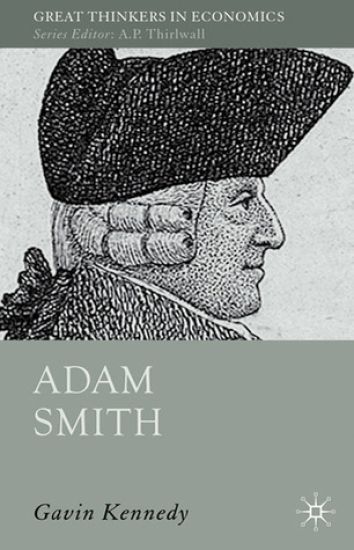
G. Kennedy

Palgrave Macmillan
2008
nidottu
This book presents the authentic Adam Smith and explores his underlying approach and radical thinking, aiming to re-establish his original intentions. The book provides a crucial reminder of how relevant Adam Smith was in his own time, and how relevant he remains as we experience the worldwide spread of opulence today.
The Essential Adam Smith

The Essential Adam Smith

Adam Smith

WW Norton Co
1987
nidottu
The sheer strength of his great work, The Wealth of Nations, discourages many from attempting to explore its rich and lucid arguments. In this brilliantly crafted volume, one of the most eminent economists of our day provides a generous selection from the entire body of Smith's work, ranging from his fascinating psychological observations on human nature to his famous treatise on what Smith called a "society of natural liberty," The Wealth of Nations. Among the works represented in this volume in addition to The Wealth of Nations are The History of Astronomy, Lectures on Jurisprudence, The Theory of Moral Sentiments, and Smith's correspondence with David Hume. Before each of Smith's writings Robert Heilbroner presents a clear and lively discussion that will interest the scholar as much as it will clarify the work for the non-specialist. Adam Smith emerges from this collection of his writings, as he does from his portrait in Professor Heilbroner's well-known book, as the first economist to deserve the title of "worldly philosopher."
Adam Smith
Adam Smith:Second Series completes the project of the earlier assessments by making available the many significant articles which have appeared subsequently. Providing immediate access to one of the world's greatest economics theorists.
Adam Smith
This collection gathers together comments and reviews to all the works of Adam Smith, published and unpublished. All introductions to the later editions of his works, either in English or newly translated, are included as well as the editor's notes, where possible.
Adam Smith

Adam Smith

R. H. Campbell; A. S. Skinner

Routledge
2009
sidottu
This reissued biography of Adam Smith, first published in 1982, presents both an intellectual and personal portrait of the man. It is not intended as a full-scale scholarly biography burdened with heavy footnotes. Although written by two of the world's foremost authorities on Adam Smith, the book is intended as an accessible study of a great thinker and philosopher which will help to introduce the reader to both his ideas and his period.
Adam Smith

Adam Smith

Samuel Fleischacker

Routledge
2021
nidottu
Adam Smith (1723–1790) is widely regarded as one of the great thinkers of the Enlightenment period. Best-known for his founding work of economics, The Wealth of Nations, Smith engaged equally with the nature of morality in his Theory of Moral Sentiments. He also gave lectures on literature and jurisprudence, and wrote papers on art and science. In this outstanding philosophical introduction Samuel Fleischacker argues that Smith is a superb example of the broadly curious thinkers who flourished in the Enlightenment—for whom morality, politics, law, and economics were just a few of the many fascinating subjects that could be illuminated by naturalistic modes of investigation.After a helpful overview of his life and work, Fleischacker examines the full range of Smith’s thought, on such subjects as: epistemology, philosophy of science, and aestheticsthe nature of sympathymoral approval and moral judgementvirtuereligionjustice and jurisprudencegovernmental policyeconomic principlesliberalism.Including chapter summaries, suggestions for further reading, and a glossary, Adam Smith is essential reading for those studying ethics, political philosophy, the history of philosophy, and the Enlightenment, as well as those reading Smith in related disciplines such as economics, law, and religion.
Adam Smith

Adam Smith

Samuel Fleischacker

Routledge
2021
sidottu
Adam Smith (1723–1790) is widely regarded as one of the great thinkers of the Enlightenment period. Best-known for his founding work of economics, The Wealth of Nations, Smith engaged equally with the nature of morality in his Theory of Moral Sentiments. He also gave lectures on literature and jurisprudence, and wrote papers on art and science. In this outstanding philosophical introduction Samuel Fleischacker argues that Smith is a superb example of the broadly curious thinkers who flourished in the Enlightenment—for whom morality, politics, law, and economics were just a few of the many fascinating subjects that could be illuminated by naturalistic modes of investigation.After a helpful overview of his life and work, Fleischacker examines the full range of Smith’s thought, on such subjects as: epistemology, philosophy of science, and aestheticsthe nature of sympathymoral approval and moral judgementvirtuereligionjustice and jurisprudencegovernmental policyeconomic principlesliberalism.Including chapter summaries, suggestions for further reading, and a glossary, Adam Smith is essential reading for those studying ethics, political philosophy, the history of philosophy, and the Enlightenment, as well as those reading Smith in related disciplines such as economics, law, and religion.
Adam Smith: The Theory of Moral Sentiments

Adam Smith: The Theory of Moral Sentiments

Adam Smith

Cambridge University Press
2002
sidottu
Adam Smith's Theory of Moral Sentiments (1759) lays the foundation for a general system of morals, and is a text of central importance in the history of moral and political thought. It presents a theory of the imagination which Smith derived from David Hume but which encompasses an idea of sympathy that in some ways is more sophisticated than anything in Hume's philosophy. By means of sympathy and the mental construct of an impartial spectator, Smith formulated highly original theories of conscience, moral judgment and the virtues. The enduring legacy of his work is its reconstruction of the Enlightenment idea of a moral, or social, science encompassing both political economy and the theory of law and government. This 2002 volume offers a new edition of the text with clear and helpful notes for the student reader, together with a substantial introduction that sets the work in its philosophical and historical context.
Adam Smith: The Theory of Moral Sentiments

Adam Smith: The Theory of Moral Sentiments

Smith Adam

Cambridge University Press
2002
pokkari
Adam Smith’s Theory of Moral Sentiments (1759) lays the foundation for a general system of morals, and is a text of central importance in the history of moral and political thought. It presents a theory of the imagination which Smith derived from David Hume but which encompasses an idea of sympathy that in some ways is more sophisticated than anything in Hume’s philosophy. By means of sympathy and the mental construct of an impartial spectator, Smith formulated highly original theories of conscience, moral judgment and the virtues. The enduring legacy of his work is its reconstruction of the Enlightenment idea of a moral, or social, science encompassing both political economy and the theory of law and government. This volume offers a new edition of the text with clear and helpful notes for the student reader, together with a substantial introduction that sets the work in its philosophical and historical context.