Kirjojen hintavertailu. Mukana 11 244 527 kirjaa ja 12 kauppaa.

Kirjahaku

Etsi kirjoja tekijän nimen, kirjan nimen tai ISBN:n perusteella.

174 tulosta hakusanalla "Anti-Semitism"

Anti-Semitism

Anti-Semitism

Avner Falk

Praeger Publishers Inc
2008
sidottu
In the summer of 2006, the author received a message that read, Love the Nazis, and KILL THE JEWS DEAD. And that was the trigger that launched internationally known scholar Falk into work on this book. Anti-Semitism has once again become a worldwide phenomenon, growing largely during the last decade of the 20th century and the early years of the 21st. Among the spurs for this are the migration of Muslim populations and the ongoing Israeli-Arab wars. In this far-reaching and comprehensive volume, Falk delves deeply into the current events, history, and literature on anti-Semitism, integrating insights from psychology, sociology, anthropology, psychoanalysis, and political science. The result is an absorbing exploration of one of the oldest scourges of humanity, spotlighting the irrational and unconscious causes of anti-Semitism.In the summer of 2006, the author received a message that read, Love the Nazis, and KILL THE JEWS DEAD. And that was the trigger that launched internationally known scholar Avner Falk into work on this book. Anti-Semitism has once again become a worldwide phenomenon, growing largely during the last decade of the twentieth century and the early years of the twenty-first. Among the spurs for this are migration of Muslim populations and the ongoing Israeli-Arab wars. In this far-reaching and comprehensive volume, Falk delves deeply into the current events, history and literature on anti-Semitism, integrating insights from psychology, sociology, anthropology, psychoanalysis, and political science. The result is an absorbing exploration of one of the oldest scourges of humanity, spotlighting the irrational and unconscious causes of anti-Semitism.This book also features chapters on the psychodynamics of racism, fascism, Nazism, and the dark, tragic, and unconscious processes, both individual and collective, that led to the Shoah. Holocaust denial and its psychological motives, as well as insights into the physical and psychological survival strategies of Holocaust survivors, are explored in depth. There are also chapters on scientific anti-Semitism including eugenics.

Anti-Semitism

Anti-Semitism

F. Schweitzer; M. Perry

Palgrave Macmillan
2005
nidottu
In this provocative book, Marvin Perry and Frederick M. Schweitzer analyze the lies, misperceptions, and myths about Jews and Judaism that anti-semites have propagated throughout the centuries. Beginning with antiquity, and continuing into the present day, the authors explore the irrational fabrications that have led to numerous acts of violence and hatred against Jews. The book examines ancient and medieval myths central to the history of anti-semitism: Jews as 'Christ-killers', instruments of Satan, and ritual murderers of Christian children. It also explores the scapegoating of Jews in the modern world as conspirators bent on world domination; extortionists who manufactured the Holocaust as a hoax designed to gain reparation payments from Germany; and the leaders of the slave trade that put Africa in chains. No other book has focused its attention exclusively on a thematic discussion of historic and contemporary anti-semitic myths, covering such an expansive scope of time, and allowing for such a painstaking level of exemplification. Anti-semitism is an essential book that will serve as a corrective to bigotry, stereotype, and historical distortion.
Anti-Semitism

Anti-Semitism

David Kaspar Sertl

Our Knowledge Publishing
2021
pokkari
Since the Holocaust at the latest, racism and anti-Semitism have been discussed as major problems of our time. However, anti-Semitism is a phenomenon that is decidedly not of 'racist' origin, but finds its roots, among other things, in a religious dispute that can be traced back to the beginning of the Christian era. The aim of this work is to provide a concentrated account of the development of this phenomenon and, above all, of the 'discourse of anti-Semitism' as it emerged as 'racism' in the mid-20th century and as the Holocaust, and as it continues to exist and be transmitted today.
Anti-Semitism

Anti-Semitism

Theodore Isaac Rubin

Skyhorse Publishing
2014
pokkari
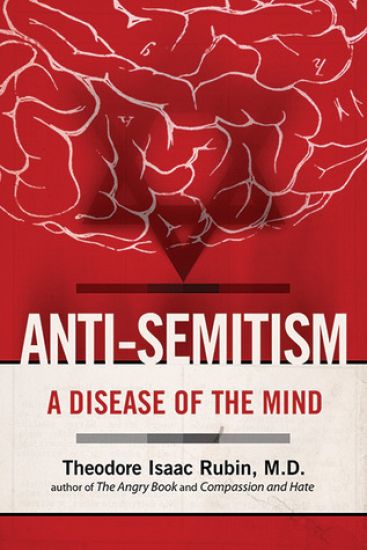
A groundbreaking work on the psychodynamics of bigotry and anti-Semitism. As a child, Ted Rubin could not understand why some people hated him and his family only because they were Jews. He soon discovered that other groups were hated and that bigotry was a dangerous disease that destroys its hosts as well as its victims. As a psychiatrist, Dr. Rubin learned that anti-Semitism and other deep-seated prejudices are nonorganic diseases of the mind: malignant emotional illnesses that can be treated only by first understanding the unique psychodynamics involved. Little has been written about this aspect of bigotry. Anti-Semitism is a bold endeavor to shed light on one of humankind’s most destructive and contagious illnesses, and it offers hope and healing for the future. In Anti-Semitism, Rubin lays the groundwork for a person to successfully overcome hatred, to understand where it comes from and why, and to recognize that anti-Semitism devastates people, cripples self-esteem, and is capable of ?engendering great suffering, horror, and murder.” Anyone who has wrestled with hatred or bigotry, either as the victim or the host, will find clarity and direction in Dr. Rubin’s eloquent analysis.
Anti-Semitism and British Gothic Literature

Anti-Semitism and British Gothic Literature

C. Davison

Palgrave Macmillan
2004
sidottu
Anti-Semitism and British Gothic Literature examines the Gothic's engagement with the Jewish Question and British national identity over the course of a century. Beginning with an exploration of Jewish demonology from the Middle Ages to the Enlightenment, Davison interprets the changing significance of the trans-national Wandering Jew in classic Gothic fiction who later migrates into Victorian realism. What emerges is the elucidation of an anti-Semitic 'spectropoetics' that convey how the spectres of Jewish difference and Jewish assimilation haunt British literature.
Anti-Semitism and Analytical Psychology
Winner of the Internationl Association for Jungian Studies (IAJS) Book Award for Best Applied Book 2021Carl Jung angrily rejected the charge that he was an anti-Semite, yet controversies concerning his attitudes towards Jews, Zionism and the Nazi movement continue to this day. This book explores Jung’s ambivalent relationship to Judaism in light of his career-changing relationship and rupture with Sigmund Freud and takes an unflinching look at Jung’s publications, public pronouncements and private correspondence with Freud, James Kirsch and Erich Neumann from 1908 to 1960.Analyzing the religious and racial, Christian and Muslim, high-brow and low-brow varieties of anti-Semitism that were characteristic of Jung’s time and place, this book examines how Muslim anti-Semitism and anti-Zionism intensified following the Balfour Declaration (1917), fostering the resurgence of anti-Semitism on the Left since the fall of the Soviet Empire. It urges readers to be mindful of the new and growing threats to the safety and security of Jewish people posed by the resurgence of anti-Semitism around the world today.This book explores the history of the controversy concerning Jung’s anti-Semitism both before and after the publication of Lingering Shadows: Jungians, Freudians and Anti-Semitism (1991), and invites readers to reflect on the relationships between Judaism, Christianity and Zionism, and between psychoanalysis and analytical psychology, in new and challenging ways. It will be of considerable interest to psychoanalysts, historians and all those interested in the history of analytical psychology, anti-Semitism and interfaith dialogue.
Anti-Semitism and Analytical Psychology

Anti-Semitism and Analytical Psychology

Daniel Burston

TAYLOR FRANCIS LTD
2023
nidottu
Winner of the Internationl Association for Jungian Studies (IAJS) Book Award for Best Applied Book 2021Carl Jung angrily rejected the charge that he was an anti-Semite, yet controversies concerning his attitudes towards Jews, Zionism and the Nazi movement continue to this day. This book explores Jung’s ambivalent relationship to Judaism in light of his career-changing relationship and rupture with Sigmund Freud and takes an unflinching look at Jung’s publications, public pronouncements and private correspondence with Freud, James Kirsch and Erich Neumann from 1908 to 1960.Analyzing the religious and racial, Christian and Muslim, high-brow and low-brow varieties of anti-Semitism that were characteristic of Jung’s time and place, this book examines how Muslim anti-Semitism and anti-Zionism intensified following the Balfour Declaration (1917), fostering the resurgence of anti-Semitism on the Left since the fall of the Soviet Empire. It urges readers to be mindful of the new and growing threats to the safety and security of Jewish people posed by the resurgence of anti-Semitism around the world today.This book explores the history of the controversy concerning Jung’s anti-Semitism both before and after the publication of Lingering Shadows: Jungians, Freudians and Anti-Semitism (1991), and invites readers to reflect on the relationships between Judaism, Christianity and Zionism, and between psychoanalysis and analytical psychology, in new and challenging ways. It will be of considerable interest to psychoanalysts, historians and all those interested in the history of analytical psychology, anti-Semitism and interfaith dialogue.
Anti-Semitism and Anti-Zionism in Historical Perspective
Previously published as a special issue of The Journal of Israeli History, this book presents the reflections of historians from Israel, Europe, Canada and the United States concerning the similarities and differences between anti-Zionism and anti-Semitism primarily in Europe and the Middle East. Spanning the past century, the essays explore the continuum of critique from early challenges to Zionism and they offer criteria to ascertain when criticism with particular policies has and has not coalesced into an "ism" of anti-Zionism and anti-Semitism. Including studies of England, France, Germany, Poland, the United States, Iran and Israel, the volume also examines the elements of continuity and break in European traditions of anti-Semitism and anti-Zionism when they diffused to the Arab and Islamic.Essential course reading for students of religious history.
Anti-Semitism before the Holocaust

Anti-Semitism before the Holocaust

Lindemann Albert S.

Routledge
2000
nidottu
An important new study on a complex and highly controversial topic. Albert Lindemann provides a clear and balanced guide to anti-Semitism from ancient times right through to the twentieth-century inter-war period and the Nazi Holocaust. He looks at all countries where anti-Semitism manifested itself at different times and in different ways xxx; in Russia, the US, Poland, England, Germany, South Africa, and Holland. Throughout he asks difficult and unfamiliar questions to challenge long held and misguided beliefs. An important new study which fills a gap in current literature.
Anti-Semitism in Times of Crisis

Anti-Semitism in Times of Crisis

New York University Press
1991
sidottu
A groundbreaking history of anti-Semitism, from the Roman Empire to the twentieth century The origins of anti-Semitism have been hotly contested. Some say that it is a transitory phenomenon, appearing randomly in Western history, while others argue that it reflects a deep-seated tradition inherent in Western culture. Anti-Semitism in Times of Crisis argues that anti-semitism is not an anomaly in Western culture, but a defining feature. In this collection of essays, 16 celebrated contributors trace representations of Jewish people over the past two thousand years. Their analysis shows how Jewish people have been consistently cast as outsiders, allowing Westerners to define themselves in contrast to the Jewish community. Even as the popular image of Jewish people changed, anti-semitism persisted. With essays on the religious, social, political, and economic origins of European and American anti- Semitism, as well as some Jewish responses, this volume is the most wide-ranging history of anti-Semitism ever compiled.
Anti-Semitism in Times of Crisis

Anti-Semitism in Times of Crisis

New York University Press
1993
pokkari
A groundbreaking history of anti-Semitism, from the Roman Empire to the twentieth century The question of whether anti-Semitism is a transitory phenomenon, appearing randomly in Western history, or whether it reflects a deep seated tradition inherent in Western culture has been often debated. This volume traces the image of the Jew and the attitudes toward the Jew over the past two thousand years, from the Roman Empire to the reunification of Germany, showing the consistent pattern of anti-Semitism in Western societies. With essays on the religious, social, political, and economic origins of European and American anti- Semitism, as well as some Jewish responses, this volume is the most wide-ranging history of anti-Semitism ever compiled. Contributors to this volume include Nicholas de Lange, Cambridge University; Pinchas Hachoen Peli, University of the Negev; David Menashri, Tel Aviv University; Bernard Lewis, Princeton University (retired); Liliane Weissberg, University of Pennsylvania; and Jeremy Cohen, Ohio State University.
Anti-Semitism and Schooling Under the Third Reich
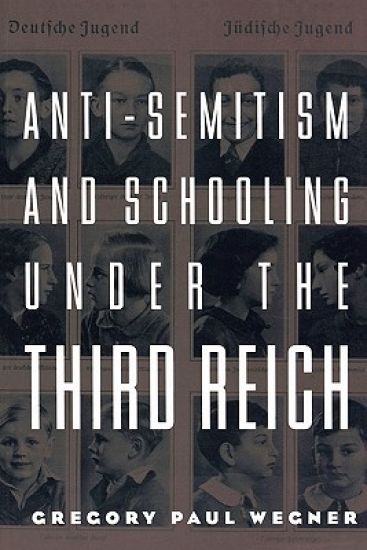
This book investigates the anti-Semitic foundations of Nazi curricula for elementary schools, with a focus on the subjects of biology, history, and literature. Gregory Paul Wegner argues that any study of Nazi society and its values must probe the education provided by the regime. Schools, according to Wegner, play a major role in advancing ideological justifications for mass murder, and in legitimizing a culture of ethnic and racial hatred. Using a variety of primary sources, Wegner provides a vivid account of the development of Nazi education.
Anti-Semitism and Schooling Under the Third Reich
This book investigates the anti-Semitic foundations of Nazi curricula for elementary schools, with a focus on the subjects of biology, history, and literature. Gregory Paul Wegner argues that any study of Nazi society and its values must probe the education provided by the regime. Schools, according to Wegner, play a major role in advancing ideological justifications for mass murder, and in legitimizing a culture of ethnic and racial hatred. Using a variety of primary sources, Wegner provides a vivid account of the development of Nazi education.
Anti-Semitism in America

Anti-Semitism in America

Harold E. Quinley; Charles Y. Glock

Transaction Publishers
1983
nidottu
Periodic outbreaks of anti-Jewish hostility testify to the continuing presence of anti-Semitism in America. Based on the most extensive research ever conducted on the subject, Anti-Semitism in America, now in a new paperback edition, provides us with the often surprising facts about the enduring form of bigotry and sheds new light on the nature of prejudice in general. The authors draw their conclusions from a specially designed nationwide survey on anti-Semitism conducted by the Survey Research Center at the University of California, Berkeley, and by other public opinion polls.