Kirjojen hintavertailu. Mukana 11 244 527 kirjaa ja 12 kauppaa.

Kirjahaku

Etsi kirjoja tekijän nimen, kirjan nimen tai ISBN:n perusteella.

2 tulosta hakusanalla "Aquatic Ecosystems Monitoring"

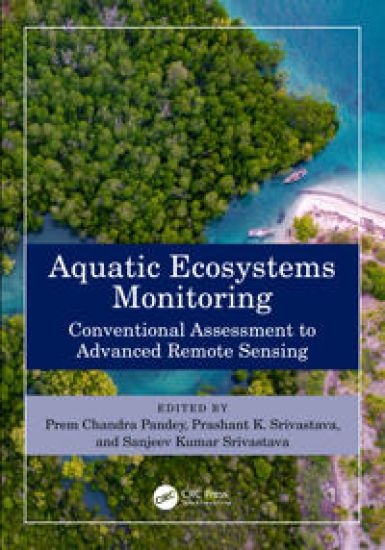
Aquatic Ecosystems Monitoring
This book collates traditional and modern applications of remote sensing in aquatic ecosystem monitoring. It covers conventional assessment methods like sampling, surveying, macroinvertebrates, and chlorophyll estimation for aquatic ecosystem health assessment. Advanced remote sensing technology provides timely spectral information for quantitative and qualitative assessment of water quality, shoreline changes, coral bleaching, and vegetation monitoring. The book covers different types of aquatic ecosystems like wetlands, rivers, lakes, saline, and the brackish lake. It also:Reviews the latest applications of remote sensing in the monitoring and assessment of aquatic ecosystemsIncludes traditional methods like cartography, sampling, surveying, phytoplankton assessment, river interlinking, and chlorophyll estimationDiscusses the application of multi-source data and machine learning in monitoring aquatic ecosystemsDiscusses aquatic ecosystem management, services, threats, and sustainabilityExplores challenges, opportunities, and prospects of future Earth observation applications for aquatic ecosystem monitoringThe book discusses space-borne, airborne, and drone geospatial data. The parts broadly cover aquatic ecosystem monitoring, vegetation management, advanced modeling practices, and challenges. It is meant for scientists, professionals, and policymakers working in environmental sciences, remote sensing, and geology.
Remote Sensing for Coastal and Aquatic Ecosystems' Monitoring and Biodiversity Management
Environmental management and the preservation of biodiversity are widely considered a priority in the context of accelerating global changes affecting the physical and biological resources of our planet. This Special Issue of the journal will focus on "Coastal and Aquatic Ecosystems". The coastal region is a transition area between terrestrial and marine ecosystems. This transition area is now considered an important component of the biosphere, both in terms of ecosystems' diversity and in the provision of resources and services. Moreover, the coastal region is home to a significant number of distinct biological communities, including coral reefs, mangroves, salt meadows and wetlands, phanerogam meadows, and kelp forests, estuarine assemblages or coastal lagoons, forests, and grasslands. The diversity of coastal ecosystems is directly threatened by human activity.Remote sensing meets this challenge by offering a wide range of standard products on environmental coastal condition, thanks in particular to various state-of-the-art sensors. The development of innovative methods based on the integration of multi-source, multi-resolution, and multi-temporal images offers promising prospects for considering the different scales of ecosystems. Consequently, the products derived from remote sensing contribute to the development of temporal and spatial indicators for better knowledge and management of coastal and aquatic ecosystems.