Kirjojen hintavertailu. Mukana 11 244 527 kirjaa ja 12 kauppaa.

Kirjahaku

Etsi kirjoja tekijän nimen, kirjan nimen tai ISBN:n perusteella.

20 tulosta hakusanalla "Chemotaxis"

Chemotaxis

Chemotaxis

Humana Press Inc.
2016
sidottu
This second edition expands on the first edition with new chapters describing methods for studying cell movement, molecular components involved in chemotaxis, spatiotemporal dynamics of signaling components, and quantitative modeling, as well as several updated chapters from the first edition. Various methods to investigate directional cell growth and movements are presented in Chapters 1-20. These chapters contains experimental procedures to visualize and measure migration behaviors of different kinds of organisms, including chemotropism in the budding yeast; cell growth and migration of D. discoideum; border cell migration in Drosophila; chemotaxis of mouse and human neutrophils; and HIV-induced T cell chemotactic response. Chemotaxis: Methods and Protocols, Second Edition also contains microscopy procedures for studying breast cancer cell migration, tumor cell invasion in vivo, and axon guidance. The book concludes with Chapters 21-27 describing methods that measure spatiotemporal dynamics of signaling components involved in chemotaxis; introduce imaging techniques, such as TRIF, BRET, FRET, and single-molecule microscopy; and mathematical models of experimentally generated chemoattractant gradients. Written in the highly successful Methods in Molecular Biology series format, chapters include introductions to their respective topics, lists of the necessary materials and reagents, step-by-step, readily reproducible laboratory protocols, and tips on troubleshooting and avoiding known pitfalls.Cutting edge and thorough, Chemotaxis: Methods and Protocols, Second Edition is a valuable resource for anyone who is interested in the diverse methodologies that are propelling chemotaxis research forward.

Chemotaxis

Chemotaxis

Humana Press Inc.
2018
nidottu
This second edition expands on the first edition with new chapters describing methods for studying cell movement, molecular components involved in chemotaxis, spatiotemporal dynamics of signaling components, and quantitative modeling, as well as several updated chapters from the first edition. Various methods to investigate directional cell growth and movements are presented in Chapters 1-20. These chapters contains experimental procedures to visualize and measure migration behaviors of different kinds of organisms, including chemotropism in the budding yeast; cell growth and migration of D. discoideum; border cell migration in Drosophila; chemotaxis of mouse and human neutrophils; and HIV-induced T cell chemotactic response. Chemotaxis: Methods and Protocols, Second Edition also contains microscopy procedures for studying breast cancer cell migration, tumor cell invasion in vivo, and axon guidance. The book concludes with Chapters 21-27 describing methods that measure spatiotemporal dynamics of signaling components involved in chemotaxis; introduce imaging techniques, such as TRIF, BRET, FRET, and single-molecule microscopy; and mathematical models of experimentally generated chemoattractant gradients. Written in the highly successful Methods in Molecular Biology series format, chapters include introductions to their respective topics, lists of the necessary materials and reagents, step-by-step, readily reproducible laboratory protocols, and tips on troubleshooting and avoiding known pitfalls.Cutting edge and thorough, Chemotaxis: Methods and Protocols, Second Edition is a valuable resource for anyone who is interested in the diverse methodologies that are propelling chemotaxis research forward.

Chemotaxis

Chemotaxis

Humana Press Inc.
2009
sidottu
Fundamental to the development and vital functions of organisms, the migration of motile cells due to the detection of shallow gradients of specific chemical signals in their environments, or chemotaxis, can be clearly seen as a major force in cell biology. In Chemotaxis: Methods and Protocols, expert researchers in the field provide state-of-the-art methods for investigating cell migration behaviors, studying molecular components involved in detecting extracellular signals and directing cell movement, visualizing spatiotemporal dynamics of the components in signaling networks of chemotaxis in real time, and constructing quantitative models that simulate chemoattractant-induced cell responses. Written in the highly successful Methods in Molecular Biology™ series format, chapters include introductions to their respective topics, lists of the necessary materials and reagents, step-by-step, readily reproducible laboratory protocols, and notes on troubleshooting and avoiding known pitfalls. Comprehensive and cutting-edge, Chemotaxis: Methods and Protocols serves scientists with practical guidance on the diverse methodologies that are currently propelling chemotaxis research forward in order to further our understanding of this vital biological system.
Chemotaxis

Chemotaxis

Nova Science Publishers Inc
2011
sidottu
Chemotaxis is the phenomenon in which bodily cells, bacteria, and other single-cell or multicellular organisms direct their movements according to certain chemicals in their environment. This is important for bacteria to find food by swimming towards the highest concentration of food molecules, or to flee from poisons. In multicellular organisms, chemotaxis is critical to early and subsequent phases of development, as well as in normal function. This book discusses research in the study of chemotaxis including the cell migration signalosome, the role of chemotaxis in the association of the azospirillum brasilense plant, the role of CD46 in the control of chemotaxis of activated T cells in MS pathogenesis and the regulation of chemotaxis by heterotrimeric G proteins.
Chemotaxis

Chemotaxis

Humana Press Inc.
2012
nidottu
Fundamental to the development and vital functions of organisms, the migration of motile cells due to the detection of shallow gradients of specific chemical signals in their environments, or chemotaxis, can be clearly seen as a major force in cell biology. In Chemotaxis: Methods and Protocols, expert researchers in the field provide state-of-the-art methods for investigating cell migration behaviors, studying molecular components involved in detecting extracellular signals and directing cell movement, visualizing spatiotemporal dynamics of the components in signaling networks of chemotaxis in real time, and constructing quantitative models that simulate chemoattractant-induced cell responses. Written in the highly successful Methods in Molecular Biology™ series format, chapters include introductions to their respective topics, lists of the necessary materials and reagents, step-by-step, readily reproducible laboratory protocols, and notes on troubleshooting and avoiding known pitfalls. Comprehensive and cutting-edge, Chemotaxis: Methods and Protocols serves scientists with practical guidance on the diverse methodologies that are currently propelling chemotaxis research forward in order to further our understanding of this vital biological system.
Chemotaxis

Chemotaxis

Michael Eisenbach; A Tamada; G M Omann; J E Segall; R A Firtel; R Meili; David Gutnick; Mazal Varon; Joseph W Lengeler; F Murakami

Imperial College Press
2004
sidottu
With contribution from Joseph W Lengeler (University of Osnabr
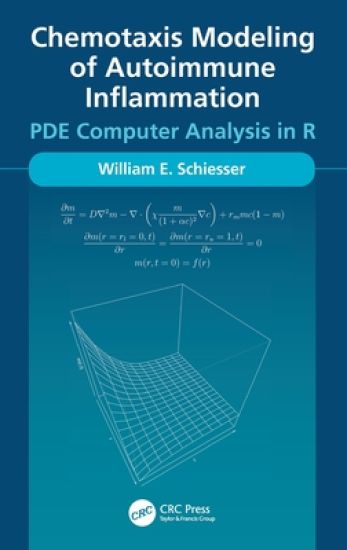
Chemotaxis Modeling of Autoimmune Inflammation

Chemotaxis Modeling of Autoimmune Inflammation

William Schiesser

TAYLOR FRANCIS LTD
2022
sidottu
In response to an infection (e.g., from pathogens such as bacteria and viruses), the immune system can deplete macrophages (specialized white blood cells) and produce cytokines that are pro-inflammatory or anti-inflammatory. This counterproductive autoimmune response is represented mathematically as nonlinear chemotaxis diffusion.This book is directed to the computer-based modeling of chemotaxis inflammation. The spatiotemporal analysis is based on a model of three partial differential equations (PDEs). The three PDE model is coded (programmed) as a set of routines in R, a quality, open-source, scientific programming system. The numerical integration (solution) of the PDEs is by the method of lines (MOL).The three PDE model can be used for computer-based experimentation, for example, parameter variation and changes in the model equations or alternate models, to enhance a quantitative understanding of a postulated inflammation.This experimentation is illustrated by chapters pertaining to: (1) the computation and display of the PDE time derivatives, (2) the RHS terms of the PDEs with emphasis on the chemotaxis terms, (3) parameter variations to demonstrate parameter effects and sensitivities and (4) additonal terms in the PDEs to include PDE coupling and extensions of the basic PDE model.
Chemotaxis Modeling of Autoimmune Inflammation

Chemotaxis Modeling of Autoimmune Inflammation

William Schiesser

TAYLOR FRANCIS LTD
2024
nidottu
In response to an infection (e.g., from pathogens such as bacteria and viruses), the immune system can deplete macrophages (specialized white blood cells) and produce cytokines that are pro-inflammatory or anti-inflammatory. This counterproductive autoimmune response is represented mathematically as nonlinear chemotaxis diffusion.This book is directed to the computer-based modeling of chemotaxis inflammation. The spatiotemporal analysis is based on a model of three partial differential equations (PDEs). The three PDE model is coded (programmed) as a set of routines in R, a quality, open-source, scientific programming system. The numerical integration (solution) of the PDEs is by the method of lines (MOL).The three PDE model can be used for computer-based experimentation, for example, parameter variation and changes in the model equations or alternate models, to enhance a quantitative understanding of a postulated inflammation.This experimentation is illustrated by chapters pertaining to: (1) the computation and display of the PDE time derivatives, (2) the RHS terms of the PDEs with emphasis on the chemotaxis terms, (3) parameter variations to demonstrate parameter effects and sensitivities and (4) additonal terms in the PDEs to include PDE coupling and extensions of the basic PDE model.
Computational Chemotaxis Models For Neurodegenerative Disease
The mathematical model presented in this book, based on partial differential equations (PDEs) describing attractant-repellent chemotaxis, is offered for a quantitative analysis of neurodegenerative disease (ND), e.g., Alzheimer's disease (AD). The model is a representation of basic phenomena (mechanisms) for diffusive transport and biochemical kinetics that provides the spatiotemporal distribution of components which could explain the evolution of ND, and is offered with the intended purpose of providing a small step toward the understanding, and possible treatment of ND.The format and emphasis of the presentation is based on the following elements:In other words, a methodology for numerical PDE modeling is presented that is flexible, open ended and readily implemented on modest computers. If the reader is interested in an alternate model, it might possibly be implemented by: (1) modifying and/or extending the current model (for example, by adding terms to the PDEs or adding additional PDEs), or (2) using the reported routines as a prototype for the model of interest.These suggestions illustrate an important feature of computer-based modeling, that is, the readily available procedure of numerically experimenting with a model. The current model is offered as only a first step toward the resolution of this urgent medical problem.
Computational Chemotaxis Models For Neurodegenerative Disease
The mathematical model presented in this book, based on partial differential equations (PDEs) describing attractant-repellent chemotaxis, is offered for a quantitative analysis of neurodegenerative disease (ND), e.g., Alzheimer's disease (AD). The model is a representation of basic phenomena (mechanisms) for diffusive transport and biochemical kinetics that provides the spatiotemporal distribution of components which could explain the evolution of ND, and is offered with the intended purpose of providing a small step toward the understanding, and possible treatment of ND.The format and emphasis of the presentation is based on the following elements:In other words, a methodology for numerical PDE modeling is presented that is flexible, open ended and readily implemented on modest computers. If the reader is interested in an alternate model, it might possibly be implemented by: (1) modifying and/or extending the current model (for example, by adding terms to the PDEs or adding additional PDEs), or (2) using the reported routines as a prototype for the model of interest.These suggestions illustrate an important feature of computer-based modeling, that is, the readily available procedure of numerically experimenting with a model. The current model is offered as only a first step toward the resolution of this urgent medical problem.
Cell Motility and Chemotaxis

Cell Motility and Chemotaxis

SPRINGER-VERLAG NEW YORK INC.
2024
sidottu
This volume explores the latest experimental and computer-based methods used to study the field of motility research. The chapters in this book cover topics such as methods to investigate motility and chemotaxis in a range of systems including macrophages and Dictyostelium discoideum; ways in which electric fields impact motility and taxis; recently developed computer-based methods for studying pseudopod-driven locomotion of amoeboid cells; and software tools for kymograph-based analysis of cell contour dynamics. Written in the highly successful Methods in Molecular Biology series format, chapters include introductions to their respective topics, lists of the necessary materials and reagents, step-by-step, readily reproducible laboratory protocols, and tips on troubleshooting and avoiding known pitfalls. Cutting-edge and practical, Cell Motility and Chemotaxis: Methods and Protocols is a valuable resource for researchers looking to expand their knowledge of motility-related research across different disciplines.
Leukocyte Locomotion and Chemotaxis

Leukocyte Locomotion and Chemotaxis

Prof. Dr. Hansuli U. Keller; Prof. Dr. Gerd O. Till

Springer Basel
2014
nidottu
Ten years ago interest in leukocyte chemotaxis was restricted to a relatively small group of scientists whose interests were quite circumscribed. In the past decade both the number of workers and their publications has grown at some­ thing approaching an exponential rate and, more importantly, the field has gradually expanded to encompass a large number of diverse areas (mediators, receptors, cell effector mechanisms, regulatory factors, etc.). It is now apparent that leukocytes are particularly useful for studies of the locomotory behavior of all cell types and of mechanisms controlling cell movement and orientation. Chemotactic factors, once discovered as substan­ ces able to induce directional migration in leukocytes, are now recognized as potent stimulators of a variety of cell functions. Based on our knowledge in the field of basic research in leuko­ cyte chemotaxis, clinical observations in combination with ex­ perimental studies in vivo have provided new insights into the role of leukocyte-mediator interactions. The recognition that a specific interaction between chemotactic factor and leukocyte can lead to a multitude of cellular responses and products has opened up a broad area of study. The diversity of contributions to this volume based on a conference which was held in May 1982 in Gersau, Switzerland, reflects this development and demonstra­ tes that leukocyte chemotaxis continues to be an area of fasci­ nating and highly active research.
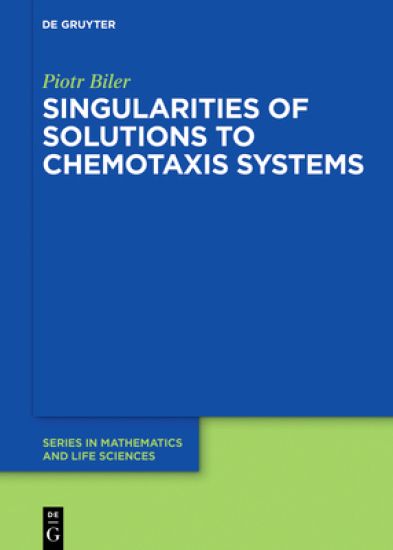
Singularities of Solutions to Chemotaxis Systems
The Keller-Segel model for chemotaxis is a prototype of nonlocal systems describing concentration phenomena in physics and biology. While the two-dimensional theory is by now quite complete, the questions of global-in-time solvability and blowup characterization are largely open in higher dimensions. In this book, global-in-time solutions are constructed under (nearly) optimal assumptions on initial data and rigorous blowup criteria are derived.