In his new collection Torn Awake, Gander continues to blend passion with intelligence, unveiling the forces of physical nature and personhood, the self as a construction of reciprocally reflective relations. Proposing models of hybridity, each of the book's major sequences develops a unique subject, rhythm, and form. Bringing to light the molten potential at the core of personality, the poems illuminate ways that language, as history read by anthropologists, discourse between lovers, gestures between parent and child, graffiti in temples, or even language as an event in itself (the very experience of words at play), incarnates presence. Addressing father and son relationships, and venerating erotic love, Gander's poems surge with vitality: the energy of active discovery.
"Heroism is a secondary virtue," Albert Camus noted, "but friendship is primary." In his gem-like first novel, Forrest Gander writes of friendship, envy, and eros as a harmonic of charged overtones. Set in a rural southern landscape as vivid as its indelible characters, As a Friend tells the story of Les, a gifted man and land surveyor, whose impact on those around him (his friend Clay, his girlfriend Sarah) provokes intense self-examination and an atmosphere of dangerous eroticism. With poetic insight, Gander explores the nature of attraction, betrayal, and loyalty. What he achieves is brilliant in style and powerfully unsettling.
Forrest Gander’s Core Samples from the World is a magnificent compendium of poetry, photography, and essay (a form of Japanese haibun). Collaborating with three acclaimed photographers, Gander explores tensions between the familiar and foreign. His eloquent new work voices an ethical concern for others, exploring empathic relations in which the world itself is fundamental. Taking us around the globe to China, Mexico, Bosnia-Herzegovina, and Chile, Core Samples shows how Gander’s “sharp sense of place has made him the most earthly of our avant-garde, the best geographer of fleshly sites since Olson” (Donald Revell, The Colorado Review).
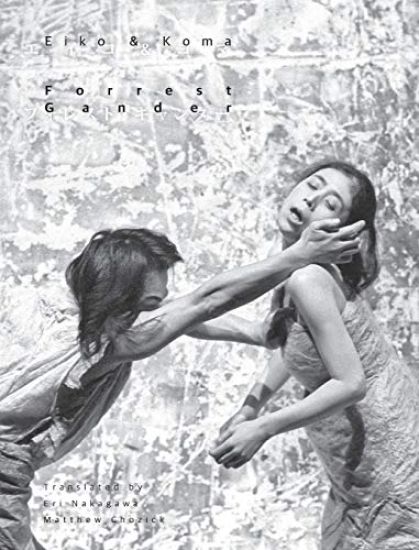
For over thirty years, Eiko & Koma, the Japanese-born choreographers and dancers,have created an influential theatre of movement out of stillness, shape, light, and sound. In tribute and collaboration, the acclaimed American poet Forrest Gander has written a mesmerizing series of poems — hinging around a dance schematic — that captures and extends the dancers’ performance with lyrical intensity and vividness.
The Trace is a masterful, poetic novel about a journey through Mexico taken by a couple recovering from a world shattered. Driving through the Chihuahua Desert, they retrace the route of nineteenth-century American writer Ambrose Bierce (who disappeared during the Mexican Revolution) and try to piece together their lives after a devastating incident involving their adolescent son. With tenderness and precision, Gander explores the intimacies of their relationship as they travel through Mexican towns, through picturesque canyons and desertcapes, on a journey through the the heart of the Mexican landscape. Taking a shortcut through the brutally hot desert home, their car overheats miles from nowhere, the novel spinning out of control, with devastating consequences. . . . Poet Forrest Gander’s first novel As a Friend was acclaimed as “profound and relentlessly beautiful (Rikki Ducornet). With The Trace, Gander has accomplished another brilliant work, containing unforgettable poetic descriptions of Mexico and a story both violent and tender.
The Trace is a masterful, poetic novel about a journey through Mexico taken by a couple recovering from a world shattered. Driving through the Chihuahua Desert, they retrace the route of nineteenth-century American writer Ambrose Bierce (who disappeared during the Mexican Revolution) and try to piece together their lives after a devastating incident involving their adolescent son. With tenderness and precision, Gander explores the intimacies of their relationship as they travel through Mexican towns, through picturesque canyons and desertcapes, on a journey through the the heart of the Mexican landscape. Taking a shortcut through the brutally hot desert home, their car overheats miles from nowhere, the novel spinning out of control, with devastating consequences. . . . Poet Forrest Gander’s first novel As a Friend was acclaimed as “profound and relentlessly beautiful (Rikki Ducornet). With The Trace, Gander has accomplished another brilliant work, containing unforgettable poetic descriptions of Mexico and a story both violent and tender.
Drawing from his experience as a translator, Forrest Gander includes in the first, powerfully elegiac section a version of a poem by the Spanish mystical poet St. John of the Cross. He continues with a long multilingual poem examining the syncretic geological and cultural history of the U.S. border with Mexico. The poems of the third section—a moving transcription of Gander’s efforts to address his mother dying of Alzheimer’s—rise from the page like hymns, transforming slowly from reverence to revelation. Gander has been called one of our most formally restless poets, and these new poems express a characteristically tensile energy and, as one critic noted, “the most eclectic diction since Hart Crane.”
In the searing poems of his new collection, Twice Alive, the Pulitzer Prize–winner Forrest Gander addresses the exigencies of our historical moment and the intimacies, personal and environmental, that bind us to others and to the world. Drawing from his training in geology and his immersion in Sangam literary traditions, Gander invests these poems with an emotional intensity that illuminates our deep-tangled interrelations. While conducting fieldwork with a celebrated mycologist, Gander links human intimacy with the transformative collaborations between species that compose lichens. Throughout Twice Alive, Gander addresses personal and ecological trauma—several poems focus on the devastation wrought by wildfires in California where he lives—but his tone is overwhelmingly celebratory. Twice Alive is a book charged with exultation and tenderness.
Mojave Ghost initiates an unusually tender bond with the reader as it chronicles an intimate relationship with arresting honesty and vividness. Moving through grief and loss towards a renewal that never sidesteps the wholeness of experience, Gander's new collection discovers an articulate language for the merging of exterior and interior landscapes. Gander, trained as a geologist, walked along much of the 800-mile San Andreas fault toward the desolate town of his birth, and found himself crossing permeable dimensions of time and space, correlating his emotions and the stricken landscape with other divisions: the fractures and folds underlying not only our country, but any self in its relationship with others. The result is this moving new collection that unforgettably describes a spiritual and physical journey. With its confidential tones and candid self-examination, Mojave Ghost is Gander’s most inviting and poignant book yet.
A haunting and peculiar travelogue, Deeds of the Utmost Kindness employs forms as diverse as haiku and prose poetry in settings that range from Japan to the rural Ozarks to contemporary Moscow. The compelling strangeness of the poems' precise details exposes varied rhythms of thought and illustrated how different logics work in the metaphoric structures of changing places . Yet behind the uneasy sense of dislocation felt by the constant traveler lies the personal, essentially moral, voice of the poet as observer.
The author’s training as a geologist influences the themes and forms of the poems and the single essay in this book. Often his poetic forms are determined by rock characteristics, even when the concerns of the poem are intensely human. For instance, a poem about a set of perceived relationships at twilight from the Crystal section titled “yellow quartz” breaks into six lines and references the passage of light because quartz crystals are pellucid and hexagonal. In another sequence, “Line of Descent,” sharply shifting lines of poetry enact the cutbacks and bends of the path into the Grand Canyon by which father and son descend through lines of sediment and lines of story along the bloodline that ties them together. Without calling attention to themselves, such forms underpin the strong emotional terrain upon which all the poems, whether focused on erotic love, fatherhood, the histories of empire, or the dialogue between scientific rationalism and poetic imagination, are situated. With an eye toward what we stand on literally, Gander concentrates our attention toward what we stand on and for in our various relationships with others and with the world
I den Pulitzerprisade diktsamlingen Vara med skriver Forrest Gander, djupt in i sorgen över sin hustru C.D. Wrights bortgång, smärtsamt om sina försök att nå fram till sin alzheimersjuka mor vid hennes vårdbädd, stilla dikter som förvandlas till uppenbarelser. MenVara med rör sig också fram och tillbaka över gränsen mellan USA och Mexiko i Ganders uppväxttrakter, dess historia, kultur, geologi och ödesmättade betydelse idag. Gander fångar behovet av mänsklig närhet genom sorg, förlust och ånger.Forrest Gander föddes 1956 i Mojaveöknen, växte upp i Virginia och är bosatt i Kalifornien. Han är verksam som poet, romanförfattare, essäist och är som översättare flitig introduktör av världspoesin i usa.
Started in 2009, IPNHK is one of the most influential international poetry events in Asia. In its ten-year anniversary in November 2019, 30 famous poets from various countries will be in Hong Kong and ten cities in China afterwards to read their works based on the theme ""Speech and Silence.
The damage humans have perpetrated on our environment has certainly affected a poet’s means and material. But can poetry be ecological? Can it display or be invested with values that acknowledge the economy of interrelationship between the human and the nonhuman realms? Aside from issues of theme and reference, how might syntax, line break, or the shape of the poem on the page express an ecological ethics? To answer these questions, poets Forrest Gander and John Kinsella offer an experiment, a collaborative volume of prose and poetry that investigates—both thematically and formally—the relationship between nature and culture, language and perception. They ask whether, in an age of globalization, industrialization, and rapid human population growth, an ethnocentric view of human beings as a species independent from others underpins our exploitation of natural resources. Does the disease of Western subjectivity constitute an element of the aesthetics that undermine poetic resistance to the killing of the land? Why does “the land” have to give something back to the writer?This innovative volume speaks to all people wanting to understand how artistic and critical endeavours can enrich, rather than impoverish, the imperilled world around us.
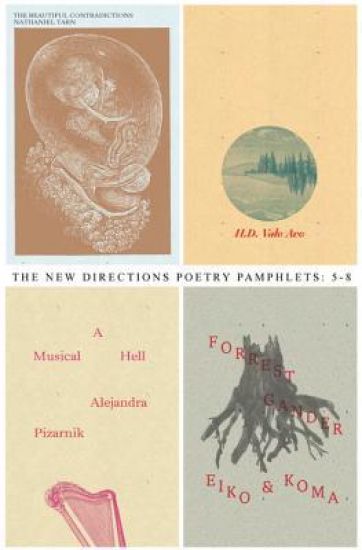
The second set of New Directions Poetry Pamphlet series, which includes Vale Ave by H. D.; Eiko & Koma by Forrest Gander; A Musical Hell by Alejandra Pizarnik; The Beautiful Contradictions by Nathaniel Tarn.