Kirjojen hintavertailu. Mukana 11 241 044 kirjaa ja 12 kauppaa.

Kirjahaku

Etsi kirjoja tekijän nimen, kirjan nimen tai ISBN:n perusteella.

1000 tulosta hakusanalla "Goethe"

Goethe

Goethe

Ritchie Robertson

Oxford University Press
2016
nidottu
In 1878 the Victorian critic Matthew Arnold wrote: 'Goethe is the greatest poet of modern times... because having a very considerable gift for poetry, he was at the same time, in the width, depth, and richness of his criticism of life, by far our greatest modern man.' In this Very Short Introduction Ritchie Robertson covers the life and work of Johann Wolfgang von Goethe (1749-1832): scientist, administrator, artist, art critic and supreme literary writer in a vast variety of genres. Looking at Goethe's poetry, novels and drama pieces, as well as his travel writing, autobiography, and essays on art and aesthetics, Robertson analyses some of the key themes in his works: love, nature, religion and tragedy. Dispelling the misconception of Goethe as a sedate Victorian sage, Robertson shows how much of his art was rooted in turbulent personal conflicts, and draws on recent research to present a complete portrait of the scientific work and political activity which accompanied Goethe's writings. ABOUT THE SERIES: The Very Short Introductions series from Oxford University Press contains hundreds of titles in almost every subject area. These pocket-sized books are the perfect way to get ahead in a new subject quickly. Our expert authors combine facts, analysis, perspective, new ideas, and enthusiasm to make interesting and challenging topics highly readable.
Goethe

Goethe

Benedetto Croce

Routledge
2019
sidottu
Croce admired Goethe partly because the latter possessed a knowledge of human nature in all its aspects but nonetheless kept his mind above and beyond political sympathies and the quarrels of nations. In this volume originally published in English in 1923, Croce distils his critical ideas about Goethe with the aim of helping readers to better understand the German poet’s work.
Goethe

Goethe

Benedetto Croce

Routledge
2021
nidottu
Croce admired Goethe partly because the latter possessed a knowledge of human nature in all its aspects but nonetheless kept his mind above and beyond political sympathies and the quarrels of nations. In this volume originally published in English in 1923, Croce distils his critical ideas about Goethe with the aim of helping readers to better understand the German poet’s work.
Goethe

Goethe

Ronald Gray

Cambridge University Press
1967
pokkari
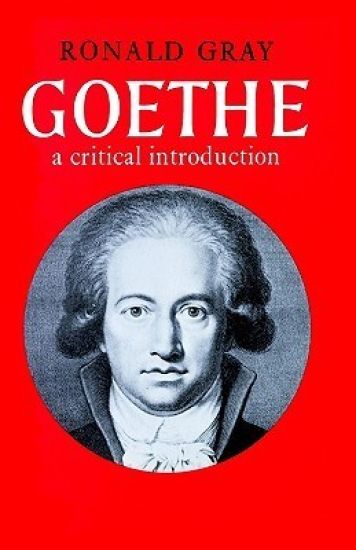
This is a concise survey and criticism of Goethe’s work, for the general reader and the student. It is intended as a useful first book from which the reader can proceed to more specialised studies. Here Goethe’s work is seen as a whole, and from the point of view of literary criticism. The first chapter summarises Goethe’s life. The other chapter discuss the works, singly and in groups. Much attention is given to the poems; and there are two long chapters on Faust. Werther, Wilhelm Meister, Elective Affinities, and the Divan are given a chapter each; so are the dramatic works, the autobiographical writings, and the scientific work. A refreshing aspect of the book is that while Dr Gray takes account of earlier criticism he also seeks to see Goethe’s work entirely afresh, and to reappraise it; by questioning the value of some works, he enhances the valuation of others. Quotation is in German, but English translations are given in footnotes. There is a useful comparative table of biographical dates, which shows what was happening, politically and culturally, in Europe while Goethe lived. There are references at the end of the book, a select bibliography and an index. The book can be used in conjunction with Dr Gray’s selection of the poems. The two books together are the best possible introduction to one the greatest European men of letters.
Goethe

Goethe

Johann Wolfgang von Goethe

Princeton University Press
1996
pokkari
This series brings into modern English a representative portion of Johann Wolfgang von Goethe's vast body of work. This edition, selected from over 140 volumes in German, is the new standard in English, and contains poetry, drama, fiction, memoir, criticism, and scientific writing by the man who is probably the most influential writer in the German language. The executive editors of this collection are Victor Lange of Princeton University, Eric Blackall of Cornell University, and Cyrus Hamlin of Yale University. Princeton University Press is proud to be the distributor of the twelve volumes in hardcover of the originating publisher, Suhrkamp Verlag. By the end of 1995, Princeton will have made all twelve volumes available in paperback, publishing the last six within the next year.
Goethe

Goethe

Matthew Bell

PRINCETON UNIVERSITY PRESS
2025
sidottu
A new intellectual biography of Goethe, examining the paradox of his thoughtJohann Wolfgang von Goethe (1749–1832) was a poet, a novelist, a scientist and an essayist on a dizzying range of topics. In the nineteenth century, he was widely regarded as one of the most important thinkers of modern Europe. In this important and ambitious work, Matthew Bell offers a wide-ranging intellectual biography of Goethe, tracing the evolution of his thought and reassessing its value. Bell examines the full spectrum of Goethe’s writing, from his most well-known works, including the dramatic poem Faust and the novels Wilhelm Meister and The Sorrows of Young Werther, to lesser-known essays and reviews. Throughout, Bell draws on Goethe’s letters and diaries, most of which are stll only available in German, embedding Goethe’s thought in his lived experience and in the cultural and intellectual life of Europe from the 1750s to the 1830s.Bell presents new interpretations of Goethe’s work as one of the first evolutionary biologists, describing discoveries that anticipated Darwin’s, and of his political ideas, which pervade his literary work in ways that have not been fully recognized. Bell offers an original and illuminating explanation for the paradox of Goethe’s thought, exploring how a radical individualist who espoused liberal and innovative ideas in some areas—in particular, religion, sexuality and science—could remain consistently conservative and authoritarian in his political outlook. Rereading Goethe through this new lens, Bell shows, reveals new dimensions of work we thought we knew well.
Goethe

Goethe

Derek Van Abbe

TAYLOR FRANCIS LTD
2024
sidottu
First published in 1972, Goethe presents a biography looking at one of the few great Europeans to be universally recognized as a hero of culture, and in the light of modern sociological thought puts the hero into his background, human, social and political. Goethe is seen in the context of his times- not as the Great Poet or the Great Lover but as the worried contemporary of the French Revolution and Napoleon. The author is much more interested than most biographers in the mature Goethe and the problems of the poet’s old age. This stems from his intense preoccupation with Goethe’s friend and biographer Eckermann, whose Conversations (for which Eckermann is ranked by many with Boswell) he is re-editing.This is an interesting read for scholars of German language & literature and European literature.
Goethe

Goethe

Derek Van Abbe

TAYLOR FRANCIS LTD
2026
nidottu
First published in 1972, Goethe presents a biography looking at one of the few great Europeans to be universally recognized as a hero of culture, and in the light of modern sociological thought puts the hero into his background, human, social and political. Goethe is seen in the context of his times- not as the Great Poet or the Great Lover but as the worried contemporary of the French Revolution and Napoleon. The author is much more interested than most biographers in the mature Goethe and the problems of the poet’s old age. This stems from his intense preoccupation with Goethe’s friend and biographer Eckermann, whose Conversations (for which Eckermann is ranked by many with Boswell) he is re-editing. This is an interesting read for scholars of German language & literature and European literature.
Goethe

Goethe

Richard Friedenthal

Routledge
2017
sidottu
"The study of Goethe's life is a task that each generation must undertake anew." Thus writes Richard Friedenthal, author of this rich biography. Spanning eight momentous decades of war, revolution, and social upheaval, Goethe's life reveals itself as one of conflict and dynamic development, of inner contradiction and unceasing creativity.As novelist, dramatist, and poet, Goethe produced epochal works of fiery romanticism, only later to dedicate himself to a classical ideal of purity and measure. His superb love lyrics immortalize a succession of ardent relationships; yet, in him too, was a strain of frigid egotism mingled with an Olympian detachment. The new introduction serves to place in perspective this outstanding work on the German master.He was capable of tirelessly exploring the external world as physiologist, geologist, and botanist. He was equally capable of plunging to the depths of profound subjective analysis. A minister of state, a model of distinguished probity, Goethe nonetheless lived a life of passionate seeking, eternally questioning official values. Nothing perhaps better sums up this vast complexity than his lifelong work, Faust, the supreme dramatization of man's quest on earth.