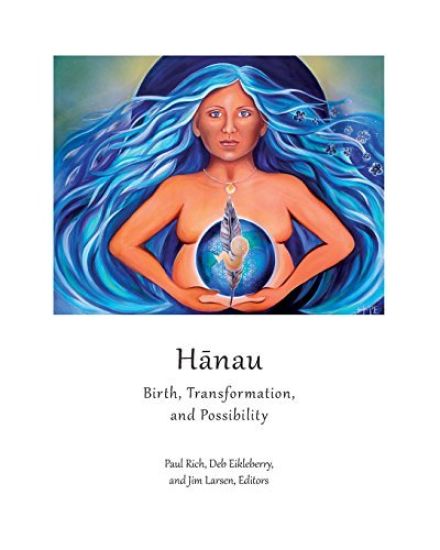
Hānau is the Hawaiian word for birth, with deep significance as the literal biological act of birthing new life, and as a symbolic act of forming or transforming to bring new possibility. "I hear the soul song of Babyand I sing all night..."- Beth LeoneBirth is among the great topics of literary expression, along with love, epic journey, war, loss, death, conquest, discovery, success, wisdom in nature, and the sacred. We are pleased to share with you a diverse and delightfully surprising collection of original creative writing, art, and music, focused on the theme "Hānau: Birth, Transformation, and Possibility". "We're ready to birthand willing to die, to do what is called, to continue the cycle of life..."- Hope MedfordHawaiian heritage is rich with legend and lore, much of which refers to birth. Birth is prominent as the origin of genealogical lineages of the Hawaiian people. Birth is also prominent as the symbolic origin of all that matters in the life of Hawaiian people - formation of the Hawaiian Islands, food, natural resources, ideas, beliefs, and lore itself."It makes sense... rhythm of labor, swaying of woman, beat of drum..." - Hope Medford Goddess of Fertility and Childbirth Haumea embodies the mystical tree of life - source of abundant food, with infinite branches of taro, bamboo, coconut, sugarcane, breadfruit, and fish. Moon Goddess Hina represents the power of womanhood and motherhood. Primordial Earth Mother Papahanaumoku (Papa), together with Sky Father Wakea is the ancestor of Native Hawaiians (Kanaka Maoli). "Today has not quite begun, but it shimmers and giggleswith anticipation and possibility."- Erin DietzelWe recognize analogues of birth in all the processes of nature - sunrise, springtime, rain after drought, blooming of a flower, regrowth after a forest fire, appearance of the first crescent moon..."The day gestates under stars, to be born anew at dawn..."- Jim LarsenLuxuriant gardens grow from sowing of seeds, whims of weather, and careful tending. Magma spews from the floor of the ocean, birthing new volcanic islands. The commonalities are newness, transformation, and possibility."The sun sets, birthing darkness, time for reflection, rest, renewal, time for lovers to hold each other..."- Paul RichThis book is published by Nature and Imagination Press (NIP), a non-profit publisher and philanthropy organization dedicated to cultivating deep respect for the natural world and nurturing active imaginations through literature, art, film, music, education, and other creative expression (http: //natureandimagination.com). This initial Presence of Place book, Hānau: Birth, Transformation, and Possibility, expands and refines the debut issue of Kalani Literary Review, originally published online in January 2016 (http: //kalanireview.com).Contributors include editors Paul Rich, Deb Eikleberry, and Jim Larsen; authors Stewart Blackburn, Jennifer Brooks, Jennifer Dietz, Erin Dietzel, William M. Donnelly, Deb Eikleberry, Evita Huapaya, Jim Larsen, Beth Leone, Hope Medford, Richard Koob, Genevieve Russell, Jim Larsen, Paul Rich, and Genevieve Russell; along with artists and photographers, Mark Albertson, Maria Arroyo, Katalin E. Csikos, William M. Donnelly, Lisa Ann Gimbel-Hildwine, Kecia Joy, Robert Kent, Richard Koob, Hope Medford, Doya Nardin, Jolanta Staczek.Proceeds from sale of this book go to cover publication costs of Kalani Literary Review in support of writers and artists through Nature and Imagination Press .
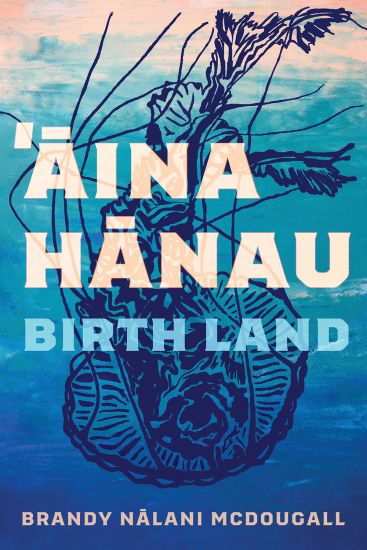
‘Aina Hanau / Birth Land is a powerful collection of new poems by Kanaka ?Oiwi (Native Hawaiian) poet Brandy Nalani McDougall. ‘Aina hanau—or the land of one’s birth—signifies identity through intimate and familial connections to place and creates a profound bond between the people in a community. McDougall’s poems flow seamlessly between ‘Olelo Hawai‘i and English, forming rhythms and patterns that impress on the reader a deep understanding of the land. Tracing flows from the mountains to the ocean, from the sky to the earth, and from ancestor to mother to child, these poems are rooted in the rich ancestral and contemporary literature of Hawai?i —mo?olelo, mo?oku?auhau, and mele —honoring Hawaiian ?aina, culture, language, histories, aesthetics, and futures. The poems in Aina Hanau / Birth Land cycle through sacred and personal narratives while exposing and fighting ongoing American imperialism, settler colonialism, militarism, and social and environmental injustice to protect the ?aina and its people. The ongoing environmental crisis in Hawai?i, inextricably linked to colonialism and tourism, is captured with stark intensity as McDougall writes, Violence is what we settle for / because we’ve been led to believe / green paper can feed us / more than green land. The experiences of birth, motherhood, miscarriage, and the power of Native Hawaiian traditions and self-advocacy in an often dismissive medical system is powerfully narrated by the speaker of the titular poem, written for McDougall’s daughters.‘Aina Hanau reflects on what it means to be from and belong to an ?aina hanau, as well as what it means to be an ‘a¯ina ha¯nau, as all mothers serve as the first birth lands for their children.
Title: Geschichte der Provinz Hanau und der unteren Maingegend, etc.Publisher: British Library, Historical Print EditionsThe British Library is the national library of the United Kingdom. It is one of the world's largest research libraries holding over 150 million items in all known languages and formats: books, journals, newspapers, sound recordings, patents, maps, stamps, prints and much more. Its collections include around 14 million books, along with substantial additional collections of manuscripts and historical items dating back as far as 300 BC.The HISTORY OF EUROPE collection includes books from the British Library digitised by Microsoft. This collection includes works chronicling the development of Western civilisation to the modern age. Highlights include the development of language, political and educational systems, philosophy, science, and the arts. The selection documents periods of civil war, migration, shifts in power, Muslim expansion into Central Europe, complex feudal loyalties, the aristocracy of new nations, and European expansion into the New World. ++++The below data was compiled from various identification fields in the bibliographic record of this title. This data is provided as an additional tool in helping to insure edition identification: ++++ British Library Arnd, Carl; 1858. x. 614 p.; 8 . 10231.d.4.