Kirjojen hintavertailu. Mukana 12 494 905 kirjaa ja 12 kauppaa.

Kirjahaku

Etsi kirjoja tekijän nimen, kirjan nimen tai ISBN:n perusteella.

11 tulosta hakusanalla "Hans Haacke"

Hans Haacke

Hans Haacke

MIT Press
2015
pokkari
Critical texts that span almost fifty years, mapping Haacke's progression from engagement with biological systems to interrogation of the social and economic underpinnings of art.For five decades, the artist Hans Haacke (b. 1936) has created works that explore the social, political, and economic underpinnings of the production of art. His works make plain the hidden and not-so-hidden agendas of those-from Cartier to David Koch-who support art in the service of industry; they expose such inconvenient social and economic truths as the real estate holdings of Manhattan slumlords, and the attempts to whitewash support for the Nazi regime, apartheid, or the war on terror through museum donations. This book gathers interviews, difficult-to-find essays, cornerstones of institutional critique, and new critical approaches by writers that include Benjamin H. D. Buchloh, Jack Burnham, Rosalyn Deutsche, and Leo Steinberg. Haacke's 1971 Guggenheim exhibition was famously canceled when the artist refused to withdraw several proposed works, including one exposing the business dealings of a Manhattan real estate company. This volume includes Edward Fry's catalog text for that show, as well as Walter Grasskamp's "An Unpublished Text for an Unpainted Picture," redacted from an exhibition catalog in 1984 because of statements about the German collector Peter Ludwig. Other essays consider such topics as Haacke's controversial commission for the Reichstag; the activation of the spectator, from Condensation Cube to the Polls; the conceptual continuity of his practice with regard to General Systems Theory; and his delayed and problematic reception in both the United States and Europe. With contemporary essays and scholarly reassessments, this collection serves as an essential guide to critical thinking on Haacke's artistic practice, from the works of the 1960s that engage with physical and biological systems to his later interrogations of the social and economic underpinnings of art.ContributorsYve-Alain Bois, Benjamin H. D. Buchloh, Jack Burnham, Douglas Crimp, Rosalyn Deutsche, Sam Durant, Edward F. Fry, Walter Grasskamp, Rosalind Krauss, Jack McGrath, Luke Skrebowski, Leo Steinberg
Hans Haacke

Hans Haacke

Phaidon Press Ltd
2019
sidottu
A monograph surveying the storied career of German artist Hans Haacke, on the occasion of a major retrospective exhibition Born in Germany in 1936, Hans Haacke is known for his intellectual and politically engaged art that has long shed light on systems of power. A pioneer of institutional critique, conceptual art, and environmental art, Haacke creates incisive, often site-specific works that call upon the viewer to engage or participate and thereby question invisible structural dynamics at play in society. This book offers an opportunity to revisit the artist’s thought-provoking career in light of contemporary culture.
Hans Haacke

Hans Haacke

HIRMER VERLAG
2025
sidottu
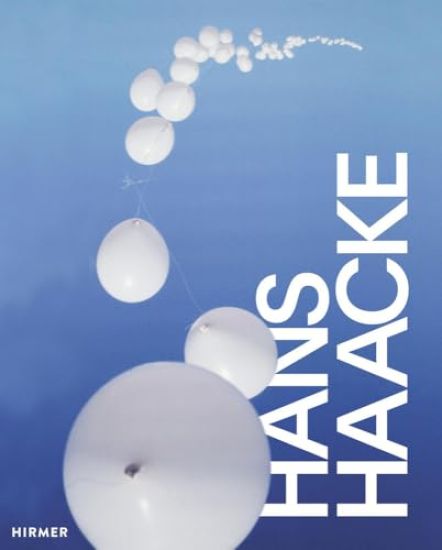
Engage in pursuit of democracy and social change through the provocative and political art of Hans Hacke. Hans Haacke is a legend of political conceptual art, and at the same time, his work is highly topical and of great relevance today. As a founding figure of artistic institutional critique, Haacke redefined the relationship between art and society, as well as influenced generations of artists. This lavishly illustrated volume, Hans Haacke, presents a comprehensive introduction to the German-American artist with works from 1959 to the present day. Haacke's works are provocative and political, but also humorous and poetical. In his early work of the 1960s, he initially reflected on biological and physical (eco-)systems before turning his attention to socio-political structures, which he then subjected to a sharp--often unsparing--analysis. Thus, he examines the abuse of power, historical and political upheavals, the entanglement of public institutions, politics and the economy, and anti-democratic tendencies. He insists on the societal relevance of art and its transformative potential.
Hans Haacke: Swiss Institute Visitors Poll
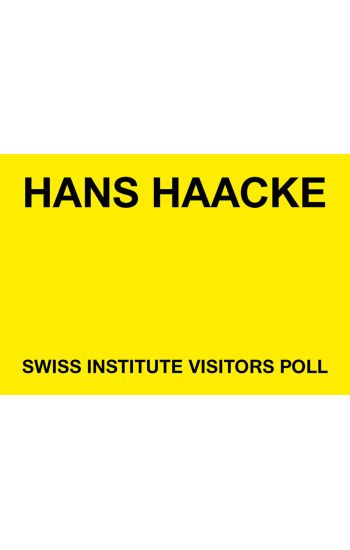
Complete documentation of the longest-running work from Hans Haacke's famous Poll series German artist and institutional critique pioneer Hans Haacke (born 1936) is famed worldwide for examining museums by directly asking their audiences questions. Hans Haacke: Swiss Institute Visitors Poll documents the results of his longest ever poll work, which was conducted at Swiss Institute from June 21, 2018 to October 24, 2019. Newly commissioned for this publication, Haacke's featured essay outlines the history of his poll works, discussing the context and development of this body of work over four decades—all leading up to the Swiss Institute Visitors Poll. The book documents the results of the poll, including 652 pages of facsimile index cards that were written by poll respondents in response to Question #20: “What multiple-choice question would you also have liked to see in this poll?”
Hans Haacke und Pierre Huyghe

Hans Haacke und Pierre Huyghe

Ursula Ströbele

De Gruyter
2024
isokokoinen pokkari
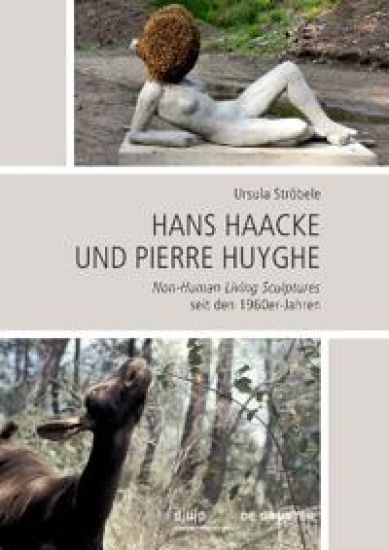
Since the 1960s, artists have questioned the traditional idea of opposition between art and nature. They have incorporated animals and plants as co-actors in their work, and so established a sculptural aesthetic of the living, which called for a redefinition of the sculptural genre. This study is the first to examine so-called Non-Human Living Sculptures using the examples of Hans Haacke and Pierre Huyghe. Following a re-reading of the historiography of modernist sculpture, the author re-evaluates and expands on existing theories in individual work analyses. She shows how Haacke’s real-time systems, determined by US systems theory, biology and cybernetics, as well as his rejection of the object aesthetic have shaped contemporary positions such as Huyghe’s situational-aesthetic works. First comprehensive academic study of socalled Non-Human Living Sculptures Re-reading of the historiography of 20th century sculpture Sculptural aesthetics of the living Look inside
Working Conditions

Working Conditions

Hans Haacke

MIT Press
2016
sidottu
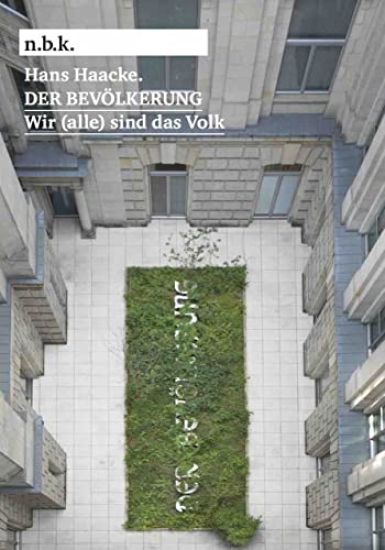
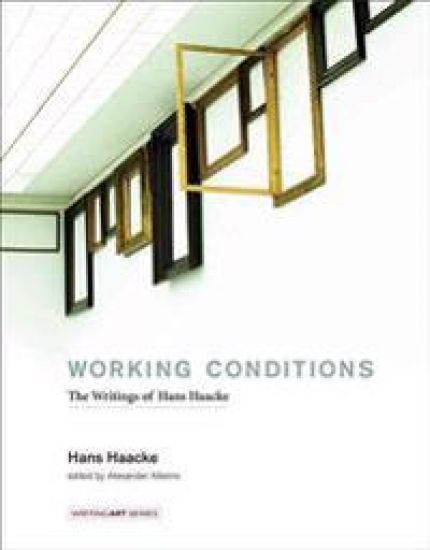
Texts by Hans Haacke that range from straightforward descriptions of his artworks to wide-ranging reflections on the relationship between art and politics.Hans Haacke's art articulates the interdependence of multiple elements. An artwork is not merely an object but is also its context-the economic, social, and political conditions of the art world and the world at large. Among his best-known works are MoMA-Poll (1970), which polled museumgoers on their opinions about Nelson Rockefeller and the Nixon administration's Indochina policy; Gallery-Goers' Birthplace and Residence Profile (1969), which canvassed visitors to the Howard Wise Gallery in Manhattan; and the famously canceled 1971 solo exhibition at the Guggenheim Museum, which was meant to display, among other things, works on two New York real estate empires.This volume collects writings by Haacke that explain and document his practice. The texts, some of which have never before been published, run from straightforward descriptions to wide-ranging reflections and full-throated polemics. They include correspondence with MoMA and the Guggenheim and a letter refusing to represent the United States at the 1969 Sao Paulo Biennial; the title piece, "Working Conditions," which discusses corporate influence on the art world; Haacke's thinking about "real-time social systems"; and texts written for museum catalogs on various artworks, including GERMANIA, in the German Pavilion of the 1993 Venice Biennial; DER BEVOELKERUNG (To the Population) of 2000 at the Berlin Reichstag; Mixed Messages, an exhibition of objects from the Victoria and Albert Museum (2001); and Gift Horse, unveiled on the fourth plinth in Trafalgar Square in 2015.
Free Exchange

Free Exchange

Pierre Bourdieu; Hans Haacke

Polity Press
1995
nidottu
In this book, leading social thinker Pierre Bourdieu and the artist Hans Haacke discuss contemporary art and the relations between art, politics and society. Their dialogue ranges widely from censorship and obscenity to the social conditions of artistic creativity, and focusses on the central themes in the work of both authors.