Kirjojen hintavertailu. Mukana 12 390 323 kirjaa ja 12 kauppaa.

Kirjahaku

Etsi kirjoja tekijän nimen, kirjan nimen tai ISBN:n perusteella.

31 tulosta hakusanalla "Martin R. Delany"

Martin R. Delany

Martin R. Delany

The University of North Carolina Press
2003
nidottu
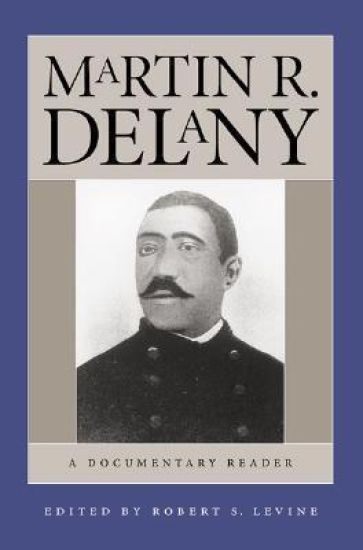
Martin R. Delany (1812-85) has been called the ""Father of Black Nationalism,"" but his extraordinary career also encompassed the roles of abolitionist, physician, editor, explorer, politician, army officer, novelist, and political theorist. Despite his enormous influence in the nineteenth century, and his continuing influence on black nationalist thought in the twentieth century, Delany has remained a relatively obscure figure in U.S. culture, generally portrayed as a radical separatist at odds with the more integrationist Frederick Douglass. This pioneering documentary collection offers readers a chance to discover, or rediscover, Delany in all his complexity. Through nearly 100 documents - approximately two-thirds of which have not been reprinted since their initial nineteenth-century publication - it traces the full sweep of his fascinating career. Included are selections from Delany's early journalism, his emigrationist writings of the 1850s, his 1859-62 novel, Blake (one of the first African American novels published in the United States), and his later writings on Reconstruction. Incisive and shrewd, angry and witty, Delany's words influenced key nineteenth-century debates on race and nation, addressing issues that remain pressing in our own time.
Martin R. Delany: Selected Writings

Martin R. Delany: Selected Writings

Martin R. Delany

BROADVIEW PRESS LTD
2023
pokkari
One of the most powerful and provocative voices to emerge from the social and political unrest preceding the Civil War, the abolitionist and political activist Delany is today considered to have been among the earliest black nationalists. This volume offers a concise introduction to Delany's extraordinary career: included in full is the rousing separatist oration 'Political Destiny of the Colored Race on the American Continent,' followed by a substantial selection from Delany's sole published novel, Blake, often hailed as one of the masterpieces of nineteenth-century American literature. The volume concludes with an epistolary debate between Delany and Frederick Douglass, situating Delany's ideas in relation to those of Douglass and of Harriet Beecher Stowe. This volume is one of a number of editions that have been drawn from the pages of the acclaimed Broadview Anthology of American Literature; like the others, it is designed to make a range of material from the anthology available in a format convenient for use in a wide variety of contexts.
Martin R. Delany’s Civil War and Reconstruction
Militant? Uncompromising? Pragmatic? Utilitarian? Accommodating? Conservative? To engage Martin Robison Delany (1812–1885) is to wrestle with almost all the complexities and paradoxes of nineteenth-century black leadership in one public intellectual. After his previous book on Delany, senior historian Tunde Adeleke has compiled here letters, speeches, contemporary nineteenth-century newspaper articles, and reports written by and about Delany. These vital primary sources cover his Civil War and Reconstruction career in South Carolina and include key critical reactions to Delany’s ideas and writings from his contemporaries. There are over ninety documents, the vast majority not previously published. Delany remains the Subject of conflicting and confusing interpretations. Adeleke indicates that Delany actually manifested complex dispositions. He presaged manifestations of the strands of both protest and compromise that would define the early twentieth-century world of Booker T. Washington and W. E. B. Du Bois. An African American abolitionist and journalist, Delany advocated for black nationalism, one of the first to do so. After working alongside Frederick Douglass to publish the North Star in the 1840s, Delany looked into establishing a Settlement in West Africa. Yet during the Civil War, he served as the first African American field grade officer in the Union Army. Then he labored for the Freedmen’s Bureau in South Carolina. Delany even ran unsuccessfully for lieutenant governor as a Republican and later defected to the Democrats. These documents will prove an indispensable call and response to an unparalleled intellectual life.
Martin R. Delany’s Civil War and Reconstruction
Militant? Uncompromising? Pragmatic? Utilitarian? Accommodating? Conservative? To engage Martin Robison Delany (1812–1885) is to wrestle with almost all the complexities and paradoxes of nineteenth-century black leadership in one public intellectual. After his previous book on Delany, senior historian Tunde Adeleke has compiled here letters, speeches, contemporary nineteenth-century newspaper articles, and reports written by and about Delany. These vital primary sources cover his Civil War and Reconstruction career in South Carolina and include key critical reactions to Delany’s ideas and writings from his contemporaries. There are over ninety documents, the vast majority not previously published. Delany remains the Subject of conflicting and confusing interpretations. Adeleke indicates that Delany actually manifested complex dispositions. He presaged manifestations of the strands of both protest and compromise that would define the early twentieth-century world of Booker T. Washington and W. E. B. Du Bois. An African American abolitionist and journalist, Delany advocated for black nationalism, one of the first to do so. After working alongside Frederick Douglass to publish the North Star in the 1840s, Delany looked into establishing a Settlement in West Africa. Yet during the Civil War, he served as the first African American field grade officer in the Union Army. Then he labored for the Freedmen’s Bureau in South Carolina. Delany even ran unsuccessfully for lieutenant governor as a Republican and later defected to the Democrats. These documents will prove an indispensable call and response to an unparalleled intellectual life.
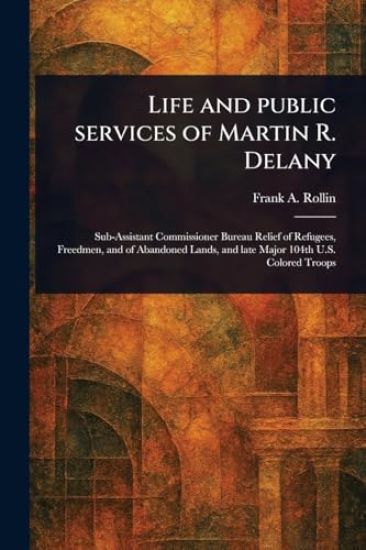
Life and Public Services of Martin R. Delany

Life and Public Services of Martin R. Delany

Frank A. Rollin

Createspace Independent Publishing Platform
2018
nidottu
At the close of every revolution in a country, there is observed an effort for the gradual and general expulsion of all that is effete, or tends to retard progress; and as the nation comes forth from its purification with its existence renewed and invigorated, a better and higher civilization is promised. Before entering upon such an effort, it is usual to compute the aid rendered in the past struggle for national existence, and the present status of the auxiliaries in connection with it. In this manner, as the sullen roar of battle ceases, as the war cloud fades out from our sky, we are enabled to look more soberly upon the stupendous revolution, its causes and teachings, and to consider the men and new measures developed through its agency, the material with which the country is to be reconstructed. In reviewing the history of the late civil war, it will be found, as in former revolutions, that those who were able to master its magnitude were men who, prior to the occasion, were almost wholly unknown, or claimed but a local reputation.
Life and Public Services of Martin R. Delany

Life and Public Services of Martin R. Delany

Frances Rollin Whipper

Hansebooks
2017
pokkari
Life and Public Services of Martin R. Delany - Sub-assistant commissioner, Bureau relief of refugees, freedmen, and of abandoned lands, and late major 104th U.S. colored troops is an unchanged, high-quality reprint of the original edition of 1883. Hansebooks is editor of the literature on different topic areas such as research and science, travel and expeditions, cooking and nutrition, medicine, and other genres. As a publisher we focus on the preservation of historical literature. Many works of historical writers and scientists are available today as antiques only. Hansebooks newly publishes these books and contributes to the preservation of literature which has become rare and historical knowledge for the future.
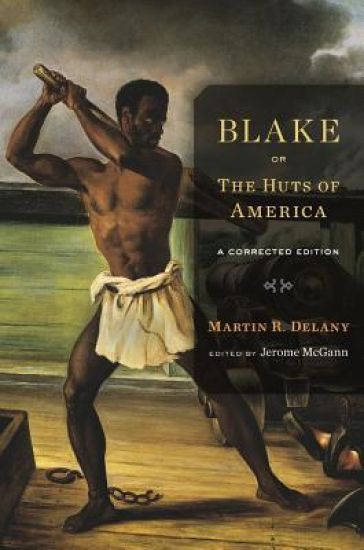
Blake; or, The Huts of America

Blake; or, The Huts of America

Martin R. Delany

Harvard University Press
2017
nidottu
Martin R. Delany’s Blake (1859, 1861–1862) is one of the most important African American—and indeed American—works of fiction of the nineteenth century. It tells the story of Henry Blake’s escape from a southern plantation and his subsequent travels across the United States, into Canada, and to Africa and Cuba. His mission is to unite the black populations of the American Atlantic regions, both free and slave, in the struggle for freedom, whether through insurrection or through emigration and the creation of an independent black state. Blake is a rhetorical masterpiece, all the more strange and mysterious for remaining incomplete, breaking off before its final scene.This edition of Blake, prepared by textual scholar Jerome McGann, offers the first correct printing of the work in book form. It establishes an accurate text, supplies contextual notes and commentaries, and presents an authoritative account of the work’s composition and publication history. In a lively introduction, McGann argues that Delany employs the resources of fiction to develop a critical account of the interconnected structure of racist power as it operated throughout the American Atlantic. He likens Blake to Upton Sinclair’s The Jungle, in its willful determination to transform a living and terrible present.Blake; or, The Huts of America: A Corrected Edition will be used in undergraduate and graduate classes on the history of African American fiction, on the history of the American novel, and on black cultural studies. General readers will welcome as well the first reliable edition of Delany’s fiction.
Blake

Blake

MARTIN R. DELANY

Beacon Press
1971
pokkari
Delaney's hero is a West Indian slave who travels throughout the South advocating revolution, and later becomes the general of a black insurrectory fore in Cuba. Blake hopes that, with rebellion in Cuba and the expulsion of all Americans, Cuba's model as a self-governed black state will ultimately precipitate the downfall of slavery in the United States. Focusing on the political and social issues of the 1850s - slavery as an institution, Cuba as the prime interest of Southern expansionists, the practicality of militant slave revolution, and the possibilities of collective action - "Blake "is one of the most revealing novels of its period.