Kirjojen hintavertailu. Mukana 12 390 323 kirjaa ja 12 kauppaa.

Kirjahaku

Etsi kirjoja tekijän nimen, kirjan nimen tai ISBN:n perusteella.

7 tulosta hakusanalla "Miriam Hansen"

Miriam Hansen

Miriam Hansen

Duke University Press
2014
pokkari
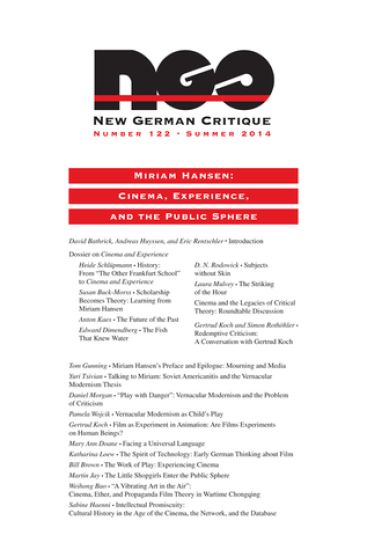
This issue is dedicated to the thought and writing of Miriam Hansen, whose contributions broke ground in film history, film theory, and the politics of mass culture and the public sphere. The collection focuses on the areas in which she was most influential: early cinema, its reception, and the legacy of vernacular modernism, including essays touching on the concept’s impact on contemporary thinking about Russian and Chinese cinemas. The issue also features extensive commentary on Hansen’s pioneering book Cinema and Experience, expanding on the book’s inquiry into the continuing legacy of the Frankfurt School.
Cinema and Experience

Cinema and Experience

Miriam Hansen

University of California Press
2011
sidottu
Siegfried Kracauer, Walter Benjamin, and Theodor W. Adorno - affiliated through friendship, professional ties, and argument - developed an astute philosophical critique of modernity in which technological media played a key role. This book explores in depth their reflections on cinema and photography from the Weimar period up to the 1960s. Miriam Bratu Hansen brings to life an impressive archive of known and, in the case of Kracauer, less known materials and reveals surprising perspectives on canonic texts, including Benjamin's artwork essay. Her lucid analysis extrapolates from these writings the contours of a theory of cinema and experience that speaks to questions being posed anew as moving image culture evolves in response to digital technology.
Cinema and Experience

Cinema and Experience

Miriam Hansen

University of California Press
2011
pokkari
Siegfried Kracauer, Walter Benjamin, and Theodor W. Adorno - affiliated through friendship, professional ties, and argument - developed an astute philosophical critique of modernity in which technological media played a key role. This book explores in depth their reflections on cinema and photography from the Weimar period up to the 1960s. Miriam Bratu Hansen brings to life an impressive archive of known and, in the case of Kracauer, less known materials and reveals surprising perspectives on canonic texts, including Benjamin's artwork essay. Her lucid analysis extrapolates from these writings the contours of a theory of cinema and experience that speaks to questions being posed anew as moving image culture evolves in response to digital technology.
Babel and Babylon

Babel and Babylon

Miriam Hansen

Harvard University Press
1994
nidottu
Although cinema was invented in the mid-1890s, it was a decade more before the concept of a “film spectator” emerged. As the cinema began to separate itself from the commercial entertainments in whose context films initially had been shown—vaudeville, dime museums, fairgrounds—a particular concept of its spectator was developed on the level of film style, as a means of predicting the reception of films on a mass scale. In Babel and Babylon, Miriam Hansen offers an original perspective on American film by tying the emergence of spectatorship to the historical transformation of the public sphere.Hansen builds a critical framework for understanding the cultural formation of spectatorship, drawing on the Frankfurt School’s debates on mass culture and the public sphere. Focusing on exemplary moments in the American silent era, she explains how the concept of the spectator evolved as a crucial part of the classical Hollywood paradigm—as one of the new industry’s strategies to integrate ethnically, socially, and sexually differentiated audiences into a modern culture of consumption. In this process, Hansen argues, the cinema might also have provided the conditions of an alternative public sphere for particular social groups, such as recent immigrants and women, by furnishing an intersubjective context in which they could recognize fragments of their own experience.After tracing the emergence of spectatorship as an institution, Hansen pursues the question of reception through detailed readings of a single film, D. W. Griffith’s Intolerance (1916), and of the cult surrounding a single star, Rudolph Valentino. In each case the classical construction of spectatorship is complicated by factors of gender and sexuality, crystallizing around the fear and desire of the female consumer.Babel and Babylon recasts the debate on early American cinema—and by implication on American film as a whole. It is a model study in the field of cinema studies, mediating the concerns of recent film theory with those of recent film history.
The Uncanny Gaze

The Uncanny Gaze

Heide Schlupmann; Miriam Hansen

University of Illinois Press
2010
sidottu
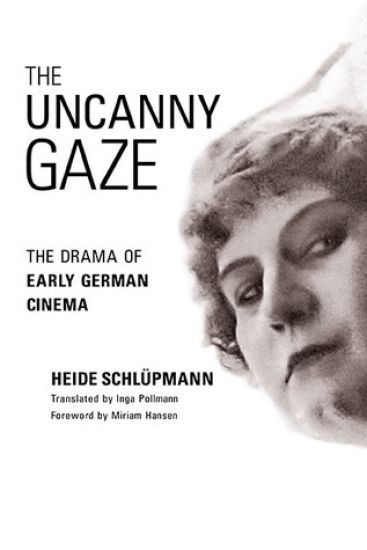
Heide Schlüpmann's classic study of early German cinema was published in German as Unheimlichkeit des Blicks: Das Drama des Frühen deutschen Kinos in 1990. For the first time in English, this translation makes available her feminist examination of German cinema and Germany in the sociopolitical context of Wilhelmine society. By examining then-unknown pre-World War I narrative films, this study paints a picture of the conflicted early years of the German cinema. During this period cinema and film production were able to develop independently from the cultural bourgeoisie and relied on those forces excluded from high "culture": technology, business, performers, showmen, and actors. In cinema, the dime novel and kitsch were exhibited for all, and the internationalism of modernity prevailed over the prevailing nationalism of the period.Featuring a foreword by film scholar Miriam Hansen and a new afterword by Schlüpmann, this volume performs a critical perusal of film commentary and offers an in-depth look at little-known films in early German cinema.
The Uncanny Gaze

The Uncanny Gaze

Heide Schlupmann; Miriam Hansen

University of Illinois Press
2010
nidottu
Heide Schlüpmann's classic study of early German cinema was published in German as Unheimlichkeit des Blicks: Das Drama des Frühen deutschen Kinos in 1990. For the first time in English, this translation makes available her feminist examination of German cinema and Germany in the sociopolitical context of Wilhelmine society. By examining then-unknown pre-World War I narrative films, this study paints a picture of the conflicted early years of the German cinema. During this period cinema and film production were able to develop independently from the cultural bourgeoisie and relied on those forces excluded from high "culture": technology, business, performers, showmen, and actors. In cinema, the dime novel and kitsch were exhibited for all, and the internationalism of modernity prevailed over the prevailing nationalism of the period.Featuring a foreword by film scholar Miriam Hansen and a new afterword by Schlüpmann, this volume performs a critical perusal of film commentary and offers an in-depth look at little-known films in early German cinema.
Public Sphere and Experience

Public Sphere and Experience

Alexander Kluge; Oskar Negt; Miriam Hansen

Verso Books
2016
nidottu
The "public sphere" is a key concept in political discourse, designating a space for political action. But is this a single authoritative and universal space in which various positions compete for recognition, or does it consist of multiple local spaces spread over diverse collectivities? In Kluge and Negt's groundbreaking book they examine the material conditions of experience in an arena that had previously figured only as an abstract term: the media of mass and consumer culture.With new, up-to-date introduction from Alexander Kluge.