Kirjojen hintavertailu. Mukana 11 717 486 kirjaa ja 12 kauppaa.

Kirjahaku

Etsi kirjoja tekijän nimen, kirjan nimen tai ISBN:n perusteella.

29 tulosta hakusanalla "Nicholas of Cusa"

Nicholas of Cusa: The Catholic Concordance

Nicholas of Cusa: The Catholic Concordance

Nicholas of Cusa

Cambridge University Press
1991
sidottu
Now available in paperback, this is the first English translation of the most important work of political thought of the fifteenth century. The Catholic Concordance is the first major treatise to argue for consent through representative councils as a major prerequisite for legitimate law and government, and is the most learned and original work associated with the conciliar movement in the late medieval church. Cusa’s arguments influenced such thinkers as Luther, Bruno and Locke, and Professor Sigmund’s introduction places his work in its full historical and philosophical context. The volume contains all the standard series features including a chronology, note on sources and bibliography, and as one of the earliest formulations of the view that political legitimacy rests on consent, The Catholic Concordance will be of interest to a wide range of scholars and students of the history of European ideas.
Nicholas of Cusa

Nicholas of Cusa

RoutledgeCurzon
2001
sidottu
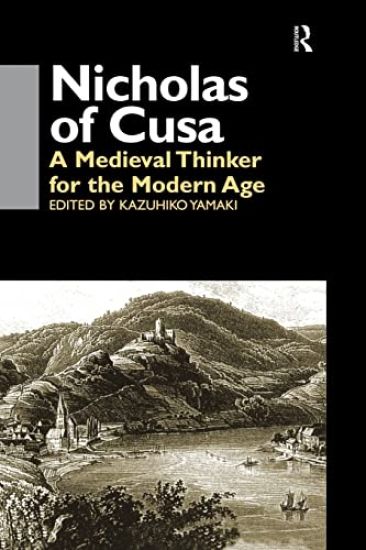
Nicholas of Cusa (1401 64), doctor of canon law, church politician and philosopher, was one of the most important thinkers of 15th century Europe. This year marks the sixth centenary of his birth. Scholars from round the globe gathered in Tokyo for the 19th Cusanus Congress last year; this volume makes their contributions more widely available. Major themes examined include tradition and innovation, religion, the relevance of Nicholas of Cusa's thought for today, the relationship between East and West in his thought, and the development of his thought and scholarship as we enter a new millennium. Multilingual text: English, German, French.
Nicholas of Cusa

Nicholas of Cusa

Paulist Press International,U.S.
1997
nidottu
"English-speaking Christians owe Paulist Press an enormous debt of gratitude for their continuing efforts to help us gain a deeper appreciation of our spiritual heritage." Spiritual Life Nicholas of Cusa: Selected Spiritual Writings translated and introduced by H. Lawrence Bond preface by Morimichi Watanabe "This cloud, mist, darkness, or ignorance into which whoever seeks your face enters when one leaps beyond every knowledge and concept is such that below it your face cannot be found except veiled. But this very cloud reveals your face to be there beyond all veils…The denser, therefore, one knows the cloud to be the more one truly attains the invisible light in the cloud. I see, O Lord, that it is only in this way that the inaccessible light, the beauty, and the splendor of your face can be approached without veil." From De visione Dei, c. 6 Nicholas of Cusa (1401-1464) is often called the outstanding intellectual figure of the fifteenth century as well as the principal gatekeeper between medieval and modern philosophy. This volume gives fresh attention to the theological and mystical dimensions of his thought. The introduction casts new and exciting light on the development of Cusa's theology of spirituality. The book also provides for the first time in one volume an English translation of Cusa's basic mystical corpus: On Learned Ignorance; On the Hidden God; On Seeking God; On the Vision of God; and On the Summit of Contemplation. Another unique feature is the annotated glossary of key Cusan terms that accompanies the texts. Cusa's writings reveal a remarkable imaginative and gifted theologian who anticipated contemporary questions of ecumenicity and pluralism, empowerment and reconciliation, and tolerance and individuality. These translations particularly communicate to us his experience of a very large God that jostles us out of our parochialism. For all his intellectual power, he never closes his thought into a system. He is a significator and a conjecturer. He keeps pointing beyond his own words and beyond even his prized formulae and labels, including "learned ignorance" and "coincidence of opposites." He persistently brings theology to the edge of incomprehensibility, beyond both positive and negative ways, beyond even paradox and the coincidence of opposites, to the realm of the Purely Absolute and Infinite, to the contemplation of Possibility Itself. †
Nicholas of Cusa

Nicholas of Cusa

The Catholic University of America Press
2010
nidottu
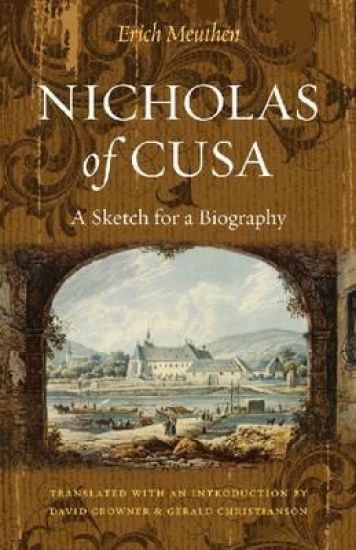
This translation of Erich Meuthen's well-known biography of Nicholas of Cusa presents the foremost summary of Cusanus's life and thought. From its original edition in 1964 through its seventh edition in 1992, Meuthen's sketch has found an appreciative audience. As Meuthen takes readers through Cusanus's life (1401-1464) they will be amazed that, in an age when writers set down every word with quill and ink, and one traversed every mile on land by foot or horse, Cusanus covered thousands of miles, maintained detailed administration of church affairs, rose in rank to cardinal, served as a papal legate, and still found time to write penetrating treatises such as The Catholic Concordance, Learned Ignorance, The Vision of God, and The Peace of Faith. While rendering Meuthen's language into smooth prose that still reflects his style and intent, the translators have added an introduction that describes the historical context for Cusanus. New also is a glossary of terms, as well as an updated bibliography of Cusanus research compiled by Hans Gerhard Senger, and a tribute to Meuthen by Morimichi Watanabe.
Nicholas of Cusa
Nicholas of Cusa (1401 64), doctor of canon law, church politician and philosopher, was one of the most important thinkers of 15th century Europe. This year marks the sixth centenary of his birth. Scholars from round the globe gathered in Tokyo for the 19th Cusanus Congress last year; this volume makes their contributions more widely available. Major themes examined include tradition and innovation, religion, the relevance of Nicholas of Cusa's thought for today, the relationship between East and West in his thought, and the development of his thought and scholarship as we enter a new millennium. Multilingual text: English, German, French.
Nicholas of Cusa: The Catholic Concordance
Now available in paperback, this is the first English translation of the most important work of political thought of the fifteenth century. The Catholic Concordance is the first major treatise to argue for consent through representative councils as a major prerequisite for legitimate law and government, and is the most learned and original work associated with the conciliar movement in the late medieval church. Cusa’s arguments influenced such thinkers as Luther, Bruno and Locke, and Professor Sigmund’s introduction places his work in its full historical and philosophical context. The volume contains all the standard series features including a chronology, note on sources and bibliography, and as one of the earliest formulations of the view that political legitimacy rests on consent, The Catholic Concordance will be of interest to a wide range of scholars and students of the history of European ideas.
Nicholas of Cusa's "On Learned Ignorance

Nicholas of Cusa's "On Learned Ignorance

Karsten Harries

THE CATHOLIC UNIVERSITY OF AMERICA PRESS
2024
sidottu
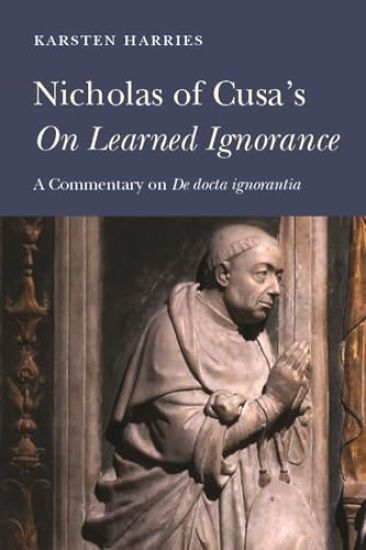
This is the first commentary to have been written on Nicholas of Cusa's most famous work, On Learned Ignorance. This fact testifies to the difficulty of what has long been recognized to be the most significant philosophical text produced by the Renaissance. While there are many passages in the work that can be cited in support of Cassirer's celebration of Cusanus as the first modern philosopher, that judgment is challenged by the way his work is rooted in a faith and a tradition likely to strike us as thoroughly medieval. This commentary shows how closely the two are linked. Despite the many ways in which what the cardinal has to say belongs to a past that the progress of reason would seem to have left irrecoverably behind, it yet provides us with a continuing challenge. Key to On Learned Ignorance is the incommensurability of the infinite and the finite, of God and creation. Cusanus lets us recognize the essential transcendence of reality, so different from the ontology implied by Descartes' insistence on clear and distinct understanding, which has presided over the progress of science and has helped shape our world. What makes Cusanus' thought important is not the way it anticipates modernity, but the way it challenge often taken for granted presuppositions of our worldview, most importantly a distinctly modern self-assertion or self-elevation that has made our human reason the measure of reality. If it is impossible to deny the countless ways in which our science and technology have given us ever deeper insights into the mysteries of nature and improved our lives, it is equally impossible to deny that this very progress today endangers this fragile earth and the quality of our lives. Cusanus can help us preserve our humanity.
Nicholas of Cusa and the Renaissance

Nicholas of Cusa and the Renaissance

F. Edward Cranz; Thomas M. Izbicki

Variorum
2000
sidottu
This volume brings together Professor Cranz’s published studies on Nicholas of Cusa with a set of seven papers left unpublished at the time of his death. Their subjects are the speculative thought of Cusanus and his relationship with the broader themes of the Renaissance. Particular attention is given to patterns of development in Cusanus’ thought as he wrestled with problems of divine transcendence and the limits of human capacities. Overall, these studies also reveal Professor Cranz’s interest in the larger changes in Western modes of thought during the Middle Ages and the Renaissance, which define our ways of thinking as different from those of Antiquity.
Nicholas of Cusa and Medieval Political Thought. --

Nicholas of Cusa and Medieval Political Thought. --

Paul E. Sigmund

Hassell Street Press
2021
sidottu
This work has been selected by scholars as being culturally important and is part of the knowledge base of civilization as we know it.This work is in the public domain in the United States of America, and possibly other nations. Within the United States, you may freely copy and distribute this work, as no entity (individual or corporate) has a copyright on the body of the work.Scholars believe, and we concur, that this work is important enough to be preserved, reproduced, and made generally available to the public. To ensure a quality reading experience, this work has been proofread and republished using a format that seamlessly blends the original graphical elements with text in an easy-to-read typeface.We appreciate your support of the preservation process, and thank you for being an important part of keeping this knowledge alive and relevant.
Nicholas of Cusa and Medieval Political Thought. --

Nicholas of Cusa and Medieval Political Thought. --

Paul E. Sigmund

Hassell Street Press
2021
nidottu
This work has been selected by scholars as being culturally important and is part of the knowledge base of civilization as we know it.This work is in the public domain in the United States of America, and possibly other nations. Within the United States, you may freely copy and distribute this work, as no entity (individual or corporate) has a copyright on the body of the work.Scholars believe, and we concur, that this work is important enough to be preserved, reproduced, and made generally available to the public. To ensure a quality reading experience, this work has been proofread and republished using a format that seamlessly blends the original graphical elements with text in an easy-to-read typeface.We appreciate your support of the preservation process, and thank you for being an important part of keeping this knowledge alive and relevant.
Nicholas of Cusa - A Companion to his Life and his Times

Nicholas of Cusa - A Companion to his Life and his Times

Morimichi Watanabe; Edited by Gerald Christianson

TAYLOR FRANCIS LTD
2024
nidottu
This work is a guide to the life, thought and activities of Nicholas of Cusa (1401-1464), the great fifteenth-century philosopher, theologian, jurist, author of mystical and ecclesiastical treatises, cardinal and reformer. It is intended not only for advanced scholars, but also for beginners and those simply curious about a man who has been called 'one of the greatest Germans of the fifteenth century' and a 'medieval thinker for the modern age'. The book provides a series of detailed but readable essays on ideas, persons, and places, a work developed over the course of nearly three decades. First, it contains articles on the important events and concepts that affected Cusanus--philosophical, religious, intellectual and political. Then it turns to his precursors and contemporaries, both friendly and critical. These include philosophers, theologians, politicians, and canon lawyers. And third, the book follows the footsteps of the man from Kues and examines various sites where he lived, studied, or visited. Because the author has also visited many of these sites, he can contribute personal observations to enliven the journey. To add to the book's usefulness as a resource and reference tool, each entry is followed by a bibliography containing both recent and older works. The purpose of the volume is to gain a greater appreciation of Cusanus and his legacy by striving for a total view of his thought and experience instead of narrowly focusing on specific philosophical, theological or intellectual ideas, or certain periods of his activities in isolation from other facets of this compelling figure.
Nicholas of Cusa - A Companion to his Life and his Times

Nicholas of Cusa - A Companion to his Life and his Times

Morimichi Watanabe; Edited by Gerald Christianson

Ashgate Publishing Limited
2011
sidottu
This work is a guide to the life, thought and activities of Nicholas of Cusa (1401-1464), the great fifteenth-century philosopher, theologian, jurist, author of mystical and ecclesiastical treatises, cardinal and reformer. It is intended not only for advanced scholars, but also for beginners and those simply curious about a man who has been called 'one of the greatest Germans of the fifteenth century' and a 'medieval thinker for the modern age'. The book provides a series of detailed but readable essays on ideas, persons, and places, a work developed over the course of nearly three decades. First, it contains articles on the important events and concepts that affected Cusanus--philosophical, religious, intellectual and political. Then it turns to his precursors and contemporaries, both friendly and critical. These include philosophers, theologians, politicians, and canon lawyers. And third, the book follows the footsteps of the man from Kues and examines various sites where he lived, studied, or visited. Because the author has also visited many of these sites, he can contribute personal observations to enliven the journey. To add to the book's usefulness as a resource and reference tool, each entry is followed by a bibliography containing both recent and older works. The purpose of the volume is to gain a greater appreciation of Cusanus and his legacy by striving for a total view of his thought and experience instead of narrowly focusing on specific philosophical, theological or intellectual ideas, or certain periods of his activities in isolation from other facets of this compelling figure.
Nicholas of Cusa and Muhammad

Nicholas of Cusa and Muhammad

Nathan Ron

PETER LANG PUBLISHING INC
2023
sidottu
Nicholas of Cusa (1401–1464), thinker, polymath, and cardinal, had a long-standing interest in Islam. To date, however, no work has satisfactorily dealt with his volatile attitude towards the Islamic faith and the Ottoman Turks. This book revisits Nicholas of Cusa’s attitude towards Islam, criticizing previous work that has overlooked Cusa’s involvement in preparations for a crusade, and the significance of Cusa’s polemical A Scrutiny of the Koran (Cribratio Alkorani) of 1461. The book also addresses the prevailing image of Cusa as a dove of peace and champion of interreligious dialogue, and suggests an alternative and more complex picture which takes account of Cusa’s crusading activities and his attitude towards Muslims and Jews. A significant new study, Nicolas of Cusa and Mohammed will appeal to students and scholars interested in the Renaissance, Humanism, church–state relations, the history of the crusades, and Nicholas of Cusa’s life and works. "Nathan Ron sets the record straight about Nicholas of Cusa as so-called pioneer of ‘inter-religious dialogue’ based on a close reading of the irenic Peace of Faith and the polemical Scrutiny of the Koran, together with his role in mounting a crusade for Pope Pius II." —Gerald Christianson, Professor Emeritus of Church History, United Lutheran Seminary, Gettysburg; Past President, American Cusanus Society "Nicholas of Cusa often is presented as a champion of interreligious dialogue. This book rightly brings to the fore Cusanus’ often harsh polemic against Islam and his role in Pius II’s crusade against the Turks." —Thomas Izbicki, Humanities librarian emeritus, Rutgers University
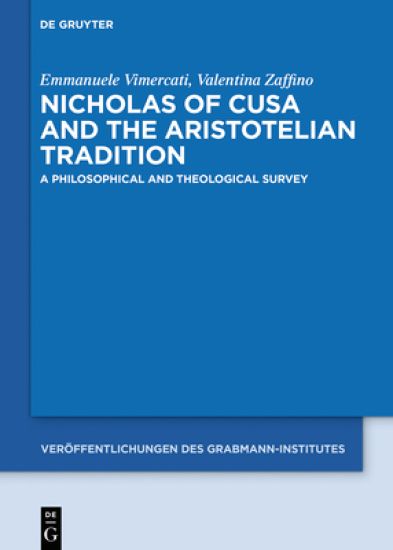
Nicholas of Cusa and the Aristotelian Tradition
The volume focuses on the relation between Cusanus and Aristotle or the Aristotelian tradition. In recent years the attention on this topic has partially increased, but overall the scholarship results are still partial or provisional. The book thus aims at verifying more systematically how Aristotle and Aristotelianism have been received by Cusanus, in both their philosophical and theological implications, and how he approached the Aristotelian thought. In order to answer these questions, the papers are structured according to the traditional Aristotelian sciences and their reflection on Cusanus' thought. This allows to achieve some aspects of interest and originality: 1) the book provides a general, but systematic analysis of Aristotle's reception in Cusanus' thought, with some coherent results. 2) Also, it explores how a philosopher and theologian traditionally regarded as Neoplatonist approached Aristotle and his tradition (including Thomas Aquinas), what he accepted of it, what he rejected, and what he tried to overcome. 3) Finally, the volume verifies the attitude of a relevant Christian philosopher and theologian of the Humanistic age towards Aristotle.
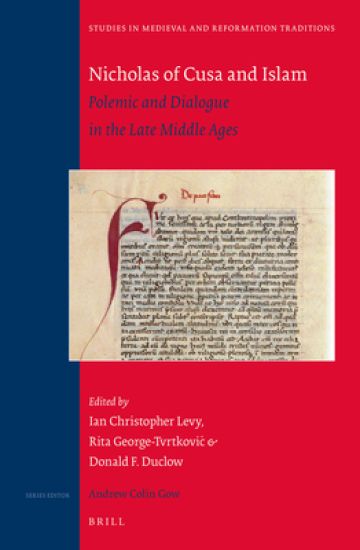
Nicholas of Cusa and Islam
This collection of essays explores the complex relations between Christians and Muslims at the dawn of the modern age. It begins by examining two seminal works by Nicholas of Cusa: De pace fidei, a dialogue seeking peace among world religions written after the conquest of Constantinople in 1453, and Cribratio Alkorani (1460-61), an attempt to confirm Gospel truths through a critical reading of the Qur’an. After considering Nicholas, his sources, and his context, the book explores a wider range of late medieval texts on Christian-Muslim relations—not only Christian writings about Islam but also Muslim responses to Christianity. The book’s focus is historical, but it can also contribute to efforts at increasing Muslim-Christian understanding today.
Tracing Nicholas of Cusa's Early Development

Tracing Nicholas of Cusa's Early Development

J. de Guzman Miroy

PEETERS PUBLISHERS
2009
nidottu
The history of philosophy has painted two differing, if not contradictory, images of Nicholas of Cusa. He was hitherto considered either as a mystical theologian or as a political philsopher. This book is a comparative study of the two great works that have generated these divergent representations of the 15th century German thinker, namely De concordantia catholica and De docta ignorantia. The study yields an understanding of the continuity and discontinuity in the thinking of the Cusanus of the Council of Basel and that of the post-Basel period. This book also provides details that are necessary to offer a unified as well as a dynamic thought, which is of vital importance to argue for the continued relevance of medieval thought in contemporary times.