Kirjojen hintavertailu. Mukana 12 459 402 kirjaa ja 12 kauppaa.

Kirjahaku

Etsi kirjoja tekijän nimen, kirjan nimen tai ISBN:n perusteella.

213 tulosta hakusanalla "Niklas Luhmann"

Niklas Luhmann

Niklas Luhmann

Christian Borch

Routledge
2011
sidottu
Niklas Luhmann offers an accessible introduction to one of the most important sociologists of our time. It presents the key concepts within Luhmann’s multifaceted theory of modern society, and compares them with the work of other key social theorists such as Jürgen Habermas, Michel Foucault, and Zygmunt Bauman.The book pays particular attention to introducing and discussing Luhmann’s original sociological systems theory. It presents a thorough investigation into the different phases of his oeuvre, through which both the shifting emphases as well as the continuities in his thinking are shown. The primary focus of this text is Luhmann’s theory of modern society as being differentiated into a plethora of ‘function systems’ – such as politics, law, and economy – which operate according to their own distinct logics and which cannot interfere with one another. For Luhmann, this functional differentiation works as a bulwark against totalitarian rule, and as such is a key foundation of modern democracy. Furthermore, the book critically examines the implications of this functional differentiation for inclusion and exclusion dynamics, as well as for the understanding of power and politics.This is a key text for both undergraduate and postgraduate students of areas including contemporary social theory, political sociology, and sociology.
Niklas Luhmann

Niklas Luhmann

Christian Borch

Routledge
2011
nidottu
Niklas Luhmann offers an accessible introduction to one of the most important sociologists of our time. It presents the key concepts within Luhmann’s multifaceted theory of modern society, and compares them with the work of other key social theorists such as Jürgen Habermas, Michel Foucault, and Zygmunt Bauman.The book pays particular attention to introducing and discussing Luhmann’s original sociological systems theory. It presents a thorough investigation into the different phases of his oeuvre, through which both the shifting emphases as well as the continuities in his thinking are shown. The primary focus of this text is Luhmann’s theory of modern society as being differentiated into a plethora of ‘function systems’ – such as politics, law, and economy – which operate according to their own distinct logics and which cannot interfere with one another. For Luhmann, this functional differentiation works as a bulwark against totalitarian rule, and as such is a key foundation of modern democracy. Furthermore, the book critically examines the implications of this functional differentiation for inclusion and exclusion dynamics, as well as for the understanding of power and politics.This is a key text for both undergraduate and postgraduate students of areas including contemporary social theory, political sociology, and sociology.

Niklas Luhmann

Niklas Luhmann

Walter de Gruyter
2013
sidottu
Niklas Luhmanns "Soziale Systeme" (1984) bildet den Grundstein der von ihm ausgearbeiteten Systemtheorie; das Werk ist die Einleitung in seine "Theorie der Gesellschaft".Hier entfaltet er seine systemtheoretische Terminologie, wobei oft dieselben Begriffe wie in der traditionellen Terminologie auftauchen, von Luhmann in der eigenen Gesellschaftstheorie jedoch anders gef llt werden. Die Beitr ge des vorliegenden Bandes ebnen vor diesem Hintergrund den Zugang zur Luhmannschen Theorie und zeigen auf, dass sie wie jede Theorie ein Konstrukt ist, das uns hilft, die Realit t zu erfassen. Die Autorinnen und Autoren des kooperativen Kommentars zu Luhmanns Werk "Soziale Systeme" sind namhafte Theoretikerinnen und Theoretiker, die ihr Forschen in engem Zusammenhang mit der Luhmannschen Theorie betreiben. In den Beitr gen dieses Bandes werden die Leserinnen und Leser ber den Inhalt des Buchs von Luhmann informiert und dessen Kapitel, der Chronologie des Originalwerks folgend, f r ein besseres und erweitertes Verst ndnis aufgeschlossen. MIT BEITR GEN VON: Dirk Baecker, Cornelia Bohn, Marcus Emmerich, Elena Esposito, Dietmar Gensicke, Detlef Horster, Christina Huber, Maren Lehmann, Julian M ller, Armin Nassehi, Martin Petzke, William Rasch, Anna Schriefl, Michael Urban, Christine Weinbach und Niels Werber.
Niklas Luhmann

Niklas Luhmann

Claudio Baraldi; Giancarlo Corsi

Springer International Publishing AG
2016
nidottu
This book provides an insight into the ideas of one of the world’s greatest sociologists: Niklas Luhmann. It explains, in clear and concise language, the basic concepts of Social Systems Theory and their application to the specific case of the Education System, which was considered by Luhmann as a primary subsystem of modern society. It illustrates the complex and sophisticated thinking that characterises Luhmann’s work and explains that Luhmann’s theory has given an important and original contribution to the study of education from a sociological point of view. His contribution has some resonance in recent social constructionist and relational approaches to education, as well as in studies of educational interaction. In addition, research methodologies, in particular mixed methods strategies, draw heavily on epistemological issues. The book finally argues that educationists can appreciate the extent of Luhmann’s contribution to the field of education, although their perspective cannot be fully harmonised with, nor reduced to, the sociological one. This divergence of perspectives can stimulate pedagogy to call into question its conceptual framework as well its approach to social situations in the classroom.
Niklas Luhmann

Niklas Luhmann

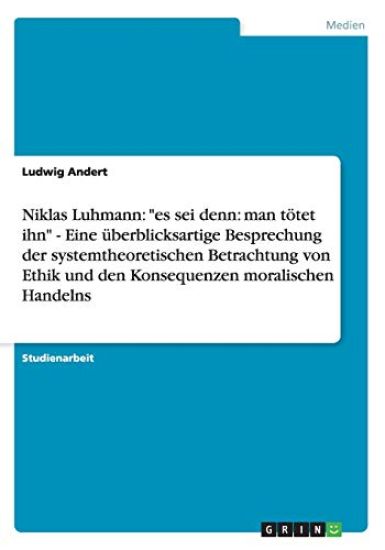
Ludwig Andert

Grin Publishing
2009
nidottu
Studienarbeit aus dem Jahr 2009 im Fachbereich Medien / Kommunikation - Medienethik, Note: 1,0, Universit t Siegen, Sprache: Deutsch, Abstract: Am Beispiel der wissenschaftlichen Reflexion von Moral zeigt Luhmann, dass eine r cksichtslos vereinfachende Vorgehensweise zu einer "Infektion" f hren kann, so dass ein Wissenschaftler am Ende nicht mehr wissenschaftliche, sondern moralische Urteile f llt. Damit ist er einem zentralen Problem jeder Ethik auf der Spur: Letztlich soll ein Theoriegeb ude der Moral dazu dienen, die Begr ndung der Moral von einem seinerseits moralischen Urteil unabh ngig zu machen. Doch wenn eine Ethik nicht moralischen Kriterien gen gen muss, wie kann sie dann Basis f r Werturteile wie "gut" oder "schlecht" sein? Der vorliegende Text wird Luhmanns Vorschlag beleuchten, Ethik als Probleml sungsstrategie moralischer Reflexion zu verstehen, die historisch unter dem Einfluss moralexterner Rahmenfaktoren steht und zwischen diesen und der konkreten Ausformulierung von Moral vermittelt. Au erdem soll ein Blick auf die Konsequenzen der Ethiktheorie Luhmanns geworfen werden.
Niklas Luhmann

Niklas Luhmann

Eberhard Blanke

Books on Demand
2017
pokkari
Eine Biografie zu Niklas Luhmann ist bislang nicht verf gbar, dennoch ist der Nachlass des Bielefelder Soziologen f r diesen Zweck nicht erschlossen. In der vorliegenden biografischen Einf hrung (in 2., korrigierter und aktualisierter Auflage) werden Leben, Werk und Wirkung Luhmanns erstmals in ihren Grundlinien aufeinander bezogen. Der Titel "... stattdessen ..." deutet an, dass der Systemtheoretiker des 20. Jahrhunderts davon berzeugt war: "Es gibt keine Biografie."
Niklas Luhmann

Niklas Luhmann

Justine Grønbæk Pors & Niels Åkerstrøm Andersen

Jurist- og økonom-
2018
nidottu
Niklas Luhmann (1927-1998) er en af de helt centrale tænkere for enhver, der ønsker at forstå det moderne samfunds kompleksitet og aktuelle betingelser for politik, styring og ledelse. Luhmann havde en imponerende evne til at dekonstruere statskundskabens sædvanlige antagelser og formulere nye indsigter. En gennemgående pointe i forfatterskabet er, at samfundet grundlæggende er ustyrligt, og at enhver styring producerer ny ustyrlighed. Denne bog introducerer Luhmanns særlige systemteoretiske blik og de kontraintuitive indsigter, dette blik giver i forhold til politik, styring og ledelse. Bogen formidler Luhmanns teorier om samfundet men viser også, hvordan hans begreber åbner for forskellige analytiske strategier, som læseren kan bruge til egne empiriske analyser af ledelse i politik og forvaltning.Om forfatteren Professor Niels Åkerstrøm Andersen og lektor Justine Grønbæk Pors er begge ansat ved Institut for Ledelse, Politik og Filosofi på Copenhagen Business School.
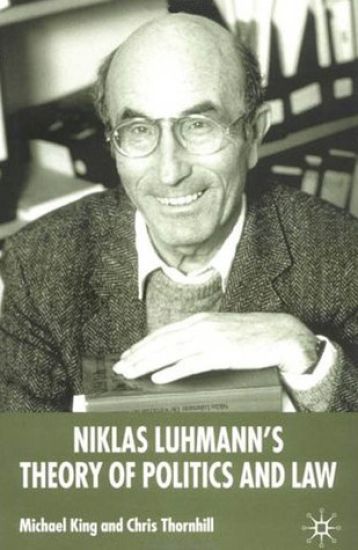
Niklas Luhmann's Theory of Politics and Law

Niklas Luhmann's Theory of Politics and Law

M. King; C. Thornhill

Palgrave Macmillan
2003
sidottu
Niklas Luhmann's social theory stands in direct opposition to the dominant 'anthropocentric' traditions of legal and political analysis. King and Thornhill now offer the first comprehensive, critical examination of Luhmann's highly original theory of the operations of the legal and political systems. They describe how from the perspective of his 'sociological enlightenment' Luhmann continually calls to account the certainties, the ambitions and rational foundations of The Enlightenment and the idealized versions of law and politics which they have produced.
Niklas Luhmann: Law, Justice, Society

Niklas Luhmann: Law, Justice, Society

Andreas Philippopoulos-Mihalopoulos

Routledge
2009
sidottu
Niklas Luhmann: Law, Justice, Society presents the work of sociologist Niklas Luhmann in a radical new light. Luhmann’s theory is here introduced both in terms of society at large and the legal system specifically, and for the first time, Luhmann’s texts are systematically read together with theoretical insights from post-structuralism, deconstruction, phenomenology, radical ethics, feminism and post-ecologism. In his far-reaching book, Andreas Philippopoulos-Mihalopoulos distances Luhmann’s theory from its misrepresentations as conservative, rigorously positivist and disconnected from empirical reality, and firmly locates it in a sphere of post-ideological jurisprudence.The book operates both as a detailed explanation of the theory’s concepts and as the locus of a critique which brings forth Luhmann’s radical credentials. The focal points are Luhmann’s concept of society and the law’s paradoxical connection to justice. However, these concepts are also transgressed in order to show how the law deals with the illusion of its identity, and more broadly how the theory itself deals with its limitations. This is illustrated by examples drawn from human rights, constitutional theory and ecological thinking. On the whole, Niklas Luhmann: Law, Justice, Society serves both as an introductory text and as a critical response to Luhmann’s theory, and is recommended reading for students and researchers in sociology, law, social sciences, politics and whoever is interested in seeing the influential work of Niklas Luhmann from a critical new perspective.
Niklas Luhmann: Law, Justice, Society

Niklas Luhmann: Law, Justice, Society

Andreas Philippopoulos-Mihalopoulos

Routledge
2011
nidottu
Niklas Luhmann: Law, Justice, Society presents the work of sociologist Niklas Luhmann in a radical new light. Luhmann’s theory is here introduced both in terms of society at large and the legal system specifically, and for the first time, Luhmann’s texts are systematically read together with theoretical insights from post-structuralism, deconstruction, phenomenology, radical ethics, feminism and post-ecologism. In his far-reaching book, Andreas Philippopoulos-Mihalopoulos distances Luhmann’s theory from its misrepresentations as conservative, rigorously positivist and disconnected from empirical reality, and firmly locates it in a sphere of post-ideological jurisprudence.The book operates both as a detailed explanation of the theory’s concepts and as the locus of a critique which brings forth Luhmann’s radical credentials. The focal points are Luhmann’s concept of society and the law’s paradoxical connection to justice. However, these concepts are also transgressed in order to show how the law deals with the illusion of its identity, and more broadly how the theory itself deals with its limitations. This is illustrated by examples drawn from human rights, constitutional theory and ecological thinking. On the whole, Niklas Luhmann: Law, Justice, Society serves both as an introductory text and as a critical response to Luhmann’s theory, and is recommended reading for students and researchers in sociology, law, social sciences, politics and whoever is interested in seeing the influential work of Niklas Luhmann from a critical new perspective.
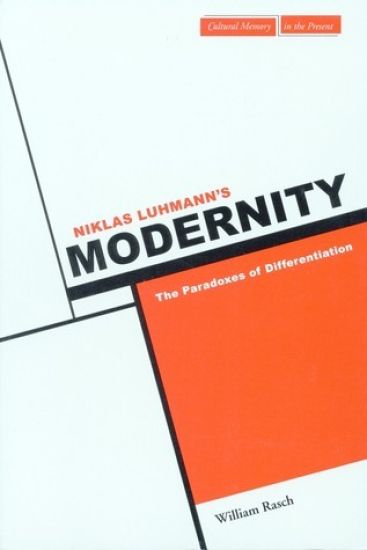
Niklas Luhmann's Modernity

Niklas Luhmann's Modernity

William W. Rasch

Stanford University Press
2000
sidottu
This book is an introduction to the nature of modernity as envisioned by Germany's leading social theorist of the late twentieth century, Niklas Luhmann. For Luhmann, modernity is neither an Enlightenment project nor a ludic rejection of that project, but rather the pre-condition of all our deliberations, the structure within which our semantics makes sense, even as we think we celebrate (or mourn) its passing. Rather than viewing modernity as a disease for which we seek a cure, Luhmann poses it as a question to which we continually devise incomplete and partial answers. When we grow impatient with the contingency and indeterminacy that is thus forced upon us and seek solace in community, religion (orthodox or civic), consensus, and a universal vision of the good life, we grow impatient with modernity itself. The book injects concepts derived from Luhmann's influential systems theory (complexity, contingency, and enforced selectivity; system differentiation, self-referential closure, and autopoiesis) into debates about modernity and postmodernity, constructivist and foundationalist epistemologies, the relationship between politics and ethics, and the possibilities of interdisciplinary work that spans the great divide between science and the humanities. Delighting in Luhmann's provocatively cool and dispassionate bursting of cherished balloons, the book stages challenging engagements with such thinkers as Jürgen Habermas, Jacques Derrida, Jean-François Lyotard, Drucilla Cornell, Judith Butler, Michel Serres, N. Katherine Hayles, and such political theorists as Chantal Mouffe and Carl Schmitt. The irrepressibility of paradox emerges as a stubborn feature of all of these confrontations. The book closes with two interviews: one a discussion with Luhmann and Hayles on epistemology, the other with Luhmann on the functional differentiation of modern society.
Niklas Luhmann's Modernity

Niklas Luhmann's Modernity

William W. Rasch

Stanford University Press
2000
pokkari
This book is an introduction to the nature of modernity as envisioned by Germany's leading social theorist of the late twentieth century, Niklas Luhmann. For Luhmann, modernity is neither an Enlightenment project nor a ludic rejection of that project, but rather the pre-condition of all our deliberations, the structure within which our semantics makes sense, even as we think we celebrate (or mourn) its passing. Rather than viewing modernity as a disease for which we seek a cure, Luhmann poses it as a question to which we continually devise incomplete and partial answers. When we grow impatient with the contingency and indeterminacy that is thus forced upon us and seek solace in community, religion (orthodox or civic), consensus, and a universal vision of the good life, we grow impatient with modernity itself. The book injects concepts derived from Luhmann's influential systems theory (complexity, contingency, and enforced selectivity; system differentiation, self-referential closure, and autopoiesis) into debates about modernity and postmodernity, constructivist and foundationalist epistemologies, the relationship between politics and ethics, and the possibilities of interdisciplinary work that spans the great divide between science and the humanities. Delighting in Luhmann's provocatively cool and dispassionate bursting of cherished balloons, the book stages challenging engagements with such thinkers as Jürgen Habermas, Jacques Derrida, Jean-François Lyotard, Drucilla Cornell, Judith Butler, Michel Serres, N. Katherine Hayles, and such political theorists as Chantal Mouffe and Carl Schmitt. The irrepressibility of paradox emerges as a stubborn feature of all of these confrontations. The book closes with two interviews: one a discussion with Luhmann and Hayles on epistemology, the other with Luhmann on the functional differentiation of modern society.
Niklas Luhmann's Theory of Politics and Law

Niklas Luhmann's Theory of Politics and Law

M. King; C. Thornhill

Palgrave Macmillan
2003
nidottu
Niklas Luhmann's social theory stands in direct opposition to the dominant 'anthropocentric' traditions of legal and political analysis. King and Thornhill now offer the first comprehensive, critical examination of Luhmann's highly original theory of the operations of the legal and political systems. They describe how from the perspective of his 'sociological enlightenment' Luhmann continually calls to account the certainties, the ambitions and rational foundations of The Enlightenment and the idealized versions of law and politics which they have produced.
Niklas Luhmann — beobachtet

Niklas Luhmann — beobachtet

Peter Fuchs

VS Verlag fur Sozialwissenschaften
2004
nidottu
Systemtheorie ist sehr abstrakt, labyrinthisch verfasst und so geartet, dass Leser/innen u. a. eine umfassende (nicht nur soziologische) Vorbildung haben mussen, um sie zu verstehen. Der Autor versucht, in diese 'widerborstige' Theorie einzufuhren, ohne ihr Niveau fahrlassig zu unterschreiten. Dabei wird ein Trick benutzt: Die Theorie wird in einer Simulation von Kommunikation (von der sie ja handelt) entfaltet. Der Text realisiert, wovon er spricht, er ist sein eigenes Beispiel und darin tautologisch. Und weil er sich an Kommunikationen entwickelt, an denen sehr verschiedene Personen beteiligt sind, unterlauft er die Gefahr des Dogmatismus und verwirklicht - versuchsweise - ein Stuck Wissenschaftsliteratur, das mit dem belehrenden Einfuhrungscharakter ein spielerisches Moment verbindet, was wohl heisst: Offenheit fur mogliche Anschlusse.
Niklas Luhmann und Pierre Bourdieu - Erziehung und Gesellschaft
Studienarbeit aus dem Jahr 2005 im Fachbereich Soziologie - Klassiker und Theorierichtungen, Note: 1,2, Universit t Wien (Soziologie, Wien), Veranstaltung: Theorien zur Schichtbildung, 8 Quellen im Literaturverzeichnis, Sprache: Deutsch, Abstract: Inhaltsverzeichnis 1. Einleitung S 2 2. Zentrale Begriffe S 2 2.1 Ungleichheiten S 2 2.2 Der Habitusbegriff bei BourdieuS 2-3 2.3 FeldS 4 2.4 System, Verstehen, Beobachten und Kommunikation bei LuhmannS 4-7 2.5 Bildung und UngleichheitS 7-8 3. Erziehung und Bildung aus der Sicht BourdieusS 8 3.1 Das Missverst ndnis in der p dagogischen Kommunikation zwischen Professoren und StudentenS 8 3.2 Das Einverst ndnis im Missverst ndnisS 9-10 3.3 Die Rhetorik der Verzweiflung S 10- 11 3.4 Der Professor S 11- 12 3.5 Die b rgerliche und vulg re SpracheS 12-13 4. Erziehung aus der Sicht von Niklas LuhmannS 13-14 4.1 Die Bedeutung der Erziehung f r die GesellschaftS 14 4.2 Die Selektion im ErziehungssystemS 14-15 4.3 Das SelektionsproblemS 15-16 4.4 Pr fungenS 16-17 5. Konklusion und SchlussbetrachtungS 17-19 6. LiteraturverzeichnisS 20 1. Einleitung Die vorliegende Seminararbeit besch ftigt sich mit dem Problem der Chancengleichheit im Bildungs- bzw. Erziehungssystem. Die von mir zus tzlich verwendete Literatur bezieht sich fast ausschlie lich auf Bourdieu und Luhmann. Mein Anliegen ist es, theoretische Unterschiede zwischen Luhmann und Bourdieu im Hinblick auf Ungleichheit im Erziehungssystem herauszuarbeiten. Zu Beginn umfasst meine Arbeit Teile der Bourdieu schen Theorie, welche anschlie end von der Theorie Luhmanns abgel st wird. 2. Zentrale Begriffe Zun chst bedarf es einiger Erl uterungen zentraler Begriffe, um ein besseres Verstehen der Theorien zu erm glichen. 2.1 Ungleichheiten Unter sozialer Ungleichheit beziehungsweise Schichtung versteht man strukturierte Ungleichheiten zwischen versc