Kirjojen hintavertailu. Mukana 11 244 527 kirjaa ja 12 kauppaa.

Kirjahaku

Etsi kirjoja tekijän nimen, kirjan nimen tai ISBN:n perusteella.

2 tulosta hakusanalla "Rich Languages From Poor Inputs"

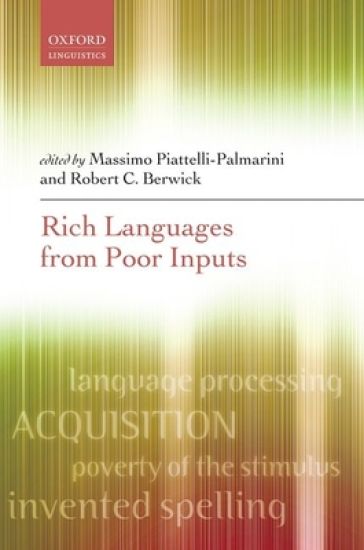
Rich Languages From Poor Inputs

Rich Languages From Poor Inputs

Oxford University Press
2015
nidottu
This book addresses one of the most famous and controversial arguments in the study of language and mind, the Poverty of the Stimulus. Presented by Chomsky in 1968, the argument holds that children do not receive enough evidence to infer the existence of core aspects of language, such as the dependence of linguistic rules on hierarchical phrase structure. The argument strikes against empiricist accounts of language acquisition and supports the conclusion that knowledge of some aspects of grammar must be innate. In the first part of Rich Languages from Poor Inputs, contributors consider the general issues around the Poverty of the Stimulus argument, review the empirical data, and offer new and plausible explanations. This is followed by a discussion of the processes of language acquisition, and observed 'gaps' between adult and child grammar, concentrating on the late spontaneous acqquisition by children of some key syntactic principles, mainly, though not exclusively, between the ages of 5 and 9. The last part of the book widens the horizon beyond language acquisition in the narrow sense, examining the natural development of reading and writing and of the child's growing sensitivity for the fine arts.
Rich Languages From Poor Inputs

Rich Languages From Poor Inputs

Oxford University Press
2012
sidottu
This book addresses one of the most famous and controversial arguments in the study of language and mind, the Poverty of the Stimulus. Presented by Chomsky in 1968, the argument holds that children do not receive enough evidence to infer the existence of core aspects of language, such as the dependence of linguistic rules on hierarchical phrase structure. The argument strikes against empiricist accounts of language acquisition and supports the conclusion that knowledge of some aspects of grammar must be innate. In the first part of Rich Grammars from Poor Inputs, contributors consider the general issues around the POS argument, review the empirical data, and offer new and plausible explanations. This is followed by a discussion of the the processes of language acquisition, and observed 'gaps' between adult and child grammar, concentrating on the late spontaneous acquisition by children of some key syntactic principles, basically, though not exclusively, between the ages of 5 to 9. Part 3 widens the horizon beyond language acquisition in the narrow sense, examining the natural development of reading and writing and of the child's growing sensitivity for the fine arts.