
Kirjojen hintavertailu. Mukana 11 244 527 kirjaa ja 12 kauppaa.

Kirjahaku

Etsi kirjoja tekijän nimen, kirjan nimen tai ISBN:n perusteella.

2 tulosta hakusanalla "Three Approaches to Data Analysis"

Three Approaches to Data Analysis

Three Approaches to Data Analysis

Igor Chikalov; Vadim Lozin; Irina Lozina; Mikhail Moshkov; Hung Son Nguyen; Andrzej Skowron; Beata Zielosko

Springer-Verlag Berlin and Heidelberg GmbH Co. K
2012
sidottu
In this book, the following three approaches to data analysis are presented: - Test Theory, founded by Sergei V. Yablonskii (1924-1998); the first publications appeared in 1955 and 1958,- Rough Sets, founded by Zdzislaw I. Pawlak (1926-2006); the first publications appeared in 1981 and 1982,- Logical Analysis of Data, founded by Peter L. Hammer (1936-2006); the first publications appeared in 1986 and 1988.These three approaches have much in common, but researchers active in one of these areas often have a limited knowledge about the results and methods developed in the other two. On the other hand, each of the approaches shows some originality and we believe that the exchange of knowledge can stimulate further development of each of them. This can lead to new theoretical results and real-life applications and, in particular, new results based on combination of these three data analysis approaches can be expected.- Logical Analysis of Data, founded by Peter L. Hammer (1936-2006); the firstpublications appeared in 1986 and 1988.These three approaches have much in common, but researchers active in one of these areas often have a limited knowledge about the results and methods developed in the other two. On the other hand, each of the approaches shows some originality and we believe that the exchange of knowledge can stimulate further development of each of them. This can lead to new theoretical results and real-life applications and, in particular, new results based on combination of these three data analysis approaches can be expected.These three approaches have much in common, but researchers active in one of these areas often have a limited knowledge about the results and methods developed in the other two. On the other hand, each of the approaches shows some originality and we believe that the exchange of knowledge can stimulate further development of each of them. This can lead to new theoretical results and real-life applications and, in particular, new results based on combination of these three data analysis approaches can be expected.
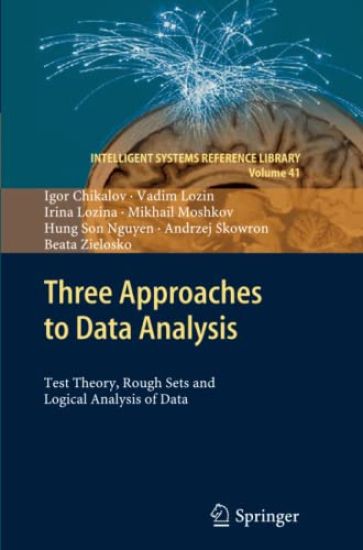
Three Approaches to Data Analysis

Three Approaches to Data Analysis

Igor Chikalov; Vadim Lozin; Irina Lozina; Mikhail Moshkov; Hung Son Nguyen; Andrzej Skowron; Beata Zielosko

Springer-Verlag Berlin and Heidelberg GmbH Co. K
2014
nidottu
In this book, the following three approaches to data analysis are presented: - Test Theory, founded by Sergei V. Yablonskii (1924-1998); the first publications appeared in 1955 and 1958,- Rough Sets, founded by Zdzislaw I. Pawlak (1926-2006); the first publications appeared in 1981 and 1982,- Logical Analysis of Data, founded by Peter L. Hammer (1936-2006); the first publications appeared in 1986 and 1988.These three approaches have much in common, but researchers active in one of these areas often have a limited knowledge about the results and methods developed in the other two. On the other hand, each of the approaches shows some originality and we believe that the exchange of knowledge can stimulate further development of each of them. This can lead to new theoretical results and real-life applications and, in particular, new results based on combination of these three data analysis approaches can be expected.- Logical Analysis of Data, founded by Peter L. Hammer (1936-2006); the firstpublications appeared in 1986 and 1988.These three approaches have much in common, but researchers active in one of these areas often have a limited knowledge about the results and methods developed in the other two. On the other hand, each of the approaches shows some originality and we believe that the exchange of knowledge can stimulate further development of each of them. This can lead to new theoretical results and real-life applications and, in particular, new results based on combination of these three data analysis approaches can be expected.These three approaches have much in common, but researchers active in one of these areas often have a limited knowledge about the results and methods developed in the other two. On the other hand, each of the approaches shows some originality and we believe that the exchange of knowledge can stimulate further development of each of them. This can lead to new theoretical results and real-life applications and, in particular, new results based on combination of these three data analysis approaches can be expected.