Total Quality Management: Key Concepts and Case Studies provides the full range of management principles and practices that govern the quality function. The book covers the fundamentals and background needed, as well as industry case studies and comprehensive topic coverage, making it an invaluable reference to both the novice and the more experienced individual. Aspects of quality control that are widely utilized in practice are combined with those that are commonly referred to on University courses, and the latest developments in quality concepts are also presented. This book is an ideal quick reference for any manager, designer, engineer, or researcher interested in quality.
This work considers the strategic aspects of the key management issues of the future - Total Quality Management (TQM). TQM is a philosophy of management that strives to make the best use of all available resources and opportunities by constant improvement. This book is intended for use as a reference manual. The intended readership is chief and senior executives who wish to understand and commit themselves to total quality as a vehicle for change, as well as those managers and staff who have the detailed task of implementing a TQM strategy. The objective of the book is to assist the reader to recognize the need for TQM, educate the reader on the tools and techniques available, and inform the reader as to how to develop a strategic plan and then implement a TQM programme. In content the book describes the concepts of Total Quality and provides guidance on how they can be applied to maximize an organization's operational efficiency and to provide a strategic, competitive edge to your business. An "Executive Encyclopedia" is featured, which explains the essential jargon and provides briefings on the major improvement tools and techniques. The editorial style of the book is reinforced by profiles of what major manufacturing and service organizations have achieved through adopting TQM and how they went about it. A bibliography and information on further resources of help completes the book. This book should be of interest to chief and senior executives and managers concerned with total quality in manufacturing and service-based industries, consultants, academic and professional researchers, and business school MBA students.
Quality is a customer issue. It arises because customers require products and services, which not only meet their performance requirements but are satisfac tory in terms of safety, length of working life and pride of ownership. In a manufacturing organization, therefore, the achievement of quality standards is not restricted to the production departments. It extends to all parts of the business from conceptual design to marketing, from order processing and distribution. A quality product is not just a solidly made item dating from the days when 'Made in Britain' distinguished goods from all the inferior products coming out of the emerging industries of the Far East. It is a product which ranks high against all the criteria which sophisticated consumers now use to evaluate the things they buy. If you agree with the argument that a company is much more likely to produce high quality if all departments are motivated to achieve high quality results then you already have a good understanding of the basic principles of Total Quality Management (TQM). But TQM is not a 'quick fix' or a magic cure. It is a management technique designed to involve all parts of the business in the pursuit of, and commitment to, the highest quality result. By involving everyone from the Chief Executive to the most junior employee in the company's objectives, in a way which means something in their particular job, the company is well on the way to achieving the best results its workforce can achieve.
In this book leading experts including George Box, Noriaki Kano, Yoshio Kondo, John Oakland and James Harrington, analyse and document various aspects of Total Quality Management. Contributions range from discussions of the principles, strategy, culture, leadership, eduction and benchmarking to world class experience and achieving excellence both in the manufacturing and service industries. With over 100 contributions this book is an invaluable resource for the total quality managment journey. It will be of special interest to educationalists, academics, senior managers and directors, and quality practitioners from both the public and private sectors.
The emphasis of Quality is pervading every facet of business, and managers are required to know and apply TQM principles. This book explores the strategic role of quality global competition, the roles of management in attaining quality excellence, the structures and systems needed to support a total quality strategy, and the main statistical and analytical tools for achieving quality improvement and control.
To understand and profit from Total Quality Management, companies must pay particular attention to the first word in the phrasetotal. The spectacular rewards enjoyed by top companies like 3M, FedEx, and Ben & Jerry's were earned through a total commitment to achieving superior quality and customer satisfaction across all company functions and processes.Total Quality Management, Second Edition gives you a completely up-to-date look at how 51 of the world's most successful companies put the total into TQM. Each of these companies, including 13 new additions and 23 Baldrige Award winners, is cited as a benchmark performer in a particular business function. Their examples help you set your sights on specific goals and learn a variety of ways to go about achieving each goal. Each chapter features the best practices of one manufacturing company, one service company, and one small business. Following the examples set by these overachievers, you'll discover how to: *Lead the transition from traditional management to management by quality *Identify customer needs and use that knowledge to drive the organization *Integrate strategic quality and business planning into a single strategic process *Communicate customer and company requirements throughout your organization *Recognize and reward employee efforts and promote improved quality *Establish uniform measurement systems and manage by fact, not fiction *Borrow shamelessly from industry leaders to encourage breakthrough thinking *Build strengths and eliminate weaknesses through an annual assessment process.Fully updatedthe book that puts the total into.Total Quality Management.In this book, the former chairman of the Baldrige Award panel of judges teams up once again with a leading quality consultant to bring you a Baldrige-based TQM model that covers every aspect of your business. Built from the best practices of 51 companies (including 23 Baldrige Award winners) whose star performances have made them benchmark corporations, this book brings you: *Best practices and TQM applications from small businesses, huge corporations, and everything in between *TQM practices from retail stores, service companies, manufacturers, and more *Hundreds of real-world examples, tested processes, and innovative techniques *Proven ways to boost profits, inspire workers, and delight customers.Praise for the First Edition"Alive . . . vivid, entertaining, successful. . . . Even the most inexperienced can understand and implement TQM using this book."Charles A. Aubrey Vice President, Juran Institute."If you read only one book about quality management, read this one . . . the definitive management handbook of the decade."Lynn A. Moline Former Executive Director, Minnesota Council for Quality."A great book about a better way to run a company."Bob G. Gower President and CEO, Lyondell Petrochemical Co."Packed with strategies that can be implemented in any organization . . . must reading for those interested in proven quality strategies."Ellen Gaucher Senior Associate Director, University of Michigan Medical Center"Get it. This book is jammed full of practical case studies from a management and profitability perspective."C. Jackson Grayson Jr. Chairman, American Productivity and Quality Center.Supplemented with an updated list of resources and a contact list for all profiled companies, Total Quality Management, Second Edition shows you how to lead your organization straight to the cutting edge of quality and keep it there.
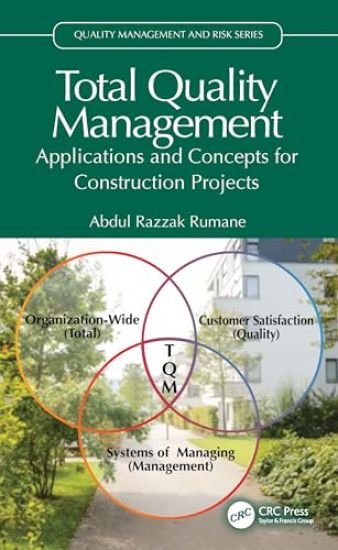
This book has been developed to provide significant information about the usage and application of the Total Quality Management (TQM) concept in a construction project environment. The content spans from the inception through to the closing of the project focusing on the TQM approach in each phase of the project.Total Quality Management: Applications and Concepts for Construction Projects, focuses on the application of the Total Quality Management concept in construction projects and contains many quick-reference figures and tables for easy comprehension. It offers a concise and complete implementation process for the application of TQM and helps achieve competitive advantages in the global marketplace resulting in the construction project being qualitatively competitive and economical. The book highlights the standards for TQM and gives a brief introduction to the quality management system along with providing an overview of the project, the quality, the types of project delivery systems, and the principles involved. Discussions of quality and the different steps it moves through within the project setting including inspection, statistical quality control, and quality assurance round out the book’s offerings.Construction and quality professionals, industrial engineers, project managers, students, academics, and trainers will find that this book satisfies their needs and meets their requirements for a book that specifically uses TQM in construction projects.
This book has been developed to provide significant information about the usage and application of the Total Quality Management (TQM) concept in a construction project environment. The content spans from the inception through to the closing of the project focusing on the TQM approach in each phase of the project. Total Quality Management: Applications and Concepts for Construction Projects, focuses on the application of the Total Quality Management concept in construction projects and contains many quick-reference figures and tables for easy comprehension. It offers a concise and complete implementation process for the application of TQM and helps achieve competitive advantages in the global marketplace resulting in the construction project being qualitatively competitive and economical. The book highlights the standards for TQM and gives a brief introduction to the quality management system along with providing an overview of the project, the quality, the types of project delivery systems, and the principles involved. Discussions of quality and the different steps it moves through within the project setting including inspection, statistical quality control, and quality assurance round out the book’s offerings. Construction and quality professionals, industrial engineers, project managers, students, academics, and trainers will find that this book satisfies their needs and meets their requirements for a book that specifically uses TQM in construction projects.
The term quality management has a specific meaning within many business sectors. This specific definition, which does not aim to assure 'good quality' by the more general definition, but rather to ensure that an organization or product is consistent, can be considered to have four main components: quality planning, quality control, Quality assurance and quality improvement. Quality management is focused not only on product/service quality, but also the means to achieve it. Quality management therefore uses quality assurance and control of processes as well as products to achieve more consistent quality.
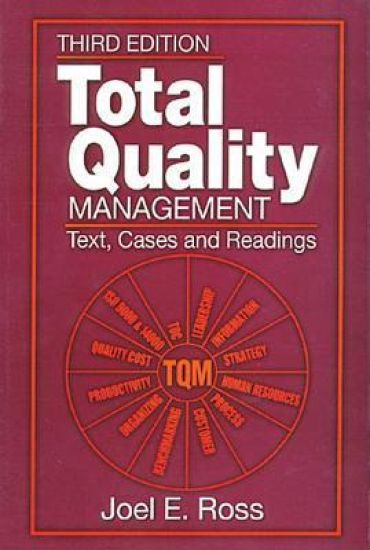
Acclaimed and used in over 200 colleges and universities around the country, Total Quality Management: Text, Cases and Readings has been completely revised and expanded to meet the growing demands and awareness for quality products and services in the competing domestic and global marketplaces.Since the publication of the first and second editions of this book, interest in and acceptance of TQM has continued to accelerate around the world. This edition has been thoroughly revised, updated and expanded. Some of the changes are:A new chapter on the emerging Theory of ConstraintsExpanded treatment of Process ManagementEleven new readingsTen new casesChapter examples of TQM at 12 Baldrige winning organizationsEnd of chapter recommendations for further readingRevised and updated textual materialThe Varifilm case is retained as a comprehensive study that illustrates good and not so good practices. Each chapter contains an exercise which provides the reader with an opportunity to apply TQM principles to the practices illustrated in each case.Based on sound principles, this practical book is an excellent text for organizational development programs aimed at practitioners responsible for developing and implementing TQM programs in their own service or manufacturing organizations.
Erfolg durch Qualitat - dazu gehoren eine ganzheitliche Qualitatsstrategie sowie Systeme wie Just-in-Time (JiT) und Total Productive Maintenance (TPM). Attila Oess zeigt die Schritte zur praktischen Einfuhrung.
Total Quality Management (TQM) is a journey towards improvement, guiding you through a continuous reassessment of yourself, your work and your organization. The author demonstrates how to improve your daily workload in order to create a quality product, control costs, and foster customer loyalty. Not only does this give your organization an edge in a competitive business environment, it also helps you grow and excel.Rampersad guides you through the effective use of problem-solving tools and helps you apply the quality improvement process in all aspects of your work. The book`s modular, practical and integral approach will appeal to today`s busy manager. All aspects of Total Quality Management are clearly, concisely, and didactically described, illustrated by a wealth of real world examples.
Die Arbeit legt eine weitgehend geschlossene Konzeption eines umfassenden Total-Quality-Management-Systems (TQM) vor. Sie basiert auf einer detaillierten Differenzierung der Systemkomponenten: der Strategien, Instrumente und Evaluierungsmoglichkeiten. Fur sie werden Ausgestaltungsvorschlage entwickelt. Gezeigt wird, wie ein alle Unternehmensbereiche und alle hierarchischen Ebenen umfassendes TQM organisatorisch umgesetzt werden kann. Dabei erfolgt eine Loslosung von herkommlichen Konzepten, die meist mit einer recht starken Zentralisierung einhergehen. Vorgeschlagen wird dagegen eine starker prozess- und projektorientierte Organisation. Zwei empirische Fallstudien zeigen auf, in welchem Umfang und in welcher Form Total-Quality-Management-Systeme bei Mercedes-Benz und Ford realisiert werden. Sie belegen die Notwendigkeit einer integrierten, die Interdependenzen zwischen den TQM-Komponenten berucksichtigenden Ausgestaltung einer solchen Konzeption."