Kirjojen hintavertailu. Mukana 11 244 527 kirjaa ja 12 kauppaa.

Kirjahaku

Etsi kirjoja tekijän nimen, kirjan nimen tai ISBN:n perusteella.

7 tulosta hakusanalla "Trace Amines"

Trace Amines

Trace Amines

Humana Press Inc.
1988
sidottu
This is the third Proceedings book to arise from biennial conferen- ces on the Trace Amines. Since our first meeting in 1983 in Edmonton, Canada, progress has been brisk and, as will be seen from the ensuing pages, it is now possible to include major contributions from inverte- brate neurobiologists as well as receptorologists. In the opening ses- sion we heard about the distribution of the trace amines-now clear- ly a misnomer-in insects and the pharmacological, receptor, and syn- aptic characteristics of octopamine and tryptamine as well as the pos- sibility of monoamines in general being targets for insecticide discov- ery. In mammalian brain the distribution and characterization of the tryptamine receptor has proceeded to the point where two types have been described as well as novel agonists and antagonists, and, for the first time, a binding site for p-tyramine has been described. The com- bination of lesions and pharmacological and metabolic manipulations now permits the mapping of trace aminergic pathways, and the rap- idly accumulating evidence from releasing drugs, in situ microdialy- sis, iontophoresis, and second messenger systems lends credence to the claim that the trace amines possess neuromodulatory functions.
Trace Amines

Trace Amines

Humana Press Inc.
2011
nidottu
This is the third Proceedings book to arise from biennial conferen- ces on the Trace Amines. Since our first meeting in 1983 in Edmonton, Canada, progress has been brisk and, as will be seen from the ensuing pages, it is now possible to include major contributions from inverte- brate neurobiologists as well as receptorologists. In the opening ses- sion we heard about the distribution of the trace amines-now clear- ly a misnomer-in insects and the pharmacological, receptor, and syn- aptic characteristics of octopamine and tryptamine as well as the pos- sibility of monoamines in general being targets for insecticide discov- ery. In mammalian brain the distribution and characterization of the tryptamine receptor has proceeded to the point where two types have been described as well as novel agonists and antagonists, and, for the first time, a binding site for p-tyramine has been described. The com- bination of lesions and pharmacological and metabolic manipulations now permits the mapping of trace aminergic pathways, and the rap- idly accumulating evidence from releasing drugs, in situ microdialy- sis, iontophoresis, and second messenger systems lends credence to the claim that the trace amines possess neuromodulatory functions.
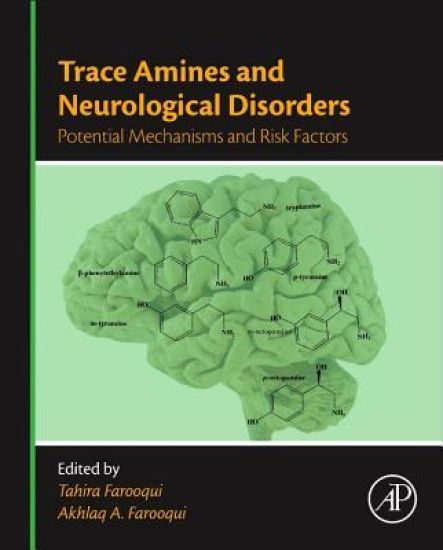
Trace Amines and Neurological Disorders
Trace Amines and Neurological Disorders: Potential Mechanisms and Risk Factors explores trace amines which, under normal conditions, are present in the mammalian brain and peripheral nervous tissues at very low (nanomolar) concentrations. However, in a diverse array of human pathologies ranging from substance abuse, depression, attention deficit hyperactivity disorder, eating disorders, schizophrenia, and other neurological and neuropsychiatric diseases, the levels of trace amines are unusually high with an imbalance in their functions. Furthermore, the rapid turnover of trace amines is evidenced by their dramatic increases following treatment with monoamine oxidase inhibitors (MAOI) or deletion of the MAO genes. This suggests that the concentration of trace amines may be considerably higher at neuronal synapses than predicted by steady-state measures, implicating some pathophysiological role. Therefore, understanding molecular mechanisms and developing selective agonists and antagonists for trace amine-associated receptors (TAARs) has become a good approach for treating these diseases. Although the effects of trace amines at low physiological concentrations in mammalian species have been difficult to demonstrate, they may serve to maintain the neuronal activity of other monoamine neurotransmitters by possessing postsynaptic modulatory effects, particularly dopamine and serotonin, within defined physiological limits. Such an effect of trace amines makes them ideal candidates for the development of novel therapeutics for a wide range of human disorders. This book presents up-to-date, cutting-edge, and comprehensive information on the link between trace amines and neurological disorders.
Neurobiology of the Trace Amines
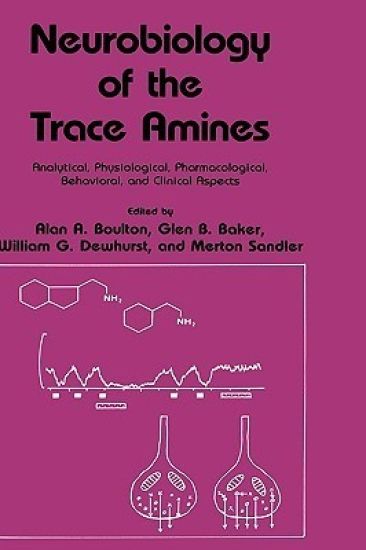
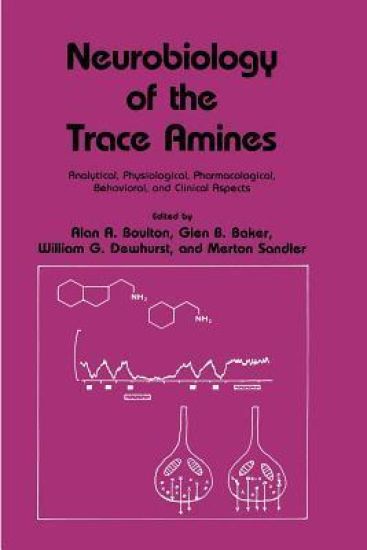
Many of the trace amines-more correctly called biogenic amines- have been known for decades, but because of their tiny concentra- tions (0. 01-100 ng/g) in brain, it was only after the development of sophisticated analytical techniques (such as mass spectrometry) that they could be identified and quantitated in nervous tissue. There are now more than 20 of them and most are related to the catecholamines and 5-hydroxytryptamine both structurally and metabolically. Their pharmacological and physiological properties make them prime candidates for a transmitter or neuromodulator role and many of them elicit profound behavioral syndromes after injection--one of them, phenylethylamine, has even been referred to as nature's amphetamine. In the clinical sphere several have been shown to be involved in: Parkinsonism, schizophrenia, depression, agoraphobia, aggression, hyperkinesis, migraine, hypertensive crises, hypertyrosinemia, he- patic encephalopathy, epilepsy, and cystic fibrosis. Thus the research reported here on these intriguing "new" substances will be of great interest to psychiatrists, neurologists, biochemists, pharmacologists, physiologists, psychologists, behaviorists and indeed to all those working in the neurosciences and related fields today. ACKNOWLEDGMENTS This book is based on the proceedings of Trace Amines and the Neurosciences, a meeting held at the University of Alberta, Edmonton, July 19-21, 1983. This meeting was organized as a Satellite Meeting of the Ninth Meeting of the International Society for Neurochemistry, held in Vancouver, July 10-15, 1983. International organizers of the satellite meeting were Drs. A. A. Boulton (Saskatoon), W. G. Dewhurst (Edmonton), G. B. Baker (Edmonton), and M. Sandler (London).
Neuropsychopharmacology of the Trace Amines
A probable neurobiological role for the trace amines began to emerge as soon as techniques sufficiently sophisticated to detect them were developed. Techniques for quantitative analyses included radioenzymatic procedures and, more recently, HPlC-EC and auto­ mated GC-MS. The methods are applied after separation of the sub­ stances to be analyzed and after their purification by physicochemical procedures that are becoming more and more efficient. The identification and quantitative analysis of minute amounts of trace amines in biological fluids or tissues is in itself a remarkable technological achievement. The enormous task that several teams of research workers have set themselves is to investigate the origin of the trace amines, to understand their metabolism, and to discover whether or not they possess an important biological role. The 2nd Trace Amines Symposium at Weitenburg Castle near Tubingen from the 15th to the 19th May 1985 was held to gain a somewhat clearer insight into the present state of knowledge. Since the first meeting in 1983 our knowledge has increased and interest is deepening. Hence the idea proposed at that first meeting, of organizing similar gather­ ings at regular intervals, has come to fruition. Covered in the Neuropsychopharmacology section of this book are studiesof the effects of certain trace amines on different forms of be­ havior, on neurotransmission mediated by . the classical neuro­ transmitters, on their biosynthesis or on catabolism, on their possible occurrence as a result of alternative metabolic pathways for the amino acids, and in some instances their neuroanatomical distributions.
Neuropsychopharmacology of the Trace Amines
A probable neurobiological role for the trace amines began to emerge as soon as techniques sufficiently sophisticated to detect them were developed. Techniques for quantitative analyses included radioenzymatic procedures and, more recently, HPlC-EC and auto­ mated GC-MS. The methods are applied after separation of the sub­ stances to be analyzed and after their purification by physicochemical procedures that are becoming more and more efficient. The identification and quantitative analysis of minute amounts of trace amines in biological fluids or tissues is in itself a remarkable technological achievement. The enormous task that several teams of research workers have set themselves is to investigate the origin of the trace amines, to understand their metabolism, and to discover whether or not they possess an important biological role. The 2nd Trace Amines Symposium at Weitenburg Castle near Tubingen from the 15th to the 19th May 1985 was held to gain a somewhat clearer insight into the present state of knowledge. Since the first meeting in 1983 our knowledge has increased and interest is deepening. Hence the idea proposed at that first meeting, of organizing similar gather­ ings at regular intervals, has come to fruition. Covered in the Neuropsychopharmacology section of this book are studiesof the effects of certain trace amines on different forms of be­ havior, on neurotransmission mediated by . the classical neuro­ transmitters, on their biosynthesis or on catabolism, on their possible occurrence as a result of alternative metabolic pathways for the amino acids, and in some instances their neuroanatomical distributions.
Neurobiology of the Trace Amines
Many of the trace amines-more correctly called biogenic amines- have been known for decades, but because of their tiny concentra- tions (0. 01-100 ng/g) in brain, it was only after the development of sophisticated analytical techniques (such as mass spectrometry) that they could be identified and quantitated in nervous tissue. There are now more than 20 of them and most are related to the catecholamines and 5-hydroxytryptamine both structurally and metabolically. Their pharmacological and physiological properties make them prime candidates for a transmitter or neuromodulator role and many of them elicit profound behavioral syndromes after injection--one of them, phenylethylamine, has even been referred to as nature's amphetamine. In the clinical sphere several have been shown to be involved in: Parkinsonism, schizophrenia, depression, agoraphobia, aggression, hyperkinesis, migraine, hypertensive crises, hypertyrosinemia, he- patic encephalopathy, epilepsy, and cystic fibrosis. Thus the research reported here on these intriguing "new" substances will be of great interest to psychiatrists, neurologists, biochemists, pharmacologists, physiologists, psychologists, behaviorists and indeed to all those working in the neurosciences and related fields today. ACKNOWLEDGMENTS This book is based on the proceedings of Trace Amines and the Neurosciences, a meeting held at the University of Alberta, Edmonton, July 19-21, 1983. This meeting was organized as a Satellite Meeting of the Ninth Meeting of the International Society for Neurochemistry, held in Vancouver, July 10-15, 1983. International organizers of the satellite meeting were Drs. A. A. Boulton (Saskatoon), W. G. Dewhurst (Edmonton), G. B. Baker (Edmonton), and M. Sandler (London).