Kirjojen hintavertailu. Mukana 11 244 527 kirjaa ja 12 kauppaa.

Kirjahaku

Etsi kirjoja tekijän nimen, kirjan nimen tai ISBN:n perusteella.

14 tulosta hakusanalla "Weak Interactions"

Weak Interactions in Nuclei

Weak Interactions in Nuclei

Barry R. Holstein

Princeton University Press
2017
pokkari
Recently a symbiotic relationship between particle and nuclear physics has developed, with techniques and ideas from one field fertilizing developments in the other. This work outlines concepts from modern particle physics important to the current understanding of nuclear physics and reviews experiments involving nuclei which have influenced the present particle physics view of the weak interaction. In his discussion, the author summarizes both past and present activity in the field and identifies areas for future work. Familiarity with quantum mechanics is assumed in the presentation of ideas in this book intended for readers at the graduate level and beyond. A major goal of Weak Interactions in Nuclei is to encourage further activity at the intersection of particle and nuclear physics, two path-breaking areas of study in modern physics. Originally published in 1989. The Princeton Legacy Library uses the latest print-on-demand technology to again make available previously out-of-print books from the distinguished backlist of Princeton University Press. These editions preserve the original texts of these important books while presenting them in durable paperback and hardcover editions. The goal of the Princeton Legacy Library is to vastly increase access to the rich scholarly heritage found in the thousands of books published by Princeton University Press since its founding in 1905.
Weak Interactions in Nuclei

Weak Interactions in Nuclei

Barry R. Holstein

Princeton University Press
2017
sidottu
Recently a symbiotic relationship between particle and nuclear physics has developed, with techniques and ideas from one field fertilizing developments in the other. This work outlines concepts from modern particle physics important to the current understanding of nuclear physics and reviews experiments involving nuclei which have influenced the present particle physics view of the weak interaction. In his discussion, the author summarizes both past and present activity in the field and identifies areas for future work. Familiarity with quantum mechanics is assumed in the presentation of ideas in this book intended for readers at the graduate level and beyond. A major goal of Weak Interactions in Nuclei is to encourage further activity at the intersection of particle and nuclear physics, two path-breaking areas of study in modern physics. Originally published in 1989. The Princeton Legacy Library uses the latest print-on-demand technology to again make available previously out-of-print books from the distinguished backlist of Princeton University Press. These editions preserve the original texts of these important books while presenting them in durable paperback and hardcover editions. The goal of the Princeton Legacy Library is to vastly increase access to the rich scholarly heritage found in the thousands of books published by Princeton University Press since its founding in 1905.
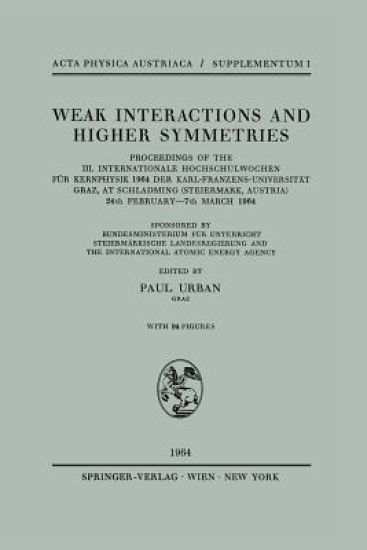
Weak Interactions and Higher Symmetries
Weak interactions and higher symmetries are nowadays of special importance for elementary particles theory. Lately both theoretical and experimental physicists became more and more interested in the subject. Because of the complicated subject and the scarce available literature proper introductions in the subject are tiresome. The mathematical back­ ground such as higher Algebra and Grouptheory etc. cannot be applied immediately in all cases. The third Schladming University Courses on the above subject belong to this category. The present first supplement volume of "Acta Physica Austriaca" contains all lectures (with literature references) giving not only a review of the fundamentals but also discussing recent research work. I ,;incerely hope that the pUblication will find interested readers. In the last years it became customary in physics and mathematics to arrange summer schools on subjects which allow the experienced as well as the young scientiflt to get quickly acquainted with special modern fields. Discussions and private contacts make it possible for participants to touch quickly the peripheries of the subject in question, and new research work will be stimulated which otherwise could not be expected. Graz, October, 1964.
Gauge Theories of Weak Interactions

Gauge Theories of Weak Interactions

J. C. Taylor

Cambridge University Press
1979
pokkari
The interaction between neutrinos and matter is an example of the type classified as weak, and such interactions also allow many elementary particle decays and the beta decay of the nuclei. The development of gauge theories has provided the basis for a complete and consistent account of weak interactions, at the same time displaying their unity with electromagnetism. Gauge theories in this context were first proposed in 1967. Rapid mathematical development took place from 1971, and on this book's publication in 1979, a moderate amount of empirical verification had been achieved.
Elementary Particles and Weak Interactions: Bnl, 443, T-91

Elementary Particles and Weak Interactions: Bnl, 443, T-91

T. D. Lee; C. N. Yang

Literary Licensing, LLC
2013
sidottu
Elementary Particles and Weak Interactions: BNL, 443, T-91 is a book written by physicist T. D. Lee. The book delves into the study of elementary particles and the weak interactions that govern their behavior. It is based on lectures given by Lee at the Brookhaven National Laboratory (BNL), where he was a researcher in the 1970s. The book covers topics such as the Standard Model of particle physics, the weak force, and the Higgs boson. It also includes discussions on experimental techniques used in particle physics research. The book is aimed at graduate students and researchers in the field of particle physics.This scarce antiquarian book is a facsimile reprint of the old original and may contain some imperfections such as library marks and notations. Because we believe this work is culturally important, we have made it available as part of our commitment for protecting, preserving, and promoting the world's literature in affordable, high quality, modern editions, that are true to their original work.
Flavor Mixing in Weak Interactions

Flavor Mixing in Weak Interactions

Springer-Verlag New York Inc.
2012
nidottu
The 50-year history of weak interaction since Fermi's pro­ posal of this coupling has been marked with striking direct inter­ plays between experimental results and theoretical understanding, e.g. the discoveries of neutrinos, parity violation, and CP vio­ lation. The recent discoveries of the quark hierarchy, the charm and the beauty, and the intermediate vector bosons W± and ZO have truly made a splendid page in the history of particle physics. It is the purpose of this conference to discuss the questions of quark and lepton generations and mixing, their relations to CP violation, and to ask the questions about what are inside the quarks and the leptons in view of the present and future exper­ imental situation. Dr. Ling-Lie Chau Brookhaven National Laboratory Upton, New York vii ACKNOWLEDGMENTS I would like to thank all the Advisory and Organizing Committee members for their advice and suggestions during the organization of the conference. The running of the conference could not have gone so smoothly without the help of many participants, I sincerely thank: L. Becker, F.J. Botella, S. Gentile, P. Le Comte, M.E. Machacek, L. Lanceri, W.M. Morse, F.J. Olness, Y.-X. Pham, G. Poulard, K.J. Sliwa, and J.N. Webb.
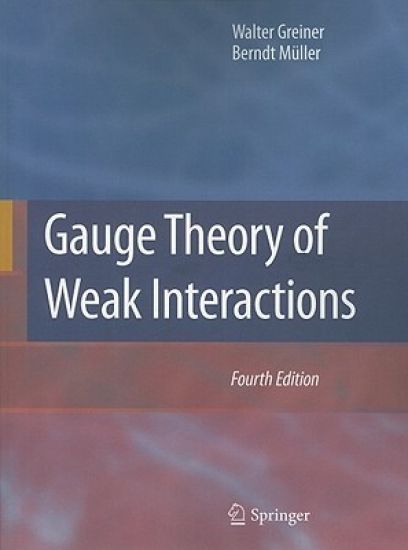
Gauge Theory of Weak Interactions

Gauge Theory of Weak Interactions

Walter Greiner; Berndt Müller

Springer-Verlag Berlin and Heidelberg GmbH Co. K
2009
nidottu
"Gauge Theory of Weak Interactions" treats the unification of electromagnetic and weak interactions and considers related phenomena. First, the Fermi theory of beta decay is presented, followed by a discussion of parity violation, clarifying the importance of symmetries. Then the concept of a spontaneously broken gauge theory is introduced, and all necessary mathematical tools are carefully developed. The "standard model" of unified electroweak interactions is thoroughly discussed including current developments. The final chapter contains an introduction to unified theories of strong and electroweak interactions. Numerous solved examples and problems make this volume uniquely suited as a text for an advanced course. This fourth edition has been carefully revised.
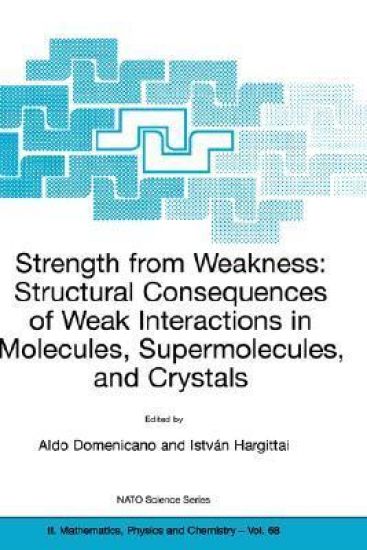
Strength from Weakness: Structural Consequences of Weak Interactions in Molecules, Supermolecules, and Crystals
The accurate determination of the structure of molecular systems provides information about the consequences of weak interactions both within and between molecules. These consequences impact the properties of the materials and the behaviour in interactions with other substances. The book presents modern experimental and computational techniques for the determination of molecular structure. It also highlights applications ranging from the simplest molecules to DNA and industrially significant materials. Readership: Graduate students and researchers in structural chemistry, computational chemistry, molecular spectroscopy, crystallography, supramolecular chemistry, solid state chemistry and physics, and materials science.
Strength from Weakness: Structural Consequences of Weak Interactions in Molecules, Supermolecules, and Crystals
The accurate determination of the structure of molecular systems provides information about the consequences of weak interactions both within and between molecules. These consequences impact the properties of the materials and the behaviour in interactions with other substances. The book presents modern experimental and computational techniques for the determination of molecular structure. It also highlights applications ranging from the simplest molecules to DNA and industrially significant materials. Readership: Graduate students and researchers in structural chemistry, computational chemistry, molecular spectroscopy, crystallography, supramolecular chemistry, solid state chemistry and physics, and materials science.